

SEO for home remodelers is the work of ranking a remodeling company’s website and Google Business Profile for the local searches homeowners use, like “kitchen remodeler near me,” so the company earns leads it owns instead of renting shared leads from Angi or HomeAdvisor. This is the full playbook, in the order we run it.
It is built from 87 remodeling SEO campaigns we have run since 2019. Across those campaigns, 78% of clients reached the Google Map Pack within six months. The steps below are what got them there.
Remodeling is a local, high-consideration buy. A homeowner researches for weeks, checks the map and the reviews, then calls one or two companies. The whole game is being the company they trust before they dial.
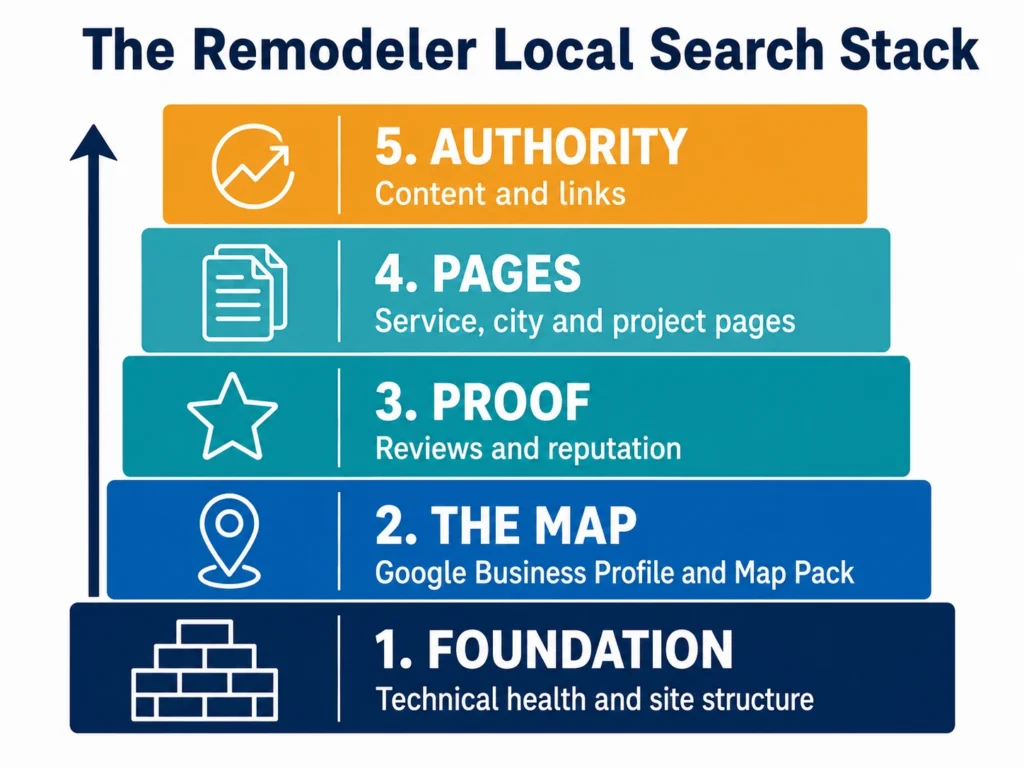
The remodeler local search stack
Five layers, built in order. Skip one and the layers above it underperform. Each layer has a job and one number we watch.
| Layer | Job | What we watch |
|---|---|---|
| 1. Foundation | Technical health and site structure | Title tags fixed, mobile and HTTPS clean |
| 2. The Map | Google Business Profile and Map Pack | Primary category set, NAP identical everywhere |
| 3. Proof | Reviews and reputation | 4 to 6 new reviews a month |
| 4. Pages | Service, city, and project pages | One page per service and per city |
| 5. Authority | Content and links | 15 to 25 local links a month, content from month 4 |
Layer 1: Foundation, the part owners never see
Google ranks the mobile version of your site first. It rewards secure HTTPS and a clean page experience. None of that shows on the surface, so it gets skipped.
When we audit a new remodeler, the most common problem is duplicate or missing title tags. We find it on 94% of sites. It is boring to fix and it moves rankings.
If the site sits on a platform that blocks proper optimization, a rebuild comes first. About 35% of our new clients need one. The rest start on the site they already have.
Layer 2: The Map, where remodeling buyers look first
The Map Pack is the block of three local listings pinned to the top of the results, with the map above them. For “near me” remodeling searches it sits above the regular links.
Two things decide it more than anything else. Your primary category and your NAP. Set the primary category to your main service. Keep your name, address, and phone identical on every listing.
Real project photos matter too. Adding them lifts map impressions 340% in the first 90 days across our clients. For the full list of what moves the map, see our guides on Google Business Profile optimization for remodelers and the Google Maps ranking factors that decide it.
Layer 3: Proof, the reviews that close the click
Before a homeowner calls, they read reviews. BrightLocal’s 2025 survey found 71% read them regularly for local businesses, and 83% use Google to do it.
Most remodelers we take on get 0 to 1 new reviews a month. An ask right after the final walkthrough moves that to 4 to 6. The work did not change. The ask did.
Velocity beats total. A steady 4 to 6 a month tells Google the business is active, and tells the homeowner you are still good today, not three years ago.
Layer 4: Pages, one per service and one per city
Google cannot rank a single “Services” page for kitchens, baths, additions, and basements at once. Build one page per service. Build one page per city you serve.
Three page types do the work. Service pages target homeowners who already know what they want. Project pages tell the story of a real job with real photos and materials. Honest local cost guides convert best of all, because a homeowner who reads your real breakdown arrives already educated and already trusting you.
This is the layer that turns rankings into signed jobs. The lead-quality math behind it is in our guide on winning better projects with SEO.
Layer 5: Authority, content and links on a clock
Content comes in month 4, not month 1. Links come at 15 to 25 a month from local directories and industry sites, never link farms.
This is the slow-compounding layer. It is where content and backlinks push your service pages up and hold them there. Start it too early and you are decorating a house with no foundation.
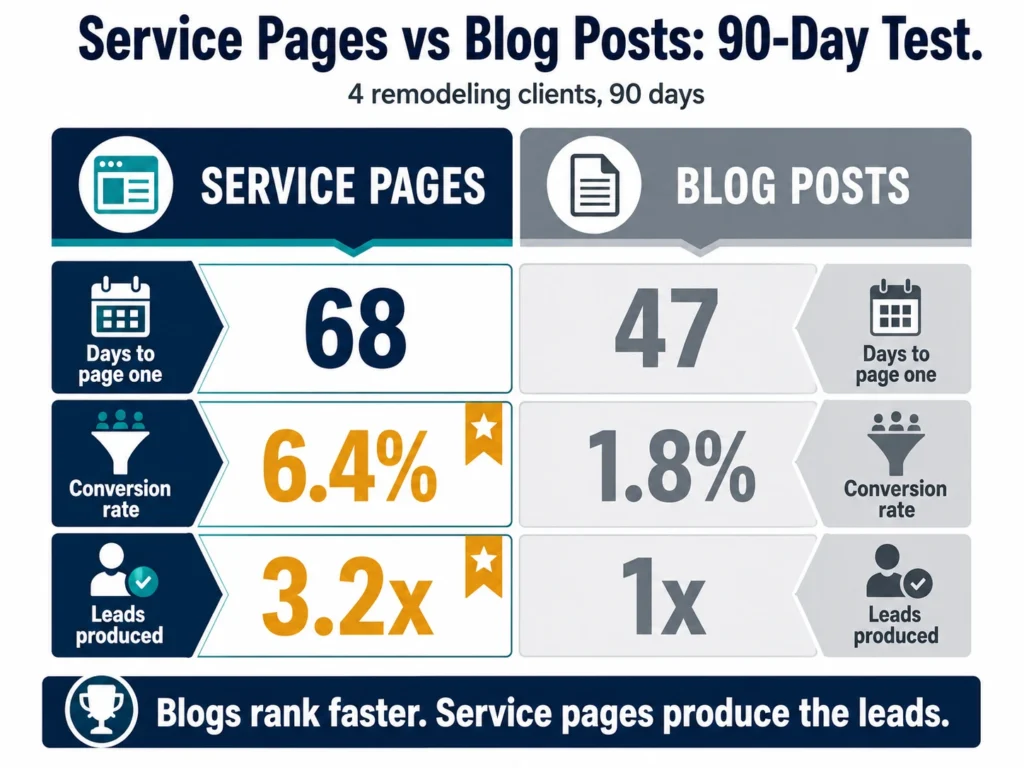
The one thing most remodeling SEO advice gets wrong
Most guides tell a remodeler to blog every week. Our own test says build pages instead.
In early 2024 we ran service pages against blog posts across four clients over 90 days. The blog posts ranked faster, 47 days to page one against 68 for service pages. Then the leads came in. Service pages converted at 6.4% against 1.8%, and produced 3.2 times more leads.
So the order is pages first, content from month 4. A blog with no service pages under it is a hobby. Service pages with a blog feeding them is a pipeline.
How long the playbook takes
Faster than the stock “twelve months” answer for the terms that bring calls. Slower for the few most competitive ones. The honest answer depends on which keyword you mean.
| Milestone | Typical timeframe |
|---|---|
| Keywords enter top 50 | 30 to 60 days |
| Page one for long-tail terms | 60 to 90 days |
| Map Pack entry, main city term | 4 to 7 months |
| Steady 15-plus leads a month | 6 to 9 months |
| Top 3 for primary keyword | 8 to 12 months |
Across our campaigns, 78% of clients reach the Map Pack within six months. The typical remodeler goes from 3 to 5 organic leads a month to 18 to 24 by around month eight. Numbers vary by market and review count.
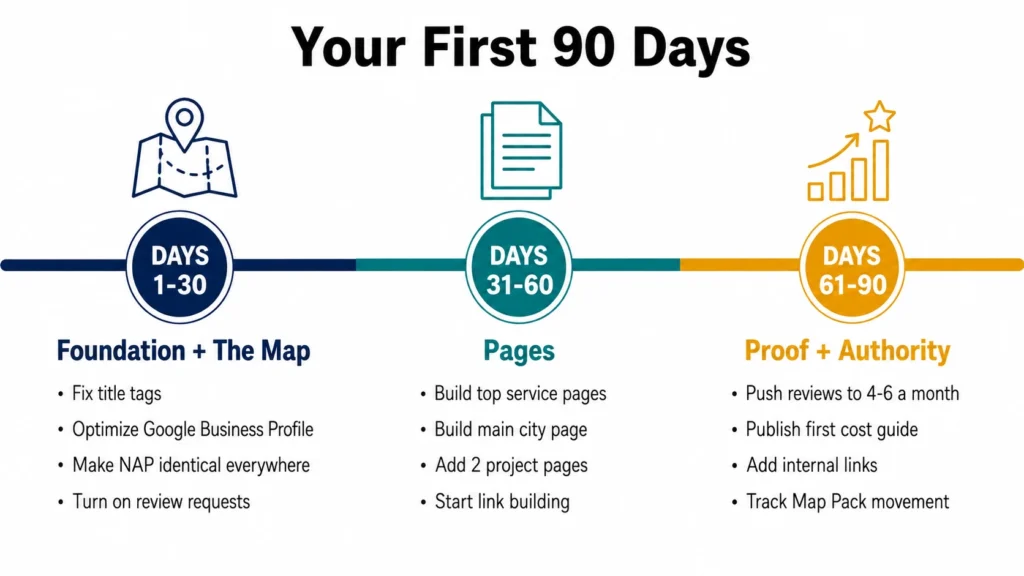
Your first 90 days, step by step
Days 1 to 30: foundation and the map
Audit the site and fix the title tags. Claim and complete the Google Business Profile. Set the primary category. Make your NAP identical across every listing. Turn on a review request after each completed job. First keywords usually enter the top 50 by day 30 to 60.
Days 31 to 60: pages
Build your top two or three service pages. Build the page for your main city. Add two project pages with real photos. Start link building at 15 to 25 a month. Long-tail terms start hitting page one around day 60 to 90.
Days 61 to 90: proof and authority
Push review velocity to 4 to 6 a month. Publish your first honest cost guide. Add internal links from that content to your service pages. Track Map Pack movement on your main city term. Entry for that term usually lands at 4 to 7 months, and steady leads follow at 6 to 9.
What to track, and the tools that show it
Watch five numbers. Map Pack rank for your main city term. Calls and direction requests from your Google Business Profile. Organic leads a month. Review count and monthly velocity. Keywords in the top 50 and on page one.
The tools are free or close to it. Google Business Profile performance for calls and map views. Google Search Console for queries and clicks. A rank tracker for the Map Pack and organic positions. Call tracking like CallRail if you want lead source down to the keyword.
One rule. Do not judge month two by lead volume. Judge it by keyword movement and review count. Leads are the last number to move, not the first.
The remodeler SEO playbook checklist
| Layer | Do this | By when |
|---|---|---|
| Foundation | Fix title tags, confirm mobile and HTTPS | Days 1 to 30 |
| The Map | Optimize GBP, set primary category, fix NAP | Days 1 to 30 |
| Proof | Turn on post-job review requests | Days 1 to 30 |
| Pages | One page per service and per city | Days 31 to 60 |
| Authority | 15 to 25 local links a month, content from month 4 | Day 60 on |
| Tracking | Map rank, GBP calls, leads, reviews | Ongoing |
Want the deeper technical version? Our full SEO checklist for remodeling companies breaks each line into sub-steps.
What it costs, and why it beats renting leads
Most remodeling SEO runs $3,500 to $5,000 a month. Metro competition is the biggest variable. Treat that as a starting range, not a quote.
The reframe we give owners is simple. $7,000 a month on a lead platform is $84,000 a year that builds no asset. SEO builds rankings you keep. If you need calls before the rankings mature, run Google Ads in parallel and let SEO replace that spend later.
FAQs
What is the Google Map Pack, and why does it matter for remodelers?
The Map Pack is the group of three local business listings shown at the top of a local search, with the map above them. For “remodeler near me” searches it sits above the regular results, so ranking there is often worth more than ranking first in the blue links.
How many service and city pages does a remodeler need?
One page for each service you sell and one page for each city you serve. A company doing kitchens, baths, and additions across three towns needs a page for each service and each town, not one “Services” page trying to rank for all of it.
Do home remodelers need a blog to rank?
Not first. In our 90-day test, service and city pages produced 3.2 times more leads than blog posts. Build the pages first, then add content from about month four to feed internal links and authority.
What is the fastest local SEO win for a remodeler?
The Google Business Profile. Setting the right primary category, fixing NAP, and adding real project photos can move map visibility inside 90 days, well before your website pages mature.
Does NAP consistency really change rankings?
Yes. One client dropped from #3 to #14 in the map after a phone number changed on the website but not on 37 citation sites. Keep name, address, and phone identical everywhere, and change it in a controlled rollout when it has to change.
How is this different from hiring a national SEO agency?
We work with one remodeler per city. If an agency takes three remodelers in the same town, two of them lose, because no one ranks all three first for the same term. Ask any agency how many other remodelers in your city they work with.
Where to start this week
Pick your main city term. Fix your title tags and your Google Business Profile. Turn on a review request after every job. Those three move first.
If you want it built by a team that only works with remodelers, that is what we do, one company per city. See our SEO for home remodeling companies service, or book a strategy call and we will show you whether your city is still open.
Written by Michael Vale, Founder of Eclipse Marketing and a certified Google Partner. Eclipse runs SEO for home remodeling companies across the U.S., one company per city.