
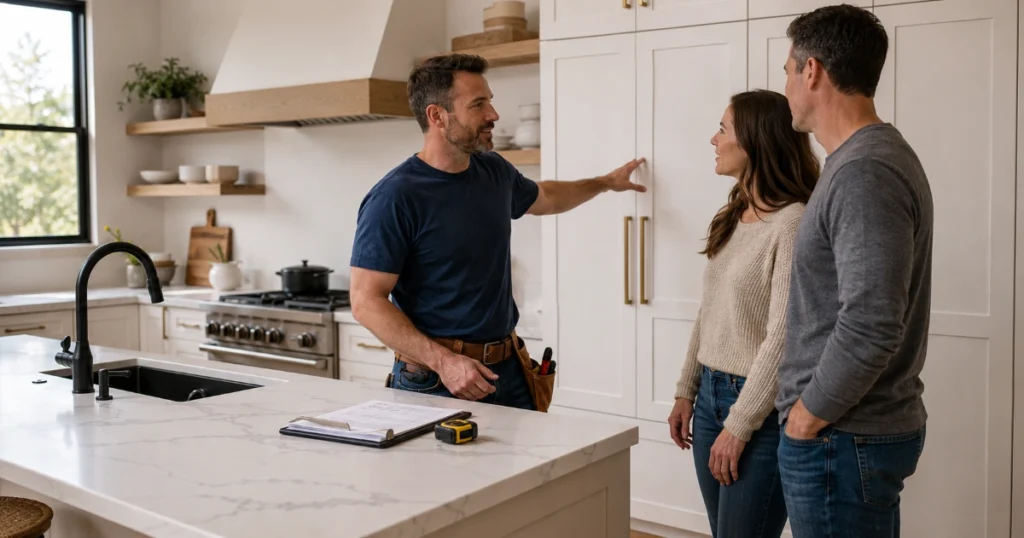
Remodelers on our review system average 4 to 6 new Google reviews a month. Before the system, the same companies averaged 0 or 1. The work didn’t change. The ask did: say it in person at the final walkthrough, text the direct review link within 24 hours, send one reminder three days later. That’s it.
Most advice about Google reviews for remodelers stops at “just ask happy clients.” The asking part is not the problem. The delivery is. A homeowner who said “of course I’ll leave a review” on Thursday has forgotten by Saturday, and the email you sent is sitting under 40 unread messages next to a furniture coupon.
Here’s the formula in one paragraph, then each piece in detail:
To get more Google reviews, a remodeler needs three things: an in-person ask at the final walkthrough, a direct review link sent by text within 24 hours, and one follow-up reminder. Remodeling companies using this system average 4 to 6 new Google reviews per month, compared to 0 or 1 without it.

Why Google reviews for remodelers decide who gets the call
Reviews are the first filter homeowners apply, before your portfolio and before your price. BrightLocal’s 2026 Local Consumer Review Survey found that 97% of consumers read reviews for local businesses, and 41% now “always” read them while browsing, up from 29% a year earlier. Google is where most of that reading happens: 71% of consumers use it to check reviews, more than any other platform.
Google itself is direct about the ranking side. Its own local ranking documentation lists prominence as one of three factors and states: “More reviews and positive ratings can help your business’s local ranking.” Review count and rating feed the Map Pack, and the stars next to your name change your click-through rate even when your position stays the same.
One of our clients put it better than any survey. Before working with us, he told me: “I did not know Google reviews affected my ranking. I had 12 reviews after 8 years in business. My competitor had 90. That is why he showed up and I did not.”
And a 2026 wrinkle most remodelers haven’t clocked yet: 45% of consumers now use ChatGPT or other AI tools for local business recommendations, up from 6% a year ago, per the same BrightLocal survey. Those tools read your review text. A profile full of detailed reviews that mention “kitchen remodel,” your city, and your crew by name gives an AI something to quote. Three reviews that say “great job” give it nothing.
How many Google reviews does a remodeler need in 2026?
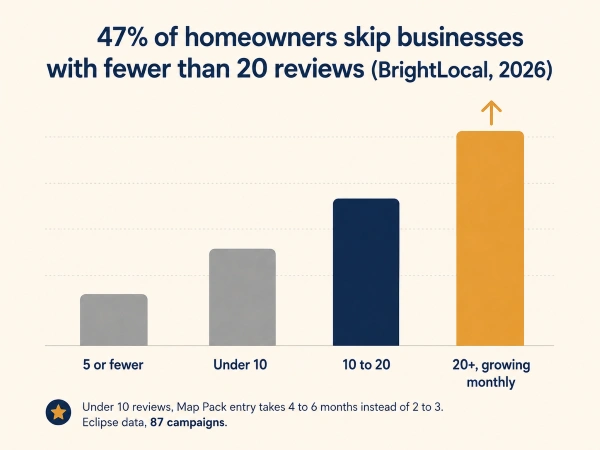
Twenty is the trust line. Ten is the ranking floor. BrightLocal found 47% of consumers won’t use a business with fewer than 20 reviews, and only 9% will consider one with five or fewer.
Our own numbers from 87 remodeling SEO campaigns say the ranking penalty starts earlier. When a client comes to us with fewer than 10 Google reviews and competitors holding 80 or more, Map Pack entry takes 4 to 6 months instead of the usual 2 to 3. We front-load review requests for exactly this reason. Across all clients, 78% reach the Map Pack within 6 months, and review count at the start is the single biggest variable in how fast that happens. Reviews work alongside the other off-page signals we build, but they’re the one you can influence this week without spending anything.
Recency matters as much as the total. In the same survey, 74% of consumers only care about reviews written in the last three months. A remodeler with 60 reviews and nothing new since last fall reads as a company that stopped doing good work.
Map Pack timelines vary by market competition and starting point. Past client results don’t guarantee identical outcomes.
The ask, link, timing formula
Every part of this exists because something simpler failed. We tried “just ask at the end of the job.” Reviews didn’t show up. The formula fixes the three places the ask dies: it never happens, the link never arrives, or the homeowner forgets.
Step 1: Ask in person at the final walkthrough
The final walkthrough is the emotional peak of a remodel. The dust is gone, the punch list is done, and the homeowner is standing in the room they’ve been picturing for a year. Ask then, face to face, and name the person who’ll send the link:
“We’re glad you love it. Reviews on Google are how homeowners find us, so it would mean a lot if you’d write a few sentences about the project. Sarah will text you the link this afternoon, it takes about a minute.”
Two details matter. You told them the text is coming, so it’s expected instead of spammy. And you said “a few sentences about the project,” which invites detail without scripting it. Detail is what makes a review persuasive to the next homeowner and readable to a search engine.

Step 2: Text the review link within 24 hours
This is the step where I’ll pick a fight with most of the advice out there: send the link by text, not email. Homeowners read texts. Your review request email lands between a utility bill and a promo from a big-box store, and even interested clients don’t dig it out. When we moved clients onto an automated text flow (we run it through GoHighLevel, triggered when the job closes), review velocity went from 0 or 1 a month to 4 to 6. The companies, the work, and the clients stayed the same. The channel changed.
The link itself has to be the direct one, not “search for us on Google.” Google generates it free inside your Business Profile, and its review link instructions also cover the QR code version, which we print on leave-behind cards for crews. One tap should open the review box. Every extra step costs you finished reviews, because the homeowner needs a Google account and about 60 seconds, and that’s already enough friction.
Get texting consent during the project, not after. We collect it on the contract so the review request is a normal part of the client thread, right after the “here’s your warranty paperwork” message.
Step 3: One reminder, three days later, then stop
People forget. That’s the whole reason this step exists. A single follow-up three days after the first text catches the homeowner on a calmer day, and in our flows it produces a meaningful share of the completed reviews. After that one reminder, stop. A second nag trades a possible review for guaranteed annoyance, and the review a client leaves to make you go away is not the review you want.
What should the review request text say?
Short, named, and specific to the project. Here’s the first text we send:
“Hi [first name], it’s [PM name] from [company]. Thank you again for trusting us with your kitchen. If you’re happy with how it turned out, would you leave us a Google review? A few sentences about the project helps other homeowners a lot. Takes about a minute: [link]”
And the reminder:
“Hi [first name], [PM name] again. No rush at all, just wanted to resend the review link in case the week got away from you: [link]”
Notice what’s not in there. No “5 stars,” no suggested wording, no bribe. Naming the project type nudges the homeowner to mention it, and reviews that describe the actual work carry more weight with readers: BrightLocal’s trust factors put a described positive experience (46%) and an owner response (37%) among the top signals that make a review believable.
Can you offer a discount for a Google review?
No. Google’s review guidelines state that “offering incentives, like free or discounted goods or services, in exchange for customers to post reviews, change reviews, or remove negative reviews is considered fake & misleading content and is strictly prohibited.” Penalties run from deleted reviews to profile restrictions, and for a remodeler whose entire lead flow depends on the Map Pack, that’s not a trade worth making.
Review gating, where you survey clients first and only send the review link to the happy ones, breaks the same policy. Ask everyone whose project you completed.
Remodelers ask us some version of “how do you get me reviews without it looking fake?” in almost every consult. The answer is the boring one: real clients, asked the same way, on a schedule. The pattern that looks fake is 15 five-star reviews in one week after two silent years. The pattern that looks real is 4 to 6 a month, every month, with an owner reply under each. A perfect score isn’t the goal either. Only 10% of consumers insist on a flawless 5.0, and Google’s own guidance notes that a mix of feedback “often feels more trustworthy.”
How do you get reviews from past clients?
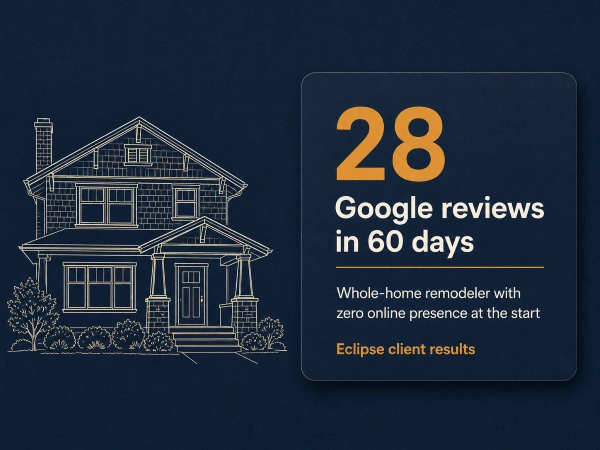
One at a time, personally, and only from the last year or so. When we onboarded a Colorado whole-home remodeler who had no online presence at all, review requests to past clients produced 28 Google reviews in 60 days. The method wasn’t a mass blast. The owner sent individual texts, each one referencing the specific project, in order of how recent and how large the job was.
A blast email to a 5-year-old client list gets you three reviews and a few confused replies. A personal text that says “we redid your primary bath last spring” gets a review with detail in it, because the memory is still there. Start with the last 10 to 15 completed projects and work backward. Past-client outreach is a one-time reserve, though. It refills your profile once, and then you’re back to needing a per-project system so the velocity never drops to zero again.
Respond to every review, even the three-word ones
An owner response is one of the top five things that make a review believable to the next reader, at 37% per BrightLocal. It’s also one of the fastest ways to show Google the profile is active. Two sentences is plenty: thank them by name, mention the project. Skip the copy-paste “Thanks for the kind words!” on every review, because homeowners scroll those replies too, and ten identical responses read like nobody’s home.
Negative review? Reply once, calmly, with your side in two or three sentences and an offer to fix it offline. The reply is for the hundred future homeowners reading it, not for the one angry client.
What the system looks like after 8 months
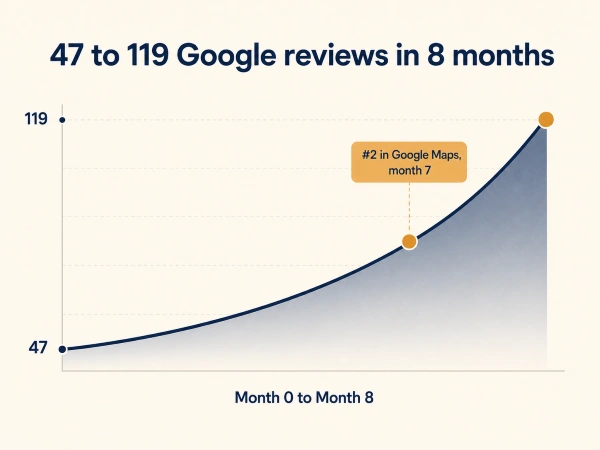
A Dallas kitchen and bath remodeler came to us with 47 Google reviews after 15 years in business, spending $6,200 a month on Angi for shared leads. We rebuilt the site, overhauled the Business Profile, and turned on the review flow. Eight months later the profile held 119 reviews, the company ranked #2 in Google Maps for “kitchen remodeler Dallas” by month 7, and the Angi bill was gone. His line: “My Angi bill was $6,200 a month. I cancelled it. Google sends me better leads for free now. The math is not even close.”
Reviews didn’t do that alone. They worked alongside the service pages, the profile work, and the rest of the SEO for home remodeling companies engagement, and results vary by market, competition, and starting point. But the review velocity was the fastest-moving piece, and it’s the piece you can start without us: ask at the walkthrough, text the link within 24 hours, remind once.
If you’d rather have the whole thing run itself, that’s what we build. The review flow is one part of how our clients replace bought leads with remodeling leads they own, and unlike a Google Ads budget, reviews don’t stop working when you stop paying. We work with one remodeler per city, so the first step is checking whether yours is open. Getting Google reviews for remodelers comes down to a repeatable system, and the remodelers who install one hold the map in their market within a year, with a marketing partner or without one.
Questions remodelers ask about Google reviews
How do remodelers ask for Google reviews without sounding pushy?
Ask once in person at the final walkthrough, then text the direct review link within 24 hours and send one reminder three days later. Telling the homeowner the text is coming makes it expected instead of pushy. Our clients average 4 to 6 new reviews a month with this exact sequence.
How many Google reviews do remodelers need?
Twenty is the consumer trust line: BrightLocal’s 2026 survey found 47% of consumers won’t use a business with fewer than 20 reviews. For rankings, we see the floor at 10. Below that, Map Pack entry takes 4 to 6 months instead of 2 to 3 across our 87 remodeling campaigns.
Do Google reviews for remodelers affect Map Pack rankings?
Yes. Google’s local ranking documentation says more reviews and positive ratings can improve local ranking, as part of its prominence factor. In our campaigns, 78% of remodeling clients reach the Map Pack within 6 months, and starting review count is the biggest variable in that timeline.
Should review requests go by text or email?
Text. Homeowners open texts and lose emails, and the clients we moved onto an automated text flow went from 0 or 1 reviews a month to 4 to 6 without any other change. Email works as a backup for clients who never opted into texting.
Is it against Google’s rules to offer a discount for a review?
Yes. Google treats incentives for posting, changing, or removing reviews as fake and misleading content, and it’s strictly prohibited. Review gating, sending the link only to clients you’ve pre-screened as happy, violates the same policy. Ask every completed-project client the same way.
Do old Google reviews still count?
They count less every month. BrightLocal found 74% of consumers only care about reviews written in the last three months, so a profile with 60 reviews and nothing recent reads as inactive. Steady velocity, a few new reviews each month, beats a big stale total.