
Importance Of Content In SEO: What Actually Moves The Needle In 2026
Content is the single biggest lever you have in SEO. Without it, search engines have nothing to index, rank, or show to people searching for what you sell. The importance of content in SEO comes down to a simple math problem: Google processes billions of queries a day, and the only way your business shows up is if you’ve published something worth showing. I’ve watched companies spend $10,000+ on technical SEO audits while publishing one blog post a quarter. That almost never works.
The importance of content in SEO is that it gives search engines the information they need to match your pages with user queries. Well-written, topic-specific content signals relevance, builds authority through backlinks, and creates the page-level signals Google uses to determine rankings. No content, no rankings.
That’s the short version. But the details matter more than most articles on this topic will tell you, and I’ll get specific about what works right now (not what worked in 2022).
This article covers why content drives organic search performance, how to build content that ranks after Google’s 2025 and 2026 core updates, and where most businesses waste their budget. I won’t cover paid content distribution or social media content strategy. Those are different playbooks entirely.
What Counts as “Content” for SEO Purposes?
SEO content is any page on your site that a search engine can crawl, index, and serve to someone searching. Blog posts, service pages, product descriptions, FAQ sections, videos with transcripts, infographics with supporting text. All of it counts.
But people get confused here. Content isn’t just “blog posts.” Your homepage is content. Your about page is content. Every URL Google can read is a piece of content that either helps or hurts your rankings. I’ve audited sites where the blog was solid but the service pages were 80-word stubs with zero useful information. Those service pages ranked for nothing because Google couldn’t figure out what the business actually did.
The global SEO services market hit $74.9 billion in 2025, and on-page content made up 41.8% of that revenue (roughly $31.29 billion), according to Mordor Intelligence’s January 2026 market report. Content isn’t a side project. It’s where the majority of the money goes. Understanding the core parts of an SEO strategy starts with understanding that content sits at the center of all of them.

Why Is SEO Content So Important for Your Business?
Content connects you to every person searching for what you offer. Organic search remains the top way people discover businesses, and 49% of marketers say it delivers the highest ROI of any channel (Search Engine Journal, cited in Backlinko’s January 2026 stats update). If you’re not publishing, you’re invisible.
It Puts You in Front of Your Target Audience
Google handles billions of searches daily. Your potential customers are in that pool right now, typing questions you should be answering. If you sell kitchen remodeling services, someone in your city is searching “how much does a kitchen remodel cost” today. If you haven’t published a page that answers that question, a competitor did. They’re getting that click.
91% of digital marketers reported that SEO (content included) had a positive impact on their performance goals in 2024 (SE Ranking, December 2025). That’s not a soft endorsement. That’s near-universal agreement.
Does Content Actually Affect Search Rankings?
Yes. Content, page experience, and links are Google’s top three ranking factors (Search Engine Journal). Google has said this publicly and repeatedly. But the part most articles skip is that content quality matters far more than content quantity after the December 2025 Core Update.
That update hammered sites running broad, thin content. E-commerce sites lost an average of 52% visibility. Health and affiliate sites got hit even harder, with 67–71% drops in some cases. The sites that survived (and gained) had narrow topical authority with original, specific content.
“Content is king” used to be true in the lazy sense. You could publish 500 mediocre posts and rank through sheer volume. After the 2025 updates, that strategy is dead. Google now rewards depth on a focused topic over breadth across a hundred unrelated ones. I’ve seen it firsthand across dozens of client accounts. Anyone still telling you to “just publish more” isn’t paying attention to how these algorithm changes actually work.

How Content Builds Your Backlink Profile
Backlinks remain one of the strongest ranking signals. And the only reliable way to earn them is to publish something other sites want to reference.
Long-form content receives 77.2% more backlinks than short-form pieces (Backlinko, January 2026). That’s not because word count itself matters. It’s because longer content tends to be more detailed, more original, and more useful. Nobody links to a 300-word post that says the same thing as 50 other pages. If you want to understand what kind of backlinks actually move rankings, the answer almost always starts with the content you’re producing.
Original research, proprietary data, and strong opinions get linked. Generic summaries don’t. I’ve seen companies invest in one solid piece of original research per quarter and earn more backlinks from that single asset than from 20 generic blog posts combined.
Publishing More Content Improves Crawl Frequency (With a Catch)
The more frequently you publish quality content, the more often Google’s bots come back to check for updates. Higher crawl frequency means new pages get indexed faster, which means they can start ranking sooner.
But there’s a catch people miss. Publishing garbage just to increase crawl frequency backfires. Google’s crawl budget is finite. If your site has hundreds of thin pages, the bots spend their time on those instead of the pages that actually matter. This is a case where less (but better) beats more. The benefits compound only when each new page is worth indexing.
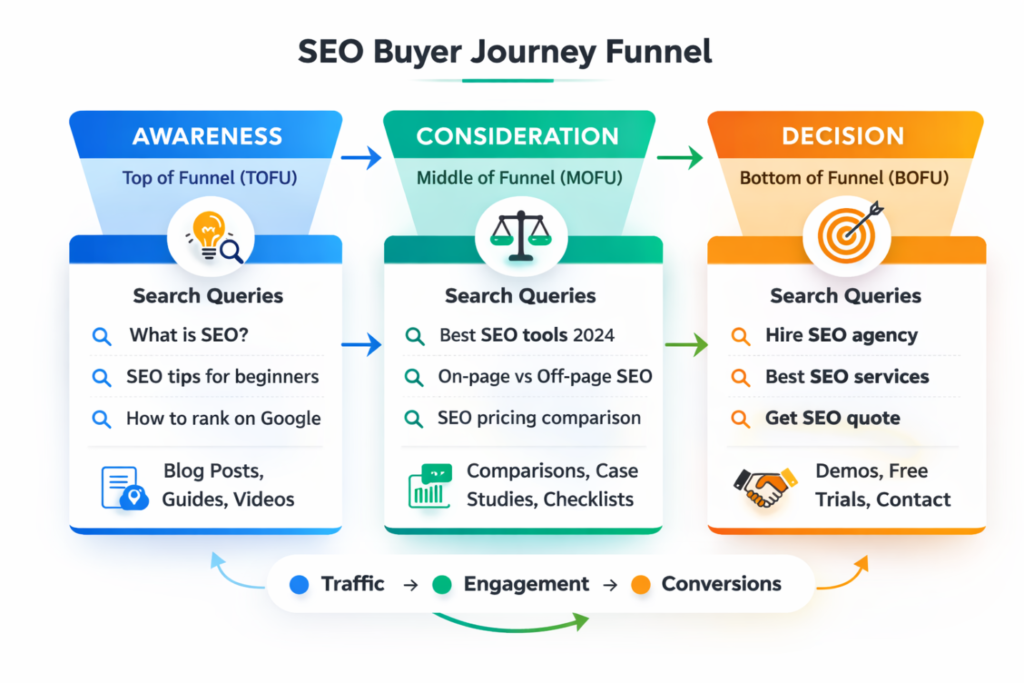
It Moves People Through the Buying Cycle
Your customers don’t go from “never heard of you” to “take my money” in one search. They search multiple times across days or weeks. Content lets you show up at each stage.
Someone searching “do I need new gutters” is early-stage. “Best gutter installation companies near me” is mid-stage. “Gutter installation cost [city name]” is ready to buy. If you’ve published content for all three queries, you can be the company they see at every step. That compounds. Organic leads convert at 14.6%, compared to 1.7% for traditional outbound marketing (MonsterInsights, cited in 2026 industry data). The people who find you through search are already looking for what you sell.
What Role Does Content Play in User Experience?
Search engines reward pages that load fast, work on mobile, and give people what they came for. But all the speed improvements in the world won’t help if the content on the page is thin, confusing, or off-topic.
Good content keeps people on your site. It reduces bounce rates, increases time on page, and sends signals to Google that your page delivered on its promise. Bad content does the opposite. If your web design and page structure are solid but your content is weak, people leave. Google notices.
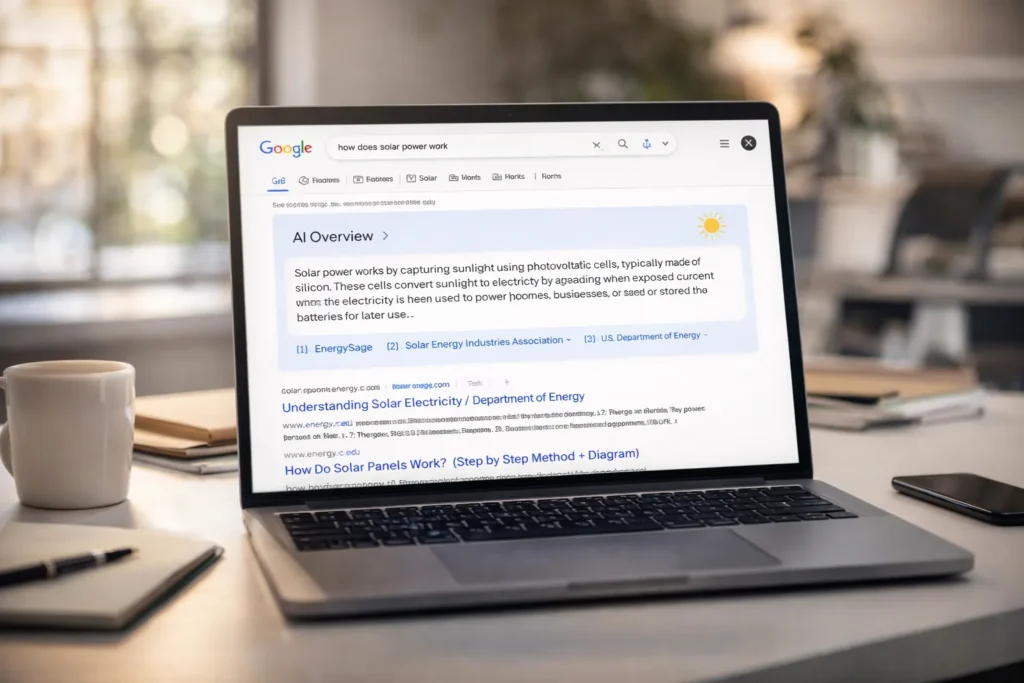
How Content Prepares You for AI Search
This is the angle most articles on this topic barely touch, and it’s the one that matters most going forward.
Google’s AI Overviews now appear on a growing percentage of searches. AI Overviews pull from content that directly answers questions with specific, well-sourced information. According to Ahrefs’ 2025 content statistics, AI Overview citations skew 25.7% fresher than traditional organic results, and they update roughly every two days. Google also rolled out a February 2026 Discover Core Update that specifically rewards in-depth, original content.
If your content doesn’t directly answer specific questions in self-contained paragraphs with real data, it won’t get cited. Period. The businesses building for this now will own AI search visibility in 12 months while everyone else plays catch-up.
86.5% of top-ranking pages already contain some AI-generated content (Ahrefs, December 2025). But 97% of companies still edit that output with human reviewers. The gap between “AI-assisted” and “AI-only” is where winners and losers separate. Google’s December 2025 and February 2026 updates specifically targeted low-effort AI content that lacked original expertise. As Kieran Flanagan, SVP of Marketing at HubSpot, put it in the 2026 State of Marketing Report: consumers are tuning out AI-generated brand content and seeking human-created material in spaces AI hasn’t flooded.
Does Better Content Increase Click-Through Rates?
Yes. And CTR matters more than many practitioners admit. Multiple studies (including analysis from Larry Kim and Rand Fishkin) suggest that pages with higher-than-expected CTR for their position tend to climb in rankings over time.
The first organic result on Google averages a click-through rate around 39.8% (Backlinko). Ads? About 2%. Organic content that ranks well earns dramatically more qualified traffic than paid placement, and it doesn’t stop when you turn off the budget.
More Visibility Means More Revenue
Content that ranks brings in traffic you don’t pay per-click for. Over time, that organic traffic becomes your most profitable channel. You publish once, and a well-ranked page can generate leads for years.
The SEO content creation services market was valued at $26.2 billion in 2023 and is projected to reach $88.6 billion by 2032 at a 14.5% CAGR (Zion Market Research). Businesses aren’t spending that kind of money on something that doesn’t deliver. The ROI compounds because content stays live and keeps earning traffic long after you publish it.
How to Create Content That Actually Ranks in 2026
Google’s own guidelines say to focus on people first, not algorithms. That sounds like corporate PR, but it’s actually useful advice. I’ve tested it across 50+ campaigns. Pages written to help a specific person answer a specific question outperform keyword-stuffed pages every single time.
Start With Your Audience, Not Your Keywords
Before you write anything, figure out what your audience is actually asking. Check Reddit threads in your industry, read your sales team’s call notes, look at reviews on Google and Amazon, and pay attention to the “People Also Ask” boxes in search results.
If you’re a roofing company, your customers aren’t searching “roofing solutions.” They’re searching “roof is leaking what do I do” and “how much does a new roof cost in [city].” Your content needs to match how real people talk, not how your industry talks about itself.

How Should You Pick the Right Keywords?
Start with the specific phrases your audience uses, then expand. A seed keyword like “kitchen remodel cost” branches into dozens of related terms: “kitchen remodel cost breakdown,” “cheap kitchen remodel ideas,” “is a kitchen remodel worth it.”
Group related keywords into clusters. One page per cluster, not one page per keyword. If you try to rank for “kitchen remodel cost” and “kitchen renovation budget” on two separate pages, you’ll cannibalize your own rankings. That’s a common mistake with a clear fix: map your keywords before you write. Choosing the right keywords from the start prevents you from wasting months on content that competes with itself.
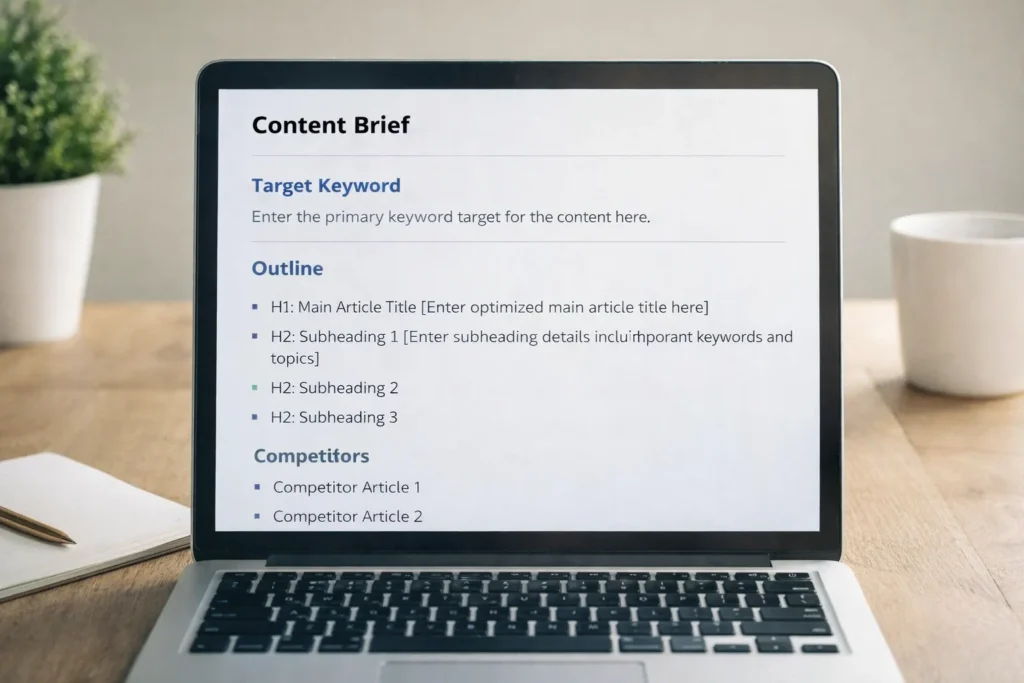
Build a Brief Before You Write a Word
A content brief saves you from the most expensive mistake in content marketing: publishing something nobody needed. Your brief should include the target keyword, secondary keywords, an outline of main points, the search intent, a target word count, and links to what’s already ranking.
Page-1 organic results average 1,447 words (Backlinko, January 2026). That’s not a prescription. Some topics need 800 words. Some need 3,000. The point is to cover the topic fully and stop. Don’t pad content to hit an arbitrary number.
What Happens When Your Content Drifts Off-Topic?
It tanks. Google can tell when a page tries to be about too many things. A post targeting “best painting supplies” shouldn’t also try to teach people how to paint. Those are different topics with different intent.
Keyword scope creep is the silent killer of otherwise good content. Pick one primary topic per page, support it with related subtopics, and stop. If a subtopic deserves deep treatment, give it its own page and link between them. That’s how you build a content cluster that signals authority to Google instead of confusion.
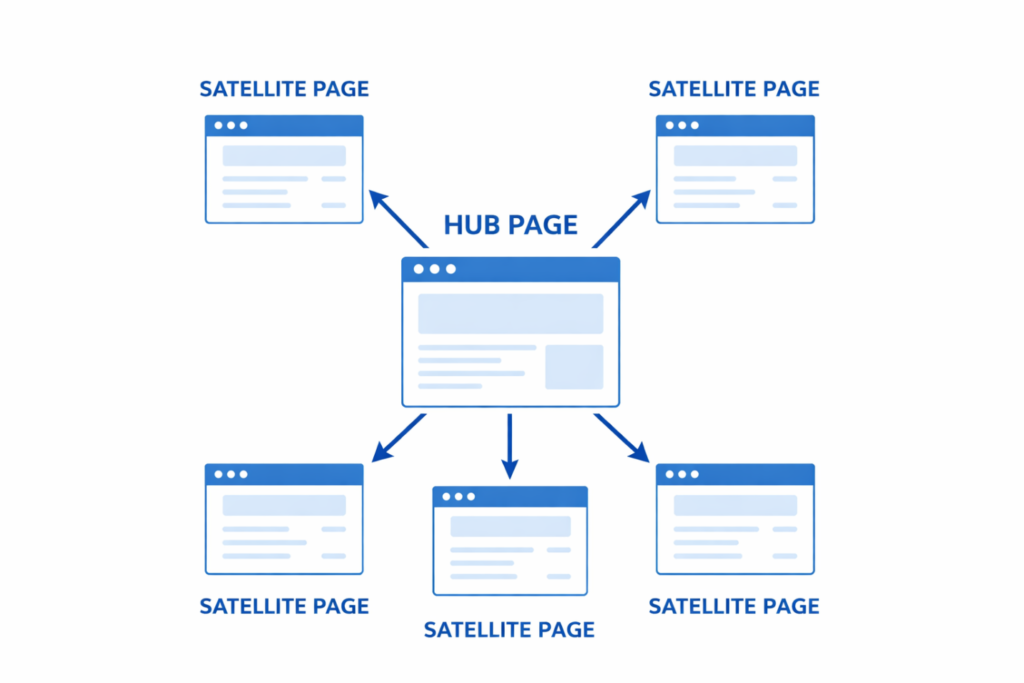
How Internal Links Strengthen Everything You Publish
Internal links do three things: they help Google understand your site structure, they pass authority between pages, and they keep users engaged. If your article on “importance of content in SEO” links to your pages about keyword strategy, backlink building, and on-page work, Google sees a connected hub of related expertise. That’s how you build topical authority.
Two to three relevant internal links per page is the minimum. Understanding why links matter for SEO isn’t complicated, but getting it right takes planning. Link with purpose, not at random.
Earning Backlinks by Publishing Something Worth Sharing
You can’t force other sites to link to you. You can publish content that makes them want to. Original research, definitive guides, and contrarian viewpoints attract links. Generic “10 tips” posts don’t.
I’ve seen this pattern repeat across dozens of industries. The company that publishes one piece of original research per month earns more natural backlinks than the company publishing four generic posts a week. Quality wins. Every time. But you need to know what to avoid when building backlinks just as much as you need to know what works. Shortcuts in link-building tend to backfire hard after algorithm updates.

The Mistake That Costs Businesses the Most
The biggest waste of money I see is companies that invest in content without a plan for building authority around it. They publish 50 blog posts, get zero backlinks, and wonder why nothing ranks.
Content without distribution and authority-building is just words on a page. You need a strategy that connects your content with link-building, technical SEO, and a clear topical focus. Working with an experienced team that understands your vertical can be the difference between content that sits there and content that drives real business results. Companies that don’t connect those dots blow through budgets with nothing to show for it.
The importance of content in SEO hasn’t changed. But the bar for what counts as “good content” is higher than it’s ever been. After Google’s 2025 and 2026 updates, you can’t get away with thin, generic, or AI-only pages. You need content built by people who know the subject, supported by a strategy that earns authority over time. That’s the work. And the businesses doing it are the ones pulling ahead.
Frequently Asked Questions
Does AI-generated content still rank in 2026?
Yes, but with a major caveat. 86.5% of top-ranking pages contain some AI-generated content, but 97% of companies edit that output with human reviewers (Ahrefs, December 2025). Pure AI content without human editing rarely ranks well after Google’s December 2025 Core Update. The key is using AI as a starting point, then adding original expertise and editing for accuracy.
How fresh does content need to be for AI Overviews?
AI Overview citations skew 25.7% fresher than traditional organic results, and Google updates AI Overview answers roughly every two days (Ahrefs, 2025). If you’re targeting queries where AI Overviews appear, updating your content at least quarterly gives you a better shot at being cited. Evergreen pages still need periodic refreshes.
What’s the real cost of bad content after 2025 algorithm updates?
Sites hit by the December 2025 Core Update lost 52–71% of their organic visibility, depending on the industry. Recovery requires full content rewrites and strong E-E-A-T signals, not minor edits. The cost of bad content isn’t just zero results. It’s the months of recovery time after a penalty.
Do word count rules still matter for SEO content?
There’s near-zero correlation between word count alone and AI Overview citations. Page-1 organic results average 1,447 words (Backlinko, January 2026), but that’s a byproduct of thorough coverage, not a target to hit. A 900-word article that fully answers the question will outperform a 2,500-word article padded with filler.
Why did my content drop after a Google core update?
Google’s recent updates prioritize narrow topical authority and original expertise over broad “best-of” content. If your site publishes across too many unrelated topics without deep expertise in any of them, you’re a prime candidate for losses. Fixing it means tightening your topical focus and adding first-hand experience signals.
How do I prove E-E-A-T in my content?
Add detailed author bios with credentials, include original research or proprietary data, cite specific sources, and show evidence of real experience with your subject. 64% of teams that published proprietary research saw ranking improvements (Datalily, 2025). E-E-A-T isn’t a checklist you bolt on. It has to be woven into how you create content.
Is content marketing still worth it with AI search taking over?
Google still sends 345 times more traffic than all AI chatbots combined (Ahrefs, 2025). Organic search remains the #1 discovery channel for most businesses. AI search is growing, but it’s additive. It doesn’t replace the volume Google delivers. The businesses investing in quality content now are positioning themselves for both channels simultaneously.

Michael Vale has over 5 years of experience helping clients improve their business visibility on Google. He combines his love for teaching with his entrepreneurial spirit to develop innovative marketing strategies. Inspired by the big AI wave of 2023, Michael Vale now focuses on staying updated with the latest AI tools and techniques. He is committed to using these advancements to deliver great results for his clients, keeping them ahead in the competitive online market.