
Multi-location SEO is how a remodeling company earns top rankings in every city it serves, one dedicated page and one local presence per market. Run showrooms or crews in three cities and you are running three local campaigns at once, because Google scores each one on its own. Rank well in Denver and it does nothing for your Aurora rankings. Each market is a separate fight.
We have run 87 remodeling SEO campaigns across 18 markets since 2019, so this guide skips the theory. You will see how long ranking actually takes by market size, what it costs per city, and the mistakes that quietly pull down half your locations at once. Build the system right and every new city plugs into a pattern that already ranks.
What is multi-location SEO?
Multi-location SEO is the practice of ranking one brand across several geographic markets, with a dedicated location page, a verified Google Business Profile, consistent citations, and its own review base for each city. For a remodeler, that means a distinct local footprint per market, so each branch competes and ranks on its own signals.
This matters because remodeling is bought locally. A homeowner searching “kitchen remodeler near me” sees the map results first, checks reviews, and calls one of the top three. Miss that local result and the job goes to the company down the road. Google’s own Business Profile guidance says local rankings come down to relevance, distance, and prominence, so the remodeler whose page and profile match the searcher’s city is the one that shows up.
How long does multi-location SEO take for a remodeler?
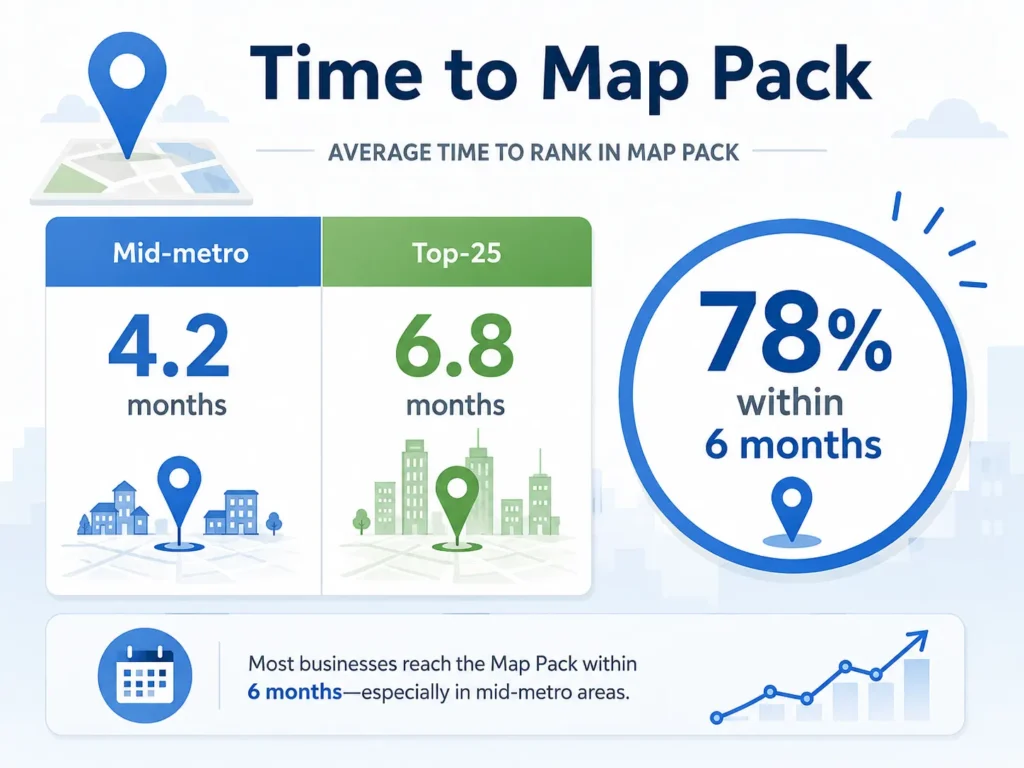
Expect measurable ranking movement in 30 to 60 days and Map Pack entry in a few months per market, not the year most agencies quote. Across our 87 campaigns, the average time to reach the Google Map Pack (the top three local results) is 4.2 months in a mid-competition metro and 6.8 months in a top-25 metro. In a given market, 78% of our clients reach the Map Pack within six months.
Timelines stretch in bigger cities for one reason: review count and competition. A remodeler entering Boise, where roughly 60 remodelers compete, ranks faster than one entering Phoenix, where more than 400 do. When you add a city, budget the longer timeline for dense metros and the faster one for mid-size markets. This is the same sequencing behind our SEO work for remodelers, where each market gets its own timeline. If leads are needed sooner, run Google Ads in parallel while the rankings build.
We stake a top three ranking for your main keyword within 12 months or a full refund. That guarantee applies to agreed target keywords, with full terms provided at onboarding.
How Google ranks each of your locations
Google ranks each location on its own, using three signals: relevance, distance, and prominence. Relevance is how well your page and profile match the search. Distance is how close your location sits to the searcher. Prominence is how known and trusted you are.
Your Denver profile lends no ranking power to your Fort Collins profile. Both earn their spots alone. That is why per-location work beats one statewide push, and why you rarely outrank an established competitor in a city where you have no real presence. Google Business Profile signals carry the most weight in the local pack, around 32% by Whitespark’s ranking-factors research, with on-page and review signals close behind. Prominence draws on reviews and links from local sites, and proximity remains the single strongest factor, so you need a verifiable location in the market to compete.
One page per city, and the copy that actually ranks
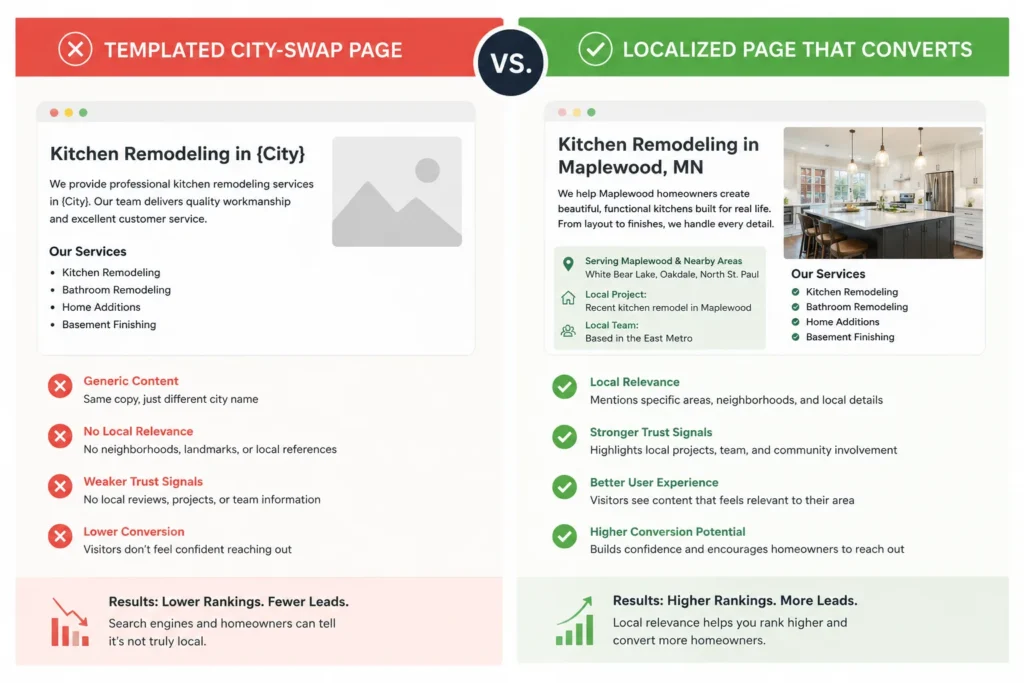
The advice everywhere is to scale location pages with templates and automation. Our data says the opposite. The more you templatize the words on the page, the faster every location stalls. Pages that swap only the city name read as thin, duplicated content, and Google demotes them. Industry testing puts the bar around 30% to 60% unique content per location page before it stops looking like a copy.
We see the cost of shortcuts at intake. On 94% of new remodeling client audits, we find duplicate title tags across service and location pages, the single most common issue we catch. It is the templated approach showing up in the data. When we tested custom, locally specific pages against thin templated ones, the specific pages won on both rankings and leads.
A location page earns its ranking with things only that branch can say: the local permit timeline, a named past project in that neighborhood, the review count from that market, real photos of that crew or showroom, and LocalBusiness schema with the correct address. Real, locally written content beats stock photos and recycled paragraphs every time.
The contrarian take, with the data behind it. Templates feel efficient and quietly sink your rankings. Industry testing shows city-swap pages underperform, and in our own audits 94% of new remodeling clients arrive with duplicate title tags across their pages. The win comes from substance in each market, not from publishing pages faster.
Map one keyword to one city
Give each city one primary keyword and one page that owns it. Nearby pages are the usual cause of cannibalization: a metro page and a neighborhood page chase the same term, and Google splits the rankings between them. Your Denver page owns “kitchen remodeler Denver.” A page for a suburb like Littleton takes the suburb term and links up to Denver as its parent.
Keep a simple keyword map: the city, its one primary keyword, the exact URL, and the supporting terms that live on the same page. Across the whole list, no primary keyword appears twice. If two URLs both target “bathroom remodeler Aurora,” fix it before launch: consolidate, redirect, or re-scope the weaker page. One clear owner per query keeps rankings steady as you add markets.
How much does multi-location SEO cost?
For a remodeler, multi-location SEO usually runs $3,500 to $5,000 per month per market, with the metro’s competition level as the biggest variable. A top-10 metro like Los Angeles or Dallas sits at the high end. A mid-size market like Boise or Raleigh typically lands at $3,500 to $4,000.
| Market type | Typical monthly investment per market | Typical Map Pack timeline |
|---|---|---|
| Mid-size metro (Boise, Raleigh) | $3,500 to $4,000 | About 4 months |
| Large metro (top 25) | $4,000 to $5,000 | About 7 months |
| Top-10 metro (Los Angeles, Dallas) | $4,500 to $5,000 | 7 months or more, review-dependent |
Compared with renting shared leads, the math shifts fast. A remodeler paying $6,000 a month for Angi leads shared with four competitors is buying access, not an asset. Rankings are something you keep.
Give every location its own Google Business Profile
Every physical location needs its own verified Google Business Profile. The most damaging mistake we see is one profile with several addresses bolted on. Google treats each address as a distinct local entity, so collapsing branches into one profile splits every signal and ranks none of them well.
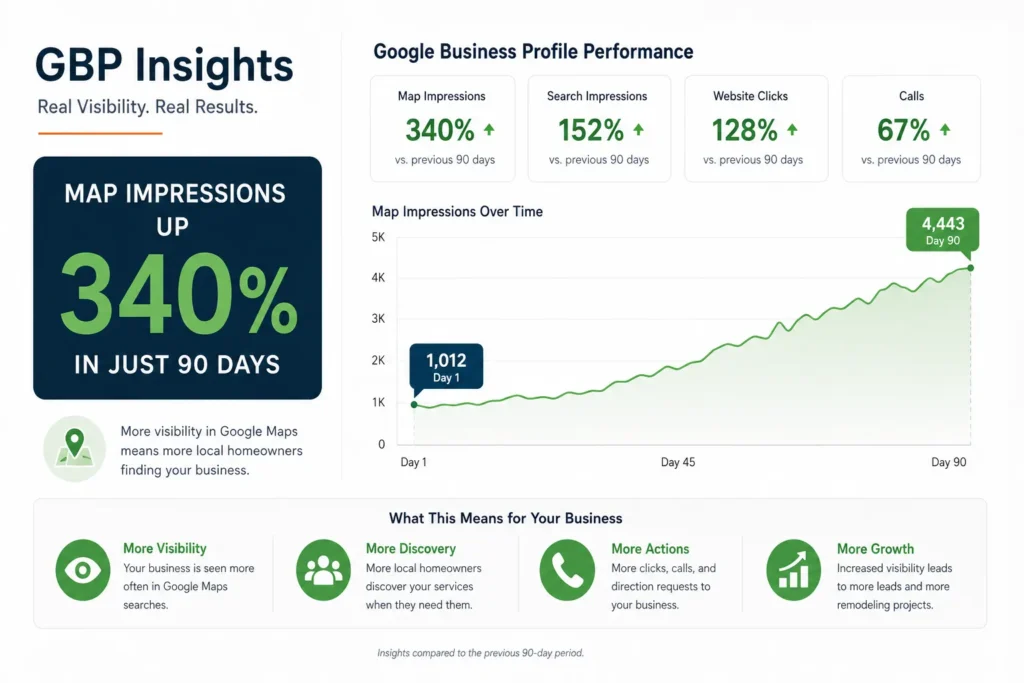
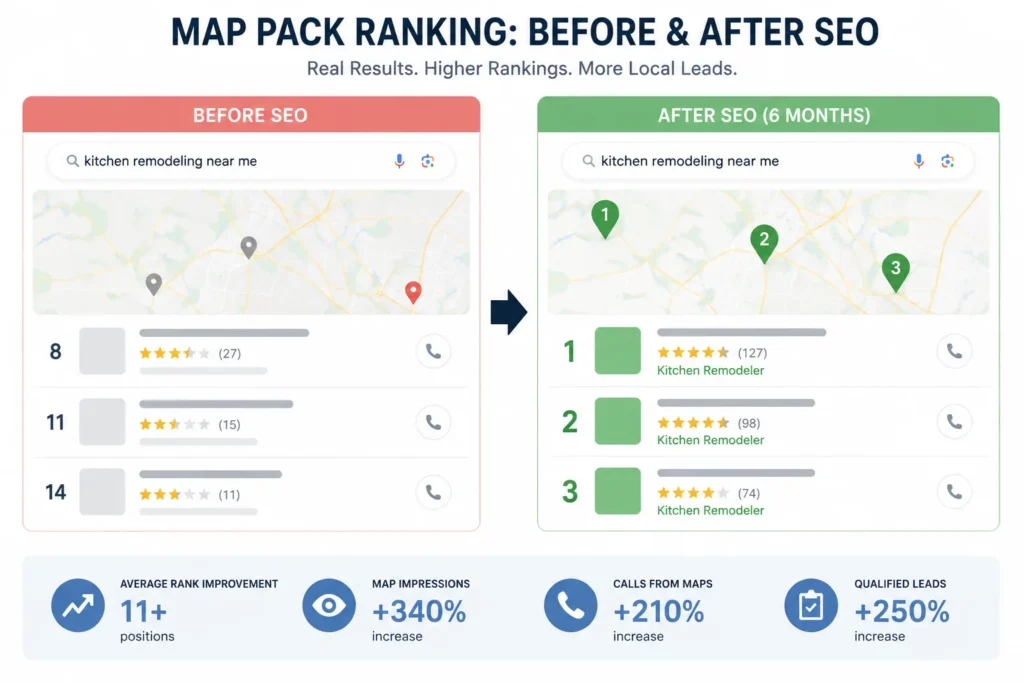
Per profile, get the basics right: exact name, address, and phone that match your site, the correct primary category, complete hours, real photos refreshed often, and services filled in. In our campaigns, a full Google Business Profile overhaul lifts map impressions by an average of 340% in the first 90 days. Reviews decide a lot after that. Google’s guidance and BrightLocal’s 2026 consumer research point the same way: fresh, answered reviews move both rankings and the homeowner’s choice.
Keep your name, address, and phone identical everywhere. Mismatched details create doubt, and doubt costs rankings. One remodeling client changed their phone number on the website but not on 37 citation sites and dropped from third to fourteenth in the Map Pack until we corrected it across every directory at once. For reviews, build a steady pace per market. A trickle every week beats a flood once a year, and each city needs its own flow so no market goes quiet.
Where your location pages live: subfolders win
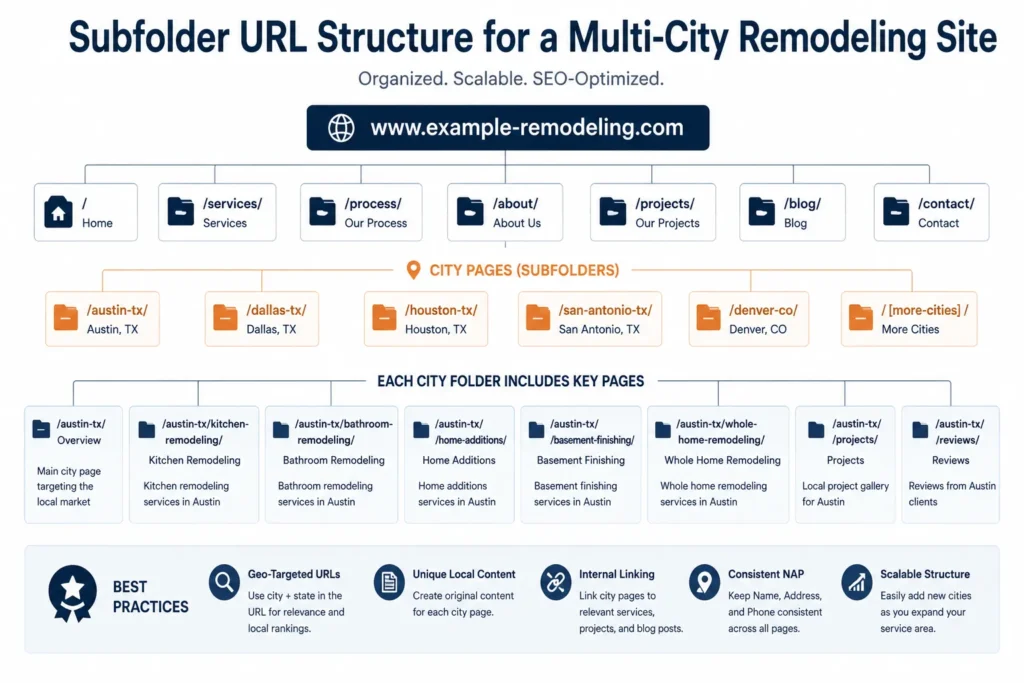
For almost every remodeler, put your location pages in subfolders on one domain, like yoursite.com/denver. Subfolders feed every link and every bit of authority back to a single site, so a new city page benefits from everything the domain already earned. Reach for subdomains or separate domains only when a location runs as its own brand, such as a franchise with different ownership and a different name.
| Approach | Example | Best for | Trade-off |
|---|---|---|---|
| Subfolders | yoursite.com/denver | Almost every remodeler | Keeps authority on one domain |
| Subdomains | denver.yoursite.com | Large, semi-separate regions | Splits authority across hosts |
| Separate domains | yourdenverbrand.com | A distinct franchise brand | Hardest to build authority |
Service-area and showroom remodelers
Most remodelers are a hybrid: a showroom or office in one city plus a service radius covering nearby towns. That shapes each market. Where you have a real address customers can visit, show the full address and let proximity work. Where you only serve an area, hide the street address on the Google Business Profile, define the service area by city, then build a location page around the towns you cover rather than a single pin.
Do not fake a presence. A virtual office or a mailbox in a city you do not really serve is a suspension risk, and Google is good at spotting it. If the client site sits on a builder that blocks real SEO work, plan a website rebuild before chasing new markets. Earn each city with a real address, real crews, and real projects, or target it as a service area you can honestly claim.
A remodeler with a Denver showroom and crews covering Boulder and Fort Collins runs a full-address profile for Denver and service-area pages for the towns it drives to, each built around that area’s projects and permits. That is one company running two setups, each matched to how Google reads that market.
Do AI Overviews change multi-location SEO in 2026?
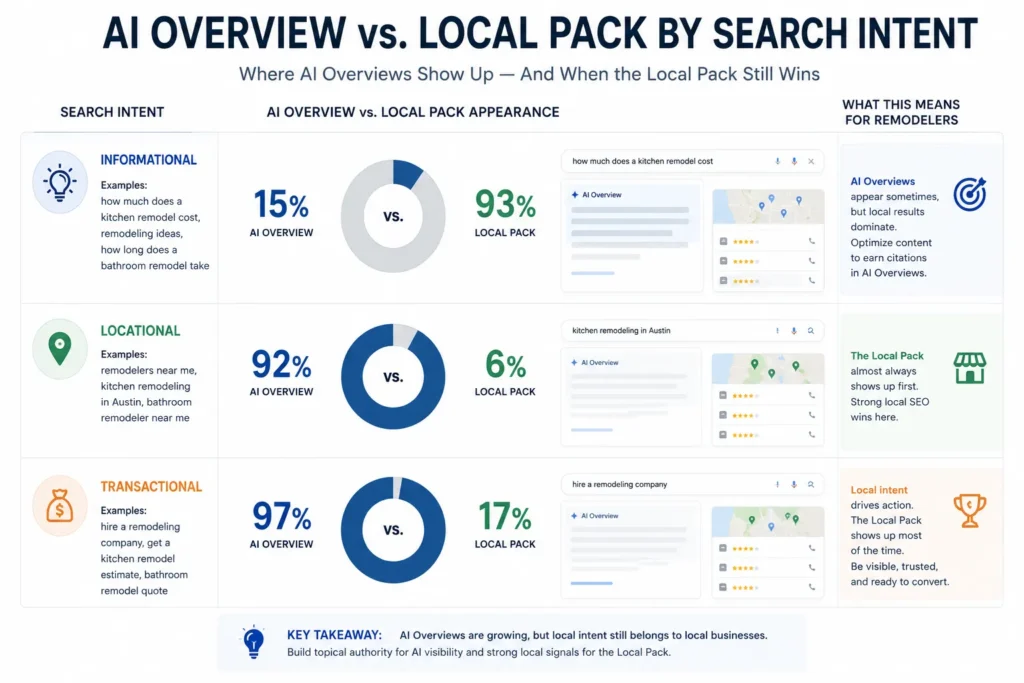
Yes, but less than the headlines suggest, and intent decides everything. AI Overviews now appear on a large share of informational searches, but for the transactional local searches that drive remodeling calls, the map pack still wins. A 2025 Whitespark study of 540 local queries found AI Overviews on only about 15% of pure local-intent searches, while local packs showed on roughly 93% of them. For informational and cost-style queries, that flips.
| Search intent (example) | AI Overview shows | Local pack shows |
|---|---|---|
| Local, transactional (kitchen remodeler Denver) | ~15% | ~93% |
| Informational (how long does a remodel take) | ~92% | ~6% |
| Hybrid (kitchen remodel cost in Denver) | ~97% | ~17% |
So split the work. For “kitchen remodeler [city],” win the map pack: profile, reviews, and proximity. For “how much does a kitchen remodel cost in [city],” write the clear, direct answer an AI Overview can lift, because Ahrefs found a click-through drop of about 34.5% when an AI Overview is present. Chasing AI answers for your money keywords is mostly a distraction right now. Winning the pack is where the calls are, and social media stays a supporting channel, not the lead engine.
The mistakes that quietly sink half your locations
Most multi-location problems trace back to shortcuts that looked efficient at the time. Here are the ones that cost remodelers rankings, and the fix for each.
| Mistake | Fix |
|---|---|
| Templated pages that only swap the city name | Write genuinely local copy per market: permits, projects, real photos |
| One Google Business Profile with several addresses | One verified profile per physical location |
| Inconsistent NAP across directories | Keep a master NAP record and push consistent citations |
| No reviews in a new market | Build steady review velocity, city by city |
| Location pages with no internal links | Link each to its parent city and related services |
| Two nearby pages targeting the same keyword | One primary keyword, one page, one city |
| An agency that also ranks your competitor | Ask how many companies in your city they already work with |
That last one gets missed. If an agency runs SEO for three remodelers in your city, someone gets the top spot and someone gets page two, and the agency is paid either way. Ask the question almost no one asks: how many companies in my market are you already working with? We cap it at one remodeler per city for exactly this reason, and we have turned down qualified prospects whose city was already claimed.
What this looks like in practice. A Dallas-area kitchen and bath remodeler came to us spending about $10,000 a month on shared leads and ads, getting 8 to 12 leads split with four competitors. We rebuilt the site, published 34 city-specific pages, overhauled the profile, and ran a review system that took them from 47 reviews to 119 in eight months. By month seven they ranked second in Maps and organic for their main city keyword, organic leads reached 22 to 27 a month, and they cancelled the $6,200 Angi bill. Results vary by market, competition, and engagement, and past performance does not guarantee the same outcome.
Own every market you serve
Strong multi-location SEO comes down to repeatable work done per city: one page a local would recognize, one verified profile, consistent citations, steady reviews, and internal links that tie it together. Map one keyword to one city. Add schema and AI-ready answers once the basics hold. Then every new market plugs into a system that already ranks.
Pick your top two markets and start this month. Audit the profiles, fix the duplicate title tags, and track rankings city by city. If you would rather have a team that works with only one remodeler per city build and run it, that is what we do at Eclipse.
FAQs
How does multi-location SEO work for a remodeling company?
Multi-location SEO ranks one remodeling brand in several cities by giving each market its own location page, verified Google Business Profile, consistent citations, and reviews. Google scores each location on its own, so the work repeats per city. In our campaigns, 78% of clients reach the Map Pack in a market within six months.
How long does multi-location SEO take to rank a new market?
Expect keyword movement in 30 to 60 days and Map Pack entry in a few months per market. Across 87 remodeling campaigns, the average time to the Map Pack is 4.2 months in a mid-competition metro and 6.8 months in a top-25 metro. Review count and competition drive the difference.
Do I need a separate Google Business Profile for each location?
Yes. Every physical location needs its own verified profile. Putting several addresses on one profile is the most damaging mistake we see, because Google treats each address as a distinct local entity and splits the signals. One verified profile per location ranks far better.
How much does multi-location SEO cost for a remodeler?
It typically runs $3,500 to $5,000 per month per market, with the metro’s competition level as the biggest variable. Mid-size markets sit at the low end and top-10 metros at the high end. Pricing varies by market and scope, so treat these as ranges, not quotes.
Will AI Overviews replace local rankings for remodelers?
Not for the searches that drive calls. A 2025 Whitespark study found AI Overviews on only about 15% of transactional local queries, while local packs appeared on roughly 93%. Win the map pack for remodeler-plus-city searches, and write clear answers for informational, cost-style queries where AI Overviews show.
How many location pages should a remodeler have?
Build one page per city where you have a real, verifiable presence, each targeting that city’s keyword. Fold low-demand markets into a single regional page rather than spinning up pages no one searches for. One clear owner per keyword keeps the pages from competing with each other.
Can I rank in a city where I do not have an office?
You can, as a service-area business. Hide the street address on the Google Business Profile, define the service area by the towns you cover, and build the page around those areas. Do not fake an address with a virtual office; it is a suspension risk.