
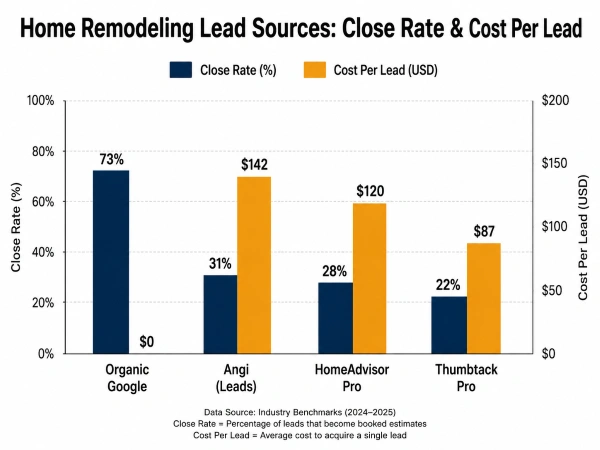
Hire influencers. Build 360-degree virtual tours. Post every day on three platforms. That’s the advice most kitchen remodelers get, and most of it won’t put a single signed job on the calendar. Across 87 remodeling SEO campaigns we’ve run since 2019, the pattern repeats in every market: the leads that turn into kitchens come from showing up on local Google, not from scattered social tactics. 73% of our clients’ organic leads book an estimate. Only 22 to 31% of shared leads from Angi or HomeAdvisor do. An organic lead costs about $0 once the work is done. A shared Angi lead runs $87 to $142. So the honest answer to how to get kitchen remodeling leads is narrow: own your local Google results, fix your Google Business Profile, and stop renting leads that five other contractors already bought.
A kitchen remodeling lead is a homeowner who has shown real buying interest in a kitchen project, usually by requesting a quote, calling, or filling out a form. Not all of them are equal. An exclusive lead from Google organic search behaves nothing like a shared lead resold to three to eight contractors by a platform like Angi.
What counts as a good kitchen remodeling lead
A good lead is exclusive, local, and already looking to buy. That combination is what drives close rates, and close rate is the number most remodelers ignore.
Here’s why it matters more than volume. One of our clients, a high-end kitchen remodeler in the Pacific Northwest, actually saw monthly leads drop from 15 to 11 after we repositioned their site around $75,000-plus projects. The owner was nervous. Then the numbers came in: qualified leads jumped from 30% to 72% of the total, and their close rate went from 12% to 34%. Fewer leads, far more kitchens. The average closed project was worth $94,000.
Chasing raw lead count is how remodelers end up busy and broke. A shared lead that six contractors are calling within minutes is worth a fraction of a homeowner who found you on Google, read your reviews, and called only you.

The 7 “creative” tactics, ranked by what they return
Most lead-generation articles hand you a list of seven tactics as if they all carry equal weight. They don’t. Here’s how the usual list actually performs for a kitchen remodeler.
What earns kitchens. Local search is the engine. Homeowners overwhelmingly start on Google, and 42% of local searchers click a result inside the Google Map Pack. Reviews decide the rest: 97% of consumers read them before choosing a local business, and 71% read those reviews on Google, per BrightLocal. A complete Google Business Profile makes a homeowner 2.7 times more likely to see you as reputable, per Google’s own data, while only about a third of small businesses have claimed one. Referrals and a steady review habit round out the short list of things that consistently produce signed work. These are the search rankings you own, and they compound month over month.
What buys time, not assets. Google Ads belong here. Ads deliver leads within days, which is real value when your pipeline is empty. But you rent that flow. It stops the day you stop paying. We often run Google Ads in parallel with SEO so a client has leads now while rankings build for later.
What’s mostly a distraction. Influencer partnerships and 360-degree virtual tours sit at the bottom for most kitchen remodelers. Think about the buyer. A homeowner spending $28,458 on a minor kitchen remodel, the national average in the 2025 Cost vs. Value report, is not picking a contractor off a local influencer’s reel. Daily posting across four platforms burns hours a week that would return far more spent earning three new Google reviews. Social has a role: posting project photos two or three times a week supports trust and retargeting. It is a supporting channel, not the engine.
That minor kitchen remodel number is worth sitting with. It returns about 113% of its cost, the best payback of any interior project in the 2025 report. Demand for exactly the projects you sell is strong. The question is whether the homeowner finds you or the six contractors renting the same Angi lead.
How long does it take to get kitchen remodeling leads?
Faster than the industry tells you. Most agencies say SEO takes 12 months before you see anything. In remodeling, that’s usually a story to buy a year of billing before anyone checks the work.
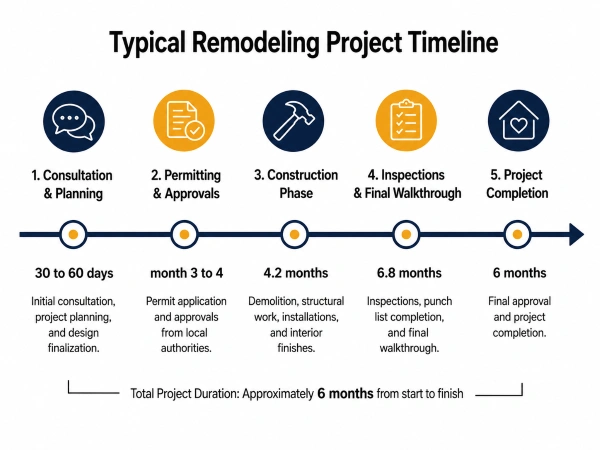
Here’s what our data actually shows. Keywords start moving into the top 50 in 30 to 60 days. First organic leads land by month 3 to 4 in most markets. Map Pack entry averages 4.2 months in a mid-competition metro and 6.8 months in a top-25 metro like Los Angeles or Dallas. Across our clients, 78% reach the Map Pack within 6 months. The 12-month figure only holds if you define success as ranking number one for the single most competitive term in a huge market. For the searches that actually ring the phone, like “kitchen remodel cost” plus a neighborhood name, traction comes much sooner.
Are Angi and HomeAdvisor leads worth it for kitchen remodelers?
Rarely, once you do the math on shared leads. When a homeowner submits a request, these platforms sell that same request to several contractors at once. You pay per lead whether you win the job or not, and you compete on who calls back first.
The model has drawn regulatory attention. In 2023, HomeAdvisor agreed to an FTC settlement of up to $7.2 million over how it marketed the leads it sold to contractors. Set the headlines aside and the economics still don’t work for most remodelers: a lead split five ways books an estimate 22 to 31% of the time in our client data, against 73% for an exclusive organic lead. You are paying $87 to $142 to fight four other contractors on price.
Kitchen remodeling lead sources compared
The fastest way to see the difference is side by side. The costs below use 2025 home-services advertising benchmarks for paid channels and our own client-reported figures for organic and shared leads.
| Lead source | Typical cost per lead | Who else gets it | Leads that book an estimate | Do you own it? |
|---|---|---|---|---|
| Organic search / Google Business Profile | About $0 after rankings are set (SEO fee separate) | Exclusive to you | ~73% | Yes, it compounds |
| Google Ads (PPC) | $90.92 avg home services; $165.67 construction and contractors | Exclusive click, but only while you pay | Varies | No, it stops with spend |
| Angi / HomeAdvisor (shared) | $87 to $142 | 3 to 8 contractors | 22 to 31% | No |
| Referrals and reviews | About $0 | Exclusive | High | Partly, you build it |
Two channels build an asset you keep. Two rent you access. That’s the whole decision.
How much does it cost to get kitchen remodeling leads in 2026?
It depends on whether you rent leads or build a source you own. Through Google Ads, the average home services lead cost $90.92 in 2025, and $165.67 for construction and contractor firms, per 2025 advertising benchmarks. Shared platform leads run $87 to $142. SEO is a flat investment, typically $3,500 to $5,000 a month in our work, and once rankings are in place the marginal cost of each new organic lead drops to near zero.
A Dallas kitchen and bath remodeler shows the swing. They came to us spending $6,200 a month on Angi and $3,800 on Google Ads, pulling 8 to 12 shared leads a month and closing about one in ten. We rebuilt the site, published 34 city-specific service pages, overhauled the Google Business Profile, and set up automatic review requests. By month 7 they ranked number two in Maps and organic for “kitchen remodeler Dallas.” Organic leads went from 3 to 4 a month to 22 to 27. They cancelled Angi, paused the ads, and watched their effective cost per lead fall from $127 to near zero. Their pipeline moved from a $1.2M to a $2.1M annual run rate. That client is now in month 29 with us. Results vary by market and competition, but the mechanics repeat.

How to get kitchen remodeling leads that actually close: a plan for this month
Start with the assets you own, in this order. None of this requires a huge budget, and the first two steps you can begin this week.
First, fix your Google Business Profile. Choose the right primary category, list every service, and add 25 or more real project photos with location data. This is the single fastest early win, and most remodelers have three photos and a one-line description.
Second, build a real page for each service and each area you cover, not one thin “kitchens” page. Dedicated service pages are among the strongest factors for local organic rankings, and they are where a homeowner searching “kitchen remodel cost Columbus” actually lands. Make sure the site itself is built to convert and clean underneath, since duplicate title tags show up on 94% of the new-client sites we audit.
Third, turn reviews into a habit. Ask every finished client for a Google review through a simple text-message flow. Our clients average four to six new reviews a month once this runs.
Fourth, if you need leads immediately, run Google Ads while the organic work builds. Treat the ads as a bridge, not the destination.
Fifth, track lead source and close rate, not traffic charts. If a keyword brings clicks but no calls, change it. Over months, the right content and links from local sites push you up the Map Pack and keep you there.
The real question isn’t how to get kitchen remodeling leads. It’s which leads you own when you stop paying. Rented leads vanish the month the invoice does. Rankings, reviews, and a Google presence keep working, which is the entire reason we take one remodeler per city and point every effort at their results alone. Fix the profile, build the pages, earn the reviews, and the pipeline stops being something you rent.
Frequently asked questions
How do I get more kitchen remodeling leads without relying on Angi?
Rank your website and Google Business Profile for local kitchen searches, then build reviews and referrals. Organic leads are exclusive to you and, across our 87 campaigns, about 73% of them book an estimate versus 22 to 31% of shared platform leads. Running Google Ads alongside SEO covers the gap while your rankings build.
How long does it take to get kitchen remodeling leads from SEO?
Most markets show ranking movement in 30 to 60 days and first organic leads by month 3 to 4. Google Map Pack entry averages 4.2 months in a mid-competition metro and 6.8 months in a top-25 metro. 78% of our clients reach the Map Pack within 6 months.
How much does a kitchen remodeling lead cost?
Through Google Ads, the average home services lead cost $90.92 in 2025, and $165.67 for construction and contractor firms, per 2025 advertising benchmarks. Shared Angi or HomeAdvisor leads run about $87 to $142 each based on client-reported data. Organic leads cost close to $0 once your rankings are in place.
Are Google Ads worth it for kitchen remodelers?
Yes, as a short-term source while SEO builds. Ads deliver leads within days, but you rent them: the flow stops when spending stops, and contractor cost per lead averaged $165.67 in 2025. Pair ads with SEO so organic rankings gradually replace the ad spend.
Why are my kitchen remodeling leads low quality?
Usually because they’re shared. Platforms like Angi resell one homeowner’s request to several contractors, so you compete on price and speed. In 2023, HomeAdvisor settled FTC charges for up to $7.2 million over how it marketed leads. Exclusive leads from your own Google presence close at far higher rates.
Do I need a new website to get kitchen remodeling leads?
Not always. If your site loads fast on mobile, has clear service pages, and can be edited for SEO, we improve what you have. About one in three sites we audit sit on a platform that blocks proper SEO, and those need a rebuild first.