Remodeling lead follow-up usually stops after 2 attempts. The largest study on contact strategy ever run found that 93% of the leads you eventually win are reached by the 6th.
That gap is the whole article. Follow-up is not a reminder to be persistent. It is a schedule with specific timing, a script for each touch, and an automation layer that makes the day 14 call happen while you are on a roof and have forgotten the lead exists.
Answering fast matters, and most remodelers can fix that side in a week. The sequence after the first call is where the contracts are, and 81% of sellers quit before they get there.

What Is a Remodeling Lead Follow-Up Cadence?
A remodeling lead follow-up cadence is the fixed schedule of contact attempts a remodeler makes after a homeowner first reaches out, covering when each attempt happens, which channel it uses, and what it is meant to accomplish. Research on 3.5 million leads puts the practical ceiling at 6 attempts.
The word that matters is fixed. A cadence you run when you remember is not a cadence, it is a mood. The difference shows up on day 14, which is the touch nobody makes and the one sitting closest to the signature.
Why Answering Fast Is Only the Easy Half
Answer inbound calls live and text back every missed call in under 60 seconds. That is the whole speed fix, and it is a week of setup.
The research behind it holds up. Harvard Business Review’s 2011 audit of 2,241 US companies found the average first response to an inbound lead took 42 hours, and that reaching a lead within 1 hour made a company about 7 times more likely to qualify it than reaching them an hour later. InsideSales.com’s 2021 analysis of 5.7 million leads found conversion 8 times higher inside 5 minutes than at 6 minutes or later.
None of it tells you what to do on day 5. A mortgage broker closes on the first call. You cannot close a bathroom gut job without a site visit, a material conversation, and a written proposal, so your first call buys an appointment and attempts 2 through 6 buy the contract. Speed is the entry fee. The cadence is the game.

The Follow-Up Stats in Your Feed, Traced to the Source
Nearly every contractor marketing article repeats the same 3 numbers, and none of the 3 survives a source check. We tried to trace each one to its original study. Here is where they land.
| Claim you will see | What we found when we traced it |
|---|---|
| “78% of customers buy from whichever business responds first” | No traceable study. It is pinned to a “Lead Connect survey” with no published methodology and no original report. Every citation chain ends at a blog quoting another blog. |
| “74.1% of home services calls go unanswered” and “62% of business calls go unanswered” | Vendor marketing figures. No stated sample size, no methodology, no published dataset behind either number. |
| “An MIT study proves the 5-minute rule” | The 100x and 21x figures come from InsideSales.com platform data covering 6 companies, analyzed by a researcher during his time at MIT. It is vendor data with academic analysis, not an MIT publication. |
This matters for a practical reason, not an academic one. Each of those 3 claims argues that the first call decides everything, which is the belief that leads a remodeler to stop at attempt 2. The numbers that actually survive scrutiny say the opposite.
What the Verified Research Actually Says
Four studies survive a source check. Here is every finding that holds, with the sample behind it, follow-up findings first.
| Finding | Source | Sample |
|---|---|---|
| 93% of converted leads are reached by the 6th call attempt | Velocify, 2013 | 3.5 million leads, 400+ companies |
| Leads needing 7 or more calls to reach are 45% less likely to convert | Velocify, 2013 | Same |
| More than half of prospects who convert are reached after the first attempt | Velocify, 2013 | Same |
| Prospects sent more than 5 emails in month 1 convert 36% lower | Velocify, 2013 | Same |
| Phone and email run together improve conversion 128% over phone alone | Velocify, 2013 | Same |
| 81% of sellers make 5 or fewer follow-up attempts | InsideSales.com, 2021 | 5.7 million leads, 55 million activities, 400+ companies |
| Average first response to an inbound lead is 42 hours | Harvard Business Review, 2011 | 2,241 US companies audited |
| Reaching a lead within 1 hour makes you about 7x more likely to qualify it than 1 hour later, and over 60x more likely than after 24 hours | Harvard Business Review, 2011 | 1.25 million leads across 42 companies |
| Contact odds drop 100x and qualification odds drop 21x between a 5-minute and a 30-minute response | Oldroyd and InsideSales.com, 2007 | 6 companies, 15,000+ leads, 100,000+ call attempts |
| After 20 hours, every additional dial starts working against your ability to make contact | Oldroyd and InsideSales.com, 2007 | Same |
Read the sample column. The 2011 Harvard Business Review audit of response times covered 2,241 companies and is the strongest thing in the set. The 2007 study that produced the famous 100x figure covered 6 companies, measured contact and qualification, and never measured close rates at all.
None of these studies measured a remodeling company. Not one. That does not make the findings useless, it means you apply the schedule and adjust the spacing for a buyer who is collecting 3 estimates over a month rather than signing on a phone call.
How Many Times Should You Follow Up With a Remodeling Lead?
The answer is 6 attempts. Not 2, which is where most remodelers stop, and not 12.
Velocify’s study of 3.5 million leads across 400+ companies found 93% of all converted leads were reached by the 6th call attempt. More than half of the prospects who eventually converted were reached after the first call, which means the single-call remodeler is throwing away the majority of his own pipeline.
Then look at what the field does instead. InsideSales.com’s 2021 analysis of 55 million sales activities found 81% of sellers make 5 or fewer follow-up attempts. Everybody quits one attempt before the data says the job closes.
The stopping rule matters as much as the count. Leads that took 7 or more calls to reach were 45% less likely to convert than leads reached in 6 or fewer. A lead who has not picked up in 6 tries is telling you something. Stop dialing and put the effort into the ones who answered.
One honest wrinkle, because it matters if you are going to use these numbers. That same 2021 dataset found sequences with 7 or more actions produced 15% more connections, which reads like a contradiction. It is not. More attempts get you more conversations. A lead that needed 7 calls before answering once was a weaker lead from the start. Both hold, and the practical read is: run all 6, keep going on anyone who has answered once, and stop on anyone who never has.
The 6-Touch Remodeling Cadence
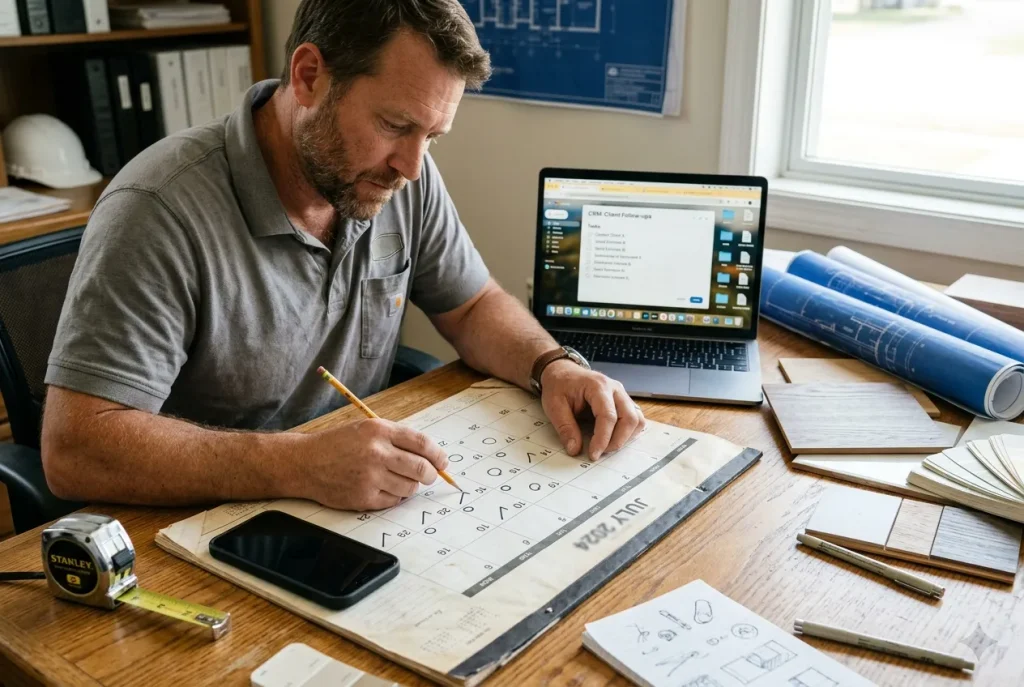
Call at 1 minute, 30 minutes, and 2 hours on day 1, then again on day 5, day 14, and day 15. That schedule produced an average 49% conversion gain from timing alone in the Velocify data. Here it is mapped to a remodeling sales process.
| Touch | Timing | Channel | What it is for |
|---|---|---|---|
| 1 | 0 to 1 minute | Call | Live conversation, book the site visit |
| 2 | 30 to 60 minutes | Call, then text if no answer | Second live attempt in the same hour |
| 3 | 1 to 2 hours | Text or email | Leave something they can act on |
| 4 | Day 5 | Call | Re-open after they have collected other bids |
| 5 | Day 14 | Call, email backup | Land inside the decision window |
| 6 | Day 15 | Call | Ask for a yes or a no and close the file |
Make 2 adjustments for remodeling, and I will mark these as my judgment rather than study findings. If the homeowner tells you on call 1 that they are gathering 3 estimates, move touches 5 and 6 to day 21 and day 30, because a remodeling decision does not land in 2 weeks. And on whole-home or addition work, add a 7th touch at day 45, because design-heavy jobs stall on spouse approval more often than on anything in your proposal.
On email, Velocify found a hard ceiling. Prospects who received more than 5 emails in the first month converted 36% lower than prospects who received 1 to 5. Phone and email run together improved conversion 128% over phone alone. So: 6 calls, 5 emails maximum, and never a 6th email.
The timing research gives you one more edge most remodelers ignore. The 2007 data found 4pm to 6pm was the best window for reaching a lead, 114% better than the worst hour of the day, and Wednesday and Thursday were the strongest days of the week. Offer those slots first when you book.
Scripts for Each Touch
Scripts are not word-for-word cages. They are the 3 questions you must not forget while you are standing in a driveway with drywall dust on your phone.
Touch 1: The 60-Second First Call
“Hi [name], this is [your name] with [company]. You just asked about a [kitchen] remodel on our site. I have 2 minutes right now, is this a good time?”
Then 3 questions, in this order:
- What is the project, and what room are we talking about?
- Are you looking to start in the next 90 days, or is this further out?
- Who else is weighing in on this decision with you?
Then book it: “I can be out Thursday at 4 or Friday at 10. Which is easier?”
Question 3 is the one most remodelers skip and the one that saves a wasted site visit. Do not try to sell on this call. Do not send a brochure. Book the visit.
Touch 2: The Missed-Call Text
“[Name], [your name] from [company]. Tried you just now about the [bathroom] project. I am on a job site until 4, but I can call you back after that, or text me the 2 or 3 things you want done and I will come back to you tonight.”
This works because it gives the homeowner an action that does not require them to be free when you are. A text-back that only says “sorry we missed you” moves nothing.
Touch 3: The Written Recap
Send one message 1 to 2 hours later with 3 things in it: a short recap of what they told you so they know you listened, 2 photos of a comparable project you finished, and a booking link. That is the whole message. Remodeling homeowners are deciding whether you are organized before they decide anything else, and a same-afternoon recap answers that question faster than anything you could say about yourself.
What Do You Send a Homeowner Who Went Quiet After the Estimate?
This is touch 4 and touch 5, and it is the call almost nobody makes.
“[Name], you have our proposal on the [kitchen] at [street]. I am not calling to re-pitch it. I am calling because most people who go quiet are stuck on 1 of 3 things: the scope, the timeline, or something a different contractor told them. Which one is it?”
Naming the 3 reasons gives them permission to say the awkward thing. In my experience running lead follow-up for remodelers, the answer is the timeline more often than anything else, and the timeline is the one you can fix on the phone.
Touch 6: The Close-the-File Call
“[Name], I am closing out my file on your [project]. If you went with someone else, no hard feelings, I would rather stop bothering you. If you are still deciding, say so and I will hold your [month] slot. Which is it?”
A no on day 15 is worth more than a maybe on day 60. It frees your calendar and it tells you which lead sources produce ghosts.
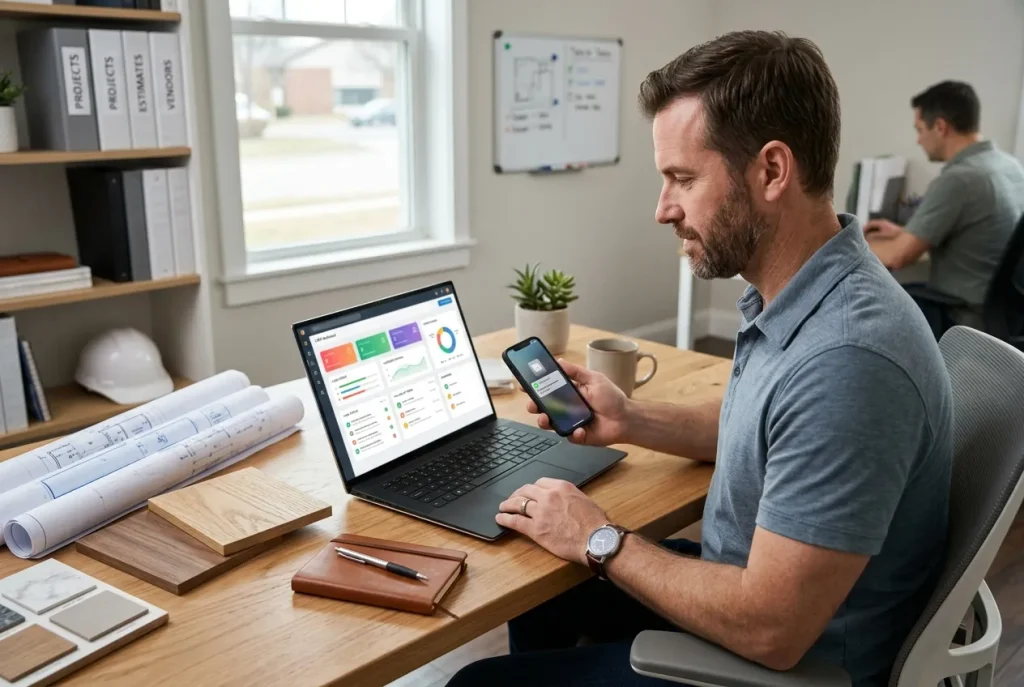
What Should a Remodeler Automate, and What Should Stay Human?
Automate the timestamp and the reminder. Never automate the conversation.
Automate these 4:
- The alert. Every lead source lands in one place and your phone buzzes inside 5 seconds. Form fills, Angi, Google Business Profile messages, your own website contact forms, all in the same feed.
- The missed-call text-back. Fires in under 60 seconds, every time, including 9pm on a Sunday.
- The 6 touches as dated CRM tasks. This is the whole point of the article. Touch 5 on day 14 only happens if something put it on a list 14 days earlier. We build this in GoHighLevel so every source funnels into a single dashboard and every touch has an owner and a due date.
- The review request after job completion. The follow-up sequence does not end at the signature. An SMS request that fires automatically when a job closes takes the remodelers we work with from 0 or 1 new Google review a month to 4 to 6.
That last one is worth sitting with, because it is the same principle applied to the other end of the job. One Colorado whole-home remodeler had been referral-only for 12 years with no review history at all. We pointed automated requests at his past clients and he gathered 28 reviews in 60 days, which is roughly a decade of passive review collection compressed into 2 months. Nothing about that required him to remember anything.
Results vary by market, competition, and client engagement. Past performance does not guarantee identical future results.
Keep these human: the first live call, the estimate walkthrough, and the “why did you go quiet” call. A homeowner choosing between 3 bids on a whole-kitchen job is reading tone, not information.
On AI receptionists: they are a real answer when the alternative is voicemail, and answering in 4 seconds at 10pm beats losing the call. But an AI receptionist covers touch 1. It does not make the day 14 call, which is where Velocify’s data puts a large share of the conversions. Buying one and calling your follow-up solved is the mistake.
How Do You Measure Remodeling Lead Follow-Up in 2026?
Count attempts, not minutes. Minutes tell you about touch 1. Attempts tell you whether the other 5 happened.
| Metric | Target | You are losing at |
|---|---|---|
| Attempts per lead before you stop | 6 | 2 |
| Touch 1 on an inbound call | Answered live | Voicemail |
| Touch 1 on a web form | Under 5 minutes | Over 1 hour |
| Missed-call text-back | Under 60 seconds | No text at all |
| Day 14 touch completion | Above 80% of open leads | Under 30% |
| Emails sent in month 1 | 5 maximum | 6 or more |
The day 14 row is the one nobody tracks and the one that decides how many jobs you win. Most remodelers cannot tell you what share of their open leads got a day 14 call, because nothing in their system asks the question.
Report 3 numbers monthly: average attempts per lead before first contact, the share of leads that received all 6 touches, and the share of leads closed out with a real yes or no rather than left open. If you want the broader audit underneath this, our 20-item remodeling site checklist covers the technical side of the same problem, and the volume side is covered in our guide to getting more remodeling leads.
Worth knowing what market you are measuring inside of. Harvard’s Joint Center for Housing Studies, in its May 2026 Leading Indicator of Remodeling Activity, projects year-over-year growth in homeowner improvement spending slowing to 0.5% by early 2027. In a flat market, extra jobs come from conversion rather than from more homeowners deciding to remodel. The day 14 call is worth more this year than it was last year.
Where the Jobs Actually Go
The research has been sitting in public since 2013. Ninety-three percent of the jobs you win are reached by the 6th attempt. Eighty-one percent of sellers quit at 5 or fewer.
That is not a gap in knowledge. It is a gap in systems. Nobody forgets to call a lead back because they do not care. They forget because it is day 14, they are on a roof, and nothing on their phone told them to.
Build the cadence into your CRM once and remodeling lead follow-up stops depending on your memory. Then the only question left is how many good leads are arriving to run it on, which is where the leads come from rather than what you do after. That is the work we do, one remodeler per city. Check whether yours is still open.
Frequently Asked Questions
What is a good remodeling lead follow-up cadence?
Six attempts over 15 days: 1 minute, 30 minutes, 2 hours, day 5, day 14, and day 15. That schedule comes from Velocify’s study of 3.5 million leads and produced an average 49% conversion gain from timing alone. Stretch touches 5 and 6 to day 21 and day 30 if the homeowner told you they are collecting 3 estimates.
How many times should you follow up with a remodeling lead?
Six. Velocify found 93% of converted leads were reached by the 6th call, and leads requiring 7 or more calls were 45% less likely to convert. InsideSales.com’s 2021 data found 81% of sellers stop at 5 or fewer, so running all 6 puts you past almost everyone you compete with.
How many remodeling lead follow-up emails are too many?
More than 5 in the first month. Velocify found prospects who received more than 5 emails converted 36% lower than prospects who received 1 to 5. Phone and email run together improved conversion 128% over phone alone, so pair them rather than choosing between them.
Is the “78% of customers buy from the first business that responds” statistic real?
No source we could find supports it. The claim is attributed to a “Lead Connect survey” that has no published methodology or original report, and every citation path ends at one blog quoting another. Use the Harvard Business Review finding instead: reaching a lead within 1 hour makes you about 7 times more likely to qualify it than reaching them an hour later.
What do you say when a homeowner goes quiet after the estimate?
Name the reasons for them. “Most people who go quiet are stuck on 1 of 3 things: the scope, the timeline, or something a different contractor told them. Which one is it?” Giving them 3 options to pick from is easier to answer than an open question, and it turns a dead lead into information you can act on.
What follow-up should a remodeler automate?
The alert on a new lead, the missed-call text-back, the 6 touches as dated CRM tasks, and the review request after a job closes. Keep the first live call, the estimate walkthrough, and the quiet-lead call human. Automation exists to make sure the day 14 touch happens, not to have the conversation for you.
How many jobs does stopping at 2 attempts lose you?
Run your own numbers rather than borrowing a vendor’s. Count your monthly leads, the share that never received a 3rd contact attempt, and your close rate on the ones you did reach. Velocify’s data says 93% of the leads you would have won are reachable by attempt 6, so every lead abandoned at attempt 2 sits inside that gap.