

Facebook ads for remodelers work when the offer does the qualifying. Most remodeling ads ask for a free consultation. That asks nothing of the homeowner, which is exactly why your calendar fills with people who wanted a ballpark number and a nice chat. Replace it with an offer that asks for something before the appointment: a scope tier they have to pick, every decision maker in the room, a build slot with a real date, or a named problem in their own house. You’ll get fewer leads. You’ll get more consultations that turn into contracts. Below are the 4 offers, the Meta settings that hold the qualification in place, and the 2 numbers worth tracking instead of lead count.
What Facebook Ads for Remodelers Actually Do
They create demand. They don’t capture it.
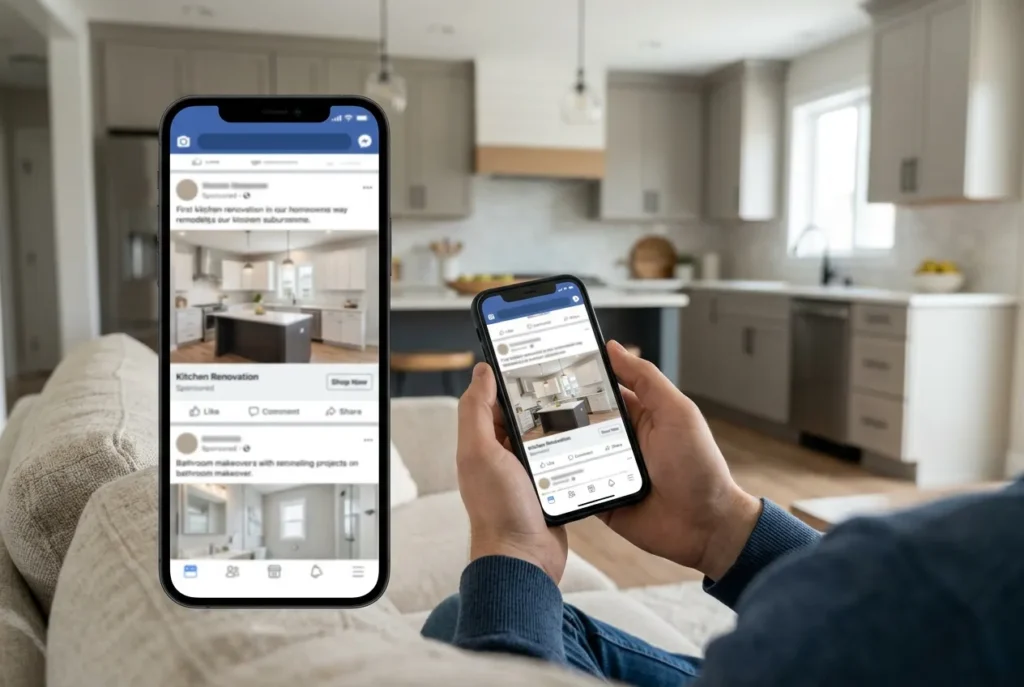
Facebook ads for remodelers are paid Meta campaigns, running across Facebook and Instagram, that put a remodeling company’s offer in front of local homeowners who aren’t searching yet. On Google the homeowner types the need first. On Meta you interrupt someone mid-scroll, so the offer has to create the need and sort the buyer at the same time.
The reach is there. Pew Research Center’s survey of 5,022 US adults, fielded February 5 to June 18, 2025, found that 71% of US adults use Facebook and 50% use Instagram. Facebook use peaks among 30 to 49 year olds at 80%, which is the same band that owns the house, has the equity, and is 6 months into arguing about the kitchen.
Reach isn’t the problem. Sorting is. That’s the split worth holding onto: Meta creates the demand, and paid search for remodelers catches it after the homeowner starts shopping. Judge them on the same scorecard and you’ll kill the wrong campaign.
Why Does a Free Consultation Attract the Wrong Homeowner?
Because it asks for nothing, so it sorts for curiosity instead of commitment.
A free consultation asks the homeowner for one thing: a form fill. It doesn’t ask whether they can fund the project, whether they have a date, or whether anything in the house is actually broken. So all three groups land in the same inbox, and your estimator burns 6 hours a week driving to people who wanted a number.
The market pressure to keep doing it is real. NAHB’s Remodeling Market Index for the second quarter of 2026, released July 9, put current conditions at 70 while the future indicators index sat at 52, with the leads and inquiries component at 51 and project backlog at 54. Current work is healthy. Future inquiry flow is barely above the break-even line of 50. When inquiry counts look soft, the reflex is to buy more of them. Harvard’s Joint Center for Housing Studies sees the same cooling from the spending side, projecting year-over-year growth in owner improvement and repair easing to 0.5% by the second quarter of 2027.
Here’s what the volume reflex costs you. Across our client base, 22% to 31% of leads from shared platforms become a booked estimate. Leads from organic search, for the same companies, book at 73%. Same trucks, same crews, same sales guy. The difference is what the homeowner did before the phone rang.
Cost per lead is the wrong number to manage. A pile of leads booking at 8% loses to a short list booking at 60%, and nearly every account we open has been tuned toward the pile for years.

The 4 Offers That Book Consultations Worth Driving To
Each one asks the homeowner to give something up before you give up a truck roll.
| Offer | What the homeowner commits | What it screens out | Where it breaks |
|---|---|---|---|
| The Scope Commitment Call | Picks a defined scope tier before booking | Anyone planning a smaller job than you build | You have to publish the disqualifying sentence |
| The Everyone-in-the-Room Plan Session | Gets every decision maker in one room for 90 minutes | Solo browsers with no buy-in at home | Only holds if you reschedule when someone’s missing |
| The Dated Build Slot | Picks a specific start window | Anyone without a timeline | The scarcity has to be true |
| The One-Problem Teardown | Names a defect in their own house | Browsers and trend shoppers | Needs a shared flaw in the local housing stock |

1. The Scope Commitment Call
Name the scope tiers you actually build and make the homeowner pick one before booking. “We do full gut kitchens and structural reconfigurations. If you’re planning a cabinet refresh, we’re not your crew. If you’re planning a gut, book 20 minutes.” The homeowner planning a refresh scrolls past, which is the entire point, and the one who books has already agreed to the size of the job.
Most remodelers won’t write the disqualifying sentence, because turning work away feels backwards. You’re not turning away work. You’re turning away appointments for work that was never coming.
2. The Everyone-in-the-Room Plan Session
Ask for something harder than a form fill: every decision maker present, in the house, for a 90-minute session that ends with a measured plan and a material list the homeowner keeps. Coordinating a spouse’s Saturday is a real filter, and it does more sorting than any qualifying question you’ll ask over the phone. It also resets the meeting. You arrive with a deliverable instead of a clipboard.
This one only has teeth if you honor it. If the spouse isn’t there, reschedule. Running the session anyway teaches your market that the condition was decorative.
3. The Dated Build Slot
“We have 3 kitchen starts left for [month]. Pick one.” The offer is a date, so it screens for homeowners who have a date. People planning around a graduation, a baby, a listing, or in-laws arriving in April will book. People who’ve been pinning tile for 2 years won’t, and that’s fine.
The scarcity has to be real. If you say 3 slots, book 3 and pull the ad down. Running the same “3 slots left” creative for 5 straight months trains your market to ignore you.
4. The One-Problem Teardown
Pick one failure mode in your local housing stock and build the whole ad around it. Cast iron drain stacks in pre-1975 homes. Aluminum branch wiring in mid-1970s subdivisions. Slab-on-grade bathrooms with no vapor barrier. The offer is a diagnostic visit for that one problem, not a remodel.
This is the hardest offer to copy and the easiest to write, because it comes out of work you’ve already done. It carries a proof burden, though: your gallery has to show that exact repair, in that exact housing stock, or the ad writes a check the site can’t cash.

How Do You Qualify Inside the Ad Instead of on the Phone?
Build the qualification into the instant form, then let the homeowner book the slot themselves.
Meta’s Marketing API documentation for lead forms covers more than most remodelers use. Forms support custom text questions, drop-downs with options you define, conditional questions that change based on a previous answer, a store-locator question keyed to ZIP, and an appointment-scheduling question with a date-time picker. That last one matters most here. The homeowner picks the time inside the ad, before anyone at your office has seen the lead.
A workable form for a remodeling offer runs 4 questions: project type, scope tier with your smallest accepted job as the lowest option, timeline, and the appointment picker. Name, phone, and email auto-fill. The homeowner spends about 25 seconds and lands on your calendar pre-sorted.
Use a landing page instead when the offer needs proof to make sense: project galleries, scope tier definitions, financing terms, a named project on a street the homeowner recognizes. Use the instant form when the offer is one clean decision. The organic side carries weight here too, because a homeowner who taps your profile and finds 4 posts from 2023 makes the ad work twice as hard, which is why steady posting for remodelers sits alongside the ad account rather than replacing it.
The Financing Offer That Quietly Breaks Your Targeting
Promote financing in the ad and you hand away ZIP-level targeting.
Since January 14, 2025, US advertisers running financial products and services campaigns have to declare that special ad category in Meta. The restrictions match the ones housing and employment advertisers live with: age is fixed at 18 through 65+, gender can’t be selected, ZIP codes aren’t supported as a location type, location exclusions are blocked, detailed-targeting exclusions are unavailable, and location radius carries a 15-mile minimum in the US and Canada. Meta’s own documentation adds that human reviewers and machine learning look for ads that should have declared a category, and that sending the wrong one risks having campaigns paused.
The lockdown traces back to the Justice Department’s 2022 settlement with Meta over discriminatory housing ad delivery, which removed the Special Ad Audience tool and barred targeting options tied to protected characteristics. The intent was fair housing. The side effect lands on any contractor whose ad mentions a payment plan.
Do the math on a 15-mile radius. If you work a 6-mile band on one side of a metro, you’re now paying to reach roughly 6 times the area you serve, and you can’t carve out the half that isn’t yours. Keep the financing out of the ad. Put it on the landing page, after the click, where it belongs.

How Should a Remodeler Set a Meta Ads Budget in 2026?
Work back from your close rate, not forward from a daily number.
Start with the share of consultations that turn into signed contracts, then apply the gross margin on a typical job. That tells you what one booked consultation is worth to the business. Decide what fraction of it you’ll give up to get one, and the daily budget falls out of that instead of out of a blog post. A remodeler closing 1 in 3 consultations on large projects can pay far more per booking than one closing 1 in 10 on small ones, which is why any single recommended daily number is useless to you.
There’s a hard platform constraint almost nobody mentions. Meta’s conversion leads integration, the setting that teaches Meta to chase leads that actually close, requires at least 200 leads per month, a CRM upload at least once a day, the lead stage you’re targeting occurring within 28 days, and a conversion rate between 1% and 40%. It also needs a 2 to 4 week learning window before the performance shows up.
Most remodeling companies will never see 200 Meta leads in a month, and shouldn’t want to. So the setting that would sort lead quality for you is closed off, and the sorting has to happen in the offer and the form instead. Every section above exists because of that constraint.

Callback Speed on a Meta Lead
Call inside 5 minutes. Not hours, and never the next morning.
A Google lead went looking for you. A Meta lead was watching a video about a dog and then filled out your form, which took about 25 seconds because the fields auto-filled. Intent that arrives that fast decays that fast. In our experience the same lead answered at minute 4 and at hour 4 behaves like two different people.
If you can’t staff a phone that rings inside 5 minutes, the appointment-scheduling question solves it for you: the homeowner picks a slot, gets a confirmation, and no human has to be fast. We run lead routing and follow-up texts through GoHighLevel so the first message goes out before the homeowner has closed the app. The rest is unglamorous. Someone has to answer.
Are Facebook Leads Worse Than Google Leads for Remodelers?
They’re earlier, which looks like worse if you measure them the same way.
A homeowner searching “bathroom remodeler near me” has already decided to hire someone. A homeowner who saw your ad decided nothing. Expect a longer gap between form fill and signed contract, and expect a higher share of first conversations to end in “not yet.”
For most established remodeling companies, Google still comes first and Meta second. Search captures the demand that already exists, which is why ranking for your service pages does the heavy lifting on booked work. Meta fills the top of the pipeline in the quarters when search volume dips, and remodeling searches drop 20% to 30% from November through January in most markets we track. Running Meta through that window keeps the calendar from going quiet in February.
Anyone selling you paid social as a replacement for search in this industry is selling you a bigger retainer.

What Happened When One Client Cut Lead Volume on Purpose
A Pacific Northwest kitchen remodeler building high-end projects was drowning in the wrong inquiries. 70% of them were budget shoppers, because the website read like every entry-level kitchen company in the metro.
We repositioned the whole site around high-end markers: project galleries with material specs, content built around what a full custom kitchen actually includes, and designer partnership pages. Monthly leads fell from 15 to 11. Qualified leads went from 30% to 72% of the total. Close rate went from 12% to 34%. Monthly revenue from those leads grew more than 6 times over.
That was a website and positioning change, not a Meta campaign. The principle transfers exactly: the message is the filter, and a filter that costs you volume can pay for itself many times over. Convincing the owner took 3 months of data, because for the first 90 days all he could see was the lead count going down.
We’ve watched the same thing in paid accounts. On a mid-Atlantic bathroom remodeler’s Google Ads account, we paused 60% of the keywords after finding zero conversions on them across 6 months. Monthly spend dropped by 57%. Lead volume held. Nothing was lost with the money we cut, which is true of most paid accounts we open. It’s also why we work with one remodeler per city instead of 4 in the same metro.
The 30-Day Test to Run Before You Spend More
Run one variable at a time or you’ll learn nothing.
- Pick 1 offer from the 4 above. The one you can actually deliver next week.
- Pick 1 audience. A radius around your service area, homeowners, no interest stacking.
- Pick 1 creative format. Before and after stills beat polished video for cold traffic in most of the accounts we’ve run.
- Set the instant form to 4 questions, with your smallest accepted job as the lowest scope option.
- Run it a full 30 days at a daily budget you can hold without flinching, and track exactly 2 numbers: booked consultations, and consultations that produced a proposal.
- Kill it if a booked consultation clears the ceiling you set from your close rate. Keep it if more than half your booked consultations produce a proposal.
Don’t touch the offer, the audience, and the creative in the same week. Change one, wait 7 days, look again. The same discipline applies to the rest of the site, and the remodeling SEO checklist covers the technical side of it.
Facebook ads for remodelers aren’t a lead problem. They’re an offer problem wearing a lead problem’s clothes. Fix what you ask for and the calendar sorts itself out. If you’d rather have that built and managed by a partner that only works with remodelers, that’s what we do, one company per city.
Results vary by market, competition, and client engagement. Past performance does not guarantee identical future results.
Frequently Asked Questions
Do Facebook ads for remodelers actually work?
They work for creating demand, not capturing it. A homeowner on Meta hasn’t decided to hire anyone, so the offer has to do the sorting a search query does on Google. Remodelers running a free consultation offer usually see high lead counts and low booking rates; across our client base, leads that arrive without prior intent book at 22% to 31% while search leads book at 73%.
What is the best offer for a remodeling Facebook ad?
The one that asks the homeowner to commit something before the appointment. A defined scope tier they have to pick, every decision maker in the room for a plan session, a dated build slot, or a diagnostic visit for a specific defect in their house. Each one removes a group you didn’t want on the calendar.
Should remodelers use Meta lead forms or a landing page?
Use an instant form when the offer is one clean decision, because auto-filled fields let a homeowner submit in about 25 seconds. Use a landing page when the offer needs proof first: project galleries, scope tier definitions, or financing terms. Meta’s lead forms support drop-downs, conditional questions and an appointment picker, so qualification can live inside the form either way.
Do remodeling ads fall under a Meta special ad category?
A standard remodeling ad doesn’t, but one promoting financing does. Since January 14, 2025, US advertisers running financial products and services campaigns must declare that category, which fixes age at 18 through 65+, removes ZIP targeting and gender selection, blocks exclusions, and forces a 15-mile minimum radius. Keep financing out of the ad and on the landing page.
How should a remodeler set a Facebook ads budget?
Work backward from value, not forward from a daily number. Your consultation-to-contract close rate and the gross margin on a typical job tell you what one booked consultation is worth; the share of that you’re willing to give up sets your ceiling. Meta’s conversion leads setting needs 200 leads a month, which most remodelers will never hit, so budget for qualification in the offer rather than for volume.
How fast do you have to call a Facebook lead?
Inside 5 minutes. The form fills in seconds and the homeowner wasn’t shopping, so the intent decays faster than a search lead’s. If you can’t staff that, use the appointment-scheduling question in the instant form and let the homeowner pick the slot themselves.
Are Instagram ads worth running alongside Facebook for remodelers?
Yes, as the same campaign rather than a separate effort. Pew Research Center found 50% of US adults use Instagram against 71% on Facebook, and the placements share one ad account, so adding Instagram costs creative sizing, not budget. Judge them together on booked consultations.