
Most remodeling companies build their pipeline the same way: work word of mouth until it slows down, then rent leads from Angi or HomeAdvisor to fill the gap. That second step is where the math falls apart. Across 87 remodeling SEO campaigns managed since 2019, organic search leads convert to booked estimates at 73%. Shared platform leads convert at 22% to 31%, because the homeowner on the other end already sent the same request to four or five other contractors. If you want more leads for your remodeling company in 2026, the fix isn’t one more channel. It’s building a mix where your own website and your own reviews do the work Angi currently does, at a fraction of the cost per booked job.
Remodeling lead generation is the mix of channels, referrals, local search, reviews, and paid ads, a remodeling company uses to keep its pipeline full once word of mouth alone can’t carry the workload. It splits into channels you own (your website, your Google Business Profile) and channels you rent (lead platforms, ads), and the second group stops producing the moment you stop paying.
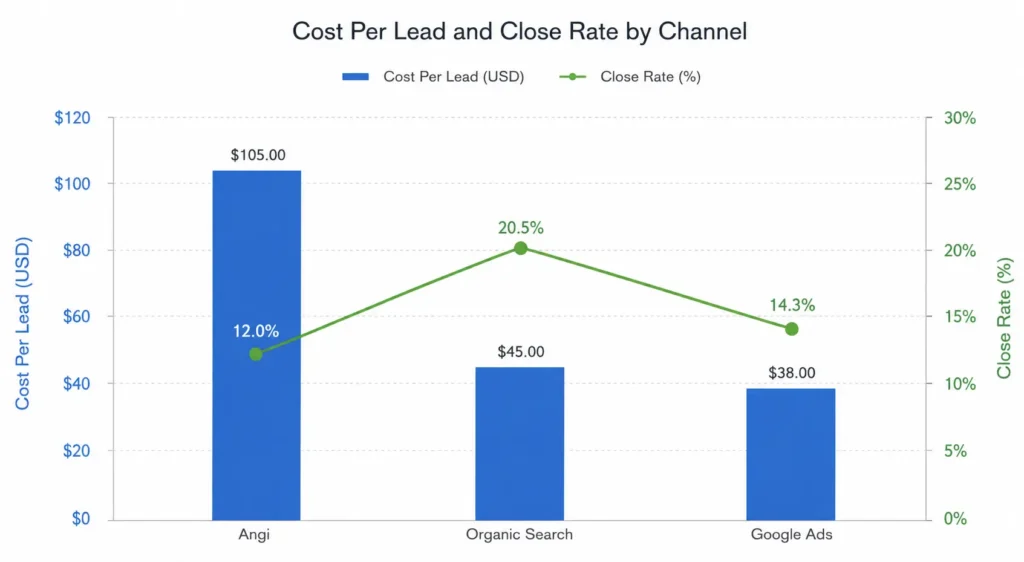
Organic leads book estimates at more than double the rate of shared platform leads
Organic search leads convert to booked estimates at 73%, more than double the 22% to 31% rate reported for shared platform leads. That’s not a one-off number. It’s the average across Eclipse Remodeling’s client base as of this year, across markets from Denver to the Dallas suburbs.
HomeAdvisor and Angi leads convert lower because they aren’t really leads, they’re auctions. A homeowner fills out one form and four contractors call the same afternoon. Whoever answers first, prices lowest, or sounds most confident wins the estimate, and the other three paid for nothing.
Cost per lead tells the same story from a different angle. Clients report paying $87 to $142 per Angi or HomeAdvisor lead. Organic leads take real investment to build, an SEO program typically runs $3,500 to $5,000 a month depending on how competitive the metro is, but once a page ranks, each additional lead from it costs close to nothing. One New Jersey bathroom remodeler put it plainly: “I was paying $150 per lead on Angi and sharing it with 5 other guys. Now homeowners find me on Google and call me directly. I have not opened Angi in 4 months.”
| Channel | Typical cost per lead | Leads that book an estimate | Real cost per booked estimate |
|---|---|---|---|
| Angi or HomeAdvisor | $87 to $142 | 22% to 31% | $280 to $645 |
| Organic search (after month 6) | Near $0 marginal | 73% | Near $0 |
| Google Ads | Varies by market and competition | Varies | Best treated as a bridge, not priced predictably |
Figures reflect Eclipse’s aggregated, client-reported data across 87 remodeling SEO campaigns. Results vary by market, competition, and client engagement; past performance does not guarantee identical future results.
Match your channel mix to your project size, not just your budget
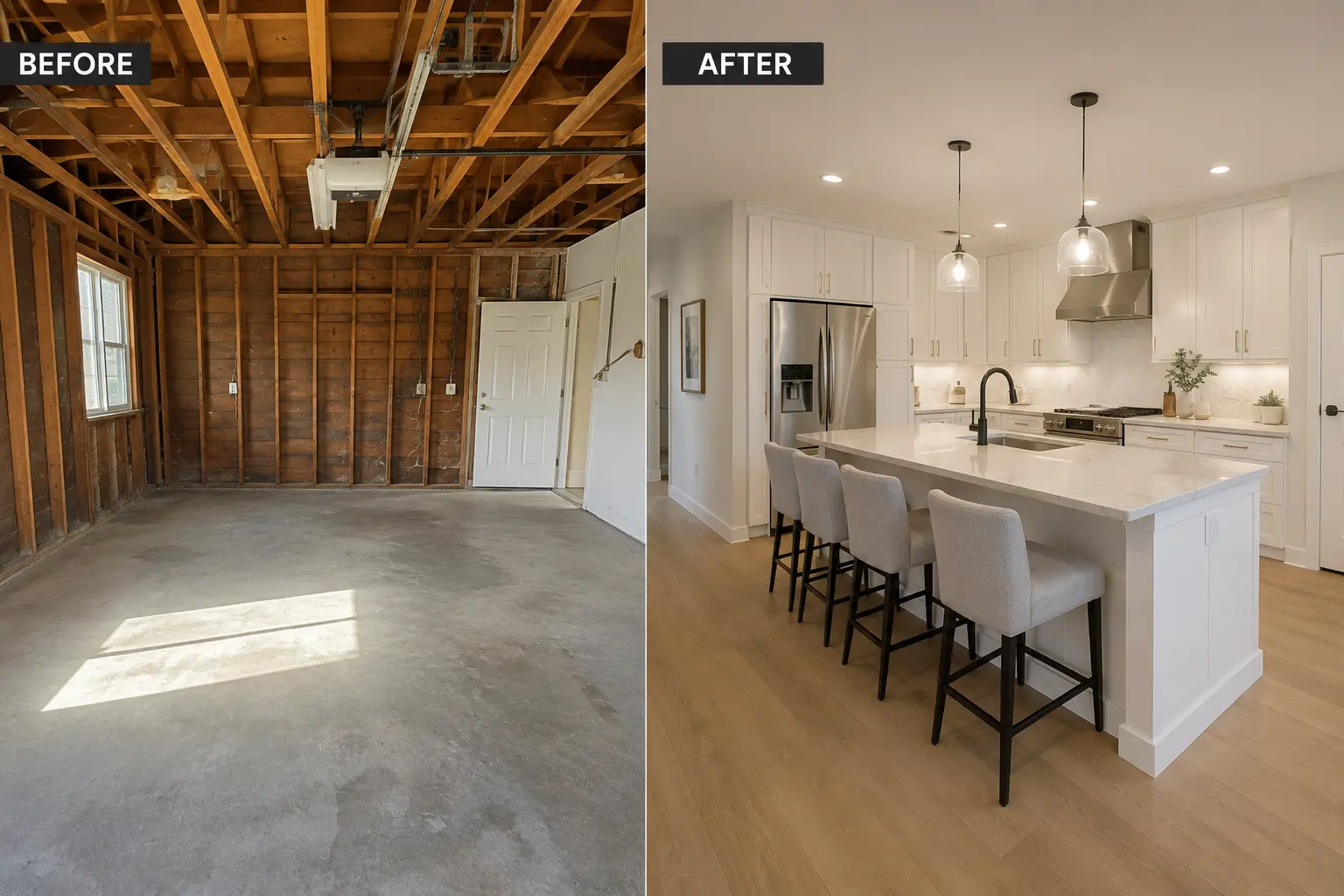
The right number of leads depends on your average project value, not a universal target. A garage conversion specialist in the Southeast built a keyword strategy around 142 long-tail terms specific to garage-to-ADU conversions. Lead volume stayed modest, 8 to 10 a month, but close rate hit 45% because every lead already wanted exactly that service. Average project value ran $62,000.
Compare that to a Pacific Northwest kitchen remodeler working $75,000 to $150,000 projects who was getting attention, just the wrong kind: 70% of inquiries were budget shoppers looking at the same generic site every $20,000 kitchen remodeler runs. After rebuilding around price-specific proof (real project costs, a “what to expect from a $100,000 kitchen remodel” guide), lead volume dropped from 15 to 11 a month on purpose. Qualified-lead share jumped from 30% to 72%, and close rate went from 12% to 34%.
Neither company needed a dozen lead sources running at once. Both needed the two or three channels that matched what they actually sell, and both needed to stop chasing volume when the real problem was fit.
Which channels actually produce remodeling leads?
Four channels do most of the work: Google Business Profile paired with reviews, referrals run as a system, tightly targeted local SEO content, and paid ads used as a bridge rather than a destination.
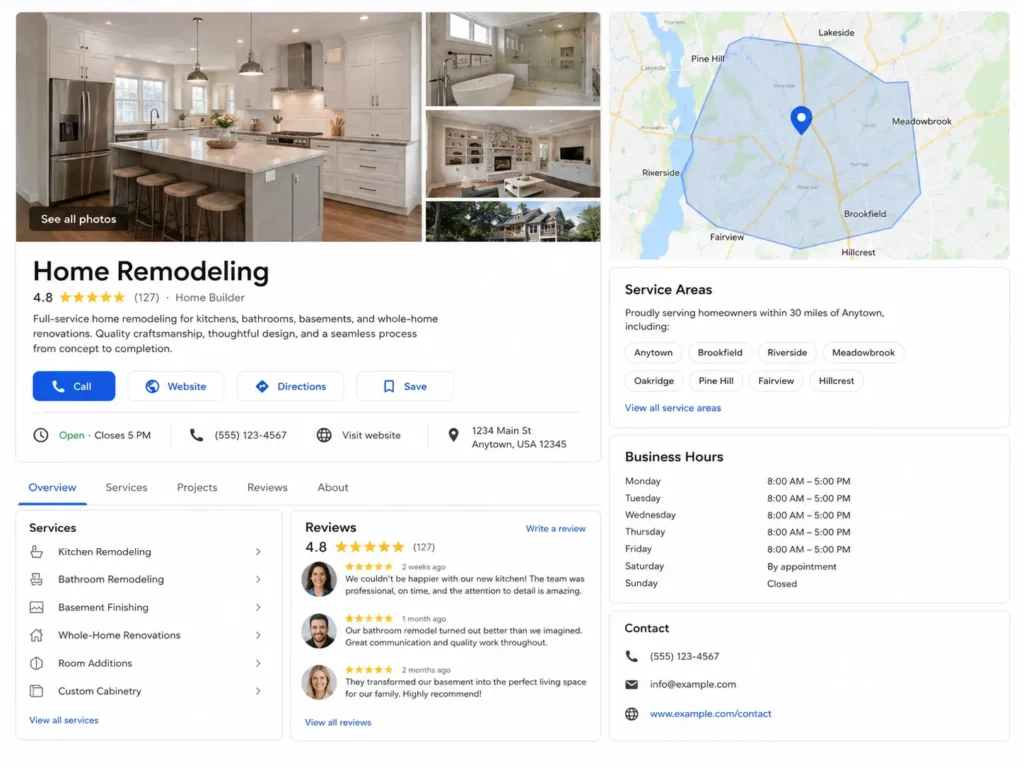
Your Google Business Profile still does the most for the least money. Across new-client audits, getting the primary category, photos, and Q&A right lifts Map Pack impressions by 340% in the first 90 days, on average. Pick a specific primary category (“kitchen remodeler,” not “general contractor”) and keep general contractor as a secondary. Reviews run on the same system: in BrightLocal’s 2026 Local Consumer Review Survey, 41% of consumers say they always read reviews before choosing a local business, up from 29% the year before, and 74% check at least two review sites before deciding. A remodeler with 12 reviews after eight years in business is invisible next to a competitor with 90, regardless of who does the better work.
Referrals still convert best of all, but only as a system, not a hope. Track who refers you, and reward it. One general contractor in Utah built a referral program that now delivers 8 to 10 referred leads a month closing at 65%, against 20% for cold leads, for about $1,600 a month in gift cards against roughly $90,000 in new contracts. That math holds at almost any project size.
Local SEO content works, but only when it’s specific. City-and-service pages (“kitchen remodel cost in [city]”) outrank one generic service-area page, and a site with 30 to 40 tightly targeted pages, each carrying proper schema markup, routinely out-produces one with 200 blog posts. The buyer isn’t reading 15 articles before calling. They’re searching, checking the map pack, and calling. A handful of local backlinks from a chamber of commerce or a sponsored little league team move rankings more than dozens of directory listings, and keeping your name, address, and phone number identical across every listing still trips up new clients more than almost anything else.
Paid ads deserve a narrower role: filling the gap while organic rankings build, not replacing them. Set up conversion tracking so you’re measuring cost per booked job, not cost per click, and expect to keep spending indefinitely, because the moment the budget stops, so do the leads. Organic is the only channel here you still own after you stop paying for it.
Your 2026 remodeling lead checklist, sorted by budget
Start free, add paid channels only once you’re tracking what they actually produce.
If you’re not spending anything yet, start with your Google Business Profile and a referral ask at every final walkthrough. Both are free, and both compound fastest.
If you have $500 to $2,000 a month to test, put it into review generation and a small retargeting budget aimed at people who already visited your site. It’s the cheapest way to close the gap between “they found me” and “they called.”
If you’re already spending $3,000 or more a month, probably on Angi, HomeAdvisor, or Google Ads, that’s the signal to shift some of it toward channels you own: rebuilt service pages, a real review system, and tracking that shows your actual cost per booked job by source, not just cost per lead. The NAHB/Westlake Royal Remodeling Market Index for the first quarter of 2026 put its sub-index for incoming leads and inquiries at 53, the weakest of its components even while the overall remodeling market stayed solidly positive at 62. Demand isn’t the problem for most remodelers right now. Capturing it is.
How long does it actually take to get leads from SEO?
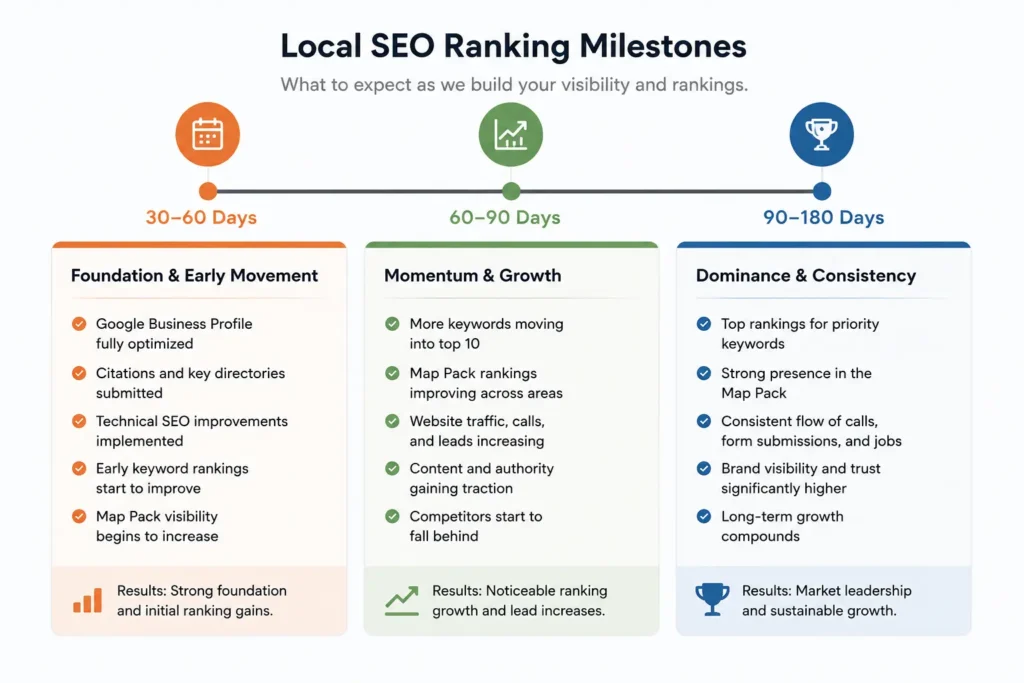
Not 12 months. That’s the timeline agencies give themselves to bill you for a year before anyone checks their work. Measurable ranking movement, keywords entering the top 50, typically shows up in 30 to 60 days. First page-one rankings for lower-competition, long-tail terms land in 60 to 90 days. Map Pack entry for your primary city keyword takes 90 to 180 days depending on review count and competition, averaging 4.2 months in a mid-competition metro and 6.8 months in a top-25 metro like Los Angeles or Dallas. First organic leads typically show up by month 3 or 4, and 78% of clients reach the Map Pack within 6 months.
The 12-month number is only true if success means ranking first for the single hardest keyword in a top-10 metro. For the long-tail searches that actually generate a phone call, “bathroom remodeler in [neighborhood]” instead of just “bathroom remodeler,” that’s not how long it takes.
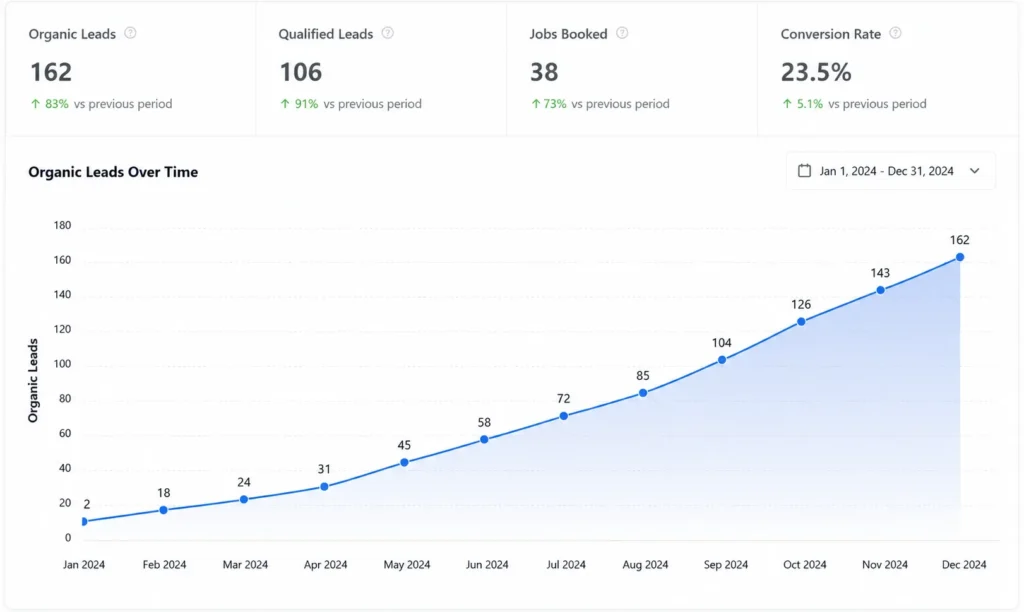
What changes when you stop renting your leads
Pipeline stops depending on whoever else bought the same lead you did. A Dallas-area kitchen and bath remodeler came in spending $6,200 a month on Angi and $3,800 a month on Google Ads, closing 1 in 10 leads, most shared with four or more other contractors. Seven months later they ranked second in Maps and organic for their primary city keyword. Organic leads went from 3 to 4 a month to 22 to 27. They cancelled Angi and paused Google Ads, cutting $10,000 a month in spend while pipeline grew from a $1.2 million to a $2.1 million annual run rate.
That’s not a guarantee. Results depend on market, competition, and how much gets invested in fixing what’s broken first. But it’s the real difference between renting leads for your remodeling company every month and owning the channel that produces them. If you want a straight answer on where you stand, book a strategy call and find out directly.
FAQs
How can a remodeling company get more leads without spending more on ads?
Start with what’s free: a complete Google Business Profile and a referral ask at every final walkthrough. Filling out the GBP category, photos, and Q&A in full lifts Map Pack impressions by 340% in the first 90 days on average, and referrals already produce 40% to 50% of new business for contractors who ask every time. Neither requires a media budget, only time.
Is SEO or paid ads better for generating remodeling leads?
They solve different problems. Paid ads produce leads within days but at an unpredictable cost per click that swings with local competition, while organic search leads convert to booked estimates at 73% versus 22% to 31% for shared lead platforms, and cost close to nothing once a page ranks. Most remodeling companies do best running paid ads as a bridge while SEO builds, then scaling ads back once organic leads carry more of the pipeline.
How long does it take to get remodeling leads from SEO?
Measurable ranking movement typically shows up in 30 to 60 days, with first organic leads by month 3 or 4 in most markets. Map Pack entry for a primary city keyword averages 4.2 months in a mid-competition metro and 6.8 months in a top-25 metro, and 78% of clients reach the Map Pack within 6 months.
Are Angi and HomeAdvisor worth it for remodeling companies?
It depends on whether the math works on cost per booked job, not just cost per lead. Clients report paying $87 to $142 per lead on these platforms with close rates of 22% to 31%, since the same request typically goes to four or five contractors at once. If that math still works against your margins and average project value, they can fill gaps; if it doesn’t, the spend is usually better redirected to owned channels.
What’s a good close rate for remodeling leads?
There’s no single number, since it depends heavily on lead source and project size, but in Eclipse’s client base 73% of organic search leads book an estimate on average, versus 22% to 31% for paid lead platforms. If a channel’s close rate falls well below its category average, lead quality, not the sales process, is usually the first thing to check.
How many leads should a remodeling company expect per month?
Fewer, better-fit leads usually beat more, generic ones. Eclipse’s remodeling clients generally move from 3 to 5 organic leads a month to 18 to 24 within about 8 months, but one high-end kitchen remodeler intentionally cut volume from 15 to 11 a month and grew revenue by raising its qualified-lead share from 30% to 72%.