

A good Cost-Per-Click (CPC) for Google Ads varies significantly by industry, with legal services averaging $6.75 per click while travel costs only $1.09 per click. The overall average CPC across all industries is $2.69 for search ads and $0.63 for display ads, according to WordStream benchmarks. Your ideal CPC depends on five key factors: business competition levels, keyword relevance, advertisement quality, target location, and audience selection.
Industries like legal services, consumer services, and finance see higher CPCs due to intense competition and high customer lifetime value. Lower CPC sectors include advocacy ($1.72), nonprofit ($1.10), and real estate ($1.81). Geographic location significantly impacts costs, with New York City averaging $5 CPC compared to $2 in smaller towns. To optimize your CPC, focus on improving Quality Score through relevant ad copy, use negative keywords to eliminate wasted spend, and adjust bids based on device and location performance data. Regular monitoring and strategic bid adjustments help maintain competitive CPCs while maximizing return on investment. For comprehensive digital marketing support, partnering with experienced professionals can accelerate your success.
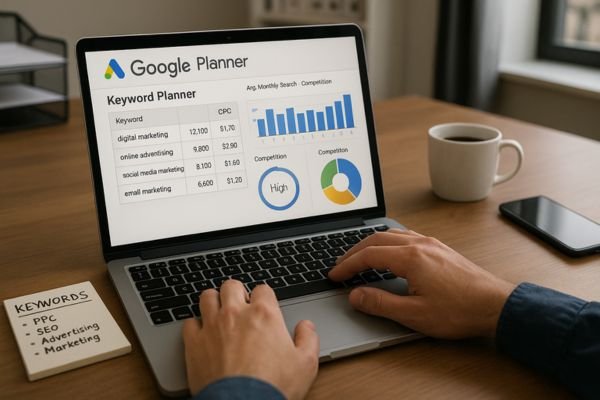
What Affects Your Cost Per Click in Google Ads
Main Elements That Impact Your CPC
Multiple factors can change the Cost Per Click (CPC) of your Google Ads campaigns:
- Business competition levels: Industries with fierce competition, like legal services or insurance, often see higher CPCs. Semrush’s research shows that average CPC for legal services is $6.75, while the travel industry pays only $1.09. More businesses competing for prime ad positions drives costs upward. This competition creates bidding wars that benefit Google but challenge advertisers.
- Keyword matching: Selecting highly relevant keywords for your ads and landing pages improves your Quality Score. Google rewards relevance with reduced CPCs. For instance, a plumber bidding on “emergency plumbing services” may pay less per click than generic terms like “plumber” due to specific keyword relevance. Targeted keywords often convert better and cost less.
- Advertisement quality: Creating engaging ad copy and linking to optimized landing pages tied to your keywords boosts ad quality. Higher Quality Scores typically result in lower CPCs. If your ad achieves a Quality Score of 8, your CPC could be 50% lower than ads with Quality Score of 5. Quality improvements directly impact your advertising costs.
- Target location: CPC varies greatly based on geographic locations you’re targeting. Wealthy areas or cities with higher living costs typically have elevated CPCs. For example, targeting New York City may result in $5 CPC, while smaller towns might only cost $2. Location targeting requires careful budget consideration.
- Audience selection: Using specific audience targeting options, like remarketing lists or in-market audiences, influences CPC due to increased competition for valuable segments. Remarketing to past website visitors may cost $3 per click compared to $1 for broader, non-targeted ads. Precise targeting often justifies higher costs through better conversion rates.
Business Examples and CPC Differences
Let’s examine scenarios showing how industry and geographic location impact CPC:
A criminal defense lawyer in Los Angeles may pay $10 per click due to high competition and affluent location. However, a family law attorney in smaller cities could pay $3 per click.
A luxury real estate agency in Miami might see CPCs around $8, while budget-friendly hostels in rural areas may only pay $0.50 per click.
These variations reflect market demand and local economic conditions. It’s essential to consider industry standards when evaluating your CPC. A $5 CPC might seem high for restaurants but low for legal firms. Analyze competitors’ ad strategies and industry reports to determine appropriate CPC for your sector. Understanding these benchmarks helps set realistic budget expectations and performance goals. For more insights on optimizing your campaigns, visit our marketing blog for the latest strategies and trends.
Typical Cost Per Click Rates Across Different Industries
CPC Breakdown by Business Sectors
Based on WordStream’s Google Ads Benchmarks, the average CPC across all industries is $2.69 for search ads and $0.63 for display ads. However, these averages change dramatically by industry type. Understanding these differences helps businesses set realistic advertising budgets and expectations.
- High CPC industries: Legal services ($6.75), consumer services ($6.40), and finance & insurance ($3.44) have some of the highest average CPCs. These sectors face intense competition for customer acquisition. The high lifetime value of clients in these industries justifies the elevated advertising costs.
- Lower CPC sectors: Advocacy ($1.72), nonprofit ($1.10), and real estate ($1.81) tend to have lower average CPCs. These industries often target broader audiences with less commercial intent. Their lower costs make digital advertising more accessible for organizations with limited budgets. Working with a professional SEO company can help maximize these cost advantages through integrated marketing strategies.
Specific Industry CPC Factors
Even within industries, CPC varies based on specific keywords, geographic locations, and target audiences. For example, a personal injury lawyer in Chicago bidding on “car accident attorney” may pay $15 per click, while a general practice attorney in rural Illinois could pay $5 for identical keywords. A high-end salon in Beverly Hills might have $10 CPC for “luxury hair styling,” while small-town barbershops may only pay $2 for “men’s haircuts.” These price differences reflect local market conditions and competition levels.
These variations highlight the importance of understanding your specific niche within your industry and tailoring ad strategy accordingly. Regularly monitor your CPC and adjust bids based on performance and industry benchmarks to ensure profitable Google Ads campaigns. Success requires continuous optimization and market awareness to maintain competitive positioning.
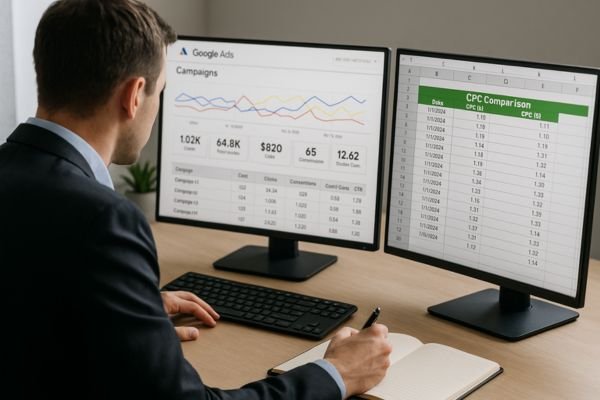
Ways to Reduce Your Cost Per Click
Getting a competitive cost-per-click (CPC) is essential for maximizing the ROI of your Google Ads campaigns. Here are proven strategies to help you lower your CPC. These methods require consistent effort but deliver significant cost savings over time.
Smart Keyword and Bid Control
- Why it matters: Targeting correct keywords and adjusting bids properly can dramatically impact your CPC. By focusing on high-performing keywords and removing irrelevant ones, you reduce wasted ad spend and improve overall CPC. Smart keyword management forms the foundation of successful advertising campaigns.
- How to do it:
- Refine your keyword targeting by regularly reviewing search term reports and identifying keywords that drive quality traffic and conversions. Adjust bids to prioritize these high-value keywords.
- Use negative keywords to exclude irrelevant search terms that may trigger your ads. This helps prevent ads from showing for queries unlikely to result in conversions, saving money on wasted clicks. For example, if you sell luxury watches, you might add negative keywords like “cheap” or “replica” to avoid attracting bargain-hunters. Regular keyword audits ensure your campaigns stay focused and cost-effective. Professional search optimization services can help streamline this process for better results.
Better Ad and Landing Page Quality
- Why it matters: The relevance and quality of your ads and landing pages directly influence your Quality Score, which determines your CPC. Higher Quality Scores can lead to lower CPCs and better ad positions. Quality improvements create a positive feedback loop that reduces costs while improving performance.
- How to do it:
- Improve ad relevance by crafting compelling ad copy that closely matches the intent behind targeted keywords. Use dynamic keyword insertion to automatically insert the user’s search query into your ad text, making it highly relevant to their search.
- Optimize your landing pages to provide a seamless user experience. Ensure that content on your landing page aligns with messaging in your ads and provides clear information and calls-to-action. A well-designed landing page can boost your Quality Score and conversion rates, ultimately lowering your CPC. Regular testing and optimization maintain peak performance levels. Expert SEO optimization services can complement your advertising efforts for maximum impact.
Smart Bid Adjustment Methods
- Why it matters: Fine-tuning bids based on factors like device usage and geographic location allows you to allocate budget more effectively and reduce CPC in areas where performance may be suboptimal. Strategic adjustments maximize the value of every advertising dollar spent.
- How to do it:
- Analyze performance data by device (desktop, mobile, tablet) and adjust bids accordingly using Google Analytics. For instance, if mobile traffic tends to convert at lower rates, you might consider lowering mobile bids to avoid overpaying for clicks less likely to result in conversions.
- Leverage location targeting to optimize bids based on geographic performance. If certain regions or cities consistently deliver better results, you can increase bids for those areas while reducing bids for underperforming locations. Data-driven bid adjustments ensure your budget works harder in the most profitable segments.
How to Keep Your Cost Per Click Competitive
Getting lower CPC is an ongoing process that requires continuous monitoring and adjustment. Here’s how you can stay competitive. Success demands consistent effort and strategic thinking to maintain profitable advertising campaigns.
Regular Monitoring and Smart Adjustments
- Why it matters: Regular campaign performance reviews allow you to identify trends, spot issues, and make data-driven decisions to optimize your CPC. Consistent monitoring prevents small problems from becoming costly mistakes that drain your advertising budget.
- How to do it:
- Set up a regular schedule (weekly or monthly) to review your campaign performance, focusing on key metrics like CPC, click-through rate (CTR), conversion rate, and Quality Score.
- Based on your analysis, make informed adjustments to your targeting, ad copy, and landing pages to improve relevance and performance. Test different variations and measure the impact on your CPC. Regular reviews help identify patterns and opportunities that might otherwise go unnoticed.
Stay Updated and Flexible
- Why it matters: Keeping up with latest industry trends and best practices ensures that your strategies remain effective in a constantly evolving digital landscape. The advertising world changes rapidly, making adaptability crucial for long-term success.
- How to do it:
- Stay informed about Google Ads updates, new features, and changes to the platform. Subscribe to official Google Ads blogs, attend webinars, and participate in industry forums to stay current.
- Be agile in adapting your strategies based on new insights and changes in the competitive landscape. Continuously test and refine your approaches to maintain a competitive edge and achieve the best possible ROI. Knowledge sharing with other professionals can provide valuable insights and fresh perspectives.Consider connecting with our experienced team for personalized guidance.
Using Your Knowledge to Get Real Results
Putting these strategies into action is key to lowering your CPC and driving better results from your Google Ads campaigns. Here’s how you can get started. Implementation requires patience and systematic execution for maximum effectiveness.
Practical Steps for Advertisers
- Why it matters: Taking concrete steps to analyze your current performance and implement optimization techniques is essential for achieving lower CPC. Without action, even the best strategies remain theoretical and provide no business value.
- How to do it:
- Begin by analyzing your current CPCs and comparing them to industry benchmarks. Use tools like Google Ads Keyword Planner and third-party research to gain insights into typical CPCs for your target keywords.
- Identify areas for improvement in your campaigns, such as low-quality keywords, underperforming ads, or poorly optimized landing pages. Prioritize these issues and develop a plan to address them systematically.
- Implement the optimization techniques discussed earlier, such as refining keyword targeting, utilizing negative keywords, improving ad relevance, and optimizing landing pages. Monitor the impact of these changes on your CPC and overall campaign performance. Documentation helps track progress and identify successful strategies for future use.
Building Long-Term Success and Adaptability
- Why it matters: Achieving and maintaining competitive CPC requires a long-term, adaptable approach that takes into account the dynamic nature of the digital advertising landscape. Short-term thinking often leads to missed opportunities and suboptimal performance over time.
- How to do it:
- Develop a long-term strategy that focuses on continuous improvement and adaptation. Regularly review your campaign data and make informed decisions based on performance trends and insights.
- Stay agile in your approach, being ready to adjust your tactics based on changes in market conditions, competitor activity, or shifts in consumer behavior. Embrace a culture of experimentation and learning within your team.
- Set realistic, data-driven goals for your CPC and overall campaign performance. Monitor your progress towards these goals and make adjustments as needed to ensure you’re achieving the best possible results for your business. Success requires balancing immediate needs with long-term strategic objectives. Small business owners can find additional resources at the SBA website for comprehensive digital marketing guidance.
Conclusion
Mastering Google Ads CPC requires understanding industry benchmarks, optimizing campaigns continuously, and adapting strategies based on performance data. Your success depends on implementing smart keyword management, improving ad quality, and making strategic bid adjustments. Regular monitoring helps identify opportunities while preventing costly mistakes that drain advertising budgets. Remember that competitive CPCs vary dramatically across industries, with legal services averaging $6.75 while travel costs only $1.09 per click.
Long-term success comes from staying informed about platform updates and maintaining flexibility in your approach. Focus on building campaigns that deliver real business value rather than chasing the lowest possible CPC. Quality scores, audience targeting, and geographic considerations all play crucial roles in determining final costs. Take action by analyzing your current performance, implementing proven optimization techniques, and setting realistic goals based on industry standards. Your commitment to continuous improvement will transform advertising expenses into profitable investments that drive sustainable business growth. For expert assistance with your digital marketing strategy, consider partnering with experienced professionals who understand the complexities of modern advertising platforms. Contact us to discuss your specific needs and goals.
FAQs
What is considered a good CPC for Google Ads?
A good CPC depends on your industry and target market conditions. Legal services average $6.75 while travel industry averages $1.09 per click.
How can I lower my Google Ads CPC quickly?
Focus on improving Quality Score through better ad relevance and landing page optimization. Use negative keywords to eliminate irrelevant traffic that wastes your budget.
Why do some industries have higher CPCs than others?
High-competition industries like legal services face more advertisers bidding for limited ad space. Industries with high customer lifetime value can afford higher advertising costs.
Should I always aim for the lowest possible CPC?
Not necessarily, as extremely low CPCs might indicate poor targeting or low-quality traffic. Focus on CPCs that deliver profitable conversions rather than just cheap clicks.
How often should I review and adjust my CPC bids?
Review campaign performance weekly or monthly depending on your budget and activity level. Regular monitoring helps identify trends and prevents small issues from becoming expensive problems.