
How Website Design And SEO Work Together In 2026
Your website’s look and your search rankings aren’t separate projects. They’re the same project.
Website design and SEO are two sides of the same build. Every layout decision, every navigation choice, every image you drop on a page sends signals to both visitors and search engines. Get those signals right and your site climbs. Get them wrong and you’re invisible, no matter how pretty the homepage looks.
Website design and SEO is the practice of building a site where visual decisions, technical structure, and content organization all work toward a single goal: making it easy for people to find you and easy for them to stay once they do. According to IBISWorld, U.S. businesses spent over $47 billion on web design services in 2025 and another $119 billion on SEO and internet marketing. Those are big numbers. And the businesses wasting the most money are the ones treating design and SEO as separate line items.
I’ve seen it play out dozens of times. A company drops $15,000 on a gorgeous redesign, then wonders why organic traffic tanked. The designer didn’t talk to the SEO team. Nobody checked Core Web Vitals. The new site looked amazing and ranked nowhere.
Why Does Website Design Affect SEO?
Design affects SEO because Google doesn’t just read your content. It measures how people interact with it. And that interaction is shaped by design.
How Design Decisions Shape Your Rankings
Bounce rate, dwell time, pages per session. These are behavioral signals Google uses to figure out if a page is worth ranking. Your design controls all three.
Navigation and UX. If visitors can’t find what they came for within a few seconds, they leave. A confusing menu or buried contact page pushes bounce rates up, and Google notices. Sites with clear, logical navigation consistently hold users longer.
Mobile responsiveness. Over 62% of web traffic now comes from mobile devices, according to Soax research data. Google uses mobile-first indexing, meaning the mobile version of your site is what gets evaluated first for rankings. A site that looks great on a desktop but breaks on a phone is a site Google will bury.
Page speed. This one’s measurable. Google’s Core Web Vitals (with INP replacing FID as of 2024) are now confirmed ranking factors. You can review Google’s core updates page to see how performance signals have grown in weight over the last two years. A page that takes four seconds to load loses roughly 25% of visitors before they even see your headline.
Content structure. Search engines read your site through headings, internal links, and content hierarchy. If your design doesn’t create a clear path through the information, crawlers struggle to index your best pages.
The short version: bad design creates bad user signals. Bad user signals create bad rankings. It’s that direct.
Core SEO Elements Every Website Design Needs
A site that ranks well in 2026 isn’t just designed to look good. It’s designed to perform. These are the building blocks where website design and SEO overlap.
Responsive and Mobile-First Design
Your site has to work on every screen size. Period. Google’s mobile-first indexing means the mobile version of your site is the one that counts for rankings. If you’re still designing for desktop first and then adapting for mobile, you’ve got the process backwards.
And a quick contrarian note: template sites aren’t automatically bad for SEO. A Search Engine Journal analysis from June 2025 by contributor Atul Jindal found that modern templates with proper SEO configuration can outperform poorly built custom sites. The template vs. custom debate matters far less than whether someone actually optimized the primary keywords and Core Web Vitals after launch.
Site Speed and Performance
Compress your images. Minimize scripts. Use browser caching. These aren’t suggestions. Forbes Advisor reported in January 2026 that professional small business websites start at $1,500, and ongoing hosting runs $15 to $150 per month. If you’re paying those numbers and your site still loads slowly, something’s broken in the build.
Navigation and Site Architecture
Think of your sitemap as a roadmap for both users and crawlers. A clean hierarchy with clear menus, breadcrumbs, and internal links makes it easier for Google to index your pages and easier for visitors to find what they need.
I’d argue navigation is the single most underrated ranking factor in web design. It doesn’t get talked about the way backlinks and citations do. But a confusing site structure can undermine even the best content.

Keyword Placement in Design
Place your keywords in headings, title tags, URLs, and image alt text. But don’t force them. If a keyword makes a heading sound robotic, rewrite the heading. Businesses that invest in geo-targeting keywords alongside their on-page work tend to see stronger local rankings without stuffing their pages full of awkward phrases. Google’s 2025 and 2026 core updates have been aggressive about penalizing content that reads like it was written for an algorithm instead of a human.
Image and Media Optimization
High-quality visuals keep people on your page. But oversized files kill your load speed. Use descriptive file names (not “IMG_4382.jpg”), add keyword-relevant alt text, and compress everything. This is also an accessibility requirement. The DOJ’s 2024 final rule mandates WCAG 2.1 Level AA compliance for government sites, with deadlines hitting in 2026 and 2027. Private-sector ADA lawsuits are referencing these same standards at an increasing rate. The full WCAG 2.2 guidelines updated in December 2024 apply broadly and double as an SEO best-practices checklist for headings, alt text, and keyboard navigation.
Meta Tags and Structured Data
Title tags, meta descriptions, and schema markup tell search engines what your page is about before anyone clicks on it. Good structured data also improves your chances of appearing in Google’s AI Overviews, which now show up in more than half of all search results.
What Are the SEO Benefits of Good Web Design?
A site where design and SEO work together produces measurable results. Not vague improvements. Actual numbers.
Stronger Organic Visibility
Search engines rank sites that are easy to crawl and easy to use. When your site architecture is clean and your content is well-organized, Google indexes more of your pages and indexes them faster. More indexed pages means more opportunities to rank.
Better User Engagement Metrics
Dwell time, pages per session, bounce rate. These metrics move when design improves. A visitor who stays longer and clicks deeper signals to Google that your content is worth showing to more people. That signal compounds over time.
Higher Conversion Rates
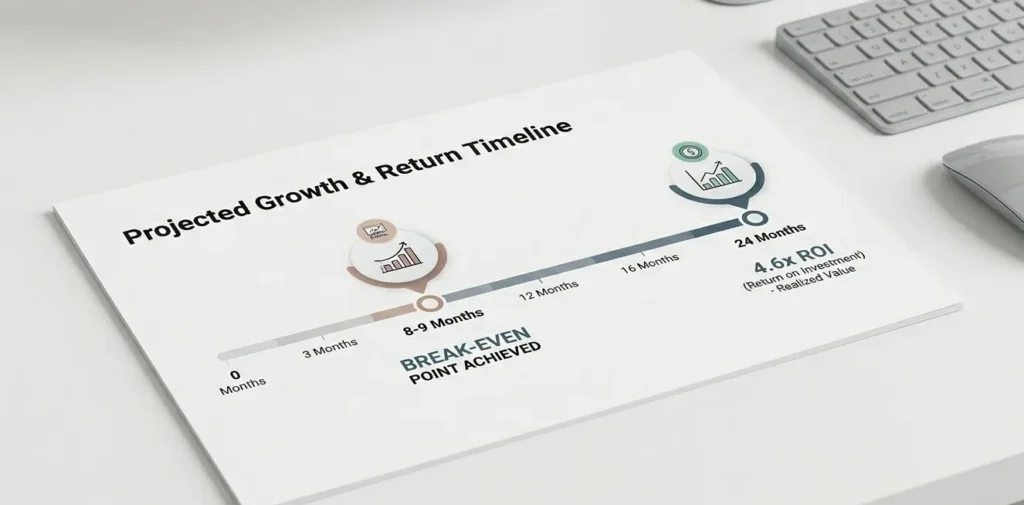
Clear CTAs, logical page layouts, and fast load times don’t just help rankings. They turn visitors into customers. FirstPageSage’s 2025 e-commerce SEO ROI report found that SEO investments break even in 8 to 9 months on average and deliver a 4.6x return within 24 months. But that ROI only happens if the design guides users from landing to action without friction.
Brand Authority and Trust
A well-built site builds brand awareness and trust. Visitors judge credibility within seconds of landing on a page. If the design feels outdated or the experience feels clunky, they leave. And they probably won’t come back.

How to Build an SEO-First Website in 6 Steps (2026)
- Start with SEO research before design. Don’t open a design tool until you’ve done keyword research, mapped search intent, and outlined your site’s content structure. Design should follow content strategy, not the other way around.
- Design mobile-first. Build every layout for the smallest screen first. Test buttons, text size, and tap targets on actual devices. Flexible grids and scalable images aren’t optional in 2026.
- Organize content with a clear heading hierarchy. Use H1, H2, and H3 tags to structure information logically. Every section should be a self-contained chunk that makes sense on its own, even if pulled out of context by an AI system.
- Optimize every media file. Compress images, use descriptive filenames, and write alt text that includes keyword variations naturally. Don’t skip this. Slow pages with missing alt text leave money on the table.
- Test speed and usability regularly. Use Google PageSpeed Insights and run UX testing at least quarterly. The Bureau of Labor Statistics reports over 214,900 web developers and digital designers employed in the U.S. as of 2024, with median pay around $90,930. You’re paying skilled people good money. Make sure the work holds up over time.
- Audit and adjust continuously. Google rolled out multiple core updates through 2025 and early 2026, including updates targeting thin AI-generated content and spam. Businesses running enterprise SEO strategies across large sites feel these shifts first, but small sites aren’t immune. A Storm Brain analysis from March 2026 put it plainly: if a website redesign doesn’t recoup its investment within 12 to 18 months, it wasn’t worth doing.
What Mistakes Kill Your SEO and Web Design?
Keyword stuffing. Cramming keywords into every sentence doesn’t help. Google’s recent core updates actively penalize it. Write for people first.
Ignoring technical debt. The most expensive mistake I see? Hiring the cheapest option for a quick win, then paying $10,000 to $50,000 to fix the damage 12 to 18 months later. Broken schema, JavaScript rendering issues, and chains of 404 errors are common wreckage from cut-rate builds.
Skipping analytics. If you’re not tracking bounce rates, organic traffic, and Core Web Vitals, you’re flying blind. Opportunities you don’t measure are opportunities you miss.
Over-relying on AI content without human oversight. Google’s 2025 and 2026 updates have been clear: thin, machine-generated content that doesn’t add original insight gets pushed down. Use AI as a tool, not a replacement for actual expertise.

Where Are Website Design and SEO Headed?
AI Overviews, voice search, and machine learning are changing how search works. Grand View Research projects the global SEO software market will grow from $74.6 billion in 2024 to $154.6 billion by 2030, a 13.5% compound annual growth rate. The money flowing into this space tells you where attention is going.
The sites that will win aren’t the flashiest ones. They’re the ones built with structured data that AI systems can read, content that answers real questions directly, and designs that work for every screen and every ability level.
Questions almost nobody asks their web team (but should): “What’s your process for monitoring Core Web Vitals after launch?” and “How do you handle structured data for AI Overviews?” If your web team can’t answer those, you’ve got a gap.
Get Your Website Working Harder
Website design and SEO aren’t separate budget lines. They’re one investment. At Eclipse Marketing, we build sites where every design decision serves a ranking purpose and every SEO strategy is baked into the build from day one.
If your current site looks good but doesn’t perform, that’s a design problem disguised as an SEO problem. Reach out to Eclipse Marketing and let’s figure out what’s actually holding your traffic back.
FAQs
Does web design actually affect SEO rankings in 2026?
Yes. Core Web Vitals, mobile-friendliness, and structured data are confirmed Google ranking factors. A site with slow load times, broken mobile layouts, or missing meta tags will rank lower than a competitor with the same content but better design fundamentals. Google’s 2025 and 2026 core updates have made this connection even more direct.
How much does a website with SEO cost?
It depends on scope. Professional small business websites start at around $1,500 for a basic build, according to Forbes Advisor data from January 2026. Add ongoing SEO retainers of $1,000 to $5,000 per month for mid-range services. DIY builders like Wix or Squarespace run $0 to $450 upfront but come with limited SEO control.
Is a template website bad for SEO?
Not automatically. Modern templates can rank well if Core Web Vitals are optimized, headings are structured correctly, and content quality is strong. A poorly executed custom site often performs worse than a well-configured template. The deciding factor isn’t template vs. custom. It’s whether someone actually did the SEO work after launch.
How long until SEO pays off after a website redesign?
FirstPageSage’s 2025 e-commerce SEO ROI report puts the average break-even point at 8 to 9 months. By 24 months, the average return reaches 4.6x. But those numbers assume the redesign was done with SEO in mind. Redesigns focused purely on aesthetics often see traffic drops that take months to recover from.
What’s the most expensive website design and SEO mistake?
Hiring the cheapest option. Businesses that go with rock-bottom pricing often spend $10,000 to $50,000 fixing broken schema, JavaScript rendering problems, and redirect chains 12 to 18 months later. The initial savings get wiped out by the cost of rebuilding.
Should I redesign my website for Google AI Overviews?
If your site doesn’t use structured data and your content isn’t organized in clear, extractable sections, you’re missing out. AI Overviews appear in over 50% of search results now. Sites with proper schema markup, question-format headings, and self-contained answer paragraphs are the ones getting cited.
Do I need ADA/WCAG compliance for my business website?
Increasingly, yes. The DOJ’s 2024 final rule mandates WCAG 2.1 Level AA for government sites, with compliance deadlines in 2026 and 2027. Private businesses face rising ADA lawsuit risk, and accessible design practices like proper headings, alt text, and keyboard navigation also directly improve SEO performance.

Mike has over 5 years of experience helping clients improve their business visibility on Google. He combines his love for teaching with his entrepreneurial spirit to develop innovative marketing strategies. Inspired by the big AI wave of 2023, Mike now focuses on staying updated with the latest AI tools and techniques. He is committed to using these advancements to deliver great results for his clients, keeping them ahead in the competitive online market.