
Most remodeling companies shop for the wrong thing. They go looking for the best SEO tools for home remodeling companies, but tools don’t rank you. The work does. Across 87 remodeling SEO campaigns since 2019, we’ve used the same short list of software, and most of it is free. The paid research tools that get hyped in every “best tools” post are built for people who do SEO all day, not for a remodeler running crews and quoting jobs.
Here’s the honest version: which tools earn their price, which ones you can skip, what each one costs in 2026, and where a remodeler should spend first. If you read one section, make it the table.
What are SEO tools for home remodeling companies?
SEO tools for home remodeling companies are the software remodelers use to get found on Google: a free Google Business Profile for the local Map Pack, Google Search Console and Google Analytics for data, plus optional paid tools for keyword research, rank tracking, and reviews. Most remodelers need three free tools, not ten paid ones.
The mistake is treating tools as the strategy. A $129 a month subscription you don’t know how to use is money set on fire. Pick tools that match what you’ll actually do.
Which SEO tools do remodelers actually need?
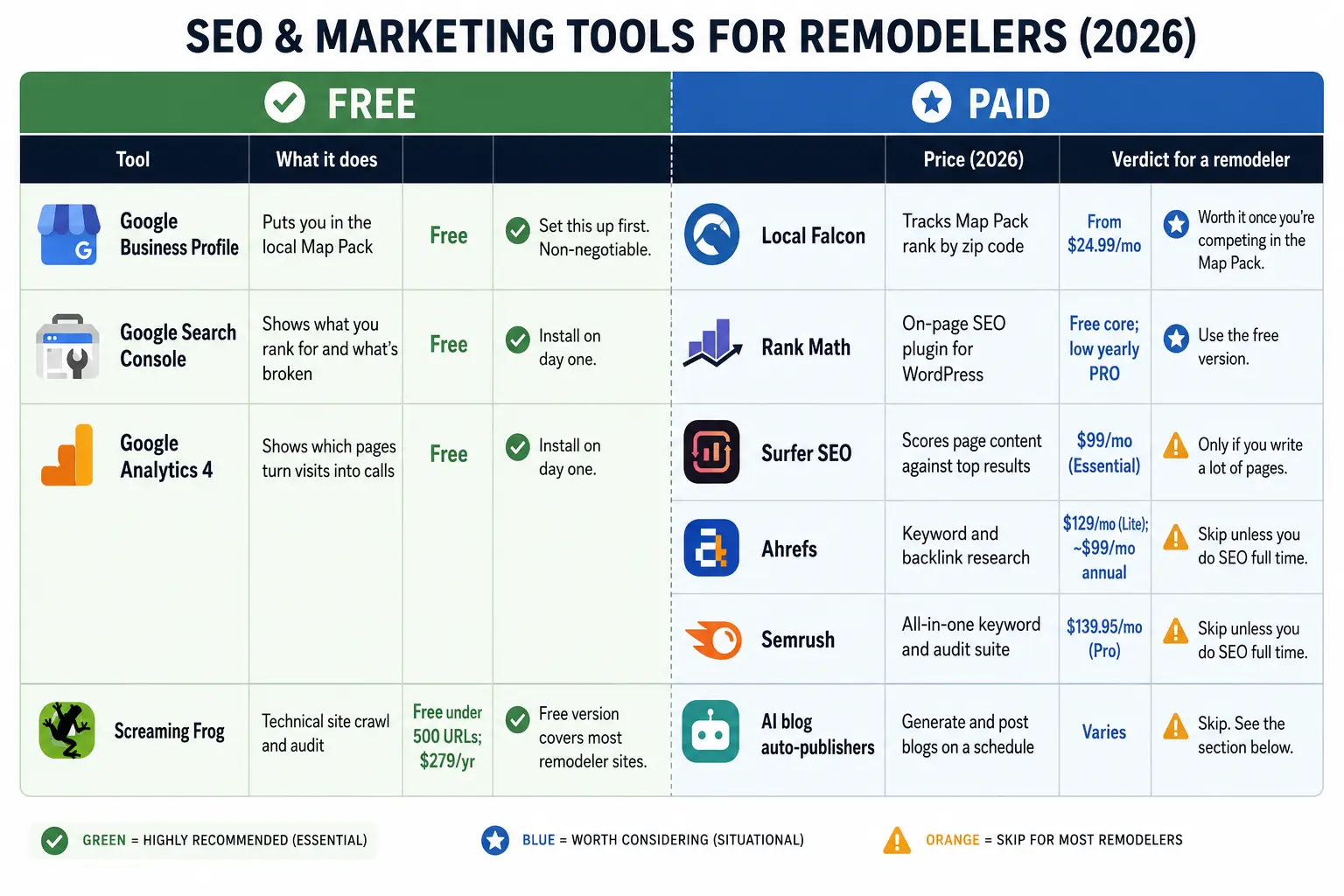
Three free tools to start, and at most two paid ones after that. Here’s the full list with real 2026 prices and a plain verdict for a remodeling business owner.
| Tool | What it does | Price (2026) | Verdict for a remodeler |
|---|---|---|---|
| Google Business Profile | Puts you in the local Map Pack | Free | Set this up first. Non-negotiable. |
| Google Search Console | Shows what you rank for and what’s broken | Free | Install on day one. |
| Google Analytics 4 | Shows which pages turn visits into calls | Free | Install on day one. |
| Local Falcon | Tracks Map Pack rank by zip code | From $24.99/mo | Worth it once you’re competing in the Map Pack. |
| Rank Math | On-page SEO plugin for WordPress | Free core; low yearly PRO | Use the free version. |
| Surfer SEO | Scores page content against top results | $99/mo (Essential) | Only if you write a lot of pages. |
| Ahrefs | Keyword and backlink research | $129/mo (Lite); ~$99/mo annual | Skip unless you do SEO full time. |
| Semrush | All-in-one keyword and audit suite | $139.95/mo (Pro) | Skip unless you do SEO full time. |
| Screaming Frog | Technical site crawl and audit | Free under 500 URLs; $279/yr | Free version covers most remodeler sites. |
| AI blog auto-publishers | Generate and post blogs on a schedule | Varies | Skip. See the section below. |
Notice the pattern. The tools that actually move your rankings are free. The paid ones are for the people doing the work hour after hour.
The free tools every remodeler should set up first
Start with Google Business Profile, Google Search Console, and Google Analytics 4. All free, and they cover the work that actually generates calls. Search Console alone shows you the queries homeowners type before they find you, and it flags the technical problems blocking your pages.
That second part matters more than most remodelers think. On 94% of the sites we audit at onboarding, we find duplicate or missing title tags, one of the most common on-page SEO issues that quietly caps rankings. You can’t fix what you can’t see, and Search Console shows it for free.
Google Business Profile is your fastest win
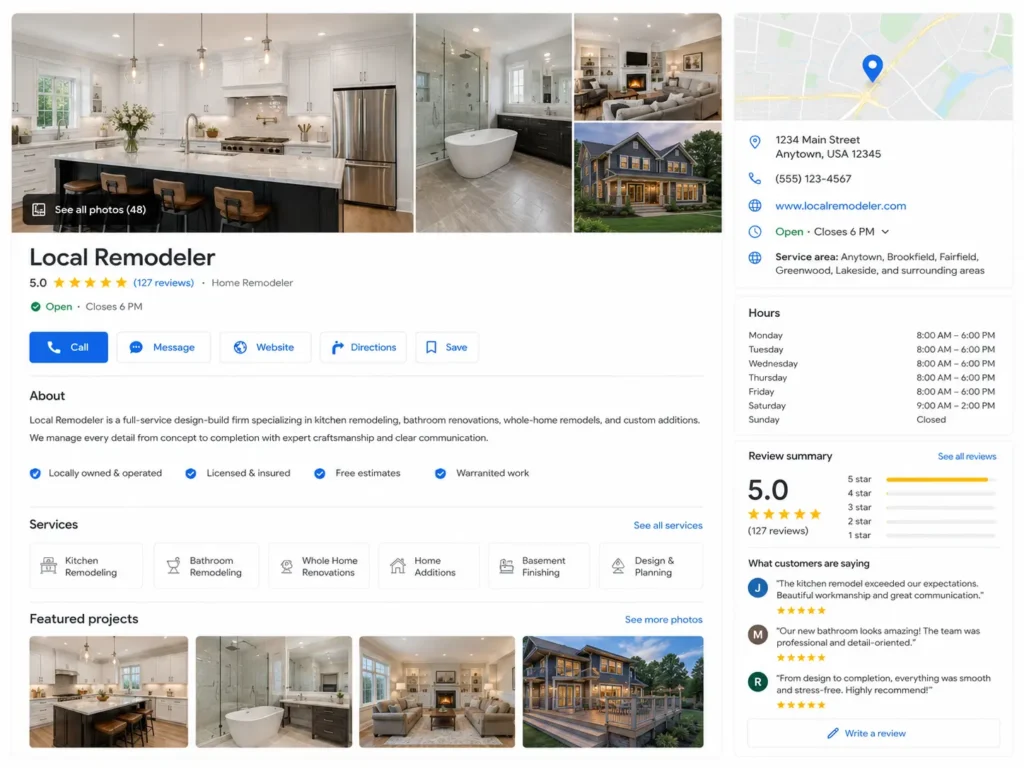
Your Google Business Profile decides whether you show up in the Map Pack for searches like “kitchen remodeler near me.” It’s the fastest win a remodeler has. Across our campaigns, a full profile overhaul lifts map impressions by 340% in the first 90 days.
Reviews feed that result. BrightLocal’s 2026 Local Consumer Review Survey found 97% of consumers read online reviews for local businesses, and 83% read them on Google. So fill every field, add 25 or more real project photos, and ask for a review after every job. Once you’re competing for the top three map spots, a tool like Local Falcon ($24.99 a month to start) shows your rank at the zip-code level, because you can sit at number one in your own neighborhood and number eight three miles away.
Do you need Ahrefs or Semrush?
Probably not, unless you’re doing SEO full time. These are research tools, and they’re priced for daily users. Ahrefs starts at $129 a month for its Lite plan (about $99 a month billed annually, with a stripped-down Starter tier at $29). Semrush Pro runs $139.95 a month. Both are real tools. We use Ahrefs ourselves and chose it over Semrush because its backlink index is larger and updates faster, which matters when you’re checking whether backlinks still matter for a local remodeler.
There’s a simple test. If you’ll open the tool once, glance at a few numbers, and then go back to running jobs, you don’t need a $129 a month subscription. You need someone to do the research and act on it. The tool is the cheap part.

The tools we run across 87 campaigns
For full transparency, here’s the actual stack we use on remodeling accounts, and why. This is an agency setup. A solo remodeler does not need all of it.
We crawl every new site with Screaming Frog (free under 500 URLs, $279 a year for the full version) because it catches redirect chains and rendering problems that cloud crawlers miss. We use Ahrefs for backlink and keyword research. We score every service page with Surfer SEO ($99 a month) before it goes live. We build client sites on WordPress with Rank Math, whose free version handles on-page SEO and schema. We track Map Pack rankings with Local Falcon. And we run review requests and lead tracking through GoHighLevel ($97 a month for the Starter plan), which texts a review request after a job is marked complete. Underneath all of it sit Google Search Console and Google Analytics, because every call we make gets checked against real click data, not third-party guesses.
That’s seven tools. Five of them a remodeler will never touch directly, and that’s the point. You’re not buying logins. You’re buying the work.
Should you trust AI blog automation tools?
Be careful. The pitch is seductive: connect your site, let the software publish a fresh SEO blog every week, and watch the rankings climb. Our data says it doesn’t work the way it’s sold.
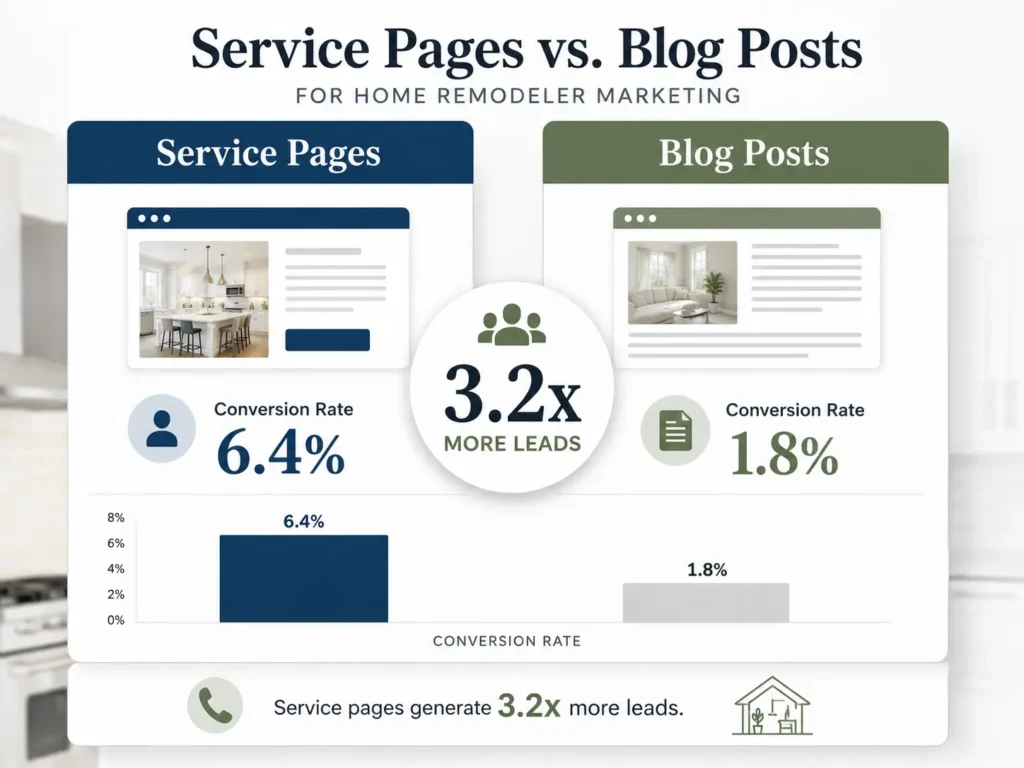
In early 2024 we ran a 90-day test across four clients, comparing long-form blog content against building city-specific service pages. The service pages out-produced blog posts for lead generation by 3.2 times. The blog posts ranked faster (about 47 days to page one, against 68 days for service pages) but converted at 1.8%, while service pages converted at 6.4%. The blogs pulled in people researching, not people buying. We’ve also audited remodeling sites with 200 or more posts that generate fewer leads than sites with 35 targeted service pages.
Google’s own Search Central guidance is blunt about this: it rewards helpful, people-first content, not volume. Machine-published filler is the opposite. Build your service pages first, then add a handful of guides homeowners actually search for (cost, timeline, permits in your city). That’s the role content plays in SEO, and it’s a supporting one, not the engine.
Tracking AI search visibility (AEO and GEO)
AI engines like ChatGPT, Gemini, and Perplexity now send buyers, so it’s fair to ask whether they mention your business. The tracking tools are new and mostly immature. Surfer offers an AI Tracker as an add-on ($95 a month for 25 prompts), and Ahrefs and Semrush have added brand-mention features.
Our take: spot-check monthly, don’t overspend. Don’t let any platform sell you “AI optimization” as a separate product. The same helpful, well-structured pages that rank on Google are what these engines pull from. Get the fundamentals right and you show up in both places.
Can you do remodeling SEO yourself, or hire an agency?
You can do a lot yourself with the free tools and time. The question is whether your time is better spent there. Run this five-question check: Are you spending $3,000 or more a month on lead platforms? Do you have 20 or more Google reviews? Have you been in business three or more years? Is your average project $15,000 or more? Are you willing to invest for 6 to 12 months? Four yeses means SEO is worth real money, and probably worth handing to a team that does it daily.
The tools are cheap. The knowledge and the hours are not. Real SEO for remodeling companies means remodeling-specific keyword research, locally targeted pages, steady review building, and link work over months. If you need leads while that builds, you can run Google Ads in parallel for immediate calls, and if your current site is on a locked builder, you may need a WordPress rebuild before any of it works.
A starter stack, and what to skip
Here’s the short version. Set up Google Business Profile, Search Console, and Analytics (all free). Add a rank tracker once you’re chasing the Map Pack. Skip Ahrefs and Semrush unless you’re doing SEO full time, skip the AI auto-blog tools, and skip bulk directory submissions, which create inconsistent NAP data and can drop your rankings.
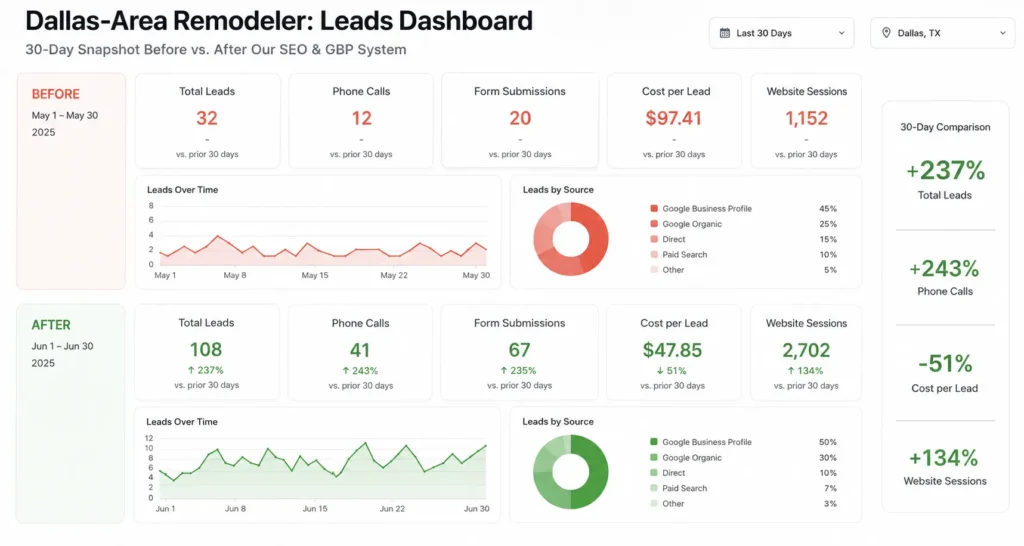
One example shows why the tools aren’t the story. A Dallas-area kitchen and bath remodeler we worked with was spending around $10,000 a month on shared paid leads. After the work (a rebuilt site, city-specific service pages, a review system, and link building) they ranked number two in Maps and organic and went from 3 to 4 organic leads a month to 22 to 27, then cancelled Angi. The tools were ordinary. The work wasn’t. Social media played a supporting part for project photos, but Google sold the jobs.
Best practices for remodeling SEO in 2026
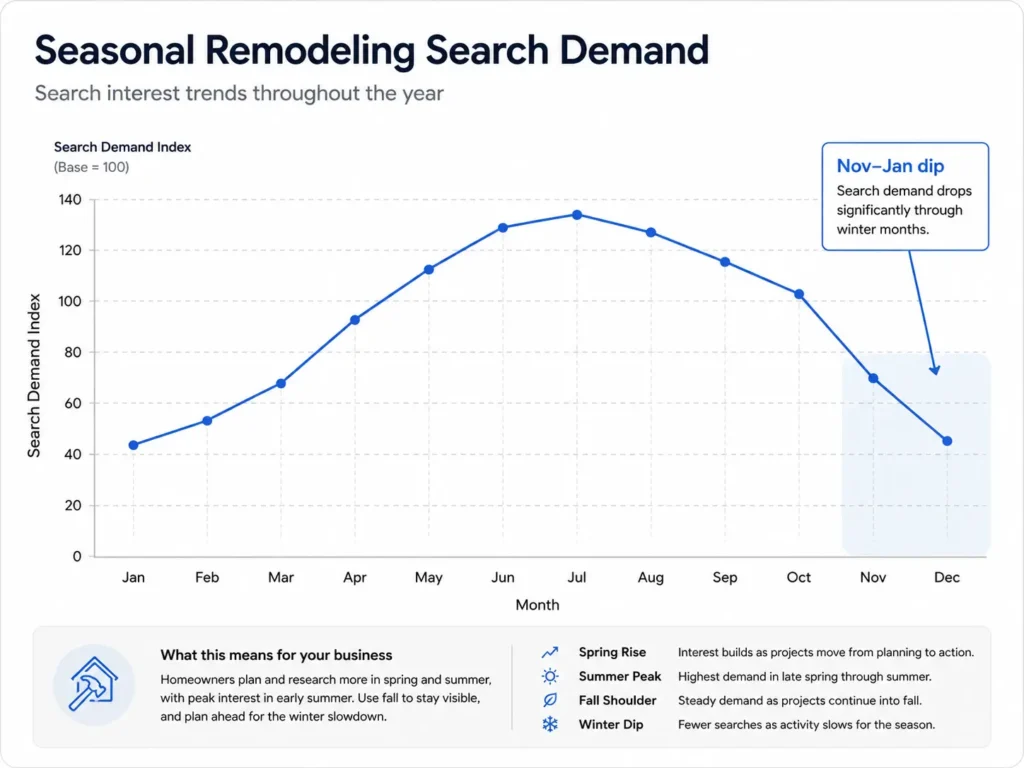
A few specifics that decide results, drawn from what we see across markets. Keep your name, address, and phone identical everywhere; we’ve watched a single phone-number change drop a client from third to fourteenth in the Map Pack. Ask for a review after every job, and a request system will get you 4 to 6 new Google reviews a month. Build service pages before blog posts. Expect a seasonal dip of 20% to 30% from November through January in most markets, so don’t panic when it hits. And refresh your top pages quarterly instead of rebuilding the whole site.
What we’d do with your budget
If you’re comparing the best SEO tools for home remodeling companies, start with the free three, add only what you’ll genuinely use, and put the rest of the money into the work that moves rankings. Tools are the smallest line item in a campaign that works. If you’d rather have a team that already owns this stack handle it for you, that’s what we do.
FAQs
What SEO tools do home remodeling companies actually need?
Most remodelers need three free tools first: Google Business Profile, Google Search Console, and Google Analytics. They cover local visibility and the data that shows what’s working. Paid research tools like Ahrefs or Semrush are optional and mostly for full-time SEO work.
How much do SEO tools cost for a remodeling company in 2026?
The core tools are free. Paid options range from $24.99 a month for Local Falcon rank tracking to $99 a month for Surfer, $129 a month for Ahrefs, and $139.95 a month for Semrush. Screaming Frog is free under 500 URLs, then $279 a year.
Are Ahrefs and Semrush worth it for remodelers?
For most remodelers, no. At $129 and $139.95 a month, they’re priced for people who use them daily. If you’ll open the tool occasionally and not act on the data, the subscription is wasted. The research matters more than the software.
Do AI blog automation tools help remodeling SEO?
Rarely the way they’re sold. In our 90-day test, service pages out-produced auto-style blog content for leads by 3.2 times, and blog posts converted at 1.8% against 6.4% for service pages. Build service pages first, then add a few useful guides.
What is the best free SEO tool for home remodeling companies?
Google Business Profile. It drives the local Map Pack, and a full overhaul lifts map impressions by about 340% in the first 90 days in our campaigns. Pair it with reviews, since 83% of consumers read reviews on Google.
Can I do SEO myself or should I hire a remodeling SEO agency?
You can start yourself with the free tools and time. Consider an agency if you spend $3,000 or more a month on leads, have a $15,000-plus average project, and can invest for 6 to 12 months. At that point your hours are worth more on the business than in a dashboard.