Most businesses get this wrong. They treat SEO and SEM as two separate tools sitting in different drawers. One’s for “organic stuff,” the other’s for “paid stuff.” And then they wonder why neither one is pulling its weight.
SEO vs SEM isn’t really a debate. SEO (search engine optimization) is the practice of earning organic rankings through content, technical fixes, and backlinks. SEM (search engine marketing) is the broader category that includes SEO and paid search advertising like Google Ads. One lives inside the other. And in 2026, with AI Overviews now showing up in over 25% of searches, running them in separate silos is one of the most expensive mistakes I see businesses make.
SEO vs SEM refers to the difference between organic search optimization and the full spectrum of search marketing, which combines organic SEO with paid search ads (PPC) to maximize visibility across search engine results pages.
What Is SEO?
SEO is how you get your site to rank in Google without paying for ad placement. Organic search drives roughly 53% of all trackable website traffic, which makes it the single biggest traffic channel for most businesses.
It breaks down into three areas. On-page SEO covers your content, title tags, headers, keyword placement, and internal linking. Off-page SEO is everything happening away from your site, mainly backlinks and brand mentions across the web. Technical SEO deals with the plumbing: site speed, mobile performance, crawlability, and indexing issues.
I won’t go deep into each of those here. The on-page and off-page SEO benefits deserve their own breakdown. What matters for this comparison is that SEO takes time, it compounds over months, and the traffic it generates doesn’t disappear the second you stop writing checks.
What Is SEM?
SEM is the big umbrella. It includes SEO plus paid search. The paid side is mostly PPC (pay-per-click), where you bid on keywords and pay every time someone clicks your ad in Google or Bing.
The global SEO services market hit roughly $108 billion in 2026 according to Xamsor research, and search advertising takes up about 41% of all digital ad spending. Both channels are massive. And they share more data than most teams realize.
Quick clarification on a definition debate that still trips people up: a lot of marketers now use “SEM” to mean just paid search. The original definition includes organic too. I’m using the original definition in this article because the distinction matters when you’re budgeting.
How Do SEO and SEM Compare on Cost?
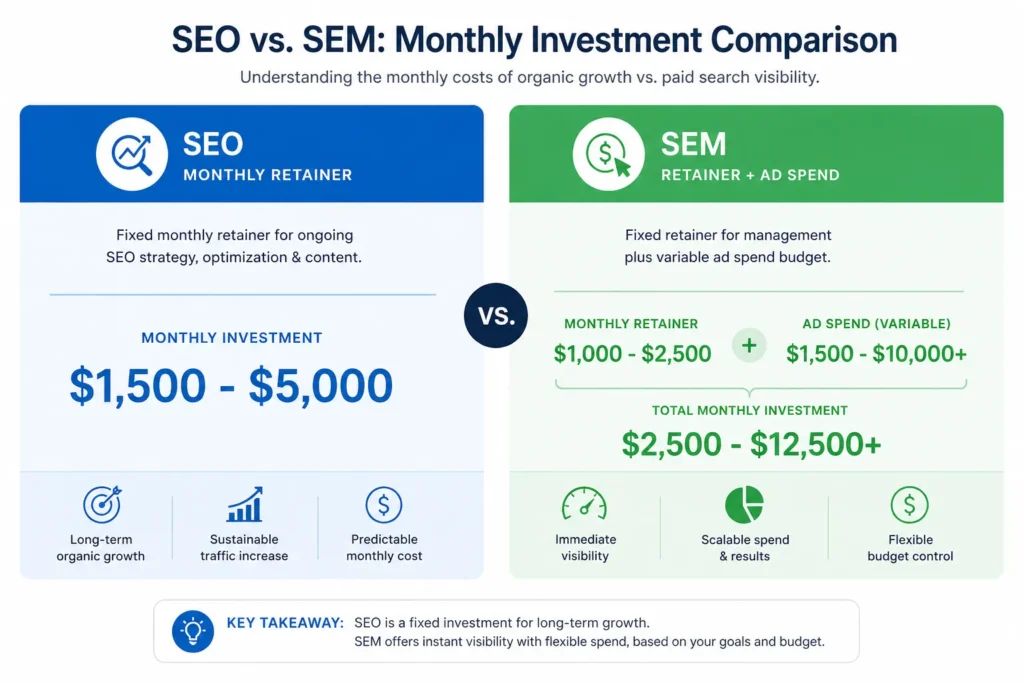
SEO isn’t free. You’re paying for content production, tools like Ahrefs or SEMrush, building backlinks from other websites, and often an agency retainer. According to aggregated agency pricing data, the average SEO retainer sits around $2,917 per month, with agencies charging closer to $3,200.
SEM costs include all of that plus your ad spend. And ad spend is variable. You might pay $2 per click in a low-competition industry or $50+ per click in legal or insurance. The gap depends entirely on your market and keywords.
The mistake? Treating these budgets as competing priorities. PPC data tells your SEO team which keywords actually convert. SEO authority improves your Quality Score in Google Ads, which lowers your cost per click. They feed each other.
How Long Does Each Strategy Take to Work?
PPC delivers traffic the day your campaign goes live. You set a budget, write ads, pick keywords, and you’re showing up in search results within hours.
SEO is slower. Most pages take 6 to 12 months before they start ranking competitively, and top-ranking pages on Google tend to be around 2 to 3 years old. If someone tells you they’ll get you to page one in 30 days, keep your wallet closed. Fixing common on-page SEO issues alone can take weeks before Google recrawls and reranks your pages.
But PPC has a hidden timeline too. Reaching a positive ROI on paid search typically takes 3 to 12 months of testing ad copy, landing pages, and bid strategies. The “instant results” pitch is only half the story.
Which One Lasts Longer?
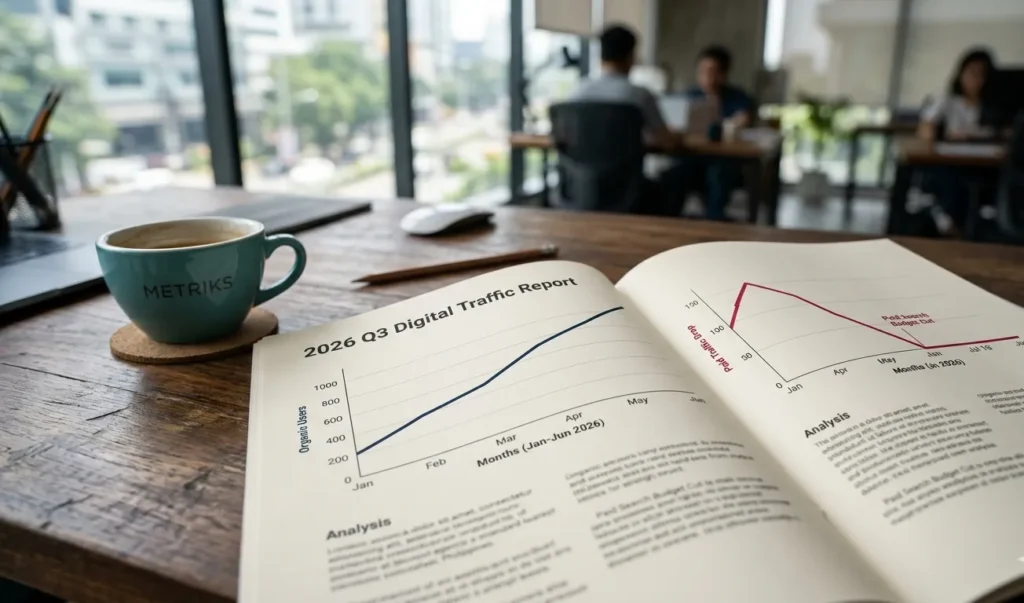
SEO wins on longevity. A page that ranks well can hold that position for years with periodic updates. Stop paying for ads, and your SEM traffic drops to zero the same day.
That durability is why HubSpot’s 2026 State of Marketing report shows 27% of marketers rate websites and SEO as their top ROI channel. PPC averages about 200% ROI when well-managed, but it requires constant spending to maintain.
What About Conversion Rates?
Organic results pull roughly 19 times more clicks than paid ads on the same search page. And SEO traffic converts at about 2.4% on average compared to 1.3% for paid search.
Those numbers make sense. People trust organic results more. But paid search catches high-intent buyers who are ready to act right now. If you’re a service business running seasonal promotions, SEM’s paid side can fill gaps that organic can’t reach on a short timeline.
Should You Pick One or Run Both in 2026?
If you’re working with a tight budget and can wait 6 to 12 months, SEO gives you the best long-term return. It builds brand authority, generates compounding traffic, and the assets you create (blog posts, landing pages, technical improvements) keep working for you.
If you need leads this month, paid search gets you in front of buyers immediately. It’s also a great testing ground. Run ads on 20 keyword variations, see which ones convert, and then build your SEO content strategy around the winners.
The real answer for most businesses? Run both. Not separately. Together. Use SEM data to sharpen SEO. Use SEO authority to lower SEM costs. With AI search reshaping how results appear, covering both organic and paid surfaces is more valuable now than it was two years ago.
FAQs
How do SEO and SEM work together in 2026?
They share keyword data, landing page performance insights, and audience targeting info. Your PPC campaigns reveal which keywords convert into actual sales. That data tells your SEO team where to focus content. Meanwhile, strong organic authority improves your Google Ads Quality Score, which can lower your cost per click. With AI Overviews appearing in over 25% of search results, covering both organic and paid surfaces gives you more chances to show up.
Does SEM include SEO?
Yes. SEM originally meant the full scope of search marketing: organic optimization plus paid advertising. Many marketers now use SEM to mean only paid search, but the original definition covers both. When you’re planning a budget, it helps to use the broader definition so you don’t accidentally leave organic out of the equation.
How much does SEO cost compared to SEM?
SEO retainers average around $2,917 per month nationally, with agencies closer to $3,200. SEM adds variable ad spend on top of that. A small local business might spend $500 to $2,000 monthly on ads. A national brand in a competitive space can easily spend $10,000 or more. The combined investment is higher, but the return often justifies it when both channels are coordinated.
Can you do SEM without SEO?
You can, but it’s a bad idea. Running paid search without any organic presence means you’re paying for every single visitor. The moment your ad budget runs out, your traffic vanishes. SEO gives you a baseline of free, ongoing traffic that paid search can supplement during high-demand periods or product launches.
Is SEO or SEM better for small businesses?
For most small businesses with limited budgets, SEO delivers better long-term value. HubSpot’s 2026 survey found that 27% of marketers rank SEO as their highest-ROI channel. Paid search works well for testing keywords or generating quick leads, but it requires sustained spending. A good starting point is investing in SEO first, then layering in targeted PPC once you know which keywords drive revenue.
How long does SEO take to beat SEM results?
SEO typically needs 6 to 12 months before pages rank well enough to drive consistent traffic. Paid search produces clicks within hours. But here’s the catch: roughly 90% of pages get zero organic traffic from Google in their first year, according to Ahrefs data. The ones that break through tend to generate compounding returns that eventually outperform paid campaigns dollar for dollar.