

Keyword research for remodelers takes about 60 minutes if you use free tools and skip the step everybody starts with. You don’t need Ahrefs. You don’t need a paid audit. You need your service list, your service area, and 3 free Google products.
Most guides tell you to start with search volume. That’s backwards for a remodeling company. Google’s own documentation says the number inside Keyword Planner is averaged over 12 months and then rounded, so it hides the month your homeowners actually search and it makes some of your best terms look worthless.
Timing matters more this year than last. Harvard’s Joint Center for Housing Studies runs a quarterly remodeling index that projects homeowner improvement and repair spending at $519 billion, growing just 0.5% year over year by Q2 2027. Flat demand rewards the remodelers who target better, not the ones who publish more.
Below is the process we run before every campaign, written so you can run it yourself, plus the point where running it yourself stops being enough.

What is keyword research for remodelers?
Keyword research for remodelers is the process of finding the search terms homeowners type when they want remodeling work done, then matching each term to one page on your website. It covers service terms, city terms, and cost terms, and it ranks them by how likely each one is to produce a phone call.
That last part is what separates it from generic keyword research. A software company chases traffic. You’re chasing 12 to 25 homeowners a month in one metro. The list is smaller and the sorting rule is different.

Why does search volume mislead remodelers?
Search volume misleads remodelers because it’s an average, not a count. Google states in its Keyword Planner documentation that the number of searches for a term “is averaged over a 12-month period,” and that “your search volume statistics are rounded.”
Think about what a 12-month average does to a seasonal trade. If a term gets searched hard in January and barely at all in July, the tool reports the flat middle. You see a mediocre number and skip the term. Your competitor who publishes in November owns it by the time the January searches arrive.
Volume also has nothing to do with who’s ready to buy. One of our clients does garage conversions and ADUs in a single Southeast metro. The term “ADU contractor” paired with their city name showed 40 searches a month. By every filter in every guide, that keyword is a waste of time. We built the page anyway, ranked it in month 4, and that page contributed to 8 to 10 leads a month at a 45% close rate and a $62,000 average project. Revenue from SEO leads in the first 6 months: $280,000. Results vary by market, competition, and client engagement. Past performance does not guarantee identical future results.
40 searches a month. That’s the whole argument against sorting by volume.
The 60-minute keyword research process for remodelers
Every tool in the process below is free.
| Minutes | Step | Tool |
|---|---|---|
| 0 to 10 | Write down what you sell and where | Paper |
| 10 to 25 | Pull the raw terms | Google Keyword Planner, Google autocomplete |
| 25 to 35 | Check the month curve | Google Trends |
| 35 to 45 | Sort by what turns into a call | Your judgment plus the rule below |
| 45 to 55 | See what already ranks in your city | Google Search, incognito |
| 55 to 60 | Give every keyword one page | Spreadsheet |
Minutes 0 to 10: Write down what you sell and where
List your actual services, not categories. “Kitchen remodeling” is a category. “Kitchen remodeling,” “kitchen cabinet refacing,” “countertop replacement,” and “kitchen island installation” are 4 services that need 4 different pages.
Then list your service area the way homeowners say it, which is rarely the way you say it. They don’t search “Denver metro.” They search the suburb they live in. Write down every suburb and neighborhood you’ll actually drive to.
Most remodelers finish this step with 8 to 15 services and 6 to 20 locations. That’s your grid.
Minutes 10 to 25: Pull the raw terms
Open Google Keyword Planner. Using it costs nothing, but Google’s own setup page says you must enter billing information on a Google Ads account before the keyword ideas feature becomes available. You never have to run a campaign or spend a dollar. Paste in your service list, let it return ideas, and export everything. Don’t filter yet. It’s one of the free tools worth using before you pay for anything.
Then open a fresh incognito window and type each service into the Google search bar without hitting enter. The dropdown is autocomplete, and it’s built from real searches. Do the same at the bottom of the results page under related searches. This catches phrasing no tool surfaces, especially the problem-first searches like “kitchen cabinets falling off wall” that turn into full remodel jobs.
If you already have a website with any traffic, open Google Search Console and go to the performance report. Google documents 4 metrics there: clicks, impressions, CTR, and average position. Sort by impressions and look for terms where you show up but nobody clicks. Those are pages you already half-rank for, and they’re the fastest wins on this entire list.
Minutes 25 to 35: Check the month curve, not the yearly average
I haven’t seen another remodeling SEO guide cover this step, and it’s the one that changes your content calendar.
Take your top 10 terms into Google Trends and set the range to the past 5 years, region to your state. Trends doesn’t give you raw volume. Google’s Trends documentation explains that each data point “is divided by the total searches of the geography and time range it represents,” then scaled 0 to 100. That’s fine. You’re not looking for a number. You’re looking for the shape.
Write down the peak month for each term. Then publish that page at least 60 days before the peak, because a new page doesn’t rank the week you hit publish. This is the same reason winter planning fills a spring calendar.
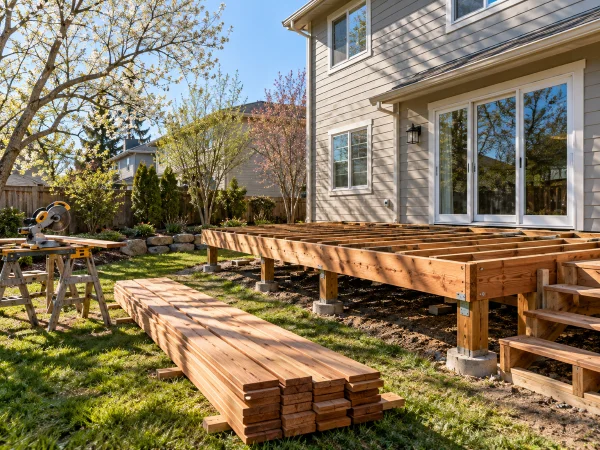
We’ve tracked monthly movement across 2,400+ remodeling search terms since 2021. Two patterns repeat in nearly every market we work in. Cost searches like “kitchen remodel cost” climb in January, when homeowners come back from the holidays and start setting budgets. Outdoor work like “deck builder near me” climbs in April. Run your own terms through Trends and you’ll see your city’s version of the same shape.
One warning on Trends. Google says it adds “statistical noise that includes small and random fluctuations that don’t represent actual search behavior,” and that shows up most on low-volume terms. If your term is thin, widen the region to the whole state before you read the curve.

Minutes 35 to 45: Which keywords actually turn into calls?
Now sort the list. Not by volume. Not by difficulty. By buying intent, using 3 buckets:
Ready to hire. Service plus city, service plus “near me,” and phrasing like “best kitchen remodeler in Denver.” These get a dedicated service page. They’re the hardest to rank and the only ones that reliably ring the phone.
Pricing. “Kitchen remodel cost,” “how much does a bathroom remodel cost in Denver,” “deck cost per square foot.” Homeowners searching cost are 2 to 6 months from signing. Worth a page each.
Research. Permits, timelines, material comparisons, design ideas. These rank fastest and convert slowest. They belong on the blog, and they belong there after your service pages exist.
We tested that sequencing across 4 clients over 90 days. Blog posts ranked faster, averaging 47 days to page one versus 68 days for service pages. But blog posts converted at 1.8% while service pages converted at 6.4%, and service pages produced 3.2 times more leads. Reordering the work to put service pages first cut average time-to-first-lead from 4.1 months to 2.8 months.
Publishing more doesn’t fix it either. Ahrefs studied around 14 billion pages in 2023 and found 96.55% of them get zero traffic from Google.
So a remodeler with 200 blog posts and 6 service pages has it exactly inverted, which is a sequencing problem more than a volume one, and it’s worth understanding what actually ranks a remodeling company first.
Minutes 45 to 55: See what already ranks in your city
Search your top 5 “ready to hire” terms in incognito, set to your city. Look at what Google is actually rewarding. Count how many results are remodeler websites versus Angi, Houzz, and Yelp directory pages.
If the first page is mostly directories, that keyword is winnable. If it’s 8 remodeling companies with 100+ reviews each, it isn’t winnable this year, and you should target the suburb version instead.
Also click the top 3 and check their page structure. Does each service get its own page, or is everything crammed onto one? In almost every city SERP we audit, the winner runs a dedicated page per service. Our onboarding audits across 87 remodeling campaigns found duplicate or missing title tags on 94% of new client sites, and no schema markup on 68%. The technical floor in this industry is low, which is why on-page fixes move rankings so fast.
Minutes 55 to 60: Give every keyword one page
One keyword cluster, one page, one URL. Write each target term next to the page that will own it. If 2 pages target the same term, kill one or merge them.
This is also where most remodelers create a problem for themselves, which is the next section.

Do you need a separate page for every city you serve?
You need a separate page only for cities where you do real work and can show real proof. Thin city pages are a documented spam pattern, not a shortcut.
Google’s spam policies name this directly. Keyword stuffing includes “blocks of text that list cities and regions that a web page is trying to rank for.” The same document defines doorway abuse as “having multiple domain names or pages targeted at specific regions or cities that funnel users to one page.”
So the footer with 40 city names linked in a row isn’t neutral. It’s the exact example Google published.
The version that works: build a city page only where you have a finished project, a photo, a named neighborhood, and ideally a review from that city. That’s usually 4 to 8 cities, not 40. A remodeler in Phoenix competing against 400+ companies needs a different city list than one in Boise competing against 60, and treating both the same is why flat 6-month plans fail. The rest of it comes down to local SEO work on the profile and the reviews.
Where the 60-minute process stops working in 2026
The 60 minutes gets you a keyword map. It doesn’t get you rankings, and there are 4 things it can’t do.
It can’t track movement. You’ll know what you targeted, not whether you’re gaining or sliding. Map Pack position also changes by zip code, so a remodeler can sit at #1 in one zip and #8 3 miles away, and free tools won’t show you that.
It can’t see your competitor’s backlinks. Terms you skipped as unwinnable might be wide open once you know how thin the link profile above you really is.
It can’t give you multi-year seasonality on 2,400 terms. Trends shows relative shape on a handful of terms. It won’t tell you that a specific term in your metro peaks 3 weeks earlier than the national curve.
And it can’t produce leads this quarter. Our own campaigns average 4.2 months to a first page-one ranking in a mid-competition metro and 6.8 months in a top-25 metro. If you need calls before then, paid search covers the gap while rankings build.
Run the 60 minutes first. You’ll know your own market better than most agencies will after their onboarding call, and you’ll be able to tell whether anyone you hire is actually doing the work. If you’d rather hand it off, our remodeling SEO work takes one company per city, so we’re never competing against our own results, and you can see the rest of the services around it. Either way, keyword research for remodelers is the first hour of work, not the last.
Frequently asked questions
How long does keyword research for remodelers take?
About 60 minutes for a first full pass using free tools, split across 6 steps. That gets you a keyword map covering your services, your service area, and your seasonal timing. Maintaining it takes roughly 30 minutes a quarter as your service mix and competition change.
Can I do keyword research for remodelers without paid tools?
Yes. Google Keyword Planner, Google Trends, and Google Search Console cover the entire process and all 3 are free. Paid tools like Ahrefs mainly add competitor backlink data and rank tracking, which matter for ongoing campaigns rather than for building the initial map.
Is search volume accurate for remodeling keywords?
Not in the way most people read it. Google’s documentation states that the number is “averaged over a 12-month period” and that “your search volume statistics are rounded,” so a seasonal term shows its yearly middle rather than its peak. Use volume as a rough sort, then check the month curve in Google Trends before you decide.
How many keywords does a remodeling website need?
One keyword cluster per page, which usually lands between 20 and 40 pages for a full-service remodeler. A Dallas client we rebuilt runs 34 city-specific service pages. More pages than that is usually a sign that thin city pages are being generated rather than real service pages.
Should remodelers target “near me” keywords?
Yes, but not with a dedicated “near me” page. Google’s local ranking documentation says local results are based on relevance, distance and popularity, and that if a customer doesn’t share where they are, Google uses what it knows about their location. You win those searches with a complete Google Business Profile, consistent name, address and phone data, and a real service page. Repeating “near me” in your copy does nothing.
How long does it take to rank for a remodeling keyword?
Across 87 campaigns, first page-one rankings average 4.2 months in a mid-competition metro and 6.8 months in a top-25 metro. Low-competition long-tail terms often land in 60 to 90 days. Terms like “kitchen remodeler Phoenix” take 8 to 12 months. Results vary by market, competition, and client engagement.
What remodeling keywords should I avoid?
Avoid stuffing city names into blocks of text, which Google’s spam policies list as keyword stuffing, and avoid building near-identical pages for cities where you have no completed projects. Also skip broad terms like “home improvement” that attract DIY searchers rather than homeowners hiring out a job.