Across 87 remodeling SEO campaigns we’ve run since 2019, the companies that rank fastest share one habit, and it isn’t blogging. They fix their Google Business Profile and city service pages first, then add content later. When we tested that order against a blog-first approach across four clients over 90 days, the service-page-first sequence cut time to first lead from 4.1 months to 2.8.
So if you want your remodeling company to rank higher on Google, start where the buyers are. In our client data, about 7 in 10 remodeling leads begin on Google, not on social media. A homeowner searches, checks the three map results, reads a few reviews, and calls. They don’t read fifteen blog posts first. Your job is to show up in those map spots, back it with reviews, and give every service and city its own page. And most agencies won’t tell you this: you’ll see keyword movement in 30 to 60 days, not twelve months.
What follows is the order we actually work in, how long each step takes, and the numbers behind it.
What ranking higher on Google actually means for a remodeler
For a remodeling company, ranking higher on Google means three things: showing up in the Map Pack (the three local results next to the map), ranking in the blue organic links below it, and appearing in AI answers like Google’s AI Overviews. For local remodelers, the Map Pack drives the most calls by far.
That matters because the three channels need different work. The Map Pack runs on your Google Business Profile, reviews, and location relevance. Organic links run on your service pages and the sites that link to them. Get the first two right and the AI answers tend to follow, because they pull from the same signals.
How long does it take a remodeling company to rank higher on Google?
Faster than most agencies claim. “SEO takes 12 months” is what a lot of firms say to buy themselves a year of billing before anyone checks the work. In our campaigns, keywords start moving into the top 50 within 30 to 60 days, and most clients get their first organic leads by month 3 or 4. The twelve-month figure only holds if you define success as the number-one spot for the single most competitive keyword in a top-10 city.
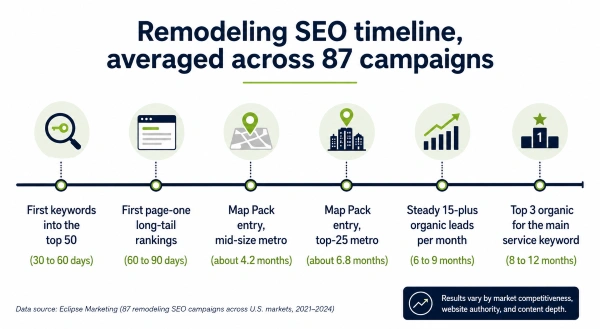
This is what the timeline looks like, averaged across 87 campaigns in 18 markets:
| Milestone | Typical timeline |
|---|---|
| First keywords into the top 50 | 30 to 60 days |
| First page-one rankings (long-tail terms) | 60 to 90 days |
| Google Map Pack entry, mid-size metro | about 4.2 months |
| Google Map Pack entry, top-25 metro | about 6.8 months |
| Steady 15-plus organic leads per month | 6 to 9 months |
| Top 3 organic for your main service keyword | 8 to 12 months |
Two things move these dates more than anything else: your review count and your city’s competition level. A remodeler in Boise (around 60 competitors on Google) ranks on a different clock than one in Phoenix (400-plus). Any agency quoting a flat “6-month plan” without asking your city size is guessing. Across our client base, 78% reach the Map Pack within six months. (Results vary by market, competition, and how many reviews you start with.)

Start with the Map Pack, not a blog
Most remodelers get this backwards. They pay someone to pump out blog posts while their Google Business Profile sits half-empty. We’ve audited remodeling sites with 200-plus blog posts pulling fewer leads than sites with 35 targeted service pages. In our four-client test, service pages converted at 6.4% while blog posts converted at 1.8%. Blog posts ranked faster but brought in researchers, not buyers.
So the first 90 days go to the assets that produce calls, and that starts with your Google Business Profile. Most remodelers show up with three photos and a one-line description. We rebuild the categories, service list, and Q&A, and load at least 25 geotagged project photos. Across clients, that work lifts map impressions by an average of 340% in the first 90 days. Blog content earns its place later, once the service pages are pulling leads, and content still matters for topical authority and internal links.

How many Google reviews does a remodeler actually need?
At least 20, and keep them fresh. BrightLocal’s 2026 review survey found that 47% of people won’t use a business with fewer than 20 reviews, and 74% only trust reviews written in the last three months. Those two numbers explain why review count and recency beat almost everything else in the Map Pack.
Now the hard part. If you have 8 reviews and the remodeler ranking above you has 85, you’re not cracking the top three for a while. We see it constantly. That’s why we install an automated review request that fires after every completed job. Clients go from 0 or 1 new review a month to 4 to 6. It’s the highest-return habit a remodeler can build, and it’s mostly free.
One warning from the field. Your reviews live on your Google Business Profile, and that profile is tied to your name, address, and phone number. Change the phone number on your website but not on your directory listings and you can fall off the map. We watched a client drop from third to fourteenth in the Map Pack after a number change hit 37 citation sites inconsistently. We now roll out any address or phone change across every listing at once.

Build a page for every service and city you serve
One page per service, one page per city. A homeowner searching “bathroom remodeler in [their suburb]” should land on a page about bathroom remodels in that suburb, not your generic homepage. For a typical client we build or rewrite 30-plus city-specific service pages, each targeting one keyword cluster with local copy, real project details, and internal links to related services.
The most common problem we find at the start? Duplicate or missing title tags. On 94% of new-client audits, service pages either share one title tag or have none, and Google can’t rank pages it can’t tell apart. Clearing those on-page issues is usually the first thing we do, before writing a word of new content.
Skip the keyword stuffing. Write the page for the homeowner, name the neighborhoods you actually work in, and show the projects you’ve actually finished. Our keyword targets come from a database of 2,400-plus remodeling search terms sorted by service, intent, and season, so we already know “kitchen remodel cost” spikes in January and “deck builder near me” spikes in April.

Do the technical basics, then stop obsessing
Site speed and mobile matter, but they’re a floor, not a strategy. Google’s Core Web Vitals set the bar: your main content should load in under 2.5 seconds, the page should react to a tap in under 200 milliseconds, and it shouldn’t jump around as it loads. At intake, 41% of new clients score below 40 on mobile speed, almost always from huge uncompressed project photos.
Fix the fundamentals: compress the images, get a fast mobile load, add LocalBusiness, Service, and Review markup so Google can read your pages, and clear crawl errors in Search Console. Google’s structured data guidelines spell out how to mark up a local business. Then move on. We’ve watched remodelers chase a perfect 100 speed score for three months while a competitor with a 78 and 90 reviews took every top-three spot. Past a solid baseline, reviews and content move rankings more than another few milliseconds. If a site is built on a locked Wix or GoDaddy template we can’t fix (about 35% of new clients), we rebuild the site first rather than bolt SEO onto broken architecture.
Backlinks and local authority still count
Links are still how Google measures trust, and most pages don’t have any. Ahrefs analyzed about 14 billion pages and found 96.55% get no organic traffic, with 55% having no other site linking to them at all. A local remodeler doesn’t need thousands of links. You need 15 to 25 solid ones a month from local directories, home improvement blogs, suppliers, and the occasional guest post. No link farms, no bought links.
Ignore the advice to get listed on as many directories as possible. Bulk submissions create inconsistent name, address, and phone data across the web, which hurts local rankings more than the links help. Pick 15 to 20 high-authority directories (Google, Yelp, BBB, Houzz, your free Angi listing) and use identical information on each. Whether backlinks still matter in 2026 comes up in nearly every sales call, and the answer is yes, but consistency and quality win, not volume.
Is SEO better than Angi for a remodeling company?
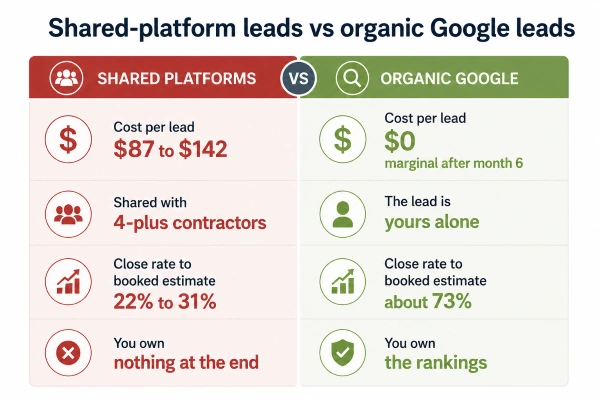
For most established remodelers, yes, and it isn’t close on lead quality. Shared platforms like Angi and HomeAdvisor sell the same lead to four or more contractors, so you compete on price the second the phone rings. Organic Google leads come to you alone. The comparison, from clients who share their CRM data with us:
| Shared platform leads (Angi, HomeAdvisor) | Organic Google leads | |
|---|---|---|
| Cost per lead | $87 to $142 (client-reported) | $0 marginal after month 6 |
| Who gets the lead | Shared with 4-plus contractors | You alone |
| Close rate to booked estimate | 22% to 31% | about 73% |
| What you own at the end | Nothing | Rankings you keep |
Take our Dallas client, a kitchen and bath remodeler fifteen years in business. They were spending $6,200 a month on Angi and $3,800 on Google Ads, pulling 8 to 12 shared leads a month and closing about 1 in 10. We rebuilt the site, launched 34 city service pages, ran the review system (47 reviews to 119 in eight months), and built 20 links a month. By month seven they ranked second in Google Maps and organic for “kitchen remodeler Dallas.” Organic leads went from 3 or 4 a month to 22 to 27. They cancelled Angi, paused the ads, and their pipeline moved from a $1.2M to a $2.1M annual run rate. (Results vary by market, competition, and client engagement. Past performance does not guarantee identical future results.)
If you need calls this week while rankings build, we often run Google Ads in parallel and let SEO replace that spend over time. Social media supports the work too (a few project photos a week on Instagram), but Google is where remodeling buyers actually decide.
How much does remodeling SEO cost?
Expect $3,500 to $5,000 a month for real remodeling SEO, with no setup fee. The main thing that moves the price is your city’s competition level. A top-10 metro like Los Angeles or Dallas sits at the high end; a mid-size market like Boise or Raleigh usually runs $3,500 to $4,000. Google Ads management or a site rebuild is scoped separately. (Pricing varies by market competition and scope. Contact us for a custom quote.)
Compare that to the lead-platform math. A remodeler spending $7,000 a month on Angi burns $84,000 a year and owns nothing when they stop. At $4,500 a month, SEO runs $54,000 a year and builds rankings that keep working. And if your “SEO” costs $500 a month, it isn’t SEO. It’s someone submitting you to directories and calling it a service.
Can you do remodeling SEO yourself?
Some of it, yes. If you’re handy and have the time, you can complete your Google Business Profile, add real project photos every week, and set up a system to ask every customer for a review. Those three habits alone will move you up. The trouble is most owners doing $500K or more a year don’t have the hours, and the rest of the work (city page architecture, technical fixes, monthly link building) is where a specialist earns the fee.
Not sure whether to hire out? Run this quick check:
- Are you spending $3,000 or more a month on lead platforms?
- Do you have 20 or more Google reviews, or a clear way to get there?
- Have you been in business three or more years with a real portfolio?
- Is your average project $15,000 or more?
- Can you commit to a 6 to 12 month build?
Four or more yeses and the math usually works. Fewer than that and you’re better off doing the free basics yourself first. We turn down handymen, brand-new startups, and anyone with a $500 monthly budget, because SEO won’t pay off for them yet.

What the first 90 days actually look like
Weeks 1 to 2 go to a full technical audit (we crawl the site with Screaming Frog and check 127 remodeling-specific items) and a keyword-to-page map. Weeks 2 to 3 rebuild the Google Business Profile, because that drives the fastest early wins. Weeks 3 to 8 build or rewrite the service and city pages and install schema. Link building and the review system start around month two and run without stopping. By day 90, most clients have pages on page one for long-tail terms and a first steady trickle of organic calls. Not a finished campaign, but a base that compounds.
Rankings are the only lead source you own
Rent leads from Angi and the day you stop paying, the calls stop. Rank your remodeling company higher on Google and those rankings keep sending work, at close to zero marginal cost, for as long as you hold them. That’s the real difference, and it’s why we tell every remodeler the same thing: stop building someone else’s business and start owning your market. Pick your city, fix the Map Pack, earn the reviews, and give every service its own page. The calls follow. If you want SEO built for remodelers, that is the whole of what we do.
Frequently asked questions
How long does it take a remodeling company to rank higher on Google?
Keywords usually start moving within 30 to 60 days, and most clients get their first organic leads by month 3 or 4. Google Map Pack entry averages about 4.2 months in a mid-size metro and 6.8 months in a top-25 metro, and 78% of our clients reach the top three local results within six months.
How much does SEO cost for a remodeling company?
Real remodeling SEO runs about $3,500 to $5,000 a month with no setup fee, priced mainly by your city’s competition level. Anything near $500 a month is not real SEO. For comparison, many remodelers spend $6,000 or more a month on shared leads and own nothing when they stop.
Is SEO better than Angi for remodelers?
On lead quality, yes. Angi and HomeAdvisor sell the same lead to four or more contractors, so you compete on price. In our client data, organic Google leads convert to booked estimates at about 73%, compared with 22% to 31% from paid lead platforms.
How many Google reviews does a remodeler need?
At least 20, kept recent. BrightLocal’s 2026 survey found 47% of people won’t use a business with fewer than 20 reviews, and 74% only trust reviews from the last three months. Aim for 4 to 6 new reviews a month through an automated request after each job.
Can I do SEO for my remodeling company myself?
You can handle the basics: complete your Google Business Profile, add project photos weekly, and ask every customer for a review. The city page architecture, technical fixes, and monthly link building are where most owners run out of time and bring in a specialist.
Why didn’t my remodeling company rank higher on Google last time?
Nine times out of ten, what was sold as SEO wasn’t. When we pull the data, the previous provider built no links, published no locally targeted pages, and never touched the Google Business Profile. Paying someone who did nothing is a different problem from SEO not working.