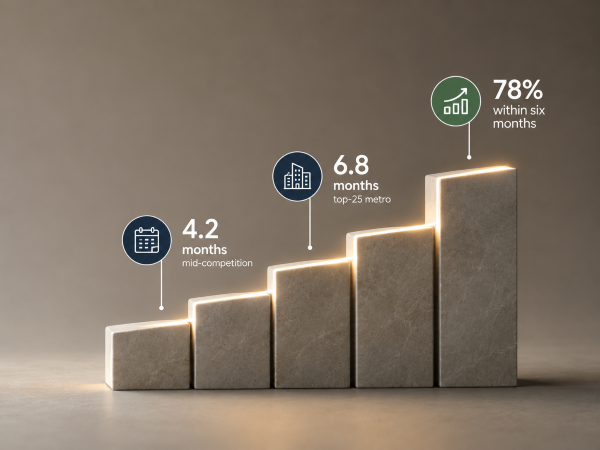
Across 87 remodeling SEO campaigns we’ve run since 2019, 78% of our clients reached the Google Map Pack, the three local listings pinned to the top of the results, within six months. The remodelers who got there fastest pulled the same levers, and those levers line up with the only ranking signals Google names in public: relevance, distance, and prominence. Those three are the real Google Maps ranking factors. Almost every tip you’ve read (finish your profile, gather more reviews, build citations) is a subset of one of them. One detail most guides skip: distance, one of the three, is the factor you can barely influence, and that changes where you should spend your effort. Below, I break down what each factor means for a remodeling company, how long ranking actually takes based on our data, and the moves that pull a remodeler into the top three.

The three Google Maps ranking factors in 2026
Google names three, and everything else rolls up into them. Google Maps ranking factors are the signals Google uses to decide which businesses show in local search and on the map. Google sorts them into three categories: relevance (how well your profile matches the search), distance (how close you are to the searcher), and prominence (how known and trusted your business is). Reviews, categories, photos, and links all feed one of these three.
Relevance
Relevance is how closely your Google Business Profile matches what a homeowner types. Google reads your primary category, your services, your description, and the words inside your reviews. A profile that lists “kitchen remodeler,” “bathroom remodeler,” and “home addition contractor” as distinct services reads as more relevant to those searches than one that just says “general contractor.” On our onboarding audits, 94% of new remodeling clients show up with duplicate or missing title tags and a half-filled profile. Fixing that alone moves keywords into the top 50 inside 30 to 60 days in most markets.

Distance
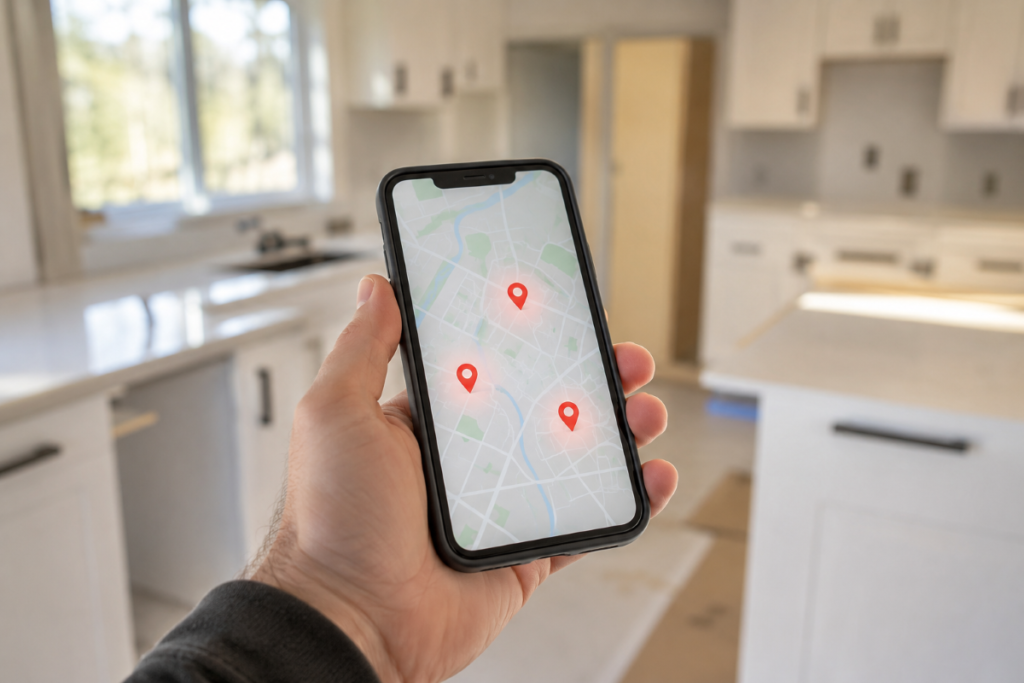
Distance is how far your business sits from the person searching, or from the city they name in the query. This is the factor you can’t argue with. You can’t move your shop, and you can’t fake your way into a neighborhood three towns over. Google leans on proximity hard for service searches. That’s why a remodeler can rank #1 for “kitchen remodeler” in their home zip code and sit at #8 three miles away. We track this at the zip-code level with LocalFalcon, because a single “you rank #3” screenshot hides the real picture. What you can do: name your true service areas in your profile, and build a page for each city you actually work in, with local detail a competitor can’t copy (permit timelines, the older housing stock in that area, real project addresses). That won’t beat proximity, but it widens the radius where you show up.
Prominence
Prominence is Google’s read on how known and trusted you are, on and offline. It’s built from your review count and quality, the number of real websites linking to you, how often your business name shows up across the web, and how consistent your name, address, and phone number are everywhere they appear. This is the factor most remodelers underrate, and the one you control most directly. Google says plainly that more reviews and higher ratings can improve local ranking. Across our campaigns, a full profile rebuild lifts map impressions by an average of 340% in the first 90 days, before we’ve built a single new link.
How long does it take a remodeler to rank in Google Maps?
Faster than most agencies will admit. Across 87 campaigns, our average time to Map Pack entry is 4.2 months in a mid-competition metro and 6.8 months in a top-25 metro. First measurable movement, keywords entering the top 50, usually shows up in 30 to 60 days.
“SEO takes 12 months” is the line agencies use to buy themselves a year of billing before anyone checks the results. It holds only if you define success as ranking #1 for the single most competitive keyword in a huge market. For the long-tail searches that actually ring your phone, like “bathroom remodeler in [neighborhood]” or “kitchen remodel cost [city],” traction comes far sooner. The gap between markets is real, though. A campaign in Phoenix, with 400-plus remodelers fighting for the map, runs on a different clock than one in Boise, with about 60. Anyone selling you a flat “six-month plan” that ignores your city’s competition is selling you a template.
| Milestone | Mid-competition metro | Top-25 metro |
|---|---|---|
| First keyword movement (top 50) | 30 to 60 days | 30 to 60 days |
| First page-one long-tail rankings | 60 to 90 days | 90 to 120 days |
| Map Pack entry, primary city keyword | about 4.2 months | about 6.8 months |
| Steady inbound lead flow (15+/month) | 6 to 9 months | 8 to 12 months |

Setting up your Google Business Profile the right way
Your Google Business Profile is the single most important asset for Map Pack ranking, and most remodelers leave half of it blank. Get these fields right before you spend a dollar on anything else:
- Business name: your exact registered name. Don’t stuff keywords like “ABC Kitchen Remodeling Denver” unless that’s your legal name. It’s against Google’s rules, and it can get the listing suspended.
- Primary category: the most specific one that fits. “Kitchen remodeler” or “Bathroom remodeler” beats the generic “General contractor” for those searches. Your primary category is the strongest single relevance lever you have.
- Secondary categories: add up to nine more, one for each real service (deck builder, home addition contractor, and so on). Nine is the current ceiling, not ten.
- Description: you get 750 characters, not 750 words. That’s roughly 100 to 120 words. Google shows the first 250 characters before a “more” link, so lead with your city and core services.
- Services and attributes: list every service on its own line, and check every attribute that applies (licensed, insured, veteran-owned, and so on).
- Photos: this is where remodelers win easily. We require at least 25 project photos at onboarding, geotagged, because most competitors have three. Before-and-after shots of real jobs pull profile views, which Google reads as an engagement signal. Name the files by service and city (kitchen-remodel-boise.jpg) so they’re at least descriptive, but the bigger win is volume and freshness, so add new photos every month.

How many Google reviews do you need for the Map Pack?
Enough to close the gap with the remodelers already ranking, which is usually more than you think. There’s no fixed number. If the three companies in your Map Pack carry 80-plus reviews and you have 12, a five-star average won’t get you in on its own. Google weighs three things: how many reviews you have, how recent they are, and your rating. Volume and recency beat a perfect score. A remodeler with 80 reviews at 4.7 stars will out-rank one with 12 at 5.0.
Reviews also close deals. BrightLocal’s 2024 Local Consumer Review Survey found 81% of consumers read Google reviews when weighing a local business, and 88% favor a business that responds to all of them. For a $50,000 kitchen, that trust gap decides who gets the call.
The fix is a system, not a sporadic ask. One client came in with 47 reviews and reached 119 in eight months by requesting a review by text within 48 hours of every finished job. We run that flow through GoHighLevel, and clients average four to six new reviews a month once it’s on, up from zero or one. Never pay for reviews or trade a discount for them. Google can suspend the listing, and it isn’t worth the risk.
Your website and your Map Pack ranking
Yes, your website affects your Maps ranking, more than most remodelers realize. Google cross-checks your Business Profile against your site to confirm you are who you say you are. A site that backs up your profile strengthens every signal on it. Four things carry the most weight:
- City service pages: a real page for each city you work in, with local detail, not one “service areas” page that lists 15 towns. This is the backbone of good city service pages.
- Service pages: separate pages for kitchen remodeling, bathroom remodeling, and home additions, each aimed at its own search.
- Schema markup: LocalBusiness and Service schema so Google can read your business type, location, and services without guessing.
- Core Web Vitals: load speed, mobile stability, and responsiveness. A slow mobile site drags down both map and organic rankings, so Core Web Vitals are worth fixing early.
Then there’s your name, address, and phone number, your NAP. Keep it identical everywhere. We watched a client fall from #3 to #14 in the Map Pack after they changed their phone number on their website but left the old one on 37 citation sites. Google saw a business with conflicting details and stopped trusting the listing. We now roll out any NAP change across every directory at once, in one controlled pass.
Why is your competitor outranking you on Google Maps?
Usually one of four reasons, and only some are fair. Work through them in order.
First, reviews. Nine times out of ten, the remodeler above you simply has more recent reviews. Close that gap and the ranking often follows.
Second, proximity. If their shop sits closer to the searcher or the city center, distance is doing the work, and there’s no fix except widening your service-area pages and earning enough prominence to overcome it.
Third, a keyword-stuffed business name. If a competitor’s listing reads “Denver Kitchen Remodeling Contractor LLC” and that isn’t their registered name, it breaks Google’s guidelines. You can file an edit or a redressal complaint, and it works more often than remodelers expect.
Fourth, fake or paid-for reviews. Harder to prove, but a sudden pile of five-star reviews with no text is reportable.
Track where you actually stand before you react. A remodeler can rank #2 downtown and #11 in the suburb where half their jobs come from. We map this per zip code with LocalFalcon so we fix the real weak spots instead of chasing a single number on one screen.
Can a remodeler rank in multiple cities on Google Maps?
Yes, but not with a single homepage that lists ten cities in the footer. Google needs a real page for each place you want to rank, built around that area’s searches and, ideally, a named local project. One Colorado client had no online presence at all, just a single-page template. We built a 40-page site with dedicated pages for six neighborhoods, gathered 28 reviews in 60 days, and had them on page one for “home remodeler [city]” by month five, generating six to eight organic leads a month by month six.
The mistake to avoid is spreading thin. A remodeler who builds ten shallow city pages usually ranks for none of them. Three strong pages beat ten weak ones. Match your page count to the markets you can actually service and support with reviews.
Is local SEO worth it for a remodeling company?
For an established remodeler already buying leads, it usually pays for itself inside a year. Done right, local SEO for remodelers runs $3,500 to $5,000 a month with a firm like ours, priced by how competitive your metro is. Pricing varies by market and scope, so treat that as a range, not a quote.
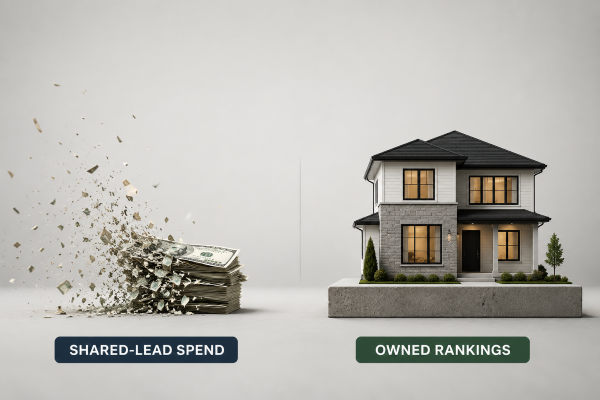
Compare the math. A remodeler spending $6,200 a month on shared Angi leads pays about $74,400 a year and owns nothing at the end of it. The same budget put into rankings builds an asset that keeps bringing in remodeling leads after you stop paying. One Dallas-area kitchen and bath remodeler we worked with was spending roughly $10,000 a month across Angi and Google Ads for 8 to 12 shared leads. Within seven months they ranked #2 in Maps and organic for their main city keyword, went from 3 to 4 organic leads a month to 22 to 27, and cancelled Angi. Results vary by market, competition, and how many reviews you start with.
Organic wins on more than cost. Across our clients, 73% of organic leads turn into booked estimates, against 22% to 31% from paid lead platforms, because a homeowner who found you and chose you is warmer than one whose contact details got sold to five contractors at once. If you need calls while rankings build, run Google Ads in parallel and let SEO replace that spend over time.
Should you do it yourself? If you’re a hands-on owner with time, you can finish your profile, ask for reviews, and clean up your NAP without help, and you should, this week. Hiring a team makes sense once ranking turns into a competitive fight that eats more hours than you can spare. Use this quick gut-check: are you spending $3,000-plus a month on lead platforms, do you have 20-plus reviews, have you been in business three-plus years, is your average job $15,000-plus, and can you commit six to twelve months? Four yeses means you’re ready to invest.
Where to start this week
If you do one thing after reading this, close your review gap. It’s the fastest and cheapest lever on the list, and it feeds the prominence factor most remodelers ignore. After that, finish your Google Business Profile completely, fix your NAP everywhere it appears, and build a real page for each city you serve.
The Google Maps ranking factors haven’t changed in years: relevance, distance, prominence. What separates the top-three remodelers from the ones on page two is boring. It’s doing the unglamorous work in the right order, month after month, before your competitor does. If you’d rather hand that work to a team built only for remodelers, that’s the whole reason Eclipse exists. We back it with a top-three ranking guarantee inside 12 months or a full refund; full terms come at onboarding.
Frequently asked questions
What are the main Google Maps ranking factors?
Google names three: relevance (how well your profile matches the search), distance (how close you are to the searcher), and prominence (how known and trusted you are). Reviews, categories, and links all feed these three. Across our 87 campaigns, 78% of remodeling clients reached the Map Pack within six months by working these factors in order.
How long does it take to rank in Google Maps for a remodeling company?
Our campaign data shows an average of 4.2 months to Map Pack entry in a mid-competition metro and 6.8 months in a top-25 metro, with first keyword movement in 30 to 60 days. The “SEO takes 12 months” claim usually reflects the hardest keyword in the biggest market, not the long-tail searches that generate calls.
How many Google reviews do I need to reach the Map Pack?
There’s no set number. What matters is closing the gap with the remodelers already ranking. If they hold 80-plus reviews and you have 12, you likely won’t crack the top three on rating alone, because Google weighs volume and recency alongside your star score.
Do Google Maps ranking factors depend on my website?
Yes. Google cross-checks your Business Profile against your website, so city pages, service pages, schema markup, fast Core Web Vitals, and consistent NAP all reinforce your Maps ranking. One client fell from #3 to #14 after a phone-number change left conflicting details on 37 citation sites.
Can a remodeler rank in Google Maps far from their address?
Only so far. Distance is the one factor you can’t control, and Google favors businesses near the searcher. Naming your true service areas and building a detailed page for each city you serve widens your radius, but it won’t fully beat a competitor sitting closer to the searcher.
Why is my competitor ranking higher on Google Maps?
Usually more recent reviews, closer proximity, or in some cases a keyword-stuffed business name or fake reviews that break Google’s guidelines. Reviews and proximity are the common causes; name-stuffing and fake reviews can be reported and often removed.
Is local SEO worth the cost for remodelers?
For an established remodeler spending on shared leads, it typically pays back within a year. Expect $3,500 to $5,000 a month depending on your market. Organic leads convert to booked estimates at 73% in our data, against 22% to 31% for paid platforms. Results vary by market, competition, and client engagement.
Can a remodeling company rank in multiple cities on Google Maps?
Yes, with a dedicated local page for each city rather than one page listing many. One client ranked on page one across six neighborhoods by month five using this approach. Three strong city pages beat ten thin ones.
Do Google Ads improve Google Maps ranking?
No. Paid ads don’t affect your organic Map Pack position; they’re a separate system. Ads can bring leads while your rankings build, but they don’t move your Maps placement.