
Most remodelers fix the wrong part of their Google Business Profile first. They rewrite the description and leave the two things that actually decide the Map Pack untouched: the primary category and review activity. Across 87 remodeling campaigns we’ve run since 2019, a full profile overhaul lifts map views an average of 340% in the first 90 days, and the single biggest move is almost always the category, not the wording.
Google Business Profile optimization for remodelers means setting up and maintaining your free Google listing so it ranks in the local Map Pack and turns nearby searchers into phone calls. For a remodeling company, it’s the fastest and cheapest lever in local SEO for remodelers, because the Map Pack sits at the top of local results, above the regular blue links.
This guide covers what to fix, in the order that moves rankings. Data first, checklist second.

What Google Business Profile optimization means for remodelers
It’s the work of claiming your listing, choosing the right categories, gathering reviews, adding real photos, keeping your contact details identical everywhere, and reading the performance numbers. Done well, it’s often the only reason a homeowner three miles away calls you instead of the remodeler down the street. It’s also the one part of local SEO you can start today for free, which is why it belongs first in any plan. Your profile can even carry you before your website does. We’ve had remodelers rank without a website on the strength of the profile alone, though that’s a floor, not a ceiling.
The three signals Google actually ranks on
Google ranks local businesses on three things: relevance, distance, and prominence. Your description is a small relevance signal. Your category and your reviews are not small.
Google’s own local ranking guidelines spell it out: relevance is how well your profile matches the search, distance is how close you are to the searcher, and prominence is how known you are, measured partly by review count and links.
So the profile is the strongest asset you own in local search. Inside it, two levers move the most: category and reviews. The common advice to write a keyword-stuffed description first has the priority backwards.

Your primary category is the biggest lever, so set it first
Pick the primary category that names exactly what you do. For a kitchen specialist, that’s “Kitchen remodeler,” not the broad “General contractor.”
Google gives remodelers specific categories to choose from, including General Contractor, Remodeler, Kitchen Remodeler, Bathroom Remodeler, and Construction Company. Your primary category carries the most weight, so match it to the service you most want to rank for, then add secondary categories for the rest of what you do. Whitespark’s research is blunt on this point: the primary category is one of the highest-impact settings on the whole profile, because it tells Google which searches you belong in.
One warning. Don’t cram keywords or your city into the business name to game this. Google’s guidelines for representing your business require your name to match your real-world branding, and profiles that break the rule get suspended. On new-client audits, the wrong or vague primary category is one of the most common problems we find, and correcting it is often what moves map views the most in the first 30 days.

Do reviews actually change your ranking?
Yes, more than anything you write yourself. Reviews are the clearest prominence signal you control, and Google states plainly that more reviews and higher ratings can improve local ranking.
Homeowners lean on them too. In 2025, 83% of consumers read reviews on Google, according to BrightLocal’s Local Consumer Review Survey, and only 4% never read reviews at all. One shift is worth knowing: the share of people who trust reviews as much as a personal recommendation fell to 42% in 2025, down from 79% in 2020. Volume alone won’t cut it now. Recent, specific, replied-to reviews carry more weight than a stack of old five-star ratings.
That’s why we install a review request that fires by text after a job wraps. Clients go from 0 to 1 new reviews a month to 4 to 6. One Dallas kitchen and bath remodeler climbed from 47 reviews to 119 in eight months, and the profile reached the top three in Maps for its main city search. Two habits do the heavy lifting: ask happy homeowners to name the job and town in their review (“kitchen remodel in Plano”), and reply to every review, the good ones and the rough ones.
Photos: why three isn’t enough
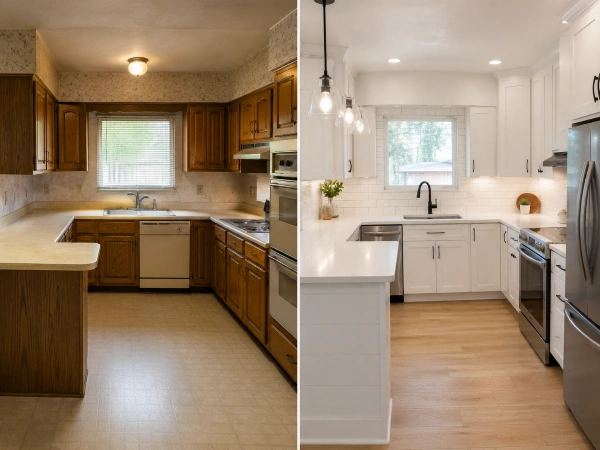
Add real project photos, a lot of them, and keep adding. Most remodelers we audit start with three photos and a one-line description, then wonder why the listing looks dead.
Upload before-and-after sets, in-progress shots, your crew and trucks, and finished rooms with the materials in frame. We require at least 25 real project photos on every profile we manage. Fresh beats polished here: add new sets as you finish jobs, because an active profile reads as a working business to both homeowners and Google. Skip the stock photography. A homeowner can tell the difference, and so can the algorithm that rewards profiles that look alive.

Set up as a service-area business and protect your NAP
If you work at customers’ homes instead of a storefront, set the profile as a service-area business and hide the street address. Then guard your name, address, and phone number like a ranking asset, because that’s what they are.
We watched one remodeler drop from third to fourteenth in the Map Pack after switching phone numbers on the website but not on 37 other citation sites. Mismatched contact details tell Google the listing can’t be trusted, and trust is part of prominence. When anything changes, a new number, a suite, holiday hours, update it everywhere at once, not just on the site. Consistent citations are one of the quieter off-page signals that hold your local ranking in place.
Do Google Posts and messaging help you rank in 2026?
A little, and mostly for conversion rather than ranking. Activity is a modest signal, not a shortcut, and any article promising big ranking gains from weekly posts is overselling it.
Turn on messaging and Q&A so homeowners can reach you fast, then seed the Q&A with the questions you already get: Do you offer free estimates? Are you licensed and insured? What areas do you serve? Post when you have something real, a finished project or a seasonal offer, instead of grinding out filler to hit a schedule. Profiles that look active do tend to do better, but a weekly post won’t outrank a competitor with sharper categories and more reviews. Spend the effort on reviews first.
Track what actually leads to booked estimates
Use the profile’s performance view to watch three numbers: calls, direction requests, and the search terms that surfaced you. Skip the vanity totals.
Pair that with what Google Analytics shows about the traffic landing on your site, so you’re measuring booked estimates, not clicks. Read the data like a to-do list. If a search term brings views but no calls, your photos or reviews are the gap. If most calls come from one neighborhood, build a page for it and add local business schema so Google connects the profile to your site.
How long until a remodeler ranks in the Map Pack?
In our data, most remodelers reach the Map Pack within six months. The exact timing depends on your market’s size and how many reviews you start with.
| Market type | Typical time to Map Pack | Biggest accelerator |
|---|---|---|
| Mid-size metro (Boise, Raleigh) | ~4.2 months | Correct primary category + first 10 reviews |
| Top-25 metro (Dallas, Los Angeles) | ~6.8 months | Review velocity + citation cleanup |
| Starting under 10 reviews | Add 2 to 4 months | Front-load the review system |
Across our clients, 78% reach the top three local results within six months. The ones who start with fewer than ten reviews take longer, because a competitor sitting on 80-plus reviews is hard to pass until you close that gap. Timelines vary by market, competition, and how fast you gather reviews, so treat these as our observed averages, not a promise. If you need calls sooner, you can run Google Ads while the profile and rankings build.
Should you optimize your profile yourself or hire help?
If you have the time, you can do most of this yourself. The category, photos, reviews, and contact cleanup are all in your hands. What’s hard to sustain alone is review velocity month after month, citation building, and ranking the website behind the profile.
Here’s the math that makes remodelers switch. Shared lead platforms charge for the same lead sent to several contractors at once.
| Shared lead platforms | Optimized profile + SEO | |
|---|---|---|
| Cost per lead | $87 to $142 (client-reported) | ~$0 marginal after setup |
| Shared with competitors | Yes, often 4 to 5 | No |
| Close rate | 22% to 31% (paid platforms) | ~73% (organic, our clients) |
Full local SEO for a remodeler runs $3,500 to $5,000 a month in our shops, month-to-month, with no contract. Pricing varies by market competition and scope, and results vary by market, competition, and engagement. We also cap it at one remodeler per city, so we’re never ranking two clients against each other for the same search. If you’d rather hand off the parts that don’t scale on your own time, that’s what we do for remodeling companies and it’s how our clients get more remodeling leads without renting them.
The profile is the rare marketing asset you own outright. Rented leads disappear the day you stop paying. Strong Google Business Profile optimization keeps sending a remodeler calls long after the setup work is done, and that’s the difference between paying for demand and owning it.
Frequently asked questions
What is Google Business Profile optimization for remodelers?
It’s the ongoing work of claiming your free Google listing, setting the right categories, collecting reviews, adding real project photos, keeping contact details consistent, and tracking performance. For a remodeler, it’s the fastest lever in local SEO because the Map Pack shows above regular search results.
How do remodelers rank higher in the Google Map Pack?
Google ranks on relevance, distance, and prominence. The moves that matter most are choosing an accurate primary category, gathering recent reviews, keeping your name, address, and phone identical across the web, and adding real photos. Category and reviews matter more than the description.
Which category should a remodeler choose on Google Business Profile?
Pick the most specific primary category that matches what you want to rank for, such as Kitchen Remodeler or Bathroom Remodeler rather than the broad General Contractor. Add secondary categories for your other services. The primary category is one of the highest-impact settings on the whole profile.
How many Google reviews does a remodeler need to rank?
There’s no fixed number, but it’s relative to your competitors. If the top three in your market have 80-plus reviews, cracking the Map Pack under ten is tough. Our clients average 4 to 6 new reviews a month once a request system is running, up from 0 to 1 before.
How long does Google Business Profile optimization take to work for remodelers?
About 4.2 months to Map Pack entry in a mid-size metro and 6.8 months in a top-25 metro, based on our campaigns. 78% of our clients reach the top three local results within six months. Starting with fewer than ten reviews adds two to four months.
Should a remodeler hide their address on Google Business Profile?
Yes, if you work at customers’ homes rather than a storefront. Set it up as a service-area business and hide the street address. Just keep your contact details identical everywhere: we’ve seen a remodeler fall from third to fourteenth after a phone number changed on the site but not across its citations.
Do Google Posts help remodelers rank?
Only a little, and mostly by helping conversion rather than ranking. Post real updates when you have them and enable messaging and Q&A so homeowners can reach you, but don’t expect weekly posts to outrank a competitor with better categories and more reviews.