

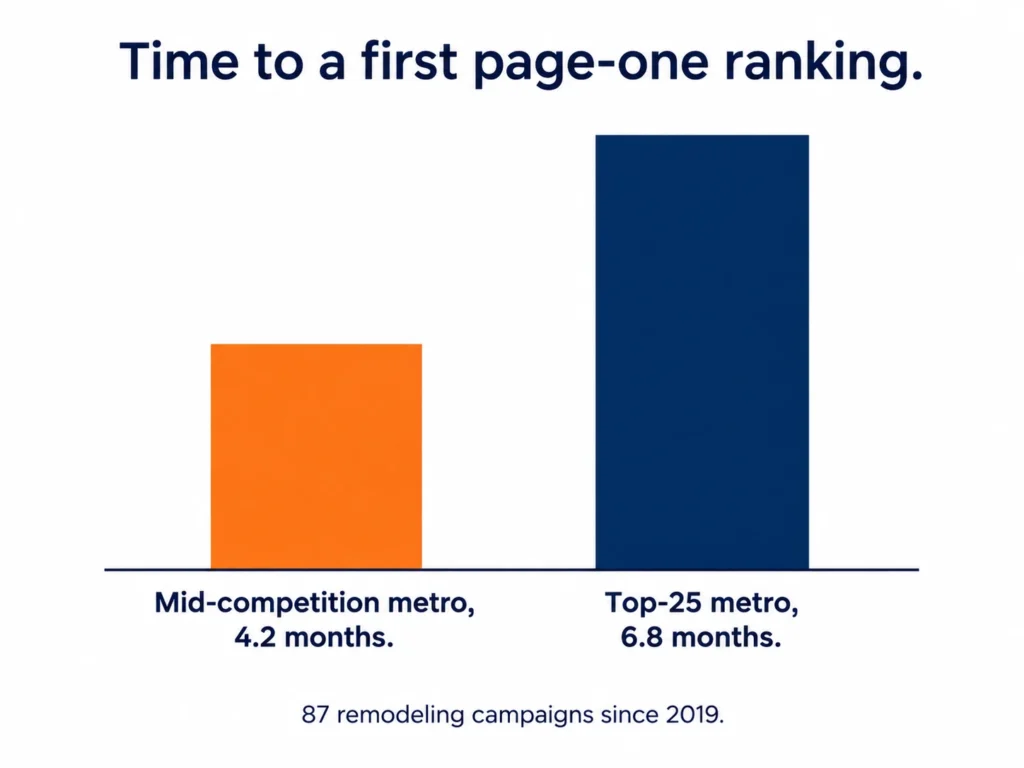
Winning the Map Pack in your city starts with an honest read of the city itself. Across the 87 remodeling SEO campaigns we’ve run since 2019, the same work reached a first page-one ranking in 4.2 months in a mid-competition metro and 6.8 months in a top-25 metro. Same checklist. Same effort. Different market.
So before you touch your Google Business Profile, count what you’re up against. How many remodelers already show up for your main service term, and how many reviews are the three in the Map Pack carrying? Those two numbers set your timeline. Everything after that is category selection, review velocity, matching business details across the web, and city pages that earn the click.
Local SEO for remodeling contractors is the work of getting a remodeling company into Google’s top three local results, the Map Pack, for searches in the city it serves. It covers the Google Business Profile, review count and recency, consistent business information across directories, and city-specific service pages on the company website.
What is the Map Pack, and why does it decide your lead flow?
The Map Pack is the block of three local businesses Google shows above the regular results with a map, star ratings, and call buttons. For a homeowner searching “bathroom remodeler near me,” those three listings are usually the whole shortlist. They tap one, read a few reviews, and call.
Google is unusually direct about how it picks those three. Its own Business Profile documentation names relevance, distance, and prominence, and defines them plainly: relevance is “how well a Business Profile matches what someone is searching for,” distance is “how far each business is from the customer who’s searching,” and prominence “means how well-known a business is.” The same page closes the door on the question every contractor asks first: “There’s no way to request or pay for a better local ranking on Google.”
That matters because it means the pack is winnable. Nobody above you bought their spot.
Your city sets your timeline before you do any work
Most agencies sell a flat plan. Six months, one price, same steps in Boise as in Phoenix. That plan fails in the bigger market and undersells the smaller one, because competition density is doing more of the work than the checklist is.
Boise has roughly 230,000 people and about 60 remodelers showing up on Google. Phoenix has roughly 1.6 million people and more than 400. A remodeler in each city can run the identical program and land months apart. Here’s what our own campaign data looks like when you split it by market size.
| What you’re reading | Mid-competition metro | Top-25 metro |
|---|---|---|
| Example | Boise, roughly 230,000 people | Phoenix, roughly 1.6 million people |
| Remodelers showing up on Google | about 60 | more than 400 |
| Our average time to a first page-one ranking | 4.2 months | 6.8 months |
| What we front-load | Category, 25+ project photos, city pages | Reviews, then everything else |
Across all 87 campaigns, 78% of clients reached the Map Pack within six months. The ones who took longer were almost always in a top-25 metro, starting with fewer than 10 reviews, or both. If a salesperson quotes you a timeline before asking which city you’re in, they’re quoting you an average, not a plan. Our real ranking timelines by market break the same data down further.
How do you read your market in 20 minutes?
Do this before you spend a dollar. Open Google from an address inside your service area, not from your office if your office sits on the edge of town, and search your main money term: “kitchen remodeler [your city]” or “bathroom remodeling [your city].”
- Count the businesses that appear when you expand the map results. Under 100 is a market you can win in a year. Over 400 means reviews come first and everything else waits.
- Write down the review count of all three businesses in the pack. That is your target number, not some benchmark from a blog post.
- Check whether any of the three has a service keyword sitting inside its business name. If they all do, you’re looking at a market where somebody is pushing the rules.
- Search the same term again from a zip code five miles away. If the three businesses change, your city is really several small markets stacked together.
Twenty minutes gives you a competition count, a review target, and a rough sense of how many neighborhoods you’ll need pages for. That’s a better starting position than most contractors have after a year of paying someone.
What local SEO for remodeling contractors actually changes in 2026
Three things move a remodeling company into the pack: the profile itself, the reviews attached to it, and whether your website confirms you serve that city. Each one gets full treatment in our guide to local SEO for remodelers. What follows is how your market decides the order you do them in.
Whitespark’s 2026 Local Search Ranking Factors survey, published in November 2025 from 47 local SEO practitioners scoring 187 factors, put primary category at the top of the list with a score of 227. Proximity of the business address to the point of search came second at 225, keywords in the business title third at 223, and a physical address in the city of search fourth at 213. Review signals moved up to the heaviest factor group in this edition, ahead of behavioral signals.
Read that list again and notice what it does to your priorities. Your primary category is a single dropdown you can fix in four minutes, and it outranks nearly everything else. We still find remodeling companies filed under “Contractor” instead of “Kitchen Remodeler” after paying an agency for a year. Getting the category and service list right is the cheapest ranking work available to you.
Keywords in the business title being a real factor does not make name stuffing a good idea. Adding “Kitchen Remodeling Phoenix” to a business name that doesn’t legally carry it violates Google’s representation guidelines and gets profiles suspended. We’ve cleaned up that mess for contractors who inherited it. The full factor breakdown for remodelers covers where the line sits.
Your review target is whatever the three businesses above you are carrying
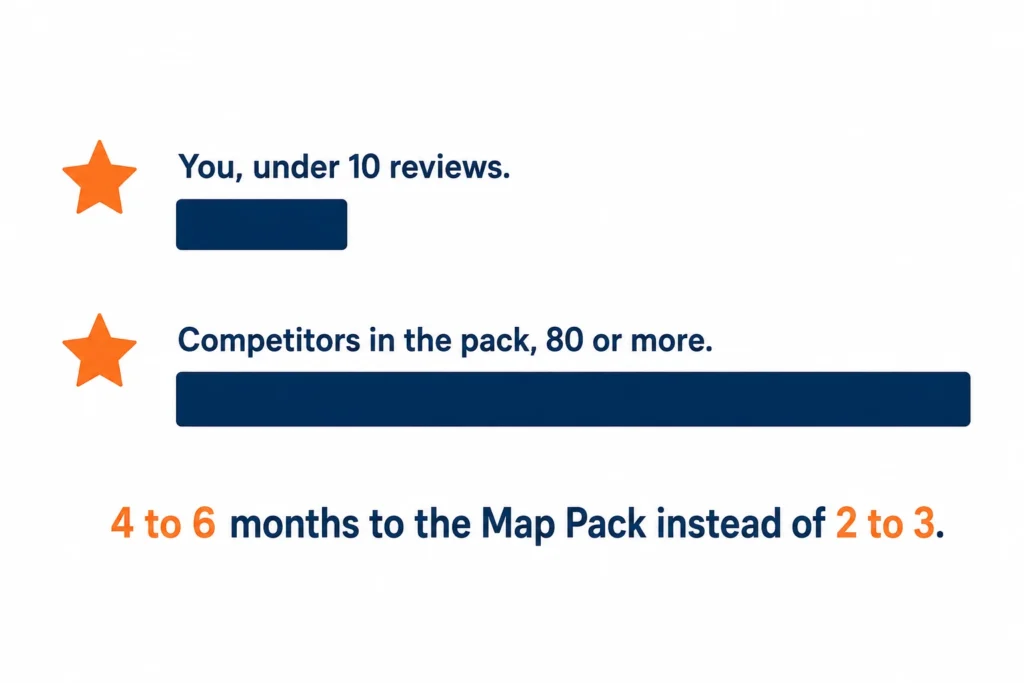
There’s no universal review count that gets you into the Map Pack. There’s only the gap between you and the three listings you want to displace. A remodeler with 40 reviews wins in a market where the pack sits at 25 and loses in a market where the pack sits at 120.
Homeowner behavior sets the floor underneath that. BrightLocal’s Local Consumer Review Survey, published in February 2026 from 1,002 US adults, found that 47% won’t use a business with fewer than 20 reviews and 74% only consider reviews written in the last three months. The share of consumers who will only use a business rated 4.5 stars or higher jumped to 31%, up from 17% the year before.
Recency is the part remodelers get wrong. A contractor with 90 reviews where the newest one is 14 months old reads as a business that stopped working. Our clients run a text-first ask at the final walkthrough and go from 0 or 1 reviews a month to 4 to 6. A Dallas kitchen and bath remodeler we took on went from 47 reviews to 119 over eight months and ranked #2 for “kitchen remodeler Dallas” by month seven.
If you’re starting under 10 reviews against competitors sitting at 80 or more, plan on 4 to 6 months to reach the pack instead of 2 to 3. We tell clients that number on the sales call, before they sign.
Why do you rank in one zip code and not the next?
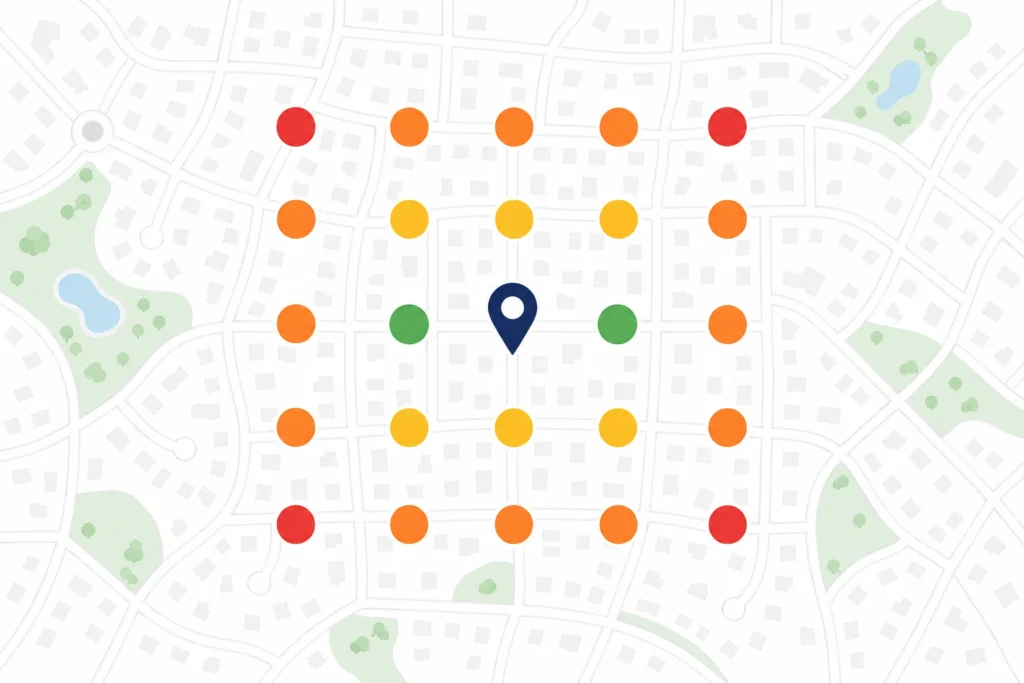
Because distance is one of Google’s three stated factors, and it’s measured from wherever the searcher is standing. Your rank isn’t one number. It’s a different number in every part of town.
We track this at the zip-code level with LocalFalcon, and the spread surprises owners every time. A remodeler can sit at #1 in the zip code holding their shop and #8 three miles away. Nothing is broken. That’s the distance factor doing what Google says it does. The fix is service-area pages and review volume, not another round of profile edits. We go deeper on this in our guide to Google Maps ranking for remodelers.
The fastest way to lose a Map Pack spot
Change your phone number and forget the directories. We watched a client fall from #3 to #14 in the Map Pack after their number changed on the website but stayed old on 37 citation sites. Google reads that inconsistency as uncertainty about which business is which.
The same principle applies to your website. At onboarding, 94% of new clients have duplicate or missing title tags on their service pages, 68% have no schema markup, and 41% score under 40 on mobile page speed. None of that shows up in the Map Pack directly, but the pack pulls prominence signals from the web at large, and a site Google can’t parse is a site that can’t support the profile. Our audit checklist for remodeling sites is the same one we run in week one.
Address and phone changes need a controlled rollout across every listing on the same day. Not the same month.
Doing it yourself or hiring it out
In a market with 60 competitors, an owner who spends two focused hours a week can do this. Fix the category, load 25 project photos, ask every customer for a review at the walkthrough, and build a page for each neighborhood you actually work in. That’s most of the job.
In a top-25 metro against 400 remodelers, it’s a job. The review system has to run without you, the pages have to be built and internally linked, and somebody has to watch the grid instead of one ranking.
Market conditions argue for moving now either way. The Harvard Joint Center for Housing Studies put annual home improvement and repair spending at $519 billion through mid-2027 in its July 2026 remodeling activity release, with year-over-year growth easing from 2.1% in the third quarter of 2026 to a projected 0.5% by the second quarter of 2027. Rachel Bogardus Drew, who directs the center’s Remodeling Futures Program, noted that “growth in remodeling permitting and retail spending on building products have flattened recently, suggesting that renovation activity is cooling.” Fewer homeowners starting projects means the three businesses in the pack take a larger share of what’s left.
We work with one remodeling company per city, which is also why we can tell you plainly whether your market is winnable before you spend anything. You can check whether your city is still open, or read how our clients replaced bought leads with Google first.
Questions remodeling contractors ask about the Map Pack
How long does it take to get into the Map Pack in my city?
Across 87 remodeling campaigns, 78% of clients reached the Map Pack within six months. Our average time to a first page-one ranking runs 4.2 months in a mid-competition metro and 6.8 months in a top-25 metro. Starting with fewer than 10 reviews against competitors carrying 80 or more pushes that to 4 to 6 months rather than 2 to 3.
How many Google reviews do I need to reach the Map Pack?
However many the three businesses currently in the pack have. There’s no fixed threshold. BrightLocal’s February 2026 survey found 47% of consumers won’t use a business with fewer than 20 reviews and 74% only weigh reviews from the last three months, so recency matters as much as the total.
Can I pay Google to be in the Map Pack?
No. Google’s own documentation states there is “no way to request or pay for a better local ranking on Google.” Local Services Ads appear above the pack and are paid, but they’re a separate placement, not a Map Pack position.
Why does my remodeling company show up in some parts of town but not others?
Distance is one of Google’s three local ranking factors, measured from the searcher’s location. Rank changes block by block. We’ve tracked remodelers sitting at #1 in one zip code and #8 three miles away with nothing wrong on the profile.
Does my website affect my Map Pack ranking?
Yes, indirectly. Prominence pulls from signals across the web, and city-specific service pages help Google connect your business to the places you serve. At onboarding we find missing or duplicate title tags on 94% of new-client sites, which limits what the profile can do on its own.
Is local SEO for remodeling contractors worth it in a slow market?
The Harvard Joint Center projects $519 billion in annual improvement and repair spending through mid-2027, with growth easing to about 0.5% by mid-2027. A flat market concentrates demand on whoever shows up first, which makes the three Map Pack spots more valuable, not less.
Where to start this week
Run the 20-minute market read. Count your competitors, write down the review counts of the three businesses above you, and check your primary category. If your city has under 100 remodelers competing on Google, you can move on that yourself starting Monday. If it has 400, get the review system running before anything else, because that’s the number you’ll be chasing the longest. Contractors who get this right usually end up with fewer leads and bigger projects, which is the outcome worth aiming at.
Local SEO for remodeling contractors is not a mystery. It’s a market read, a category, a review habit, and pages for the neighborhoods you actually serve, done in the order your city demands rather than the order a template suggests.