Most remodelers should put Google Ads first and Facebook ads second. Google catches the homeowner who just typed “kitchen remodeler near me.” Facebook interrupts the one watching a recipe video. Both can work for a contractor. They don’t work the same way, and if you need booked jobs this quarter, that difference decides where your money goes.
I’ve run 87 remodeling ad and SEO campaigns since 2019, and the Google Ads vs Facebook ads for contractors question comes up on almost every first call I take. My answer is never “just pick one.” It’s this: know what each channel is for, then judge both by the same number, cost per booked estimate, not cost per click.
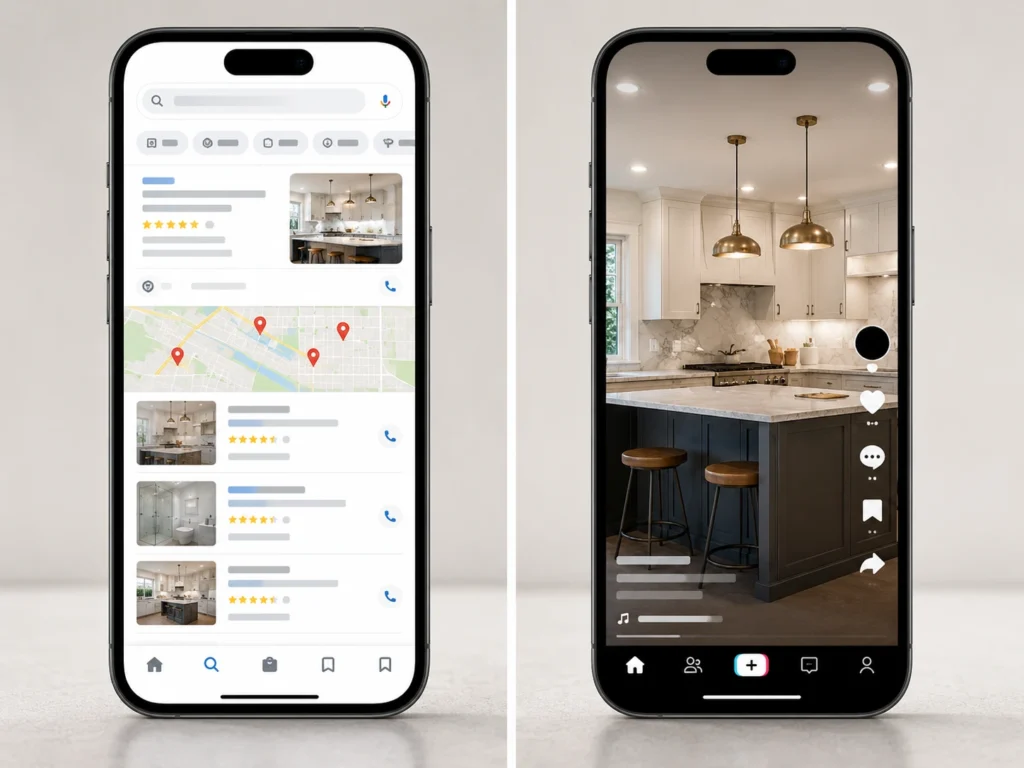
Google Ads and Facebook ads solve two different problems for contractors. Google Ads are paid search results that show when a homeowner searches something like “bathroom remodeler in Raleigh,” so they catch active buyers. Facebook ads, which include Instagram, are paid posts shown by interest and location, so they build awareness before demand exists.
Google Ads vs Facebook ads for contractors: the short answer
If you need jobs booked in the next 90 days, start with Google Ads. If you’re trying to be remembered for a project someone might want next year, that’s Facebook. This is how the two compare for a remodeler.
| Google Ads (search) | Facebook and Instagram ads | |
|---|---|---|
| Buyer mindset | “I need a remodeler now” | Not thinking about a remodel yet |
| What it does best | Captures demand that already exists | Builds awareness, retargets past visitors |
| Typical cost per click (2025) | $5 to $8 (contractors averaged $5.31) | Lower per click, lower intent |
| Lead volume | Lower | Higher |
| Lead quality | High intent | Low to medium intent |
| Cost per lead (2025) | High (contractors averaged $165.67) | Cheaper (about $22 across industries) |
| Best role | The foundation you fund first | Support once search is covered |
One thing that table hides: Facebook leads look cheaper per lead, but a lot of them never turn into a real quote. That’s why cost per lead is the wrong number to watch, which I’ll get to below.
What’s the real difference between Google Ads and Facebook ads?
Intent. Google Ads answer a question someone asked. Facebook ads interrupt someone who asked nothing.
Compare the two people. One opens Google and types “kitchen remodel cost” or “home addition contractor near me.” They have a problem and their wallet is close. The other is on Instagram to watch their niece’s recital, and your ad lands between two videos. You have to stop them first, then convince them to care about a remodel they weren’t thinking about.
Search is where buyers go. Google is used by 81% of consumers to check a local business, per BrightLocal’s 2024 survey, ahead of both Facebook and Yelp. In our own client data, Google out-produces Instagram, Facebook, and TikTok by 5 to 8 times for booked remodeling work. Social has a role. It just isn’t the room where the buying happens.
How much do Google Ads cost for contractors?
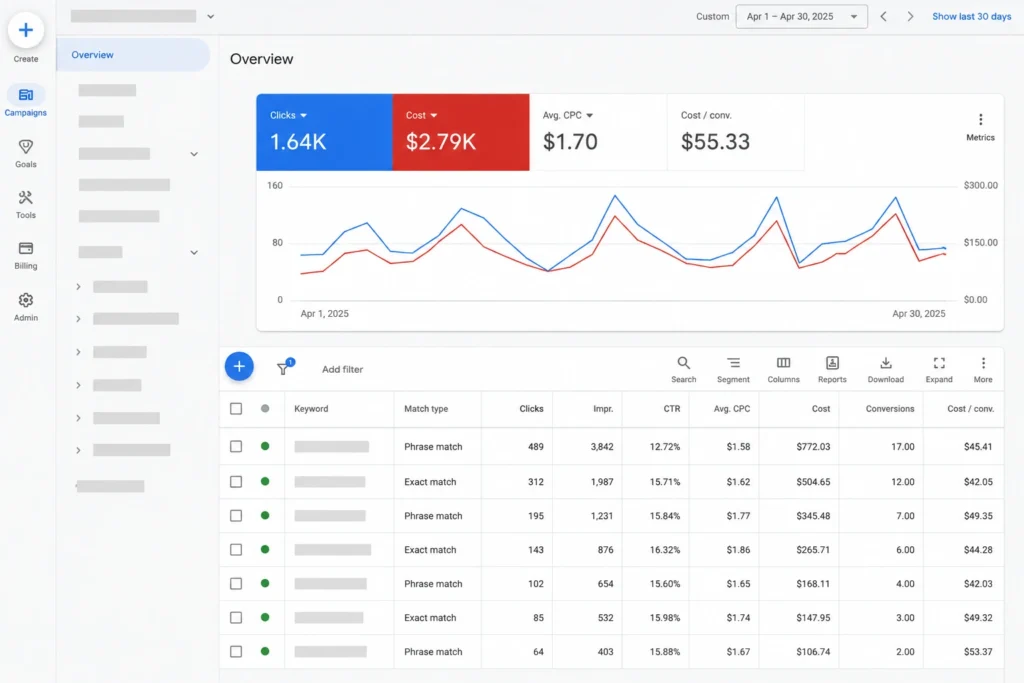
Plan for $5 to $8 per click on most remodeling searches, and a cost per lead that runs high, often above $150 for construction and contracting terms.
Home improvement carries the second-highest cost per click of any industry on Google, about $6.96, per WordStream’s 2024 benchmarks. LocalIQ’s 2025 home services data puts the construction and contractors category at $5.31 per click, with some trades higher (roofing near $10.70, painting near $13.74). A few competitive metros and terms do hit $15 or $20 a click, but that’s the ceiling, not the average.
The part most contractors miss is the conversion rate. Search clicks for construction and contractors turn into a lead only about 2.61% of the time, per that same LocalIQ home services data, because a homeowner clicks four or five remodelers before calling one. That pushes the cost per lead for contractors to roughly $165.67, the highest of any home service. Google isn’t cheap. It’s just full of people who actually want the work done.
So you don’t let a Google Ads account run on autopilot. You track which keywords produce booked estimates and cut the rest. If you’d rather a team handle the Google Ads side for you, that’s part of what we do. Costs vary by market and scope, so treat these numbers as starting points.
Do Facebook ads work for remodeling companies?
Yes, for the right job. Facebook and Instagram are good at awareness, retargeting, and showing finished work. They’re weak at producing someone ready to sign this month.
Home improvement lead forms on Facebook convert at about 5.22%, below the 7.72% average across industries, per WordStream’s 2024 data. The leads are cheaper, close to $22 each across industries, but they come from people scrolling, not searching. Cheap leads that never book are the most expensive kind you can buy.
Where Facebook earns its place for a remodeler is the follow-up. Someone finds you on Google, looks at your site, then leaves without calling (about 95% do on the first visit). A retargeting ad puts your finished kitchen back in front of them on Instagram three days later. That’s the Facebook and Instagram side working the way it should, as a second touch, not a first one.
One more note on social. You don’t need to post every day. Two or three project photos a week, plus retargeting, does more for a remodeler than a daily posting habit that eats an hour you don’t have.
Judge every channel by cost per booked estimate
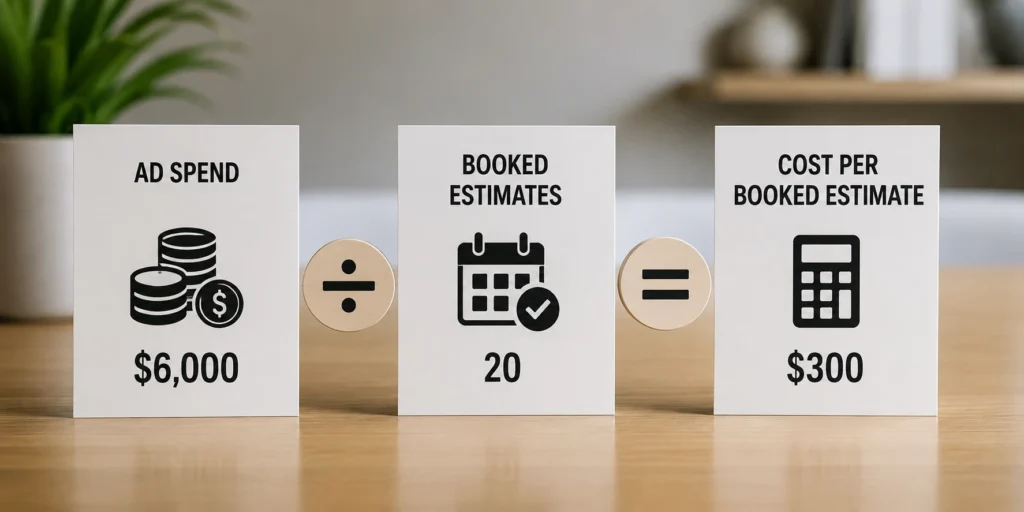
Cost per click and cost per lead both lie to you. The only number that pays your crew is cost per booked estimate: what you spend to get one homeowner sitting at the table with a real quote in hand.
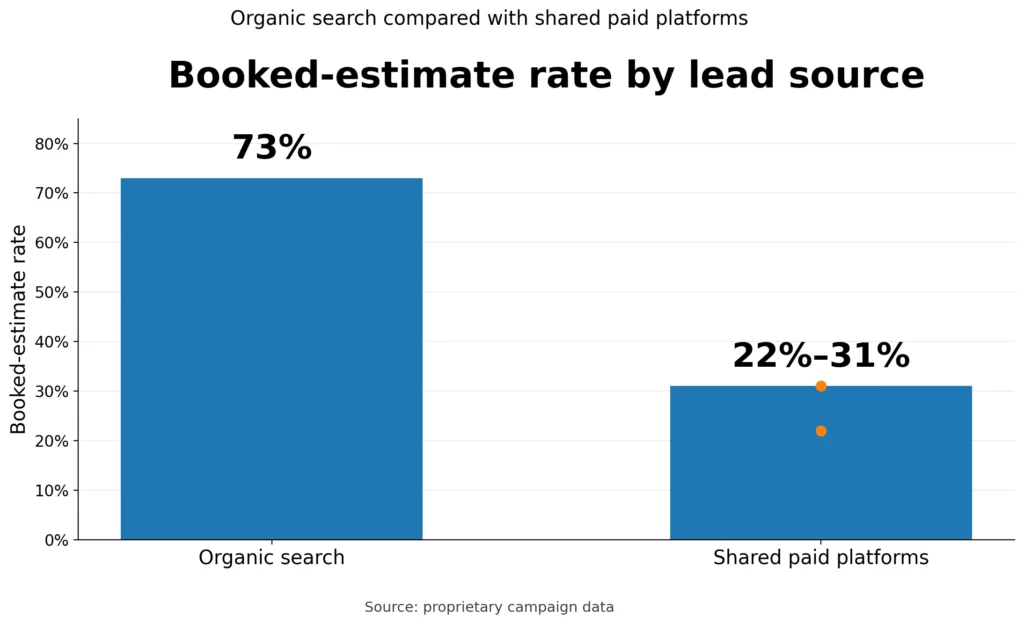
Run the math and the whole Google vs Facebook fight looks different. Across our clients, 73% of leads from organic search turn into a booked estimate. Shared paid-lead platforms convert at 22% to 31%. Facebook’s $22 leads look like a bargain until you see how few reach an estimate. A $165 Google lead that closes beats ten $22 Facebook leads that ghost you.
Do this for every channel. Take what you spent last month. Divide it by the number of booked estimates it produced. That figure, not clicks and not raw leads, tells you where the next dollar goes. Most remodelers have never once calculated it, which is exactly why they argue about the wrong things.
If your cost per booked estimate is bad on every channel, the problem usually isn’t the ads. Slow pages, no clear phone number, and thin project galleries turn good clicks into nothing, so the leak is usually the website, not the traffic. Results vary by market, competition, and how fast you follow up on leads.
Why “be on every platform” is bad advice for remodelers
You don’t need to be everywhere. For most remodelers, spreading a small budget across Google, Facebook, Instagram, TikTok, and YouTube just makes you mediocre on all five.
The advice to be on every channel sounds safe. It isn’t. A $2,000 monthly budget split five ways can’t win any of them. In every client dataset we’ve looked at, Google out-produces the social platforms by 5 to 8 times for booked remodeling jobs, because homeowners don’t open TikTok to hire a bathroom remodeler. Multi-platform plans often exist because they justify a bigger retainer, not because they book more work.
There’s one real exception. If almost nobody searches for your service, you have to create demand instead of catching it. We saw this with a garage conversion and ADU contractor whose main terms drew only about 40 searches a month. In that case, awareness ads and educational content do the work, because the search demand isn’t there yet.
How we cut a $4,200 Google Ads account to $1,800 with no drop in leads
Most contractor Google Ads accounts waste around half the budget on searches that never become jobs. We watched it happen on a Mid-Atlantic bathroom remodeler.
The previous agency had built the account on broad match with no negative keywords. So the ad for “bathroom remodel” was also showing for “bathroom cleaning service” and “bathroom accessories.” The owner was paying for clicks from people who wanted a mop, not a renovation. He had no call tracking, so he couldn’t see it.
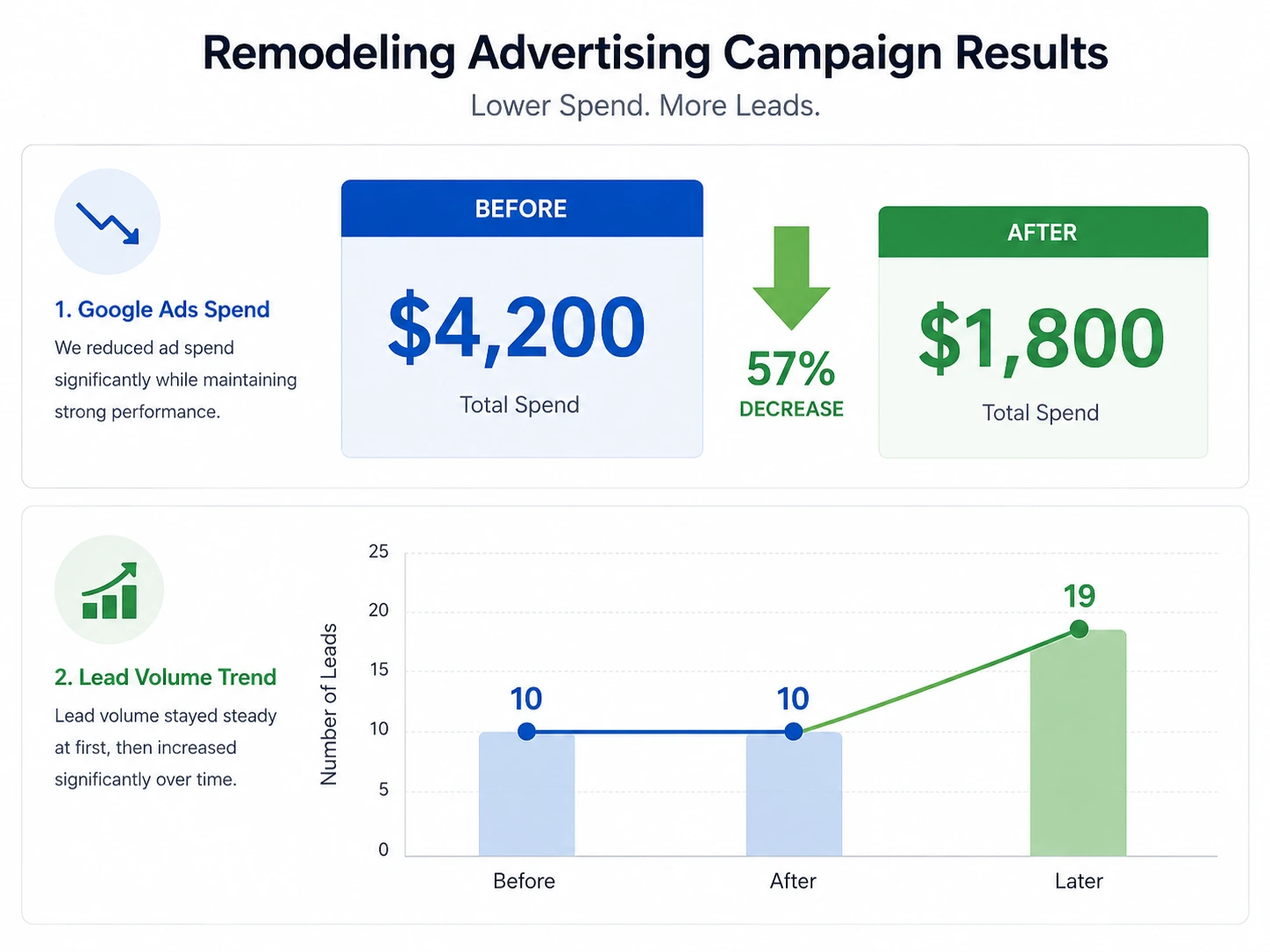
We added call and form tracking, then paused the 60% of keywords that had produced zero conversions in six months. Spend dropped from $4,200 to $1,800 a month with the same lead volume. Combined lead flow actually rose from 10 to 19 a month once the budget went to terms that convert. In his words: “The first time I actually understood what I was paying for. Every dollar is tied to a lead I can see.” Results like this vary by account and market.
The one channel neither Google nor Facebook will sell you
Every dollar in ads stops working the second you stop paying. The channel that keeps producing after you turn the spend off is organic search, and no ad platform will ever sell it to you.
Paid ads are rent. You pay, you get traffic. You stop, it’s gone. Organic rankings are an asset you own. After about month six, our clients pay roughly $0 in marginal cost per organic lead, compared with $87 to $142 per shared lead on platforms like Angi or HomeAdvisor. The model of renting shared leads is the problem, not any one company.
A Dallas-area remodeler we work with cancelled $6,200 a month in Angi fees and paused $3,800 a month in Google Ads once organic ranked second in the map and search results for his main service. A New Jersey remodeler put it this way: “I was paying $150 per lead on Angi and sharing it with 5 other guys. Now homeowners find me on Google and call me directly. I have not opened Angi in 4 months.”
This isn’t “quit ads.” Run Google Ads for cash flow now. At the same time, build the organic rankings you own, the content that feeds those rankings, and the kind of links that hold, so the day comes when you can turn the ads down instead of up. That’s how a remodeler stops renting leads and starts owning the market.
Splitting your remodeling ad budget in 2026
Fund Google search first, until you’re actually catching the buyers already looking for you. Only then add Facebook for retargeting and awareness.
A simple order of operations works for most remodelers. First, put enough into Google search to show up for your core service in your city. Second, add a small retargeting budget on Facebook and Instagram to follow the visitors who left without calling. Third, send any surplus to brand awareness and to building organic, so you depend on paid less every quarter.
As a starting point, a remodeler new to paid might run about 70% of the budget on Google search, 20% on retargeting, and 10% on awareness, then adjust as the booked-estimate numbers come in. A high-competition metro like Los Angeles needs a different split than a market like Boise, so don’t copy a flat plan from a blog. When we tested search-intent pages against top-of-funnel content across four clients, the search-intent work converted 3.2 times better, which is why the money starts with intent.
So, Google Ads vs Facebook ads for contractors? Lead with search, because that’s where the buyers are. Use Facebook to stay in front of them and to show the work. And build the rankings you own so you can eventually turn the ads down. If you want a second set of eyes on your numbers, we audit remodeling ad accounts and show you the cost per booked estimate for every channel before you spend another dollar.
FAQs
Are Google Ads or Facebook ads better for contractors?
For most remodelers, Google Ads produce booked jobs faster because they catch people already searching for the service. Facebook ads work better for awareness and retargeting. In our client data, Google out-produces social by 5 to 8 times for booked remodeling work, so it is usually the first dollar, not the only dollar.
How much should a remodeler spend on Google Ads per month?
There is no single number, but plan for a cost per click of $5 to $8 on most remodeling searches and a cost per lead that can top $150 for construction and contracting terms, per LocalIQ’s 2025 home services data. Budget enough to show up for your core service in your city, then measure booked estimates, not clicks.
Why do my Facebook ads get leads but no jobs?
Because Facebook leads are low intent. Someone tapped a form while scrolling, not because they were ready to remodel. Home improvement lead forms on Facebook convert at about 5.22%, below the 7.72% average across industries, per WordStream. Cheap leads that never book are the most expensive kind you can buy.
Is Google Ads or SEO better for a remodeling company?
Google Ads get you to the top of the page today. SEO gets you there without paying per click, but it takes months. Run ads for cash flow now and build organic rankings so you eventually stop renting your leads. After about month six, our clients pay roughly $0 in marginal cost per organic lead.
How do I know if my contractor Google Ads are working?
Track booked estimates, not clicks. Set up call tracking and form tracking, then look at which keywords produce real quotes. On one Mid-Atlantic account, 60% of keywords had zero conversions in six months. Pausing them cut spend from $4,200 to $1,800 a month with no drop in leads.
Do Facebook ads work for high-end remodelers?
They can, for awareness and retargeting, because a $100,000 kitchen is a long decision. Use Facebook and Instagram to show finished projects and stay in front of people who found you on Google. Do not expect them to produce a ready-to-sign lead the way a high-intent search does.
Google Ads vs Facebook ads for contractors: which has better ROI?
Judge ROI by cost per booked estimate, not cost per lead. Facebook leads are cheaper, around $22 each across industries, but close at a low rate. Google leads cost more but convert better because the intent is there. For most remodelers, Google wins on the number that matters: revenue per dollar spent.