
To get more Google reviews as a remodeler, ask the homeowner out loud on the day the work is finished, text them a direct review link within 24 hours, and send exactly one reminder 48 hours after that. Remodelers on our review system average 4 to 6 new Google reviews a month. The same companies averaged 0 or 1 before it. Nothing about the work changed. The ask did.
Most advice on this topic is written for plumbers and HVAC techs who run 8 jobs a day. Your job is 9 weeks long, and the moment you pick to ask decides whether you get a review or a polite “sure, I’ll do that this weekend.” This page is the version for a remodeler, including the part where the punch list quietly eats half your reviews.
Getting more Google reviews as a remodeler means asking every completed-project homeowner the same way, at the same point in the job. Say it in person when the work is done and the punch list is closed, text a direct review link the same day, and send one reminder 48 hours later. Nothing else matters as much.
Why you get far fewer chances at a review than any same-day trade
Because you finish a fraction as many jobs, and there is no way to make more of them by working harder.
Count the projects you closed last year. For most remodeling companies that number lands somewhere between 20 and 60. That is your entire supply of review opportunities for the year. A trade running service calls all day generates that many chances in a fortnight.
Run it out. Say you close 40 projects a year and you want to reach 100 Google reviews. At a 20% follow-through rate you add 8 a year, so you get there in 12 years. At 50% you add 20 and it takes 5. At 80% you add 32 and you are there in a little over 3. A trade closing thousands of jobs a year reaches 100 on a follow-through rate low enough to be a rounding error, which is why “just text everybody” works fine for them and not for you.
You have no volume to hide behind. Every completed project that doesn’t produce a review is 2.5% of your annual review program, gone, and it does not come back. The conversion rate on your ask is the only number in this article that matters.
The weight per review runs the same direction. BrightLocal’s 2026 survey found 97% of consumers read reviews for local businesses, and the homeowner reading yours is choosing a renovation rather than a drain cleaning. The 2026 Houzz & Home Study, which surveyed 10,176 renovating US homeowners, put the median 2025 renovation spend at $20,000 and the planned median for 2026 at $15,000. People read more reviews, and read them harder, when a decision is that size.
One of our clients said it plainer than any survey has: “I did not know Google reviews affected my ranking. I had 12 reviews after 8 years in business. My competitor had 90. That is why he showed up and I did not.”
There’s also a trade association pointing homeowners straight at this. The National Association of Home Builders tells homeowners shopping for a remodeler to ask for names of previous customers, and adds: “If they won’t, beware.” Your Google profile is that reference list, already assembled, already public, and already read before anyone calls you.
How many Google reviews does a remodeler need in 2026?
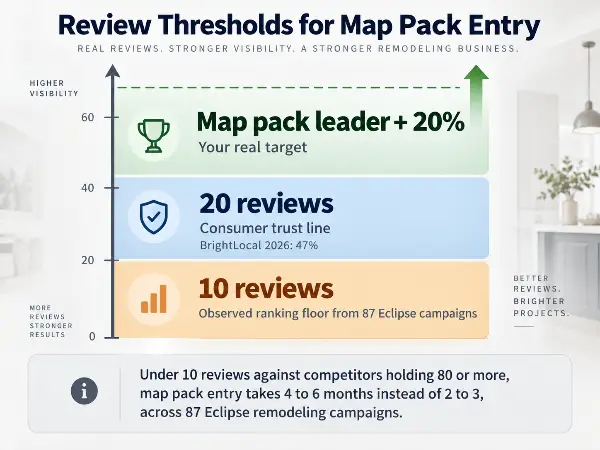
Twenty is the consumer floor. Ten is where the ranking penalty stops. Your real target is whoever holds the map pack in your city, plus about 20%.
BrightLocal’s 2026 Local Consumer Review Survey, a panel of 1,002 US adults, found that 47% of consumers won’t use a business with fewer than 20 reviews, and only 9% will consider one sitting at 5 or fewer. The same survey found 68% now require a minimum of 4 stars, up from 55% a year earlier, and 31% won’t go below 4.5. The bar homeowners set is moving up fast, and a 3.9 average that passed two years ago now filters you out for two thirds of the market.
Our own data from 87 remodeling campaigns puts the ranking floor lower and earlier. When a remodeler comes to us with fewer than 10 Google reviews while local competitors hold 80 or more, map pack entry takes 4 to 6 months instead of the usual 2 to 3. Across all clients, 78% reach the map pack inside 6 months, and starting review count is the single biggest variable in how fast that happens. That’s why we front-load review requests before anything else in the Google Business Profile work.
Recency does as much work as the total. BrightLocal found 74% of consumers only want reviews from the last 3 months, and 32% want something from the last two weeks, up from 20% last year. A remodeler with 60 reviews and nothing since last fall reads as a company that stopped taking work.
So skip the national averages. Search your service plus your city, look at the 3 businesses in the map pack, write down their counts, and set your target at the highest one plus 20%. If the leader has 140, you need 170. You do not need 1,000. While you have those 3 profiles open, note their categories and photo counts, because most of what else moves the map pack is sitting on the same screen.
Map pack timelines vary by market competition and starting point. Past client results don’t guarantee identical outcomes.
The three moments in a remodel, and the two that cost you the review
A same-day trade has one emotional peak. A remodel has three, and two of them are traps.
| Moment | What the homeowner feels | Ask here? |
|---|---|---|
| Demo day | Excitement mixed with panic. The kitchen is gone and there’s no result yet. | No. There’s nothing to review. |
| Mid-project, week 4 to 6 | The trough. Dust everywhere, washing dishes in the bathtub, a change order just landed. | No. This is where a bad review gets written if you ask. |
| The reveal | The peak. Clean room, everything works, they’re taking photos for their family. | Yes. This is the one. |
| Final walkthrough with an open punch list | Annoyance. They’re pointing at a scuffed baseboard and a cabinet door that sits proud. | No. Wait. |
| Punch list closed, final invoice paid | Relief and resolution. | Yes, second-best moment. |
Most guides say “ask at the final walkthrough.” For plenty of remodelers that advice works, because the walkthrough is the reveal. But if your walkthrough is the punch-list meeting, you are asking a homeowner to review you at the exact moment they’re cataloguing everything you got wrong. That’s our read on it rather than a measured finding, and it’s the single most common timing mistake we see when we audit a remodeler’s review flow.
The rule that survives both cases: ask when the work is done and there is nothing left on the list. If those are the same day, ask at the walkthrough. If they aren’t, ask when the punch list closes.
Once you’ve picked the moment, the ask itself is short. Say it in person, and name who’s sending the link:
“We’re glad you love it. Reviews on Google are how homeowners find us, so it would mean a lot if you’d write a few sentences about the project. You’ll get a text with the link this afternoon. Takes about a minute.”
Say the name of whoever is sending that text, so the message that lands has a face attached to it.
Two details are doing the work. You told them the text is coming, so when it arrives it’s expected rather than random. And you asked for “a few sentences about the project,” which invites detail without dictating it. Detail is what makes a review persuasive to the next homeowner and what gives an AI assistant something to quote when it summarizes local remodelers. That is no longer a small audience. BrightLocal found 45% of consumers now use ChatGPT or a similar tool for local business recommendations, up from 6% a year earlier, while Google’s share of review readers fell from 83% to 71%. Three reviews that say “great work” give those tools nothing to repeat.
What should the review request say?
Short, named, specific to their project, and no suggested wording.
The first text goes out within 24 hours. Open it with the homeowner’s first name, then the name of whoever ran their job and your company, then this:
“Thank you again for trusting us with your kitchen. If you’re happy with how it turned out, would you leave us a Google review? A few sentences about the project helps other homeowners a lot. Takes about a minute:”
Paste the review link on the end. Swap “kitchen” for whatever you built them.
The reminder goes 48 hours later. Same opening, then:
“No rush at all, just resending the review link in case the week got away from you:”
Notice what isn’t in either one. No “5 stars.” No draft sentence for them to paste. No gift card. Naming the project type nudges the homeowner to mention it, and a review that describes the actual work carries more weight with the next reader than “great job, highly recommend.”
One reminder. Not two. A second nag trades a possible review for guaranteed irritation, and the review someone leaves to make you stop texting is not the review you want. The reminder also has to cancel itself the moment they click, review, or reply STOP. A follow-up that reaches a homeowner who already left you 5 stars teaches them your texts are spam.
Should review requests go by text or email?
Text, and not because of the open rate everyone quotes.
The “98% SMS open rate” repeated across this industry has no primary source behind it, and it can’t have one, because carriers don’t report reads. Ignore it. The reason text wins is structural: it lands on a lock screen and gets read without opening an app. Your review request email lands between a utility bill and a flooring promo, and even homeowners who meant to write something never dig it out.
When we moved clients onto an automated text flow, review velocity went from 0 or 1 a month to 4 to 6. The companies, the crews, and the work were identical. The channel changed.
The strongest version is both halves together: the project manager mentions it on site, then the text arrives that afternoon with the link. The verbal ask primes it. The text removes the friction.
Two operational notes. Collect texting consent during the project, not after, so the review request lands inside a thread the homeowner already recognizes. And make the link the direct one. Google generates it free inside your profile: open your Business Profile, select “Read Reviews,” then “Get more reviews,” and copy the link or save the QR code. Google’s own documentation tells businesses to do this, in its words, “Remind customers to leave reviews: To leave reviews, you can ask customers to visit a Google link or scan a QR code.”
“Find us on Google and leave a review” is not an ask. It’s homework, and nobody does homework for their contractor.
How do you get reviews from past clients?
One at a time, by text, referencing their specific project, starting with the most recent.
When we onboarded a Colorado whole-home remodeler with no online presence at all, outreach to past clients produced 28 Google reviews in 60 days. It wasn’t a mass blast. The owner texted people individually, each message naming the actual job, working backward from the most recent and largest projects.
A blast email to a 5-year-old list gets you 3 reviews and a few confused replies. A text that says “we redid your primary bath last spring” gets a review with detail in it, because the memory is still there. Start with your last 10 to 15 completed projects and work backward until the recall gets thin, usually somewhere around 18 months.
Treat this as a one-time reserve. It fills the profile once. Then you’re back to needing a per-project system, or the velocity drops to zero again and the recency problem returns in a year. The slow months are the right time to spend the reserve, alongside the rest of the work that fills a spring calendar.
One caution on pacing. If you haven’t asked anyone in 3 years, don’t send 400 requests on Monday. Most of those homeowners have forgotten you, so you burn the list for a handful of reviews, and the pattern is the one thing in this whole article that Google’s policy language does describe as a problem.
Automating the ask without tripping Google’s filters
A spreadsheet and a calendar reminder works at 2 projects a month. It breaks at 5, because somebody has to remember every text, track who responded, time every reminder, and avoid double-sending to people who already reviewed. That’s a working-memory problem, not a discipline problem, and nobody wins it in the middle of a busy quarter.
What the automated version does, in order:
- The project is marked complete in your CRM, or it syncs from your job management software
- The homeowner gets an SMS review request with the direct link
- The system waits 48 hours
- If they haven’t clicked, reviewed, or opted out, one reminder goes
- Everything after that stops
We run this through GoHighLevel for our clients, triggered on job close. The tool matters less than the trigger. Whatever you use has to fire off project completion rather than off invoice payment, because on a remodel those can be 3 weeks apart and the emotional peak isn’t waiting around.
The thing to avoid is the setting most review software sells hardest. If a product’s marketing promises to “protect your public rating,” read the next paragraph carefully before you buy it.

Does replying to reviews help your map pack ranking?
No, and this is the most persistent myth in local SEO. Reply anyway, for a different reason.
Google’s local ranking documentation is specific about which review signals matter. It says local results are based on “relevance, distance, and popularity,” and the subsection defining that third factor, headed Prominence, is where this line sits: “More reviews and positive ratings can help your business’s local ranking.” On replies, Google’s wording is only that responding “shows that you value their feedback.” That’s a sentence about customer perception, not ranking.
Whitespark’s 2026 Local Search Ranking Factors survey, in which 47 local search specialists scored 187 individual factors, lines up with that. For local pack results, high numerical Google ratings ranked 6th and quantity of native Google reviews with text ranked 9th. The presence of owner responses on most reviews ranked 122nd out of 187. Reviews are real ranking input. Replies are not.
Here’s why you should reply to every single one anyway: BrightLocal’s 2026 survey found 89% of consumers expect owners to respond, 19% now expect a same-day reply (up from 6%), and generic or templated replies put off 50% of them, who read a copy-paste response as a sign of poor customer care. Half your audience is penalizing exactly the thing most owners automate. It’s a conversion lever pointed at a homeowner, not a ranking lever pointed at an algorithm.
So: two sentences, their name, their project. On anything under 3 stars, same day. The full scripts for the hard ones are in our guide on handling bad remodeling reviews.
What Google allows, and the two lines remodelers cross
You can ask every client, in person, by text, by email, on a yard sign, on a QR code on your leave-behind folder. You can automate it. You can send one reminder. Google’s own help documentation tells businesses to do most of this. Your count feeds a separate auction if you run Local Services Ads, which is worth understanding before you decide whether the Verified badge earns its cost.
| Allowed | Prohibited |
|---|---|
| Asking every completed-project homeowner out loud, on site | Offering a discount, a gift card, or free punch-list work for a review |
| Texting or emailing a direct review link | Deciding in advance who gets the link, based on who you think is happy |
| Printing a QR code on leave-behind folders, invoices, and yard signs | Surveying homeowners first and routing only the satisfied ones to Google |
| Automating the request and sending one reminder | Writing reviews yourself, or having staff or family post as customers |
| Replying to every review, positive and negative | Pressuring a homeowner to change or remove a review they already left |
Two of those prohibitions get remodelers in trouble more than the rest.
You cannot offer anything of value for a review. Google’s wording: “Offering incentives, like free or discounted goods or services, in exchange for customers to post reviews, change reviews, or remove negative reviews is considered fake & misleading content and is strictly prohibited.” Adding “honest review” changes nothing, because the incentive is the violation, not the sentiment. For a remodeler this shows up as a discount on the punch-list work or a gift card at closeout. Both are prohibited.
You cannot decide in advance who gets asked. Google’s Maps content policy prohibits merchants who “Discourage or prohibit negative reviews, or selectively solicit positive reviews from customers.” Surveying homeowners first and sending the Google link only to the happy ones breaks this. So does telling the crew to “only ask the good ones.”
The practical version is boring: ask everyone whose project you completed, the same way, on the same schedule. The pattern that looks manipulated is 15 five-star reviews in one week after 2 silent years. The pattern that looks real is 4 to 6 a month, every month, with an owner reply under each.
On velocity specifically: Google has never published a limit, and the word doesn’t appear in its review policies. What the policy targets is “unusual volumes or patterns of review contributions that are indicative of efforts to manipulate a place’s rating.” That’s about manipulation, not speed. Real homeowners reviewing real projects are not a manipulation pattern, however many of them there are. The risk to your profile is real though, and if it goes wrong the suspension and appeal process is not a fun week.

Four mistakes that cost remodelers reviews
| Mistake | What it costs | The fix |
|---|---|---|
| Asking at a walkthrough with an open punch list | The review from a homeowner who is, at that exact moment, listing your defects | Ask when the list is closed, even if that’s 10 days later |
| Letting the PM decide who to ask | Reviews from the homeowners you misread, plus the behavior Google’s policy names | Trigger it off job completion in the system, not off anyone’s judgment |
| Firing the request off invoice payment instead of job completion | On a remodel those can be 3 weeks apart, and the emotion is gone by then | Trigger on completion, send the invoice separately |
| Leaving a 1-star unanswered for 2 weeks | More than the review itself does. Silence reads as indifference to every homeowner who scrolls past it | Same-day reply on anything negative, even a short acknowledgment |
What this looks like after 8 months
A Dallas kitchen and bath remodeler came to us with 47 Google reviews after 15 years in business, spending $6,200 a month on Angi for leads shared with 4 competitors. We rebuilt the site, reworked the Business Profile, and turned on the review flow. Eight months later the profile held 119 reviews and the company ranked #2 in Google Maps for “kitchen remodeler Dallas” by month 7. The Angi bill was gone. His line: “My Angi bill was $6,200 a month. I cancelled it. Google sends me better leads for free now. The math is not even close.”
Reviews didn’t do that alone. They worked alongside the service pages, the profile work, and the rest of the SEO for home remodeling contractors engagement. But review velocity was the fastest-moving piece, and it’s the piece you can start this week without hiring anyone.
Results vary by market, competition, and client engagement. Past performance does not guarantee identical future results.
Worth knowing what it’s competing with: research is thin on the revenue side and mostly comes from one study. Harvard Business School’s Michael Luca, using Yelp data merged with Washington State Department of Revenue records from 2003 to 2009, found that a one-star increase in rating led to a 5 to 9 percent rise in revenue, with no measurable effect for chain restaurants. Restaurants in Seattle, not remodelers anywhere. Nobody has run that study on your industry. The independent-only finding is still the interesting half, because independents are who reads this page.
Start getting more Google reviews on the project you’re finishing this week
Pick the job that’s closing in the next 7 days. Have whoever’s running it ask at the reveal, then text the link that afternoon, then set a reminder for 48 hours out. That’s the whole system at one project. Everything else on this page is making it survive 40 projects a year without anyone having to remember.
The gap between a remodeler with 20 reviews and one with 200 is almost never the quality of the work. It’s that one of them turned the ask into a step in the job and the other one keeps meaning to.
We work with one remodeler per city, which means the first question is whether yours is still open. If you’d rather have the review flow, the profile, and the rankings you own run by someone else, that’s what we build. You can check your market before anyone else in it does, or see how the whole thing fits together with a marketing partner that isn’t already working for your competitor down the road.
FAQs
How do I get more Google reviews as a remodeler?
Ask in person when the work is finished and the punch list is closed, text a direct Google review link within 24 hours, and send one reminder 48 hours later. Remodelers running this sequence average 4 to 6 new reviews a month, compared to 0 or 1 before it. The three variables are timing, tap count, and whether you ask everyone or let someone pre-screen.
When should a remodeler ask for a Google review?
At the reveal, when the room is finished and the homeowner is seeing it clean for the first time. If your final walkthrough is also the punch-list meeting, wait until that list is closed. Asking a homeowner to review you while they’re pointing at a scuffed baseboard is the most common timing mistake we see.
How many Google reviews does a remodeler need?
More than the 3 businesses currently in your map pack, plus about 20%. As a floor, BrightLocal’s 2026 survey found 47% of consumers won’t use a business with fewer than 20 reviews. In our 87 campaigns, remodelers starting under 10 reviews against competitors holding 80 or more take 4 to 6 months to enter the map pack instead of 2 to 3.
Should review requests go by text or email?
Text. Homeowners read texts and lose emails, and clients we moved onto an automated text flow went from 0 or 1 reviews a month to 4 to 6 with no other change. Ignore the “98% SMS open rate” figure circulating in this industry; it has no primary source. Email is a backup for homeowners who never opted into texting.
Can I offer a discount or gift card for a Google review?
No. Google’s policy states that offering incentives “in exchange for customers to post reviews, change reviews, or remove negative reviews is considered fake & misleading content and is strictly prohibited.” For remodelers this usually shows up as a discount on punch-list work. It’s the same violation, and adding the words “honest review” doesn’t change it.
Is review gating against Google’s rules?
Yes. Google’s Maps content policy prohibits merchants who “Discourage or prohibit negative reviews, or selectively solicit positive reviews from customers.” Surveying homeowners first and sending the Google link only to the happy ones is exactly that. Ask every completed-project client the same way.
Does replying to reviews improve my Google ranking?
No. Google connects review count and ratings to local ranking in writing, but on replies its wording is only that responding shows you value feedback. In Whitespark’s 2026 survey of 47 local search specialists scoring 187 factors, owner responses ranked 122nd. Reply anyway: BrightLocal found 89% of consumers expect it and 50% are put off by templated responses.