The Google Guaranteed badge that remodelers spent two years chasing changed in late 2025, and most articles on the topic never caught up. In October 2025, Google merged Google Guaranteed and Google Screened into one badge called Google Verified, and it ended the money-back guarantee that gave the old badge its name. So a remodeler asking whether Google Guaranteed is worth it is really asking about Google Verified inside Local Services Ads, a pay-per-lead ad product. The short answer: the badge can bring you calls, but the system behind it was built for $200 service calls, not $40,000 kitchens. For most established remodelers, it works as a supplement to Google rankings you own, not as the main source of jobs. The rename isn’t cosmetic, and it changes what you’re actually buying.

What is the Google Guaranteed badge?
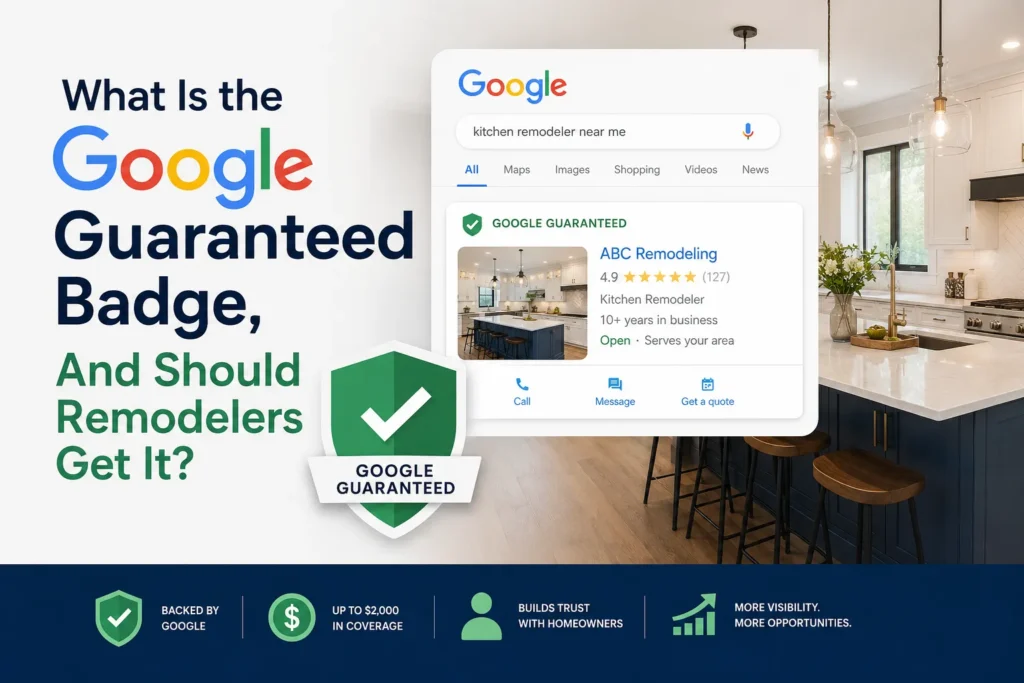
Google Guaranteed was a verification badge for home-service companies that run Google Local Services Ads. Google checked the business’s license, insurance, and owner background, then showed a green checkmark on its ad at the top of search. As of late 2025, that badge became Google Verified, and the customer money-back guarantee was discontinued.
What actually changed in 2025
The badge got simpler, and it lost its refund. For years there were two marks: a green Google Guaranteed check for home-service trades, and a Google Screened check for professional services like lawyers and financial planners. Google combined both into a single Google Verified badge. Same screening idea, one badge.
The bigger change is the guarantee. The old program let an unhappy customer ask Google for a refund of up to $2,000 (a lifetime cap per customer) on a job booked through Local Services Ads. Google discontinued that money-back guarantee; it accepted final reimbursement requests only for services completed before December 7, 2025. So the word “guaranteed” no longer describes what the badge does. It verifies you. It doesn’t back your work anymore.
One thing did not change: your spot in the ad results isn’t tied to the rename. The badge is a trust mark, not a ranking lever.
You can see the shift in how people search. Over the past year, searches for “google guaranteed” fell from about 12,100 a month to 5,400, while “local services ads” climbed past 18,000 (SE Ranking, US, July 2026). The product is being renamed in real time, and the old name is fading.
The category problem no one mentions
Sometimes, and it depends on how you label yourself, because there is no “remodeler” option. Google’s eligible service categories include Bathroom remodeling, Kitchen remodeling, and General contractor, plus narrower trades a remodeler might touch:
- Bathroom remodeling
- Kitchen remodeling
- General contractor
- Countertop services
- Flooring services
- Siding services
- Foundations services
- Window repair services
- Painter and Handyman
Notice what’s missing. There’s no “whole-home remodel,” “home addition,” or “design-build” category. A full-service remodeler usually signs up as General contractor, which is broad and competitive, or picks the single room type that matches most of the work. Availability also shifts by metro; a category live in Dallas may not be open in a smaller market yet. Your category choice matters because it decides which searches you can show for, so picking “General contractor” when 80% of your revenue is kitchens can hand your leads to the wrong homeowners.
What it costs, and how you pay
There’s no monthly fee for the badge. You pay per lead, meaning per phone call or message that comes through the ad, and Google both sets the price and decides who gets matched. Per-lead costs for general contractors run roughly $30 to $65 in agency benchmarks, though that figure comes from marketing agencies, not a Google price sheet, and it swings with your metro and category. In a competitive market, a single remodel lead can cost more than that.
One comparison decides whether any of it pays off. Look at the three ways a remodeler gets found on Google:
| Channel | How you pay | Time to first leads | Who controls it | What’s left if you stop paying |
|---|---|---|---|---|
| Local Services Ads (the badge) | Per lead, Google sets price | About 2 to 5 weeks (verification) | Google picks who’s matched | Nothing; ads switch off |
| Google Ads (PPC) | Per click | Days | You set keywords and budget | Nothing; ads switch off |
| Owned rankings (Map Pack and organic) | Time or an agency retainer | 3 to 6 months | You own the profile and pages | The rankings and reviews stay |
The badge and paid ads rent you attention. The day the card stops working, the calls stop. Owned rankings are the opposite: slower to build, yours to keep.

Is the Google Guaranteed badge worth it for remodelers in 2026?
The honest answer on Google Guaranteed for remodelers is to treat the badge as a test line, not a strategy, especially for high-ticket work. Local Services Ads reward two things: answering fast and paying for volume. That fits a drain cleaner who turns a $35 lead into a booked job the same afternoon. It fits a remodeler far less well. You’re paying per call for $40,000 projects with a sales cycle measured in months and a close rate that might be one in ten, while Google controls the matching and can change the rules whenever it wants.
We see the other side of this math with the remodelers we work with. One client cancelled about $10,000 a month in Angi, Thumbtack, and paid ads after their owned Google rankings took over, and their effective cost per lead dropped from $127 to $0 (that’s one Eclipse client’s reported result, not a promise for every business). The leads didn’t stop when the ad budget did, because the calls were coming from rankings and reviews the business owned outright.
That’s the case against building on rented channels. It isn’t a case against ever testing them. If you’ve got a slow month and the staff to answer every call within minutes, the badge can fill a gap. Just don’t confuse a rented lead line with a business asset. When you generate leads from search you own, the work compounds; when you buy them, it resets to zero each month.
The math on a month of leads
Run the numbers before you switch it on. Say general-contractor leads cost $50 in your metro, the middle of that $30 to $65 range, and you buy 20 in a month. That’s $1,000. Remodel leads don’t close like drain calls. If you sign 1 in 10, that’s two jobs from twenty leads, about $500 in ad cost per signed project. On a $40,000 kitchen, that reads cheap.
Two catches change the picture. Some of those twenty calls are wrong numbers, tire-kickers, or out-of-area homeowners. You can dispute those for credits, but only if you review every lead inside the window. And you pay that $1,000 every month to stand in place. Miss a month’s budget and the calls stop that day. A review and ranking base keeps ringing the phone whether or not you spent this month. The badge can pencil out on a spreadsheet. It just never turns into something you own.

How to get verified, step by step
Getting verified isn’t complicated. The wait is mostly the background check. The steps run in this order:
- Create your profile at the Local Services Ads site, then choose your category (General contractor, Kitchen remodeling, or Bathroom remodeling) and the areas you serve.
- Upload your contractor license, or a business registration if your category doesn’t require a license.
- Add proof of general liability insurance.
- Pass the background check on the owner, and in some states on field staff, run through Google’s verification partner.
- Set a weekly budget and go live once you’re approved.
Google also runs pre-badge ads: once you clear the first checks, your listing can start collecting leads while the rest of the verification finishes. Full approval usually takes about 2 to 5 weeks, and the background check is the common holdup. One practical tip that saves a week: make your legal business name read exactly the same on your license, your insurance certificate, and your profile, because a mismatch kicks the file back for review.
How Google decides who shows up
Money alone doesn’t win the top spot. Local Services Ads rank on a mix Google controls: your review count and rating, how fast and how often you answer calls and messages, how close you are to the searcher, your listed hours, and whether you’ve drawn complaints. Set your hours to when someone will actually pick up, because a missed call during listed hours pulls you down. This is the part remodelers underrate. The badge gets you into the auction; your response habits and review base decide whether you place in it.
What earns homeowner trust now the guarantee’s gone
Reviews do the job the guarantee used to. With no refund standing behind the badge, the trust signal moves to what sits on your profile: the number and freshness of your Google reviews, your star rating, and the license and insurance checks that Google now lists on a Verified profile. For a remodeler, that points back to the same work as always, only more so. A steady run of recent, detailed reviews that name the project and the city beats a badge every time, and it strengthens the trust signals Google reads across your whole search presence. It’s also what AI assistants read when a homeowner asks for a contractor they can count on. The badge is a checkbox. Your review history is the argument.

Google Guaranteed or your Google Business Profile, which comes first?
Your Google Business Profile, every time. It’s free, you own it, and it feeds the Map Pack and organic results that sit right under the ads. It also builds the review base and the license and insurance record that the badge, and now AI search too, read as proof you’re real. Money spent getting your profile and reviews right keeps working after you spend it. Money spent on the badge stops the day you pause the ads. If you’re deciding where the next dollar goes and you understand how SEO and paid search differ, the profile wins on every measure except speed. Build the thing you keep first. Eclipse does this for remodelers through SEO built for remodeling companies, and the badge, if it fits at all, comes after that foundation is set.
So, should remodelers get Google Guaranteed? Get verified only after your Google Business Profile and reviews are pulling their weight, and only if you want to test paid calls to fill a slow stretch. The badge is now Google Verified, the guarantee is gone, and the leads are rented. Put your money where it compounds first: the rankings and reviews you keep whether or not you’re paying Google this month. For a remodeler, that’s the case for putting local SEO first.
Frequently asked questions
Is Google Guaranteed still called Google Guaranteed in 2026?
Not really. In October 2025, Google merged Google Guaranteed and Google Screened into one badge called Google Verified. The verification checks stayed, but the customer money-back guarantee ended, with final claims accepted only for services completed before December 7, 2025.
Can home remodelers get the Google Guaranteed badge?
Yes, but there’s no “remodeler” category. You sign up under General contractor, Kitchen remodeling, or Bathroom remodeling, and availability varies by metro. Your category controls which searches you appear for, so pick the one that matches most of your revenue.
How much does Google Guaranteed cost for contractors?
There’s no monthly fee. You pay per lead, and Google sets the price. General contractor leads run roughly $30 to $65 each in agency benchmarks, but that’s not a Google-published rate and it climbs in competitive markets.
Did Google really end the money-back guarantee?
Yes. The program that refunded unhappy customers up to $2,000 was discontinued, with the last reimbursement requests accepted for services completed before December 7, 2025. The badge now signals verification, not a refund promise.
Is Google Guaranteed worth it for remodelers?
It can fill a slow month if you answer every call fast, but it’s a rented channel built for low-ticket, high-volume trades. For high-ticket remodels, a strong Google Business Profile and owned rankings usually return more, because those leads keep coming after you stop paying.
How long does verification take?
About 2 to 5 weeks. The background check on the owner is the usual bottleneck. Matching your legal business name exactly across your license, insurance, and profile helps avoid delays.
Does the badge help you show up in AI search?
Not directly. AI tools lean on the same foundation the badge checks: a complete profile, verified license and insurance, and recent reviews. Getting those right is what earns AI mentions, with or without the badge.