
A single one-star review costs a remodeler almost nothing. A review profile that has sat quiet for eight months costs you the job.
That’s the part most advice on how to handle bad remodeling reviews gets backwards. Owners agonize over the wording of one angry reply and ignore the thing homeowners actually judge them on: whether the profile looks recent, active, and mostly happy the week someone decides who to call.
Handling a bad remodeling review means three things. Reply fast and calm in public. Move the real dispute to a private phone call. Then generate enough recent positive reviews that one bad rating stops defining your profile. Part of it is customer service. The bigger part is local SEO.
The data backs that order, and so do the exact replies I give clients across 87 remodeling campaigns we’ve run since 2019.
Should you even respond to a bad review?
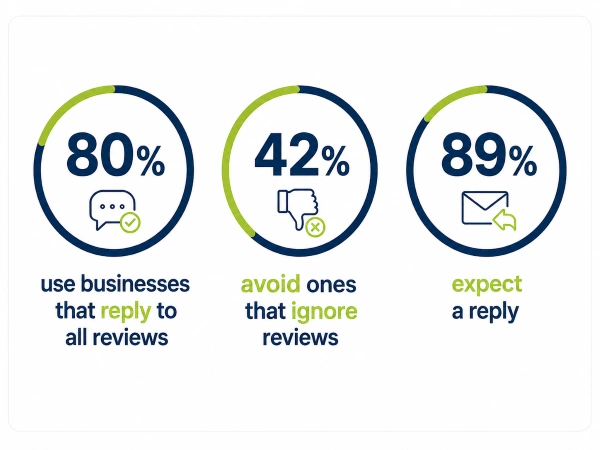
Yes, and fast. In BrightLocal’s 2026 Local Consumer Review Survey, 80% of consumers said they’re more likely to use a business that responds to all of its reviews, and 42% said they’re unlikely to use one that ignores its reviews. Silence reads as guilt. A short, steady reply reads as a company that stands behind its work.
There’s a ranking reason too, which I’ll get to. First, the reply itself.
Reply in a day, not a week
Speed changes how a reply lands. 89% of consumers now expect a response to their reviews, and 81% expect it within a week, per BrightLocal’s 2026 data. Nineteen percent expect a same-day answer. For a remodeler, that means someone checks Google, Facebook, and your Google Business Profile once a day, not once a month.
The longer a bad review sits alone and unanswered, the more it looks like the story is settled.
How to respond to a bad remodeling review
A good response does four things: it thanks the person, owns the specific standard you missed, avoids arguing the facts in public, and moves the conversation to a phone call. Four remodeling complaints come up again and again. Here’s how I’d answer each one.
| The complaint | What the homeowner wrote | How to respond |
|---|---|---|
| Timeline slipped | “Job ran three weeks past the date they promised.” | “Hi [Name]. Thank you for the honest feedback, and I’m sorry the schedule slid past what we set. When materials run late, that’s on us to tell you sooner. I’d like to hear where we lost you. Please call me directly at [number]. – Mike” |
| Cost changed mid-job | “Price jumped halfway through and nobody warned me.” | “Hi [Name]. I appreciate you flagging this. A price change should never be a surprise, and it sounds like we didn’t walk you through the change order the way we should have. I want to make this right. Can we talk this week? [number]” |
| Mess or damage | “Crew left dust everywhere and scratched my floor.” | “Hi [Name]. Thank you for telling us. Protecting your home is the baseline, and we fell short. I’ve already gone over this with the crew lead so it doesn’t repeat. I’d like to come look at the floor myself. [number]” |
| Went quiet after the deposit | “Couldn’t get a call back once they had my money.” | “Hi [Name]. That’s a fair complaint, and I’m sorry you felt chased off after signing. Steady updates are something we hold ourselves to, and we missed it with you. I want to understand what happened. Reach me at [number].” |
One warning about scripts. Don’t paste the same one under every review. BrightLocal found generic or templated replies put off 50% of consumers. Use these as a skeleton, then name the real detail, the tile, the timeline, the crew lead, so a reader can tell a person wrote it.
Once you fix the problem offline, you can ask the customer to update their review. Many will. Never offer money or a discount for it, since that breaks Google’s rules and can get your profile flagged.

Can you get a bad Google review removed?
Sometimes, but only when it breaks Google’s rules. Google removes reviews that are fake, off-topic, posted by someone with a conflict of interest, or full of profanity or harassment. It won’t remove a review just because it’s negative or you disagree with it. To report one, open the review on your Business Profile, click the three-dot menu, and flag it with the matching violation. Google says evaluation takes several days, and most real but harsh reviews will stay up.
For a fake review you can’t get pulled, reply once, briefly and factually, for the next reader. Then bury it with real ones.
Replying is damage control. Volume is the real fix.
The reply protects one review. Fresh reviews protect your whole profile. Almost no one tells remodelers that. 74% of consumers only care about reviews written in the last three months, and 32% look for reviews from the last two weeks, per BrightLocal 2026. A one-star from March matters far less once you’ve collected a dozen five-stars since.
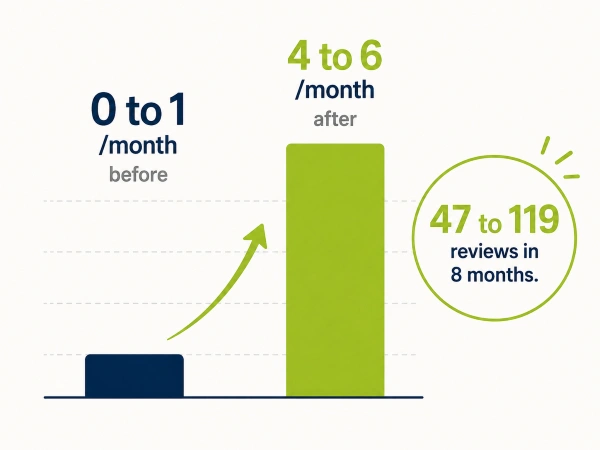
Most remodelers I onboard earn zero to one review a month. After we switch on an automated request that texts every customer the day a job wraps, they average four to six a month. One Dallas kitchen and bath client went from 47 reviews to 119 in eight months. A Colorado remodeler pulled in 28 reviews in 60 days from a standing start. At that pace, a single bad review is a rounding error, and the steady flow turns into more remodeling leads.
Do the math on your own profile. Earn five reviews a month and one bad one is under 2% of a year’s total. Earn one a year and it’s half your reputation. I’ll say it plainly: one five-star review is worth more to a remodeler than 30 social posts.
Do bad reviews hurt your Google ranking in 2026?
They can, but not the way owners fear. A negative review isn’t a penalty. The real ranking lever is review count and recency, which feed the Map Pack, the three local results pinned to the top of Google. Google’s own guidance on local ranking says review count and score factor into where a business lands, and in practice the remodelers who keep earning fresh reviews are the ones who hold those spots.
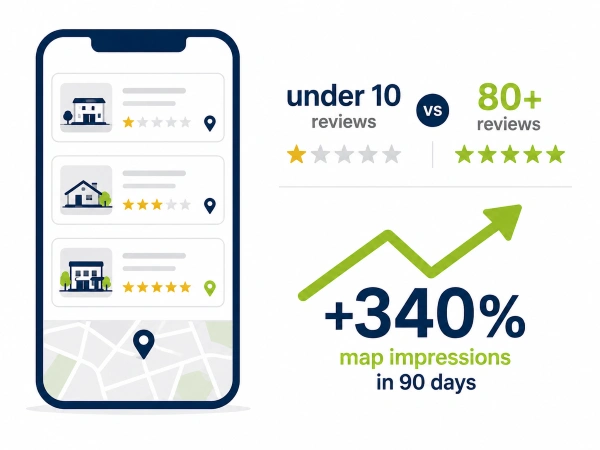
I’ve watched this decide whole markets. A remodeler with under 10 reviews rarely cracks the Map Pack when the competitor has 80-plus. It’s a conversion problem on top of a ranking one, because 47% of consumers won’t use a business with fewer than 20 reviews at all, and 68% will only use one rated four stars or higher. When we rebuild a client’s profile as part of the SEO work behind it and turn on review requests, map impressions climb an average of 340% in the first 90 days. Reviews and rankings move together.
The mistakes that make a bad review worse
The fastest way to turn one bad review into two is to argue. Don’t get defensive, don’t dispute the invoice line by line in public, and don’t recap the whole change-order history to prove you were right. It reads as a company relitigating a fight it already lost. Skip public settlement offers too.
Ignoring reviews is its own mistake. 85% of consumers say positive reviews make them more likely to hire, and 77% say negative ones make them less likely, per BrightLocal 2026. Both numbers reward the same habit. Show up, reply, move on.
Who should own reviews on your team
For most remodeling companies, it’s the owner or the office manager, not a distant vendor. That person needs alerts from every place a review can land, a one-day reply rule, and a plain log of what each complaint was really about. The log is worth more than the replies. When three reviews in a row mention dust or missed calls, you’ve found a process to fix, not just a customer to calm down.
What actually protects your name
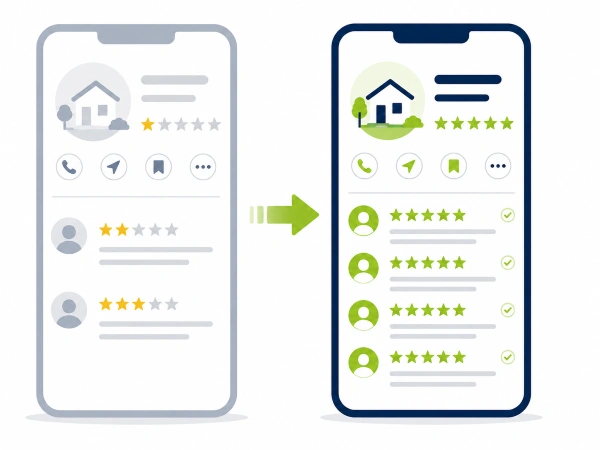
A flawless five-star average isn’t the goal, and chasing it makes you look staged. The goal is a profile that’s recent, active, and honest, with far more happy customers than unhappy ones and an owner who answers both. Handle bad remodeling reviews that way and the occasional one-star stops being a threat. It turns into proof you’re real. The remodeler with 90 reviews and one bad one wins the call over the remodeler with eight perfect ones, every time.
If you’d rather have that review engine and the rankings that follow it built for remodelers instead of built by you at 9pm, that’s what we do.
Frequently asked questions
How do you respond to a bad remodeling review?
Thank the person, own the specific standard you missed, avoid arguing the details in public, and move the conversation to a phone call. Reply within a day, since 81% of consumers expect a response within a week (BrightLocal 2026). Personalize each reply, because generic or templated responses put off 50% of readers.
Can you get a fake Google review removed?
Only if it violates Google’s policies, such as fake content, off-topic posts, a conflict of interest, or profanity. Flag it through the three-dot menu on your Business Profile and choose Report. Real negative reviews usually stay, so plan to outnumber them with recent positive ones rather than counting on removal.
Do bad reviews hurt your Google ranking?
A single negative review isn’t a penalty. Review count and recency feed the Map Pack, and 74% of consumers only trust reviews from the last three months (BrightLocal 2026). A steady flow of fresh reviews helps both your local rankings and the trust of the next homeowner reading them.
How many reviews does a remodeler need?
Enough to look clearly active and stay ahead of local rivals. 47% of consumers won’t use a business with fewer than 20 reviews, and cracking the Map Pack against an 80-review competitor usually takes similar volume. Aim for a few new reviews every month, not a one-time push.
How many bad reviews is too many?
There’s no fixed number, because ratio and recency matter more than any single rating. 68% of consumers will only use a business rated four stars or higher (BrightLocal 2026), so keep your average above that and keep fresh reviews coming. One bad review among dozens of recent good ones barely registers.
Should I ask a customer to change their review after I fix the problem?
Yes, once the issue is fully resolved. Many customers will update or remove a review when they feel heard. Never offer money, a discount, or a perk in exchange, since that violates Google’s review policy and can get your profile flagged.
Who should handle bad remodeling reviews in a small company?
Usually the owner or office manager, with alerts from every review platform and a one-day reply rule. Keep a simple log of what each complaint was about, because patterns point to process fixes that are worth more than any single reply.