

Most remodeling websites don’t lose leads because they’re ugly. They lose leads because they’re slow, hard to act on, and say the same thing as every other contractor a homeowner is comparing. We’ve audited 87 remodeling websites since 2019, across 18 markets, and the same remodeling website mistakes turn up on nearly all of them: 94% have broken or duplicate title tags, 41% score below 40 for mobile speed, and two out of three have no schema markup for search engines to read. None of that ever shows up as a complaint. It shows up as a homeowner who closes the tab and calls the next name on the list. Here are the mistakes we find most, what each one costs, and how to fix them, in the order that gets you booked estimates fastest.
What is a remodeling website mistake?
A remodeling website mistake is anything on your site that stops a ready homeowner from becoming an estimate request: slow load times, no obvious way to reach you, photos with no context, copy that reads like every competitor, a layout that breaks on a phone, or a structure Google can’t understand. Each one leaks leads you already spent money to attract.
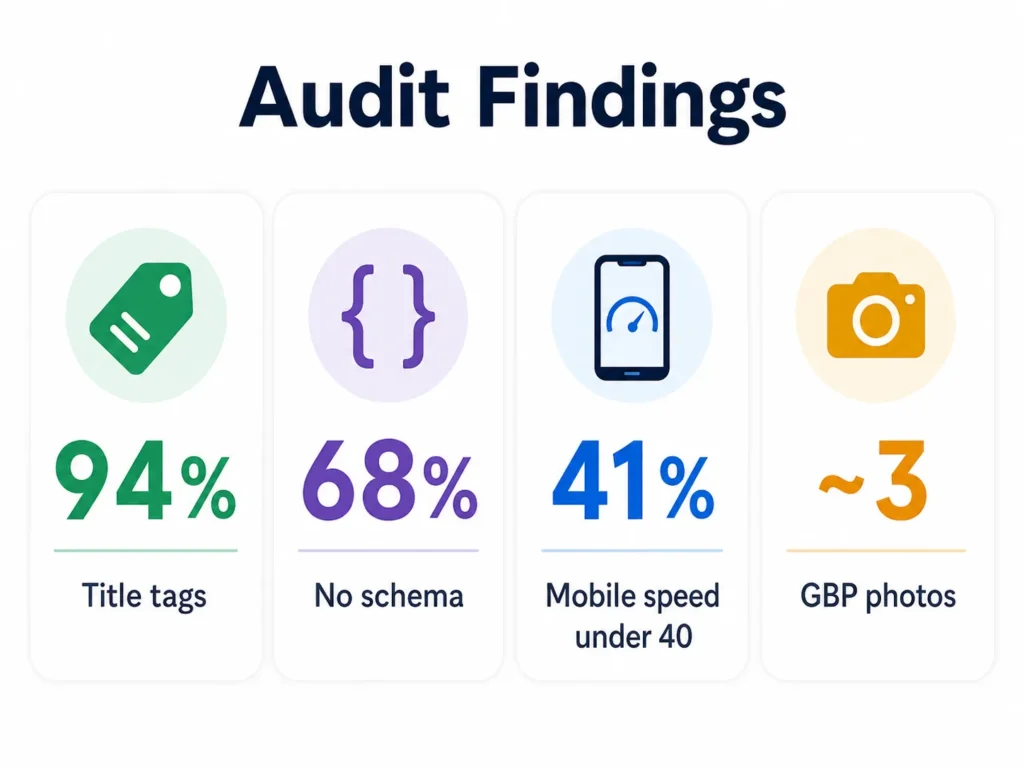
What 87 remodeling website audits show in 2026
Before the fixes, here’s the pattern. When we crawl a new client’s site, a short list of problems repeats on almost every one. We track these because they predict how fast that remodeler can start ranking and booking work.
| What we check at audit | How often it’s broken | Why it costs leads |
|---|---|---|
| Title tags (missing or duplicate) | 94% of sites | Google can’t tell pages apart, so none rank well |
| Schema markup | 68% have none | Search engines can’t confirm who you are or what you do |
| Mobile page speed (score under 40) | 41% of sites | Phone visitors leave before the page finishes loading |
| Google Business Profile photos | Most have about 3 | The map result that drives calls looks abandoned |
| Platform that blocks SEO fixes (Wix, locked builders) | About 35% of new clients | The site fights every change and wastes months |
Read that top to bottom and you see the real problem. The average remodeling site isn’t one bad decision. It’s five small ones stacked on top of each other, each shaving off a few leads a month.
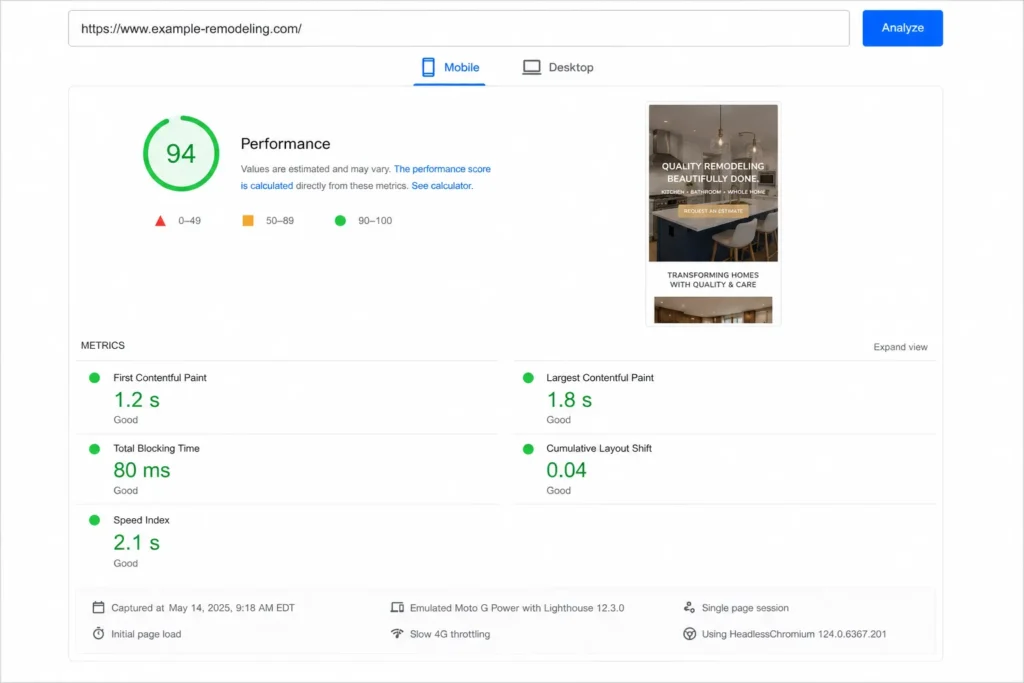
Mistake 1: Your site is too slow to keep a homeowner
If your pages take more than about three seconds to load on a phone, you’re losing people before they see a single project. Speed is the first filter, and homeowners comparing three or four contractors apply it without thinking. In Google’s research on mobile pages, the probability a visitor bounces rises 32% as load time goes from one second to three, and 90% by five seconds.
Speed is also part of how Google ranks. Google counts Core Web Vitals among the page-experience signals its systems reward, and it defines a good load as the largest element painting within 2.5 seconds. In our audits, 41% of remodeling sites miss that badly, scoring under 40 out of 100 on mobile. The causes are almost always the same three: full-size photos dropped straight off a phone, a page builder buried in plugins, and cheap shared hosting.
The fix isn’t complicated. Compress and size every image, cut the plugins you aren’t using, and move to hosting built for WordPress, which is usually where remodeling sites finally clear Google’s speed thresholds.
Mistake 2: Is there an obvious next step on every page?
A homeowner who’s ready to reach out should never have to hunt for how. If your only path to contact is a “Contact” tab in the menu, you’re making people work for the privilege of handing you a job. The moment passes, and they call someone easier to reach.
You don’t need an aggressive site. You need one primary action, worded plainly (“Request an estimate” or “Book a call”), repeated in the header, the hero, and the end of every service section. Keep the form to four fields: name, phone, project type, zip. Every extra field you add is another reason to abandon it. On the sites we rebuild, moving the estimate request into those three spots and cutting the form down is one of the fastest lifts we see. That single clear action, repeated, is the spine of good remodeling web design.
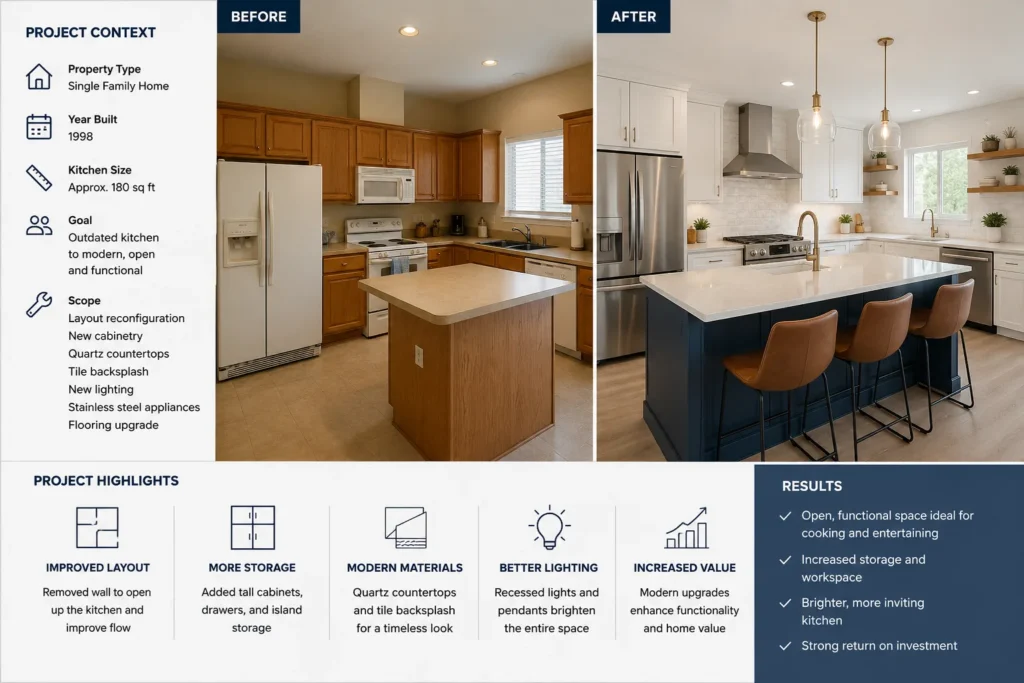
Mistake 3: Your project photos don’t tell a story
A wall of finished photos looks nice and answers nothing. A homeowner weighing a $60,000 kitchen wants proof you’ve solved a problem like theirs, not a slideshow. Trust is most of the decision here. In BrightLocal’s 2024 survey, 75% of consumers said they always or regularly read online reviews for local businesses, and the same instinct applies to your work: they’re reading it for reasons to believe you.
So give the photos context. Pair each project with two or three lines: what the space was, the problem you solved, the materials you used, and the town it’s in. A galley kitchen in a 1960s ranch that you opened up and finished in quartz tells a homeowner far more than “Kitchen Remodel #7.” Described, named projects also give Google something real to index, which turns your gallery into a way to get found instead of decoration.
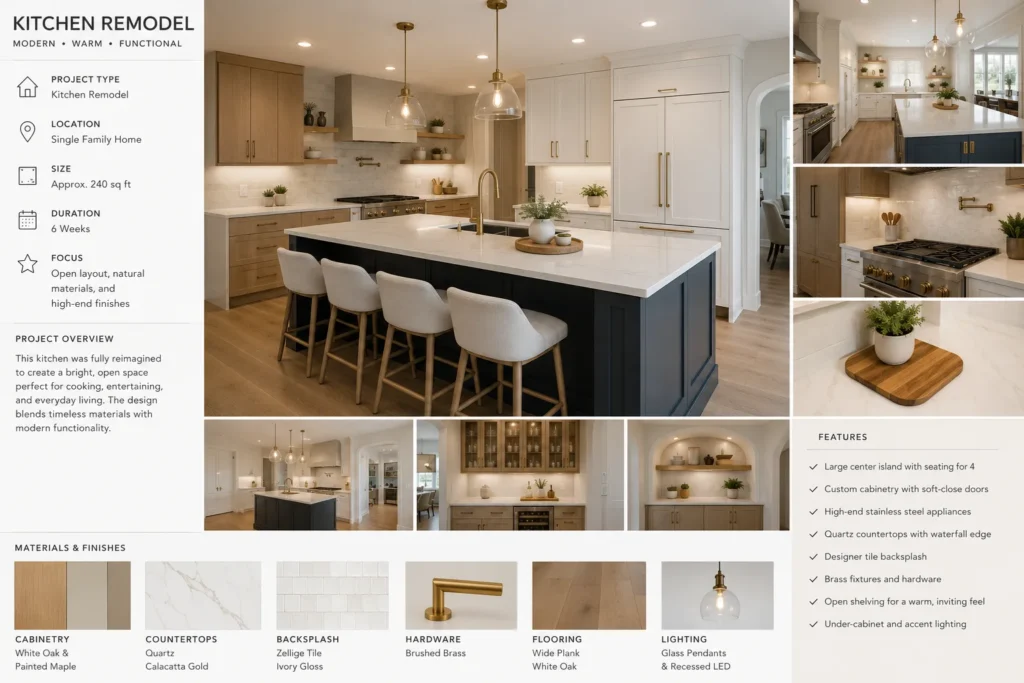
Mistake 4: Do you sound like every other contractor in town?
If your homepage leads with “quality work, honest service, family owned,” you sound like every contractor a homeowner is comparing you against. Sameness is expensive, and it’s the mistake that quietly caps what you can charge.
Here’s what specific looks like in practice. One high-end kitchen remodeler we worked with looked identical online to the $20,000 crews in their market, so 70% of their inquiries were budget shoppers wasting everyone’s time. We rebuilt the site around what they actually did: detailed galleries with material specs and real project costs, plus content explaining what a six-figure kitchen includes and why it costs that. Lead volume dropped from 15 a month to 11. That was the point. Qualified leads climbed from 30% to 72%, close rate went from 12% to 34%, and monthly revenue from search leads went from $54,000 to $352,000. Fewer leads, far more money, because the message finally spoke to the right homeowner.
You can’t buy that with adjectives. Name who you serve, the projects you want more of, your actual process, and the price bands you work in. The right clients recognize themselves. The wrong ones screen themselves out.

Mistake 5: The site falls apart on a phone
Most homeowners meet your business on a phone, often at night after work. If the site is hard to read or tap there, you’ve lost them before a word gets exchanged. Phones now drive close to 60% of web traffic worldwide, according to Statista, and for a local trade the share skews higher still.
It matters twice over, because Google now uses the mobile version of your site to decide how you rank, an approach it calls mobile-first indexing. A mobile-friendly site isn’t a shrunk-down desktop page. Text has to be readable without pinching, buttons have to be thumb-sized, and forms have to be finishable one-handed. Put the essentials first: what you do, where you work, a proof point, and the estimate button, before anything else loads.
Mistake 6: Google can’t tell what you do or where
You can fix everything a visitor sees and still be invisible, because the parts Google reads are broken. This is the mistake homeowners never notice and remodelers almost always have. In our audits, 94% of remodeling sites have missing or duplicate title tags, and 68% carry no schema markup at all. Add a site with one page trying to rank for every service in every town, and Google has nothing clear to work with.
The fix is unglamorous and it works. Write a unique title tag for every page. Add LocalBusiness, Service, and FAQ schema so search engines can confirm the basics. And build a real page for each service and each area you serve, so “kitchen remodeler in [your city]” has an actual page to match instead of a homepage trying to be everything.
The most expensive mistake is the fix itself: a full redesign
Here’s where remodelers lose the most ground, and it runs against common advice. The costliest website mistake usually isn’t a slow or dated site. It’s tearing that site down for a clean redesign that resets everything Google already trusts about you.
We’ve watched a remodeler drop six months of ranking progress because a designer rebuilt the site, changed every URL, and skipped the redirects. The new site looked better and ranked worse, and it took two quarters to climb back to where the old one already was. A website is an asset that compounds, not a wardrobe you refresh on a schedule. If the bones are sound, fix what’s broken and keep your URLs. Rebuild only when the platform blocks SEO fixes, and when you do, map every old URL to its new home before launch.
Fixing these doesn’t take a bigger website. It takes a faster one, with an obvious next step, real projects explained, a message only you could write, a layout that holds up on a phone, and a structure Google can read. Get those right and your site stops being a bill and starts being the one lead source you actually own. If you want to know which of these remodeling website mistakes is costing you the most right now, we’ll tell you straight, and since we only take one remodeling company per city, it’s worth finding out whether yours is still open.
FAQs
Why is my remodeling website not getting leads?
Usually it’s a mix of speed, clarity, and trust. In our audits of 87 remodeling sites, 41% scored under 40 for mobile speed and 94% had broken or duplicate title tags, so homeowners bounce and Google can’t rank the pages. Fix the load time, put one clear way to request an estimate on every page, and show described projects, and most sites start converting the traffic they already get.
How fast should a remodeling website load?
Aim for the largest element painting within 2.5 seconds, the threshold Google calls good. Google’s own research found the probability a mobile visitor bounces rises 32% between a one and three second load, and 90% by five seconds. For remodelers, most of the delay comes from oversized project photos and too many plugins.
How many project photos should a remodeling website have, and how should I use them?
Quality and context beat quantity. Pair each project with two or three lines on the scope, the problem you solved, the materials, and the location, so a homeowner can see work like theirs. Described, named projects also give Google something to index, which turns your gallery into a way to get found rather than decoration.
Do I need separate pages for each service and city I serve?
Yes. One page trying to rank for every service in every town rarely ranks for any of them. Dedicated service and city pages, each with a unique title tag, let Google match you to specific searches. In our audits, 94% of remodeling sites had missing or duplicate title tags, one of the most common reasons they stay invisible.
Should I redesign my remodeling website?
Often, no. A full redesign that changes your URLs without redirects can reset the rankings Google already gave you, and we’ve seen remodelers lose six months of progress that way. If the structure and speed are sound, fix what’s broken instead. Rebuild only when the platform blocks SEO, and keep every URL mapped to its new home.
How long before a new remodeling website brings in leads?
Faster than most agencies claim. We usually see keywords moving within 30 to 60 days and first organic leads by month three or four, with steadier flow by month eight. Speed depends on your market’s competition and your starting point, which is why we set the timeline per city rather than promising a flat number.