

In 2025, Semrush measured something that should change how every contractor thinks about Google: 83% of searches that triggered an AI Overview ended without a single click to any website. In Google’s AI Mode, that figure hit 93%. For publishers chasing informational traffic, that’s an extinction event. For home builders and remodelers, it’s the clearest signal yet about where your effort actually pays off.
Here’s the part the older SEO guides miss. AI Overviews now appear on roughly 48% of all searches and, per Search Engine Land, on more than 70% of “how-to” queries, but they show up on fewer than 5% of branded and local-intent searches. The phrases that win you jobs, like “kitchen remodeler near me” or “custom home builder in [city],” sit in the protected zone. So while general SEO advice is being rewritten by AI, the local game is mostly intact, and it’s where you should concentrate.
This guide covers the full picture: how search works now, what’s different for builders versus remodelers, and the local, on-page, technical, and AI-citation moves that turn searchers into signed contracts.

What SEO Means for a Contractor in 2026
SEO is the work of making your business the obvious answer when someone nearby is ready to spend money on their home. That’s it. It blends four things: a strong Google Business Profile, service and location pages that match what people search, a technically sound website, and content structured so both Google and AI assistants can quote it. If those four categories feel blurry, our breakdown of on-page vs. off-page vs. technical SEO is a useful primer.
Three myths still cost contractors money. SEO is not instant: a new remodeler should expect 6 to 12 months before organic leads flow consistently, and an established firm new to SEO usually sees movement in 3 to 6. It’s not just keywords: proximity, reviews, and site speed often outweigh the words on your page. And it’s not a one-time project: search behavior, competitors, and Google’s algorithms shift constantly. The contractors who win treat it as a habit, not a launch.
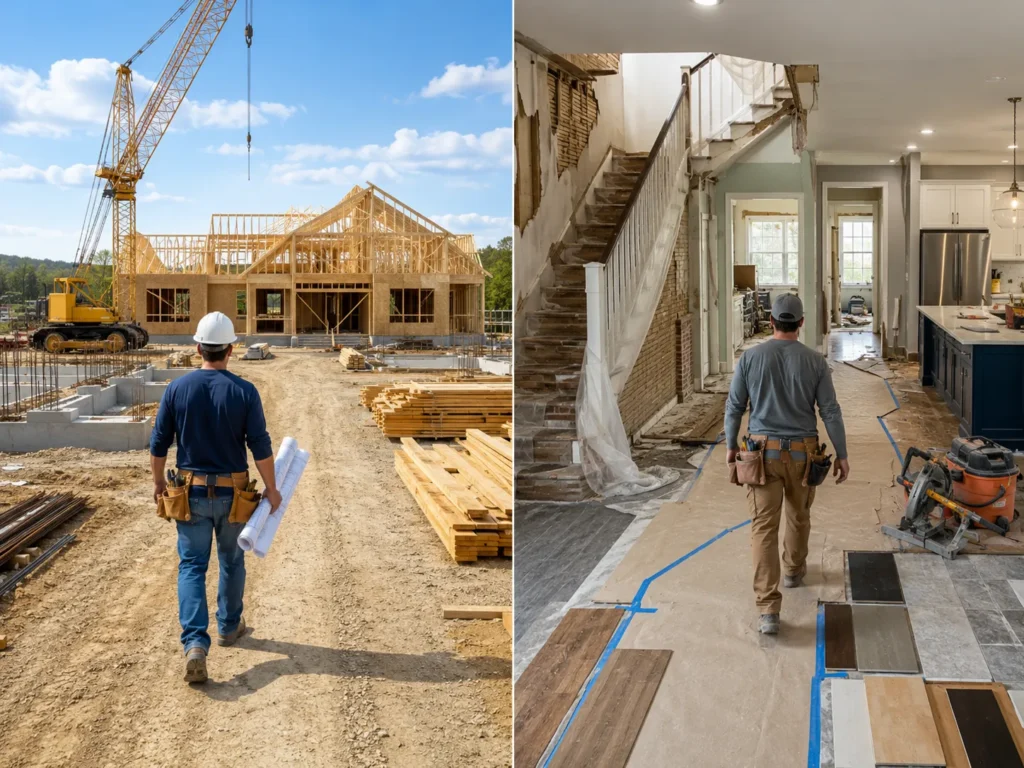
Builders and Remodelers Are Not Running the Same Race
Most guides lump “contractors” together. That’s a mistake, because the buyer’s journey is fundamentally different, and so is the website that serves it.
Remodelers sell to people who are close to buying. Someone typing “bathroom remodel [city]” has a project, a rough budget, and a timeline. “Kitchen remodeling near me” alone draws roughly 22,000 searches a month in the U.S. The intent is hot and local. Your site should answer it with dedicated service-by-city pages (kitchen, bath, additions, whole-home), before-and-after galleries, and honest cost guides. These are mostly commercial and transactional searches, which is worth understanding through the lens of the four types of keywords in SEO.
Builders sell to people who are still deciding. A new-construction buyer compares multiple builders over months and searches in ways remodelers never see: “new homes [community name],” “semi-custom homes [suburb],” “new construction [school district].” Their decisions hinge on communities, floor plans, and school zones. That demands a different architecture: market pages for each metro, community pages, individual floor-plan and quick-move-in pages, and aspirational educational content for buyers early in the journey.
The practical payoff: community pages and floor-plan pages tend to rank faster and convert better than broad city terms, because a buyer searching a named community has already narrowed the field. The catch is that builders need visibility across many cities, subdivisions, and districts at once, which makes duplicate-location content and messy site structure the most common technical failures on builder sites. Remodelers usually fight for one or two cities; builders fight for a map.

Local SEO Is the Engine: Here’s What Actually Moves It
If you do one thing well, make it local. An August 2025 Search Atlas study of local rankings put hard numbers on what drives the map pack, and the weighting is blunt: proximity to the searcher accounts for about 55% of overall local ranking power, with review count at roughly 19%.
You can’t move your business closer to every customer. But look at what happens at the top of the results, where jobs are actually won: among the top 10 listings, proximity’s pull drops to about 36%, while review count climbs to 26% and the keywords inside your reviews account for nearly 23%. Translation: reviews are the lever you control that most affects whether you crack the top of the pack.
The review math for home services is unforgiving. The average customer reads 7 reviews before choosing a contractor, and 73% won’t even consider a business rated below 4.2 stars. Top-ranking local businesses carry around 47 reviews versus 39 for typical ones, and case-study data shows real ranking movement once a profile crosses the 10-review threshold. The move most contractors skip: ask satisfied clients to mention the service and city in their review, like “They redid our kitchen in Plano,” because that review text feeds the relevance signal that breaks the top 10.
Beyond reviews, your Google Business Profile is the single biggest local asset; profile signals make up roughly a third of what determines local pack placement. Fill it completely, pick the most specific primary category, post project photos regularly, and keep your name, address, and phone identical everywhere they appear online. Then build citations on the directories your buyers already trust: Houzz, Angi, BBB, and your local chamber of commerce.
On-Page and Content: Earn the Click You Do Get
With fewer clicks to go around, the ones you earn have to land. On-page SEO is everything you control on your own pages.
Write title tags that lead with service and city and stay under 60 characters, like “Kitchen Remodeling in Plano | [Company].” Keep meta descriptions near 155 characters and give people a reason to click: a free in-home estimate, a financing option, a warranty. Use one H1 per page that names the primary keyword, and break the body into H2s and H3s that mirror how buyers actually phrase things.
Then connect the dots. Link blog posts to the relevant service or community page using descriptive anchor text (“custom home additions”), never “click here.” Name your image files for what they show (kitchen-remodel-plano.jpg, not IMG_0427.jpg) and write alt text that describes the work. Keep URLs short and readable: /kitchen-remodeling-plano/ beats /services?id=84, and a clean URL structure genuinely affects rankings. None of this is glamorous. All of it compounds.

Technical Foundations That Keep You Visible
Technical SEO decides whether Google and AI crawlers can even read you. Four things matter most for contractors.
Speed and Core Web Vitals come first, and they punish image-heavy builder galleries hardest, so compress every photo and lazy-load below-the-fold images. Mobile experience is non-negotiable, since most “near me” searches happen on phones; tap-to-call has to work on the first try. Submit an XML sitemap through Google Search Console and check it weekly for crawl errors and, for builders, duplicate community pages that cannibalize each other. Finally, add structured data: a GeneralContractor or HomeAndConstructionBusiness schema, plus Service, Review/AggregateRating, and FAQPage markup. If schema is new to you, start with the role of schema in local SEO. That FAQPage markup matters more than ever, for reasons that have nothing to do with traditional Google.

The New Frontier: Getting Cited by AI
This is the chapter the older guides don’t have. AI search engines (ChatGPT Search, Perplexity, Gemini, Google’s AI Mode) now handle an estimated 12 to 18% of English informational queries, and that share is climbing each quarter. When a homeowner asks an AI assistant “how much does a kitchen remodel cost in Denver?”, you want your site to be the source it quotes. That’s the goal of Generative Engine Optimization, or GEO, and it builds on the same shift we cover in AI and SEO in 2026.
The mechanics are specific and learnable. Front-load your answers: state the cost range, the timeline, or the direct response in the first one to three sentences of a section, before the context. Add FAQPage schema where each answer is a complete, standalone 40 to 60 words, because that length is the sweet spot AI systems pull as a citation block. Across studies, pages with proper schema have roughly a 2.5x higher chance of appearing in AI answers. Phrase your headings as the questions people ask.
One counterintuitive finding shapes the rest of the strategy. ChatGPT draws close to half its citations from Wikipedia; Perplexity pulls nearly as heavily from Reddit and community discussion. AI assistants trust the wider web, not just your homepage. So your presence on Houzz, BBB, local news features, and genuine community forums isn’t a side quest; it’s how you get named in the answer, which is also why backlinks and citations still matter. The same reviews and consistent business data that power your map ranking also feed the AI’s confidence in recommending you, which is why aligning your schema with your Google Business Profile is worth the hour it takes.
Measure Jobs, Not Traffic
Traffic is a vanity number. A contractor’s SEO scoreboard is leads and signed work, and the channel difference is dramatic: SEO-generated leads close at about 14.6%, versus 1.7% for shared or purchased platform leads, more than an 8x gap. Those organic leads also get cheaper over time, maturing toward $25 to $45 each while bought leads from lead-gen platforms average $91 and keep rising.
Track four things and ignore the noise. Google Search Console shows the queries and clicks you’re earning. GA4 tracks form submissions and consultation bookings as conversions, and there’s more you can pull from it in our guide on using Google Analytics to strengthen SEO. Call tracking by source tells you which leads came from search versus elsewhere. And a CRM like JobTread or HubSpot ties each lead back to revenue, so you learn which keywords produce paying projects, not just visits. For local visibility specifically, a geo-grid tool like Local Falcon shows your map-pack rank across your service area, not just from your own office.
Where to Start This Week
The goal has quietly shifted. It’s no longer to rank number one on a page of blue links; it’s to be the business the map pack displays and the AI assistant names by default. Those are won by the same handful of moves, and you can start three of them this week.
First, complete your Google Business Profile and ask your three most recent happy clients for a review that names the service and city. Second, audit your service or community pages and make sure each one targets a real city-plus-service phrase, with a clear title tag and a reason to call. Third, add FAQ schema with crisp, 40-to-60-word answers to the questions buyers actually ask. Do those, keep doing them, and you stop competing for clicks that are disappearing and start owning the searches that still turn into signed jobs.
Frequently Asked Questions
How long does SEO take to work for a contractor?
Expect 6 to 12 months of consistent work before a brand-new remodeler or builder sees steady organic leads. An established company that’s simply new to SEO usually sees ranking and lead movement in 3 to 6 months. Local map-pack gains, driven by reviews and a complete profile, often come faster than organic page rankings.
Do online reviews really affect my Google ranking?
Yes, directly. Review count makes up roughly 19% of local ranking power overall and climbs to about 26% among top-ranked businesses. Beyond ranking, 73% of homeowners won’t consider a contractor rated under 4.2 stars, so reviews influence both whether you appear and whether you get chosen.
Should I still blog if AI answers most questions now?
Yes, but change the aim. Blog to get cited by AI and to support commercial pages, not to chase raw traffic. Write clear, structured answers to real buyer questions, add FAQ schema, and link each post to the service or community page it supports. Quality and structure beat volume.
What’s the difference between SEO for builders and remodelers?
Remodelers target high-intent local searches with service-by-city pages and project galleries. Builders serve longer, research-heavy journeys and need community pages, floor-plan pages, and school-district-specific content across many locations. Same fundamentals, very different site architecture and content depth.