
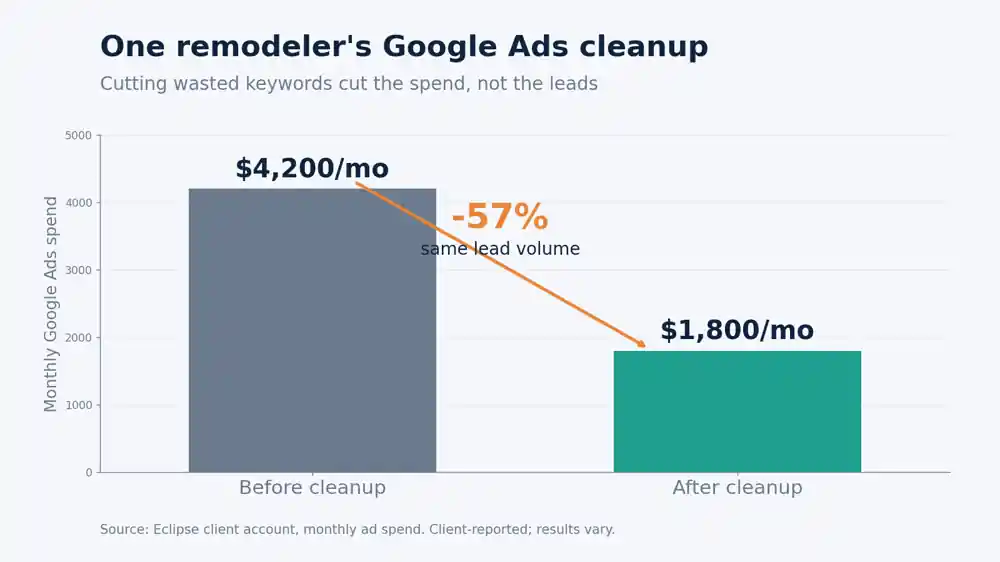
A bathroom remodeler in the Mid-Atlantic came to us spending $4,200 a month on Google Ads. His old agency had built the account on broad match with no negative keyword list. So “bathroom remodel” was pulling in clicks for “bathroom cleaning service” and “bathroom accessories.” He was paying, over and over, for clicks that could never book a $20,000 job.
We cut his spend to $1,800 a month and kept the same number of leads. His market didn’t change. We just stopped paying for the wrong clicks.
That gap, between what remodelers spend and what they need to spend, is what this guide is about. PPC for remodelers works. It can put your phone number in front of a homeowner the same afternoon they decide to renovate. But it’s the most expensive lead channel you’ll ever run, and most remodelers overpay because the account was built to spend money, not to book jobs. Here’s how to run Google Ads so every dollar ties back to a booked estimate, and how to treat paid search as a bridge to the rankings you own.

What is PPC for remodelers?
PPC (pay-per-click) for remodelers is paid search advertising where a remodeling company bids to show at the top of Google for terms like “kitchen remodeler near me,” and pays only when someone clicks. Done well, it targets homeowners with buying intent inside a set service area and sends them to a service-specific page built to book estimates.
The part most guides skip: those clicks are rented. The moment you stop paying, you disappear. That single fact should shape how you spend.
PPC is a bridge, not the business you’re building
Run PPC to fill your calendar this month. Don’t confuse it with the marketing asset that carries your company for the next decade.
Here’s the reasoning, with numbers. Across our clients, organic search leads convert to booked estimates about 73% of the time. Leads bought from shared platforms convert at 22-31% (client-reported figures; results vary by market and close process). Those shared leads run $87 to $142 each, and you split them with four or five other remodelers. Paid search sits in between: the lead is yours alone, but you rent the placement.
So the sequence that makes financial sense is straightforward. Turn on Google Ads for remodelers for immediate lead flow. Install real tracking. Then move budget, month by month, into organic rankings you keep. For clients who came to us spending $5,000 or more a month on shared leads, the point where organic starts replacing that spend usually lands in month 5 to 7.
Michael’s position on this is blunt: a remodeler who only rents leads is building someone else’s business. PPC buys you time. Rankings buy you a market.

How much should a remodeler spend on Google Ads in 2026?
Enough to buy a useful number of leads in your market, and no more than your close rate and job value can carry. For most remodelers we work with, ad spend starts around $2,000 to $5,000 a month, separate from management. Your real number comes from two things: what a click costs in your market, and how many leads it takes you to book a job.
Do the math before you fund the account. Say your average kitchen project is worth $60,000 and you close one in five qualified leads. At that job value, you can pay real money per lead and still profit, which is why remodeling is a strong fit for paid search. Now compare that to a shared platform: $87 to $142 for a lead sent to five competitors, closing at under a third. The channel that gives you an exclusive lead and a service-specific page will almost always win the math.
| Lead source | How you pay | Typical cost | Exclusive to you | Close rate (client-reported) | Who owns it |
|---|---|---|---|---|---|
| Google Ads (PPC) | Per click | Varies by market; pull your range from Keyword Planner | Yes | Above shared, below organic | Google (rented) |
| Local Services Ads | Per valid lead | Set by Google, per lead | Yes | Similar to PPC | Google (rented) |
| Angi / HomeAdvisor | Per shared lead | $87 to $142 | No, shared with 4 to 5 | 22-31% | The platform |
| Organic search | Fixed monthly investment | $3,500 to $5,000/mo | Yes | About 73% | You |
Pricing varies by market competition and scope. The table is a planning tool, not a quote.
The keyword mistake that cost one remodeler $2,400 a month
Broad match with no negative keyword list is the single fastest way for a remodeler to bleed budget. It’s also Google’s current default suggestion, paired with Smart Bidding, and that combination only behaves when your conversion tracking is clean and your negative list is long. On day one, for most remodelers, neither is true.
Back to the Mid-Atlantic bathroom specialist. Ninety percent of his leads came from Google Ads at $4,200 a month. The previous agency had never told him which keywords converted, because they had installed no conversion tracking at all. When we audited the account, “bathroom remodel” was triggering ads for “bathroom cleaning service” and “bathroom accessories,” and 60% of the keywords had produced zero conversions in six months.
We did three things. Installed call and form tracking. Paused every keyword with no conversions. Built a negative list around the junk terms. His ad spend dropped from $4,200 to $1,800 a month with the same lead volume, a 57% cut. Paired with the organic work we started in parallel, his total lead flow went from 10 a month to 19 while his combined marketing spend fell by $2,400 a month. His words: “The first time I actually understood what I was paying for.”
If you take one thing from this section: read how Google’s match types actually work before you trust the default settings, and never run broad match without a negative list you review every week.

Which keywords actually book remodeling jobs?
The ones where a homeowner names the job and signals they’re ready to hire: “kitchen remodeler near me,” “bathroom remodel estimate [city],” “home addition contractor [city].” Skip the research terms. Someone typing “kitchen design ideas” is months from a contract, if they ever sign one.
Group keywords into tight ad groups by service, one per job type: kitchen, bath, additions, garage conversions. That’s not busywork. A garage conversion contractor we work with runs 142 long-tail terms across dedicated pages for every conversion type, garage-to-bedroom, garage-to-office, detached ADU. Fewer leads came in, around 8 to 10 a month, but the close rate hit 45% because every click matched a specific job, and the average project ran $62,000.
Build the negative list from day one: jobs, salary, career, hiring, DIY, how to, free, cheap, ideas, images, and the ones that burned the bathroom client, cleaning and accessories. Then use seasonality, which almost no competitor article mentions. From our database of 2,400+ remodeling search terms, tracked monthly since 2021, “kitchen remodel cost” peaks in January and “deck builder near me” peaks in April. Fund the campaigns that match the calendar instead of spreading budget flat across the year.
On match types, the mechanics changed and old advice is still floating around. Since Google’s 2021 update, phrase match keys on the meaning of a search, not strict word order, and exact match now includes close variants like misspellings, plurals, and same-intent phrasing. So exact match is no longer “only the exact words.” Start with phrase and exact, watch the search terms report every week, and add negatives as the junk shows up.

Write ads a homeowner picks over three competitors
Your ad shows next to two or three other remodelers bidding on the same term. Specifics win the click. Name the service, show one real proof point, and make the next step obvious.
Google’s responsive search ads let you load up to 15 headlines and 4 descriptions, and the system shows up to three headlines and two descriptions at a time. Point your first headline at the exact search (“Kitchen Remodeler in [City]”). Lead the second with a real differentiator, not a baseline. “Licensed and insured” is expected; it persuades no one. A 3-week kitchen timeline, financing from [$X/month], a manufacturer certification, or a written warranty length does the work. Make the third a clear call to action.
Turn on every relevant extension, sitelinks, callouts, call, and location. They make your ad bigger and give a homeowner more reasons to pick you, at no extra cost per click. Keep the call extension live during hours when someone actually answers the phone.

Why your Google Ads aren’t converting
If clicks come in and the phone stays quiet, the leak is almost always the page you send them to. Pointing paid traffic at your homepage is the most common and most expensive mistake we see. A homepage asks a ready-to-hire homeowner to go hunting through menus. A landing page that converts gives them one service, one message that matches the ad, and one clear action.
Build one page per service. Put the phone number above the fold as a tap-to-call link, because most remodeling searches happen on a phone. Keep the form short: name, phone, a line about the project. Load in under three seconds. Then prove you’re safe to hire with real signals, your Google review rating, before-and-after photos of actual jobs, and a few of the common on-page issues fixed so the page loads fast and reads clean.
Proof changes who calls. A high-end kitchen remodeler came to us drowning in budget shoppers, 70% of inquiries wrong for a shop doing $75,000 to $150,000 kitchens. We rebuilt the pages around high-end markers: galleries with material specs and real costs, a “what to expect from a $100K kitchen remodel” page, designer partnerships. Lead volume dropped from 15 a month to 11. Qualified leads jumped from 30% to 72%, and the close rate went from 12% to 34%. Fewer calls, far better calls.

How do you track a remodeling lead back to a keyword?
Track three actions: calls from the ad, calls from the landing page, and form fills. Then go one step further than most remodelers ever do, and import which of those leads became booked estimates. That way you measure cost per booked job, not cost per click.
Use Google Ads call reporting for calls from the ad, and a Google forwarding number for calls from the page. Manage the tags through Google Tag Manager so you’re not waiting on a developer for every change, and connect the account to Google Analytics 4 for the full path a visitor takes. Google’s own conversion tracking setup covers the basics. The piece that separates a real operator from a spender is offline conversion import: push closed jobs from your CRM back into Google Ads, so the system bids toward revenue instead of raw form fills. We run this through GoHighLevel for clients. The bathroom remodeler from earlier couldn’t tell which half of his budget was wasted until this was in place. Once it was, the wasted half was obvious in a week.
PPC vs SEO for remodelers: which should you run in 2026?
Run both, in sequence. PPC for the leads you need this month, SEO for the leads you’ll get without paying once your rankings hold. If budget forces a choice and you need work now, start with PPC. If you can invest through a 6 to 9 month build, organic becomes the cheaper lead by a wide margin.
The trade-off is speed versus ownership. PPC produces calls the day it goes live, and stops the day you stop paying. SEO is slow at the start, first organic leads tend to arrive in month 3 to 4 in our client data, with steady flow by month 6 to 9, and then the marginal cost of each new lead drops toward zero. There’s a content lesson buried in the numbers, too. When we tested blog posts against service pages across four clients, the service pages converted at 6.4% versus 1.8% for blogs, so the content that ranks and pays is the page built around a service and a city, not a trends listicle. Backlinks still carry weight in that build, and backlinks still matter more than most owners expect.
The bridge model ties it together: fund PPC now, move budget to organic as rankings compound, and let paid search become the thing that funds its own replacement. Social has a supporting role here, project photos and retargeting, but for lead generation it sits well behind search.
Should remodelers run Local Services Ads too?
For most remodelers, yes, alongside search ads. Local Services Ads sit above the regular paid results, charge per valid lead instead of per click, and carry a Google Screened or Google Guarantee badge that does some of your trust-building before the phone rings. You can also dispute leads that were spam or outside your service area, so you’re not paying for junk. Running LSAs, search ads, and organic together lets you take up more of the page for the same high-intent search.
A 5-question check: should you be running PPC right now?
Score one point for each yes.
- Do you need booked estimates in the next 30 to 60 days? SEO won’t fill next month; PPC can.
- Is your average project worth $15,000 or more? A high ticket carries a high cost per lead.
- Can someone answer the phone during business hours? Most remodeling PPC leads call, and a missed call is a lost job.
- Do you have a service-specific landing page, not just a homepage?
- Is conversion tracking installed before you spend a dollar?
Four or five yes: run PPC now, and start building organic in parallel. Two to three: fix the gaps first, usually tracking and the landing page, then turn ads on. Zero or one: hold off. You’d be paying to send ready-to-hire homeowners to a page that can’t convert them.
When to hand PPC to a specialist
Bring in help when your cost per booked job climbs for three months straight despite a clean account, when your budget grows but lead quality drops, or when the weekly search terms review keeps losing to the actual work of running your company.
We build and manage Google Ads for remodeling companies, and we run it as the bridge to organic rankings you own, not as a forever expense. Month to month, no long contract. If that’s the model you want, you can hand it to a team that only works with remodelers. (Results vary by market, competition, and engagement. Pricing depends on your market and scope.)
Cheaper clicks were never the prize. The prize is the quarter your ad spend drops because your own rankings started carrying the calendar. Run PPC for remodelers as a bridge, track every lead to a booked job, and paid search turns into the thing that pays for its own replacement. That’s the version worth running.
Frequently asked questions
Is PPC worth it for remodelers?
Yes, when you need booked estimates fast and your average project is worth $15,000 or more. Paid search puts you in front of homeowners the day they decide to hire. The catch is that it’s rented. In our client data, shared-platform leads close at 22-31% while organic leads close around 73%, so the smart move is to run PPC now and shift budget to rankings you own over time.
How much does PPC cost for a remodeling company?
Most remodelers we work with start at $2,000 to $5,000 a month in ad spend, separate from management. Your real number depends on your market’s cost per click and how many leads it takes to book a job. Pricing varies by market and scope.
Should remodelers start with PPC or SEO?
If you need work in the next 30 to 60 days, start with PPC, since SEO won’t fill next month. If you can invest through a 6 to 9 month build, SEO becomes the cheaper lead. Most of our clients run PPC first, then move budget to organic as rankings hold, often reaching breakeven in month 5 to 7.
Why are my Google Ads not converting?
Usually the landing page, not the ads. Sending paid clicks to your homepage instead of a service-specific page is the most common leak. The second is broad match with no negative keyword list; one client was paying for “bathroom cleaning service” clicks until we added negatives and cut spend 57% with no drop in leads.
What are Local Services Ads and should remodelers use them?
Local Services Ads sit above the regular paid results and charge per valid lead instead of per click. They carry a Google Screened or Google Guarantee badge that builds trust before a homeowner calls. For most remodelers, running them alongside search ads is worth it, and you can dispute leads that were spam or outside your area.
How fast does PPC generate leads for remodelers?
PPC can produce calls the same day your campaign goes live, which is why it works as a bridge while slower channels build. By comparison, organic search in our client data starts producing leads around month 3 to 4, with steady flow by month 6 to 9.
What is a good cost per lead for remodeling PPC?
There’s no single number; it depends on your job value and close rate. The better metric is cost per booked estimate, not cost per click or even cost per lead. Track which leads become signed jobs and judge the account on that. Results vary by market and competition.