

Yes, local citations still matter for remodelers in 2026, and here is proof from our own client work. A remodeler we manage fell from #3 to #14 in the Google map pack after a phone number changed on the website but not on the 37 other sites that still listed the old one. Nothing else changed. The rankings dropped because the listings stopped agreeing with each other. Citations are the mentions of your business name, address, and phone number across the web. They are not as strong as reviews or a well-built Google Business Profile, but they are the quiet foundation under both. Get them wrong and you cap your ceiling. Get them consistent and you give Google the confidence to put you in front of homeowners. This guide covers what works, and what quietly costs you spots.
What is a local citation?
A local citation is any online mention of your business name, address, and phone number, together called NAP. Citations show up on directories like Yelp and Houzz, on mapping platforms like Apple Maps and Bing Places, and on industry sites. Google reads them to confirm your remodeling business is real, findable, and located where you say it is.
Some citations link back to your site and some do not. That is fine. A citation earns its value from consistent business details, not from a clickable link. That single fact is where citations split from backlinks, which is the next thing most remodelers get muddled.
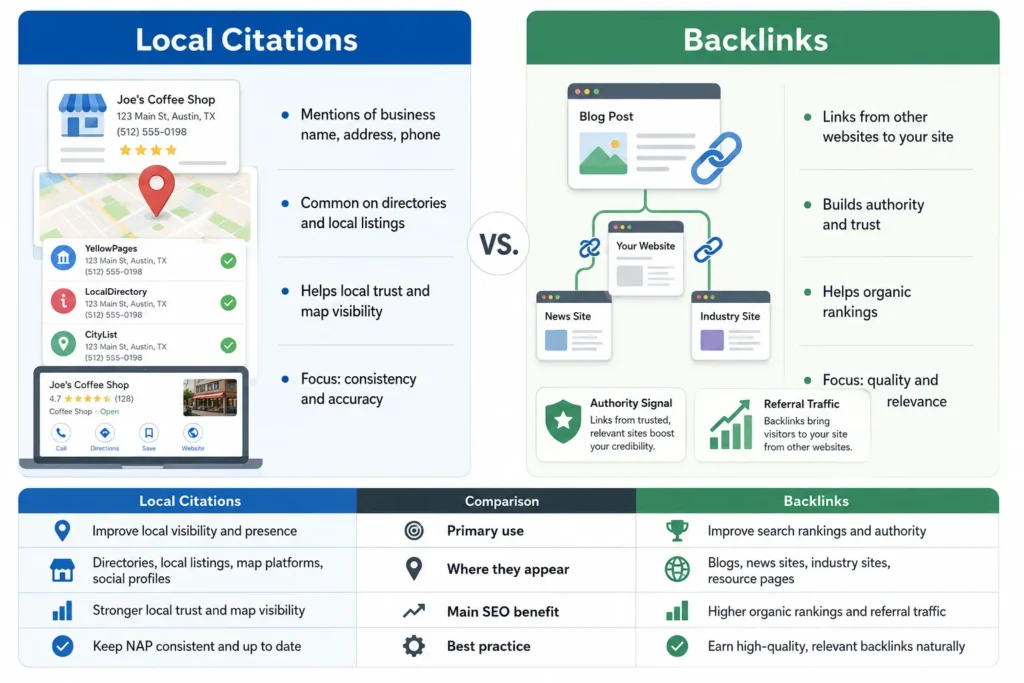
Citations vs. backlinks: what’s the difference?
Citations and backlinks both live on other websites, but they do two different jobs. A citation confirms who and where you are. A backlink passes authority to your domain. You want both, for different reasons.
| Local citations | Backlinks |
|---|---|
| Mention your NAP (name, address, phone) | A clickable link pointing to your site |
| Live on directories, maps, and listing sites | Live in articles, blog posts, and resource pages |
| Confirm your business is real and local | Pass trust and authority to your domain |
| Move the map pack and local visibility | Move organic (non-map) rankings across the site |
| Count even without a link | Only count when the link is live |
| Win by staying consistent everywhere | Win by being relevant and hard to get |
If you want the deeper version of the authority side, we break down how backlinks build domain trust in a separate post. For citations, the whole game is consistency. Which brings us to the part that decides your map-pack spot.
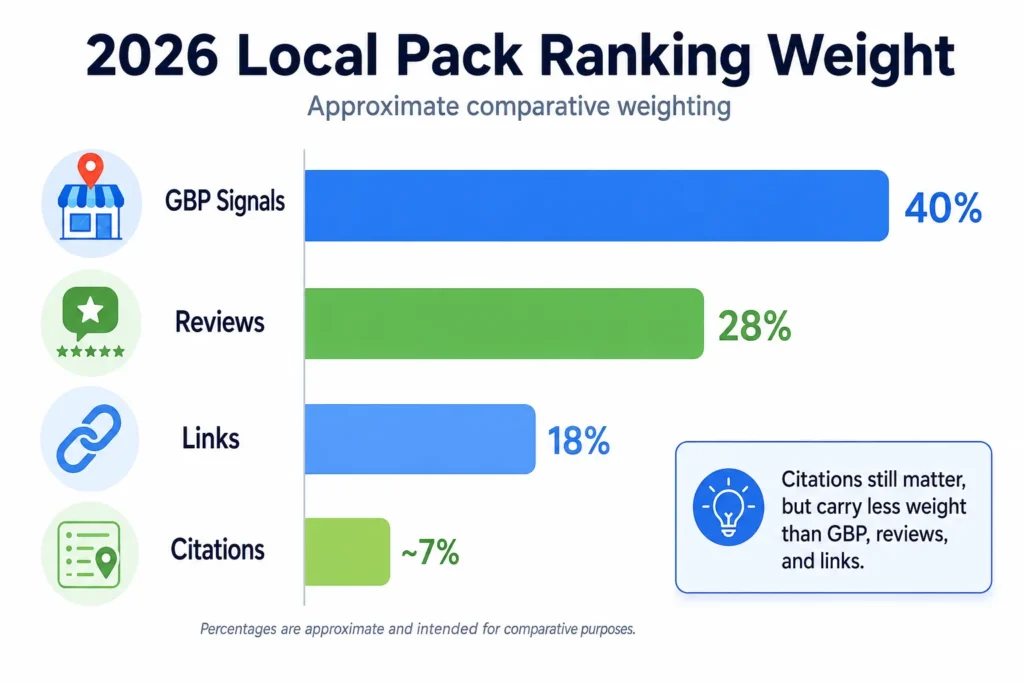
Do local citations still matter for local SEO in 2026?
They matter, but less as a ranking booster and more as a trust check that you cannot afford to fail. In Whitespark’s 2026 Local Search Ranking Factors survey, which polled 47 local SEO experts, citation signals came in as a smaller slice of local-pack weight than Google Business Profile signals, reviews, on-page content, and links. Roughly 7 percent, well behind the heavyweights.
So why obsess over 7 percent? Two reasons. First, that 7 percent is a floor, not a ceiling. Inconsistent citations do not just fail to help. They actively drag you down, the way our #3 to #14 drop showed. Second, citations now carry more weight in AI search than they do in the classic map pack. In that same 2026 data, citations rank inside the top handful of factors for showing up in AI-generated local answers. As homeowners start asking AI tools for a good remodeler near them, the sites that list you consistently become the sources those answers pull from. Most articles on this topic still have not caught up to that shift.
Why NAP consistency decides your map-pack spot
NAP consistency means your name, address, and phone number read exactly the same everywhere they appear. It is the one citation task worth doing first, and the one remodelers botch most.
Google is direct about this. Its own guidelines for representing your business say to present your company the way it shows up in the real world, on your signage and storefront, and to use one authoritative phone number and website. BrightLocal, which has cataloged local citations for years, puts it plainly: accurate NAP data is the difference between citations that help you and citations that hurt you. When your details conflict across the web, Google loses confidence in which version is true, and confidence is what a map-pack ranking is made of.
Here is where remodelers slip. They list the business as “LLC” on one site and drop it on the next. They write “Suite 200” here and “Ste 200” there. They change a phone number on the website and forget the 37 other places it lives, from the supply-house vendor page to an old chamber listing. Each mismatch is a small vote against you. Stack enough of them and you fall off the map, which is exactly what happened to the client above. Consistent details also pair with your local business schema, the structured data that spells out your NAP for search engines. We fixed the drop by pushing the correct number across every directory in one controlled pass, not one site at a time.
How many local citations does a remodeler actually need?
Most remodelers need 15 to 25 accurate citations, not 200. This is the opposite of the advice you usually hear, which tells you to copy your competitors’ lists and pile on 10 to 20 percent more. That advice is how remodelers wreck their own rankings.
We watched it happen. A client’s office manager, trying to help, submitted the business to more than 200 directories over a weekend, each with slightly different address formatting. Rankings slid within weeks. The fix took longer than the damage. The Whitespark experts land in the same place from the data side: ten citations on sites people actually trust beat fifty on directories nobody visits, and a spot on a well-known best-of list or a real industry site counts for far more than another throwaway listing.
So aim for a tight, clean set. Fewer sites, perfect data, sites that matter to homeowners and to your trade. Volume is not the goal. Agreement is.
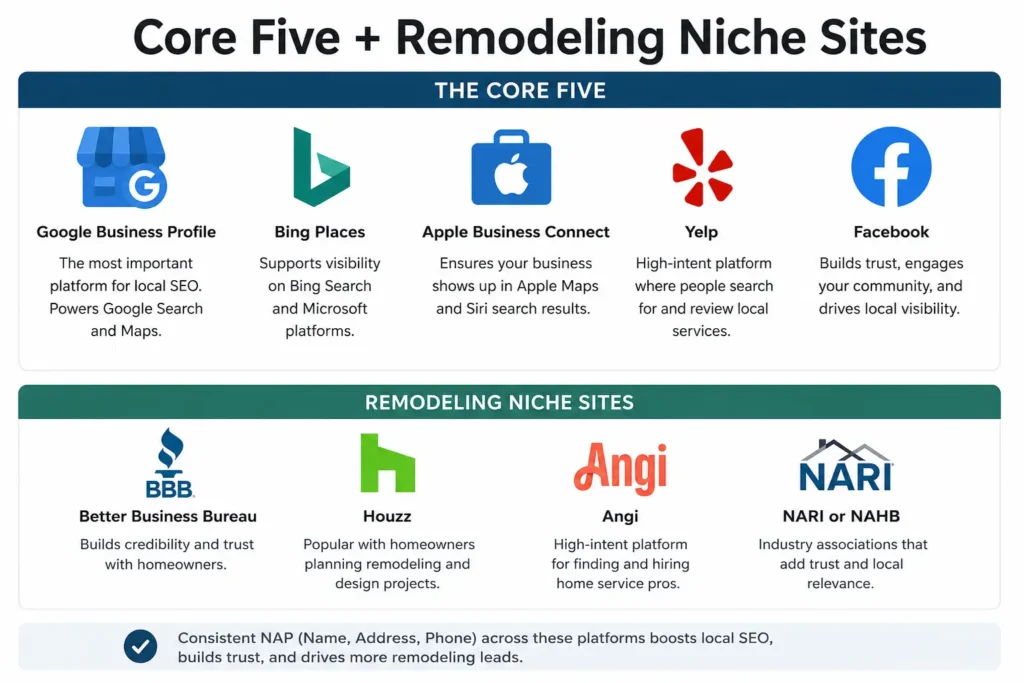
The citation sites that matter most for remodelers
Start with the platforms that feed Google and the ones homeowners open when they are ready to hire. A short, correct list beats a long, sloppy one every time.
Get these right first: Google Business Profile, Bing Places, Apple Business Connect, Yelp, and Facebook. These are the core five that other data sources copy from, so an error here spreads fast. Next come the trust and industry sites that fit remodeling: the Better Business Bureau, Houzz, Angi (the free listing is enough), Nextdoor, your local chamber of commerce, and trade groups like NARI or NAHB. A permit-office vendor list, a supplier’s find-a-pro page, or a local sponsorship page can carry real weight too, because they tie your name to your actual market. These niche sources are where you separate from the remodeler across town who only did the big directories.
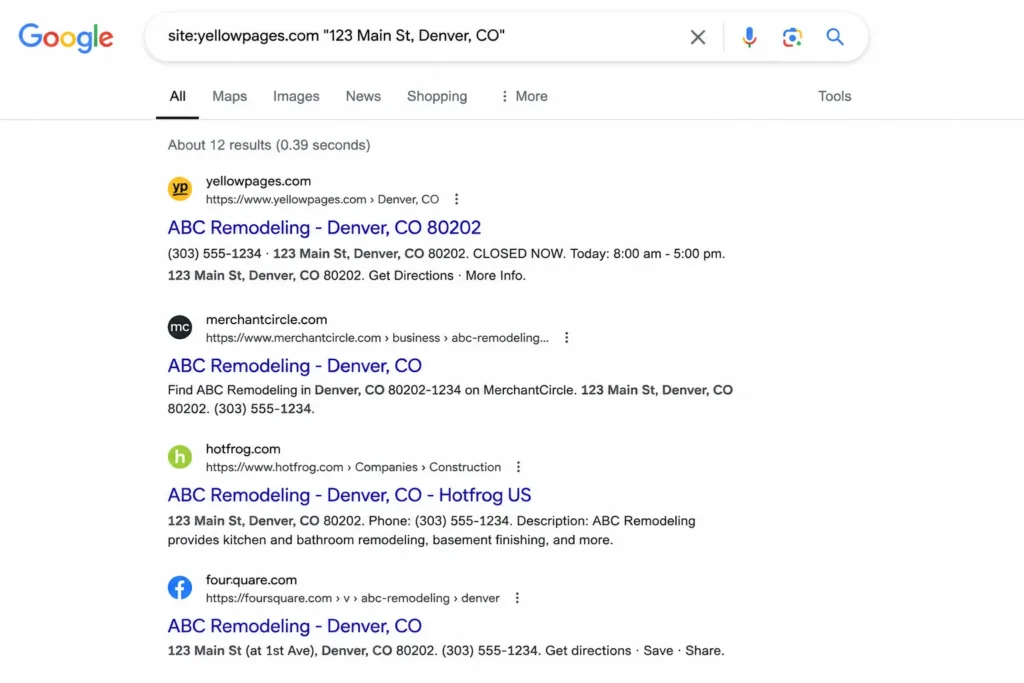
How to audit your citations in 10 minutes
You can find most of your existing citations with a free Google search, no tool required. Type your business name in quotes with a minus in front of your own domain, like Eclipse Marketing. Google returns the third-party sites that mention you and skips your own website.
Read the results with a sharp eye. Look for an old phone number, a previous address, a former business name, or a mismatched suite format. Each one is a fix. Run the same search on the remodeler ranking above you in the map pack and you get a ready-made target list of the sites that are working in your city. This is the fastest free audit there is, and it takes about ten minutes. Cleaning up what you find is the slower part, and where a listings tool or a partner earns its keep.
Should you build citations yourself or use a tool?
You can do it by hand, and for a tight core list, hand-building is fine. The trade-off is time and follow-through. Manual building means creating each listing, verifying it, and checking back so the data stays right as your business changes.
Listing-management tools sync your NAP across dozens of sites at once and flag mismatches, which saves hours and catches the drift that kills rankings. They cost money, and they are worth it once you pass a handful of locations or you have a messy history to clean up. The honest catch: a tool can push data fast, but it can also push a wrong format fast. The value is not the volume it adds. It is the consistency it protects. That is the same reason we handle every NAP change for our clients as one coordinated rollout instead of a piecemeal scramble.
Where citations fit in a remodeler’s local SEO plan
Think of citations as the foundation, not the whole house. They confirm you exist and belong in your market, then reviews and a complete Google Business Profile do the heavy lifting to rank you. Skip the foundation and the rest sits on sand.
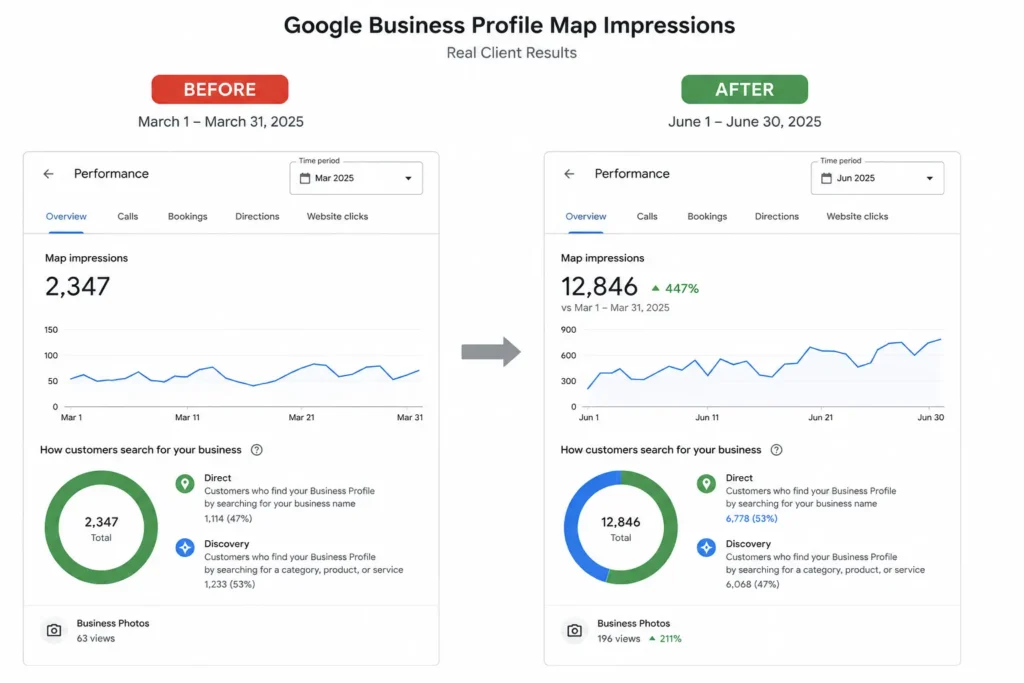
The order matters. We clean citations and NAP early, then build out the Google Business Profile, because that profile is the fastest early win. Across our clients, a fully built-out profile lifted map impressions by an average of 340 percent in the first 90 days. Citations are one of the off-page signals that back that profile up and keep it trusted. It is unglamorous work. It is also why a remodeler can stop renting shared leads and start owning the map in their own city, one market at a time. If you want that handled without the weekend directory rabbit hole, this is the kind of local SEO built for remodelers that we do, and you can start with a look at where your listings stand today.
FAQs
Do local citations still matter for local SEO in 2026?
Yes. In Whitespark’s 2026 Local Search Ranking Factors survey of 47 experts, citation signals are a smaller share of local-pack weight than reviews, links, and Google Business Profile signals, roughly 7 percent. But inconsistent citations actively hurt rankings, and citations now carry more weight in AI-generated local answers than they do in the classic map pack.
What is the difference between a local citation and a backlink?
A citation mentions your name, address, and phone number and confirms your business is real and local; it counts even without a link. A backlink is a clickable link that passes authority to your domain and moves organic rankings. Citations feed the map pack. Backlinks feed site-wide rankings.
How many local citations does a remodeler need?
Most remodelers need 15 to 25 accurate citations, not hundreds. Quality beats volume. We have seen a client lose map-pack positions after over-submitting to more than 200 directories with inconsistent formatting, so a tight, clean list wins.
What is NAP consistency and why does it matter?
NAP consistency means your name, address, and phone number read exactly the same everywhere online. Google’s guidelines ask you to represent your business the way it appears in the real world with one authoritative phone number. One mismatch can cost you: a remodeler we manage fell from #3 to #14 in the map pack after a number changed on the site but not on 37 other listings.
How do I check my current local citations for free?
Search Google for your business name in quotes with your own domain excluded. Google lists the third-party sites that mention you so you can spot old numbers, wrong addresses, and duplicates. Run it on a competitor to find sites you are missing.
Do citations help with AI search and Google’s AI answers?
Yes, and more than most people realize. In the 2026 ranking-factor data, citations sit among the top factors for appearing in AI-generated local results. Consistent listings across trusted sites make your business one of the sources AI tools cite when a homeowner asks for a remodeler nearby.
Can bad citations hurt my rankings?
They can. Duplicate listings, old phone numbers, and mismatched addresses tell Google conflicting things about your business and erode the trust a map-pack ranking depends on. Fixing or removing them is often worth more than building new ones.