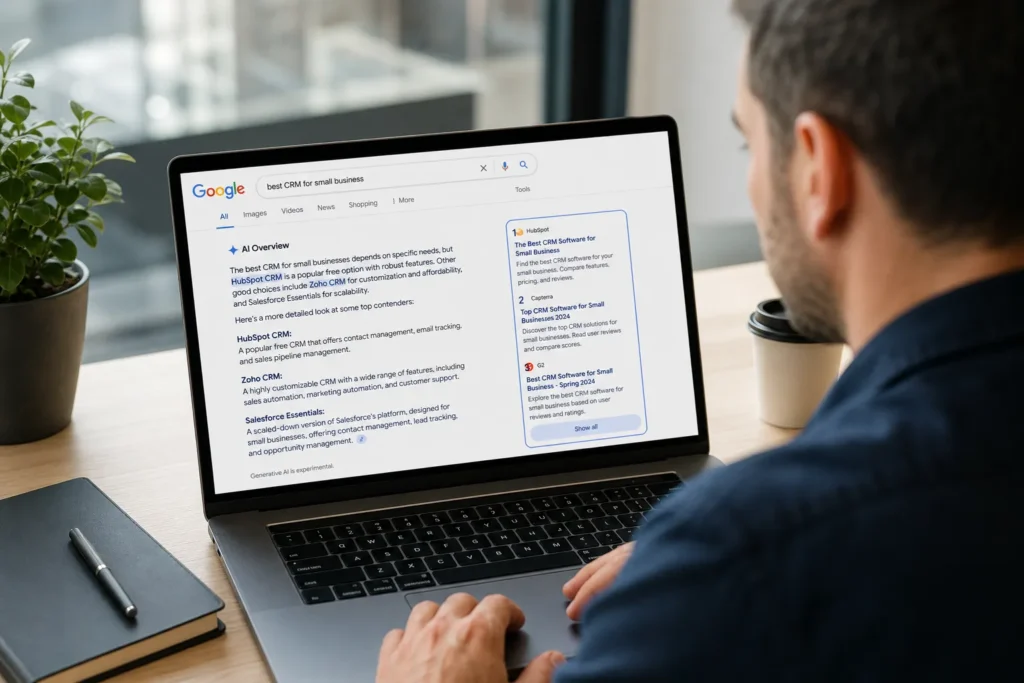
Roughly 62% of users now start searches with AI tools instead of Google, according to report. That single stat should change how you think about content. AI citations that ChatGPT, Gemini, Perplexity, and Google AI Overviews include when they answer a user’s query have become the new currency of organic visibility. If your content isn’t getting cited, it’s not part of the answer. And if it’s not part of the answer, it barely exists.
Does AI actually reward quality content? AI citations are the source references that large language models attach to their responses. They signal to users (and to the AI systems themselves) that a piece of content is credible enough to back up a generated answer. Earning these citations requires a mix of structural formatting, topical authority, and content originality but not in the way most marketers assume.
I’ve watched dozens of clients pour months into producing what they believed was the best article on their topic. Thoroughly researched. Beautifully designed. And it ranked on page four, outperformed by a 1,200-word blog post with half the production value. We’ve all been there.
The industry keeps telling us to “create high-quality content” like it’s a magic switch. But here’s what nobody wants to admit: quality is necessary, and it’s still not sufficient. A Semrush analysis of 260 billion rows of clickstream data found that AI search traffic converts at 14.2% compared to Google organic’s 2.8%. That makes each AI citation worth roughly five times a traditional organic click. So the stakes are real. But the path to earning those citations isn’t what most people think.
Can we call something “high quality” if it never gets cited, never ranks, and never reaches the audience it was built for? I don’t think so.The honest answer is that AI citations depend on a combination of factors originality, timing, structure, and authority signals and the weight of each one shifts depending on the query type. Quality matters. But it’s one variable in an equation with at least four. And as AI reshapes how search works, those variables keep shifting.
What Does “Quality” Even Mean for AI Citations?
I’m guilty of telling clients they need “better content” without defining what that actually looks like. Most people in this industry are. It’s become shorthand that means everything and nothing at the same time. Understanding how content drives SEO is one thing. Defining what “quality” actually means in the age of AI citations is something else entirely.
Ask five SEOs to define quality content and you’ll get eight answers. Is it depth of research? Word count? Expert credentials? Original data? Design polish? The answer depends entirely on who’s asking and what they’re trying to rank for.
Google’s own guidance says its ranking systems prioritize “helpful, reliable information that’s created to benefit people, regardless of how the content is produced.” That last part is important. Google Search Central’s documentation has been consistent since 2024: they don’t penalize AI-generated content outright. They penalize unhelpful content, whether a human or a machine wrote it.
But quality in the context of AI citations is more specific than quality for traditional rankings. Frase.io’s 2026 GEO playbook found that LLMs only cite 2-7 domains per response on average. That’s far fewer than Google’s ten blue links. Your content isn’t competing against a page of results anymore. It’s competing for one of a handful of citation slots.
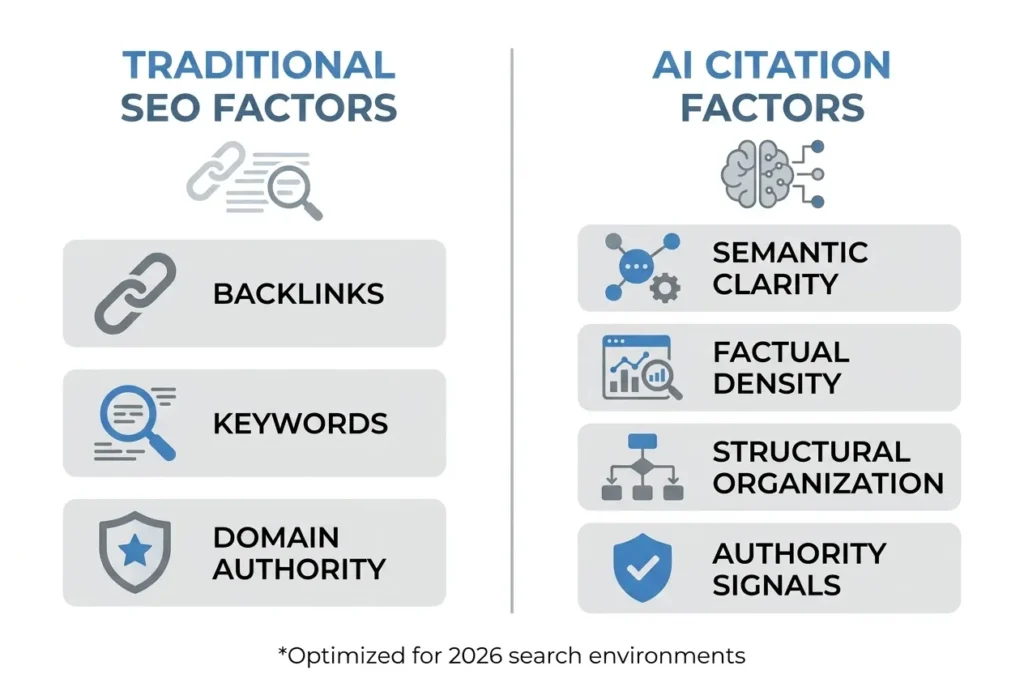
And the selection criteria are different. AI systems use Retrieval-Augmented Generation (RAG), which pulls relevant passages in real time and evaluates them for semantic clarity, factual density, structural organization, and authority signals. A beautifully written opinion piece with zero data points won’t get cited. A dry but data-rich page with clear headings and self-contained paragraphs might.
That’s a reality check for anyone spending more on copywriting polish than on data and structure. I’ve seen well-designed pages with gorgeous typography get zero AI citations while a plain WordPress post with one good comparison table earns three. The same structural principles that help you win featured snippets also make your content easier for LLMs to parse and cite.
So quality, for the purpose of AI citations, means: can a machine read your content, extract a useful passage, and attribute it cleanly? That’s a different standard than “does a human enjoy reading this.”

Does Original Content Actually Outperform Recycled Content?
Short answer: sometimes. And the “sometimes” matters more than the “yes” or “no.”
I’ve run internal analyses comparing original content against repurposed or derivative pages across Google results and AI platform citations (Gemini, ChatGPT, Perplexity). The methodology involved scoring top-ranking URLs on five criteria: primary contribution, structural novelty, interpretive depth, source dependence, and contextual insight. Each page got a score from 0-15, and we split them into two groups: original (12-15) and repurposed (0-6).
At first glance, the data looked clear. Pages with higher originality scores ranked more consistently in Google and showed up more often in AI responses.
But that first glance was misleading.
When we dug deeper, the correlation between originality and performance was weak. Strong results in one segment of the dataset didn’t predict strong results elsewhere. The relationship wasn’t random but it wasn’t reliable enough to build a strategy around.
The pattern got more interesting when we broke it down by query type:
| Query Type | Originality Impact | Example |
| Judgment/interpretation queries | Moderate positive correlation | “Benefits of marketing automation” |
| Factual/definition queries | Little to no correlation | “What is marketing automation” |
| Comparison queries | Moderate positive correlation | “Best email deliverability tools” |
| Process/how-to queries | Weak correlation | “How to set up email automation” |
For factual queries, being accurate matters more than being original. When the answer is a definition or a number, the AI doesn’t care whether you came up with a clever angle. It cares whether you got the facts right and formatted it cleanly.
For judgment-based queries “best practices,” “benefits of,” “how to choose” originality carries more weight. These are the queries where your perspective, your experience, and your interpretation add something the AI can’t generate on its own.
That distinction is one most content strategies miss entirely. They treat every piece of content like it needs to be a masterpiece. Some content just needs to be correct, well-structured, and easy for a machine to parse.

How “Good Enough” Content Can Win Against Better Competitors
I want to tell you about a project from the early 2010s that changed how I think about content strategy. And I think it’s more relevant now, in the AI era, than it was back then.
One of our clients was a 10-person startup in the API space. Every major software company was already publishing documentation, guides, and thought leadership on APIs. The competitors had massive domain authority, bigger content teams, and years of accumulated backlinks. Competing head-to-head on “what is an API” or “API documentation best practices” was a losing play.
Conventional thinking would have been to out-quality the competition. Write the single best API resource on the internet. Pour six months and a significant budget into it. And maybe, eventually, earn enough authority to rank.
We couldn’t afford that approach. Both quality and quantity would’ve been required to have any realistic shot at overtaking competitors with years of head start. Trying to compete across every relevant subtopic and keyword related to APIs meant fighting on too many fronts. We needed to find a different angle entirely, one where being first mattered more than being best.
So we flipped the problem.
Instead of chasing existing keywords, we surveyed the target audience and asked what terms they’d search for in various scenarios. Two words kept showing up together: “API” and “design.”
At the time, “API design” had essentially zero search volume. None of the competitors were targeting it. No content hubs. No landing pages. Nothing.
We published a simple 1,500-word landing page on API design in a few days. It wasn’t thorough. It wasn’t polished. By any traditional quality measure, it was mediocre.
Twelve months later, the search volume materialized exactly as predicted. Our modest page outranked every competitor even after they started publishing their own API design content with bigger budgets and better production value. Within two years, that keyword was worth roughly £200 per click. Our client never paid for a single one.
The lesson isn’t “publish bad content.” The lesson is that timing and topic ownership can outweigh polish. We were the original source. We were first. And in the context of AI citations, that matters enormously. Ahrefs’ research on AI citation patterns found that AI systems often prefer newly published or recently updated content when selecting sources. Being the first credible source on a topic gives you a compounding advantage, one fueled by the same brand mentions and backlinks that strengthen traditional authority signals.
I see the same pattern playing out right now with AI search. Brands that publish original research, proprietary data, or first-mover content on emerging topics are earning AI citations at rates that well-polished latecomers can’t match.

Why Perfection Kills Your AI Citation Strategy in 2026
The March 2026 core update was one of the most volatile in recent memory. Search Engine Land’s analysis showed it heavily favored sites with strong E-E-A-T signals and original content. But it didn’t favor sites that spent months polishing a single page. It favored sites that published consistently, updated frequently, and covered their topics thoroughly across multiple pages.
Perfection is a trap, and I say that as someone who’s fallen into it plenty of times. You spend three months refining one article while a competitor publishes twelve. They build topical authority across a cluster of related pages. They earn brand mentions. Their content gets fresher by the month. And AI systems notice all of it.
Semrush’s data shows that roughly 23% of content cited in AI Overviews is less than 30 days old. Freshness matters. And you can’t be fresh if you’re still editing the same piece you started in January.
I’m not arguing that you should publish garbage. The data from our own research and from the broader industry is clear: original, well-structured content with genuine expertise signals does perform better for judgment-based queries. E-E-A-T is real. Author credentials matter. First-hand experience gets weighted. Getting your on-page and off-page signals right still forms the foundation of any AI citation strategy.
But the gap between “good” and “perfect” is where most content strategies waste their budget. A solid article published this week will almost always outperform a perfect article published next quarter. Especially if that solid article is the first to cover an emerging topic, includes a few original data points, and is structured so AI systems can extract clean passages from it.
The API design landing page didn’t succeed because it was mediocre. It succeeded because they got there first. And because no one else had staked a claim on that territory. Quality mattered but timing and topic ownership mattered more.
This shift intensifies with AI search. LLMs can summarize information and curate ideas, but they can’t produce original perspectives or firsthand experience. Not yet. Content that adds something new to the conversation, a contrarian angle, a proprietary dataset, a specific case study – gives AI systems a reason to cite you instead of the next page.
The original source carries weight. That’s true for traditional SEO, and it’s even more true for AI citations. The top 20% of cited domains capture 80% of all AI references, according to Growth Memo’s 2026 state-of-AI-search report. Getting into that top tier means being the first and most authoritative voice on the topics you own which is why using SEO to build brand awareness matters more now than it ever has.
Stop asking whether your content is good enough. Start asking whether it says something that hasn’t been said yet. And then publish it before someone else does. If you need help building a content strategy that earns AI citations, Eclipse Marketing’s SEO team can show you where the gaps are.
FAQs
Does Google penalize AI-generated content in 2026?
No. Google’s ranking systems evaluate helpfulness, not authorship method. Their official guidance from Google Search Central says they reward helpful, reliable, people-first content regardless of how it’s produced. Scaled, low-value AI spam gets demoted but so does scaled, low-value human content. The March 2026 core update reinforced this: sites with strong E-E-A-T signals gained visibility whether they used AI tools or not.
How do you earn AI citations from ChatGPT and Perplexity?
AI platforms use Retrieval-Augmented Generation to pull passages from the web in real time. To earn citations, your content needs semantic clarity (can the passage stand alone?), factual density (does it include specific numbers and named sources?), and clean structure (headings, short paragraphs, logical flow). Frase.io’s research found that LLMs only cite 2-7 domains per response, so you’re competing for very limited slots.
Does original content rank better than repurposed content for AI citations?
It depends on the query type. For judgment-based queries like “best practices” or “benefits of X,” original content with a unique perspective does show a moderate advantage. For factual or definition-based queries, accuracy and structure matter more than originality. The correlation between originality and performance exists but is weak it’s not a guaranteed lever for predictable results.
What is E-E-A-T and why does it matter for AI search?
E-E-A-T stands for Experience, Expertise, Authoritativeness, and Trustworthiness. It’s Google’s framework for evaluating content quality, and AI systems weigh similar signals when selecting which sources to cite. Content that demonstrates real practitioner experience – specific case studies, named data sources, first-hand observations gets cited more than generic advice. Semrush and Ahrefs analyses from 2025-2026 consistently show E-E-A-T-aligned content gaining visibility in core updates.
How fresh does content need to be to earn AI citations?
Very fresh, relative to competitors. Roughly 23% of content cited in Google AI Overviews is less than 30 days old, and Ahrefs’ research confirms that AI systems often prefer recently published or updated sources. A quarterly update cadence for key pages is a minimum. For fast-moving topics, monthly or even weekly updates give you an edge.
Can a small business compete for AI citations against bigger competitors?
Yes – and sometimes more easily than in traditional SEO. The API design case study in this article proves it: a 10-person startup outranked major software companies by publishing first on an emerging keyword. AI citation patterns also favor specificity over scale. A focused, authoritative page on a niche subtopic can earn citations that a competitor’s broader resource misses. The key is identifying topics where no strong source exists yet and getting there first.
What’s the biggest mistake businesses make with AI content strategy?
Over-investing in production quality at the expense of publishing velocity and topic coverage. I’ve seen clients spend three months perfecting one article while competitors publish a dozen. The competitor builds topical authority across a cluster of related pages, earns more brand mentions, and signals freshness all factors AI systems weigh. Good content published this week almost always beats perfect content published next quarter.