
Most sites don’t lose Google rankings because they ignored SEO. They lose them because they did too much. A 2025 SEMrush survey found that 24.1% of SEO professionals flagged over-optimization as a significant concern. And Google’s March 2024 core update reportedly reduced visibility of unhelpful content by 45%.
SEO over-optimization is any pattern where search tactics get pushed so aggressively that they trigger penalties, confuse crawlers, or drive visitors away instead of converting them. It shows up as keyword stuffing, manipulative link building, thin content farms, and a half-dozen other mistakes that feel like solid SEO until rankings crater.
This article covers the 10 most common over-optimization errors found during website audits, plus the algorithm updates designed to catch them.
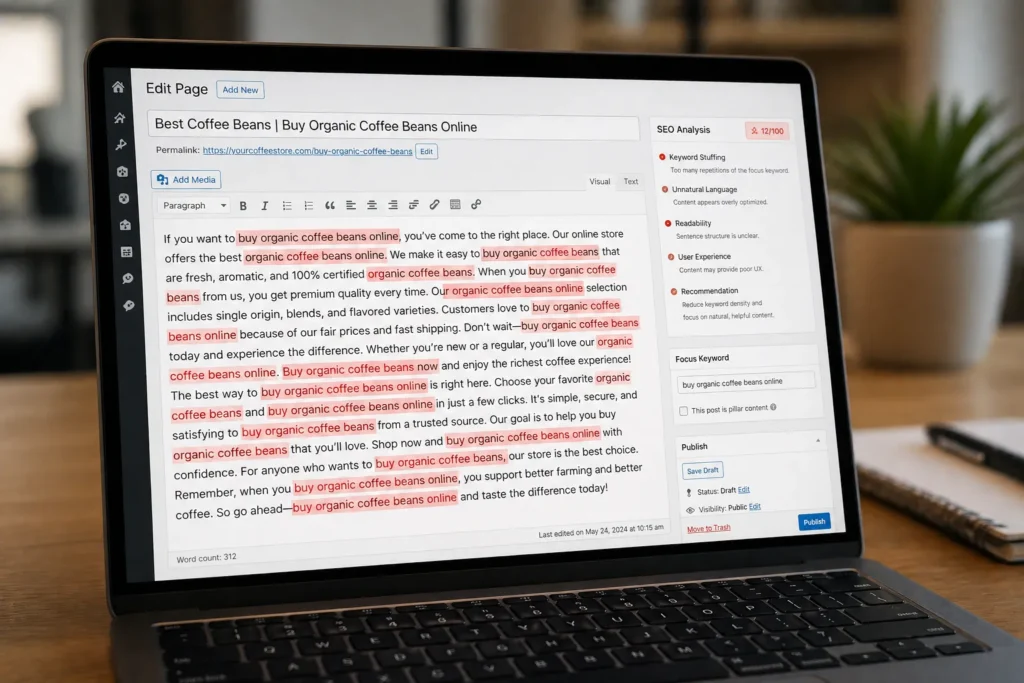
What Are the Biggest Over-Optimization Mistakes?
Google runs hundreds of updates per year. The core and spam updates from 2024 and 2025 targeted over-optimized pages specifically. Sites that relied on density checkers and exact-match keyword formulas got hit hardest. The ones that survived wrote for people first.
These 10 patterns show up in audit after audit.
1. Keyword Stuffing
Content that repeats the same phrase every other sentence reads like spam. Because it is. Google’s spam policies explicitly flag keyword stuffing as a violation, and detection has gotten sharper with each core update.
A practical benchmark: use a primary keyword roughly once per 200 words and let variations surface naturally. Cramming keywords into footers, sidebars, and every heading tag draws penalties rather than rankings. Seasoned audit teams spot this on nearly every site they review.
2. Anchor Text Stuffing
Exact-match anchor text on every internal and external link is a red flag. When every link on a page uses the same keyword phrase, Google reads it as manipulation. Mixing branded anchors, partial matches, and natural language keeps a healthy link profile looking organic.
3. Does Keyword Cannibalization Hurt Rankings?
Yes, and it’s one of the most overlooked problems on poorly organized sites. Keyword cannibalization happens when multiple pages compete for the same search query. Google can’t pick a winner, so it often ranks none of them well.
This usually points to weak site architecture. When two or three pages target overlapping topics, merging them into one stronger page almost always performs better.
4. Targeting Irrelevant Keywords
Every page should reflect what the business actually does. Chasing trending but off-topic keywords might spike short-term impressions, but it dilutes topical authority and confuses Google’s understanding of the site.
Topical relevance matters more than search volume. A page targeting a primary keyword with no connection to the site’s core offering is dead weight.
5. When Does Long-Form Content Become a Liability?
Long-form content (1,500+ words) can build authority, but length alone doesn’t equal quality. Google’s Helpful Content system, integrated into core ranking in March 2024, specifically devalues content that exists to rank rather than to inform.
Padded, repetitive, keyword-stuffed long articles get filtered. Every piece of content needs depth, originality, and actual value for the person reading it.
6. Incorrect Header Tag Structure
Multiple H1 tags on a single page split the topical signal and confuse crawlers. One H1 per page, followed by H2s and H3s in logical order. That’s it.
Header tags organize content for readers and search engines. Using them as keyword containers is a common on-page SEO mistake that’s easy to spot and quick to fix.

7. How Does a Bad Link Strategy Trigger Penalties?
Internal links loaded with money keywords trip Google’s spam detection fast. Links that exactly match another page’s primary keyword look manufactured. And linking to low-authority or spammy external sites erodes a site’s own trust signals.
Deeper internal links matter too. Sites that only link to top-level navigation pages miss the chance to push authority across their content. Connecting a service page to a relevant blog post or secondary topic page strengthens the whole site.
8. Hidden Text
White text on a white background. Tiny font behind images. CSS-hidden keyword blocks. These are textbook spam tactics, and Google catches them consistently. A site using hidden content to game rankings faces manual action risk and potential removal from search results.
9. What Happens with Duplicate Content and Wrong Canonical Tags?
Google wants to serve original content for every query. When the same page exists across subdomains or partner sites without proper canonical tags, Google doesn’t know which version to index. The result: wasted crawl budget and diluted rankings across every duplicate.
Canonicalization tells Google which URL is the master copy. Getting it wrong or ignoring it entirely is one of the more technical over-optimization problems, but it does serious damage.
10. Keyword-Stuffed Domain Names
Non-branded, keyword-heavy domains like “best-cheap-seo-services-nyc.com” were a ranking trick a decade ago. Now they’re a liability. Google treats keyword-dense domains as a spam signal, especially when combined with other over-optimization patterns on the site.
Clean, branded domains build more trust with both users and algorithms.
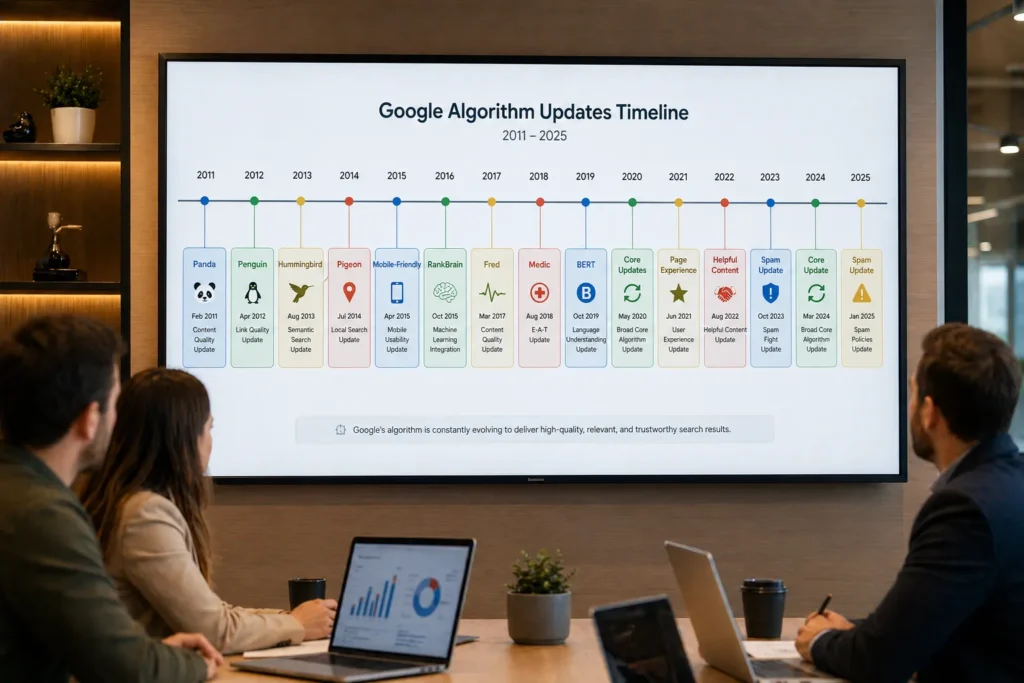
How Google’s Algorithm Updates Target Over-Optimization in 2026
Google doesn’t publish a playbook for catching SEO over-optimization. But its major algorithm updates, running from the early 2010s through 2025, spell it out clearly.
Google Panda and Content Quality
Panda launched in 2011 and reshaped how Google evaluated content quality. It hit roughly 12% of U.S. search queries and penalized thin, duplicate, and low-quality pages. Panda became part of Google’s core algorithm in 2016, and its principles now live inside the Helpful Content system. Content farms filled with shallow, keyword-stuffed articles still get caught by these systems.
Google Penguin and Link Manipulation
Penguin arrived in 2012 targeting link spam. Exact-match anchor abuse, paid link schemes, and private blog networks all fell within its scope. It merged into core ranking in 2016. The December 2024 and August 2025 spam updates continued this work, flagging manipulative link tactics with increasing accuracy.
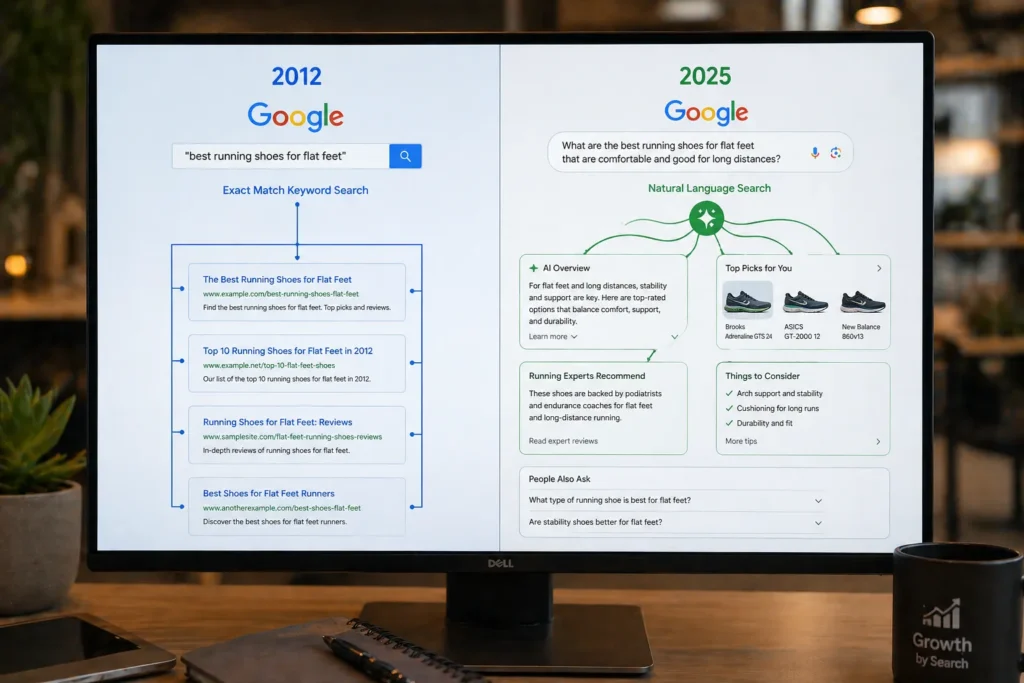
How Did Hummingbird Change the Game for Search Intent?
Hummingbird (2013) shifted Google from matching exact keywords to analyzing what people actually meant. That made keyword stuffing less effective overnight. Combined with AI Overviews (appearing in roughly 44% of queries per BrightEdge 2025 data), over-optimized content now gets filtered at multiple levels of the search process.
The pattern across every update stays the same: Google rewards content built for people and penalizes content built for algorithms. Sites that treat E-E-A-T signals as a foundation rather than a checkbox are the ones holding steady through each update cycle.
FAQs
Does SEO over-optimization still cause Google penalties?
Yes. Google’s spam policies and core updates actively target over-optimization signals including keyword stuffing, manipulative links, and thin content. The March 2024 core update reduced unhelpful content visibility by an estimated 45%. Recovery from these penalties can take weeks to months depending on severity.
How can a site owner tell if content is over-optimized?
The fastest check: read it out loud. If the same phrase appears unnaturally often, if every heading sounds like a search query rather than a useful label, or if the text reads like it was written for a bot, it’s probably over-optimized. Tools like SEMrush and Ahrefs can flag density issues, but human readability still matters more than any score.
What is keyword cannibalization and why does it hurt SEO?
Keyword cannibalization happens when two or more pages on the same site compete for the same search query. Google can’t determine which page to rank, so it often ranks neither one well. A 2024 SEMrush analysis found that roughly 24.1% of professionals considered over-optimization (including cannibalization) a top concern. Consolidating competing pages into one stronger page typically fixes the problem.
Is keyword density still a valid SEO metric?
No. Keyword density as a formula (X% of total words) hasn’t been a reliable ranking factor for years. Google’s systems now evaluate intent, context, and natural language patterns. Forcing a target density percentage creates robotic text that triggers spam signals. Writing naturally and covering the topic thoroughly works better than hitting a number.
How do AI Overviews change the risk of over-optimization?
AI Overviews appeared in roughly 44% of search queries by late 2025 according to BrightEdge data. These AI-generated answers prioritize natural, authoritative content and rarely pull from keyword-stuffed or robotic pages. Over-optimized content that might have ranked in traditional results often gets skipped entirely by AI citation systems.
Can a website recover from an over-optimization penalty?
Most over-optimization damage is reversible. Recovery involves removing stuffed keywords, cleaning up manipulative link patterns, consolidating cannibalized pages, and publishing genuinely useful content. Timelines range from a few weeks after a spam update to several months after a core update, depending on how deep the problems run.