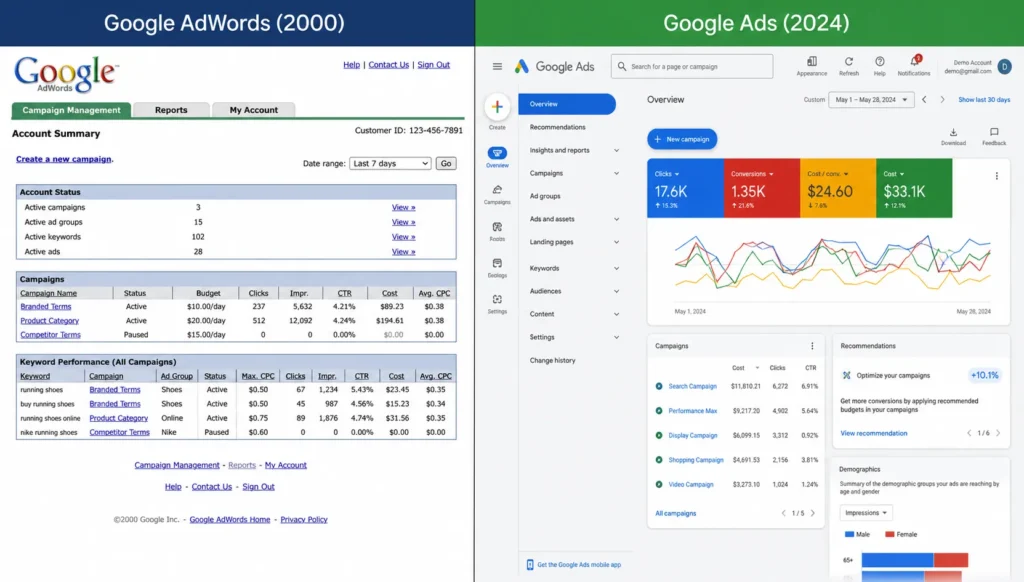
The average cost per click on Google Ads hit $5.26 in 2025, a 12.88% jump in a single year, according toWordStream’s 2025 benchmarks. In 2002, you could buy that same click for pennies. Figuring out what counts as a good CPC for Google Ads now depends entirely on your industry and margins.
That stat alone tells you something about how Google Ads has changed. But the cost is just one piece. The platform that started as a scrappy self-serve text ad system in 2000 has turned into an AI-driven machine that manages bidding, creative, and targeting across six channels at once. Google’s ad revenue topped $82.3 billion in Q4 2025 alone.
Google Ads is Google’s pay-per-click advertising platform, originally called Google AdWords, that lets businesses place ads across Search, YouTube, Display, Shopping, Discover, and Maps. Over 25 years, it has evolved from simple keyword-based text ads into an AI-powered system processing millions of data signals per second to match advertisers with buyers.
I’ve managed Google Ads accounts since the manual bidding days. And here’s where I’ll be blunt: the platform is better now in most measurable ways. But “better” doesn’t mean “better for everyone.” Small advertisers lost something real when Google started handing control to algorithms.
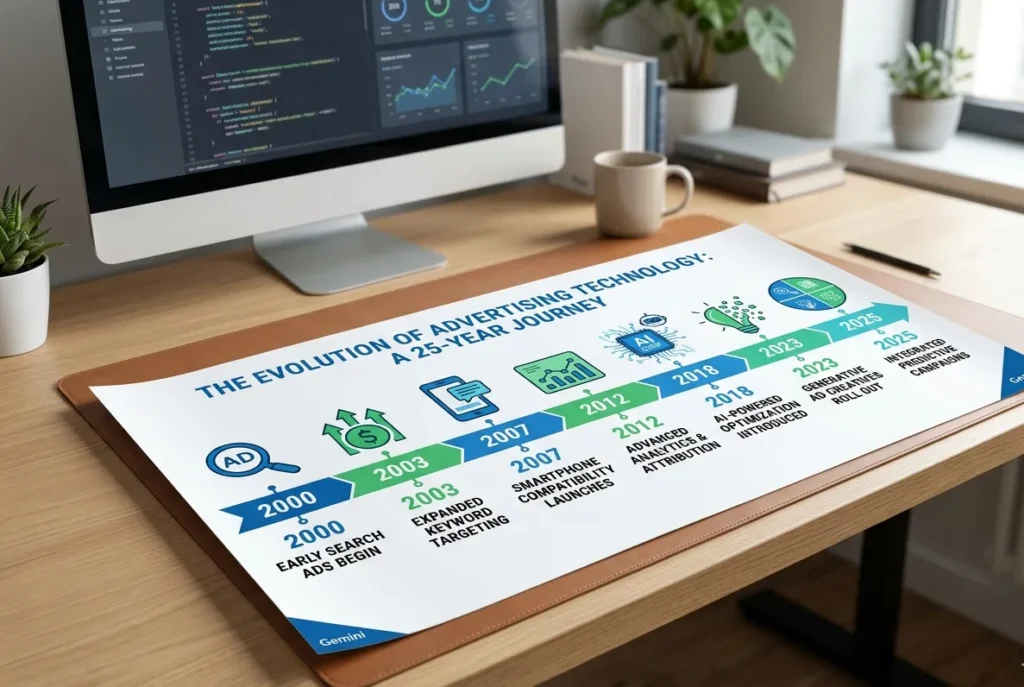
How Google Ads Evolved Over 25 Years
The timeline matters because each change shifted who could win on the platform and how.
2000: Google AdWords Goes Live
Google launched AdWords in October 2000 with roughly 350 advertisers. It was a self-serve system: pick keywords, write text ads, set a maximum bid. That was it. The barrier to entry was basically nothing.
2002: Pay-Per-Click Takes Over
AdWords moved to a full cost-per-click model. You only paid when someone clicked. This single decision shaped the entire digital ad industry. Every accountability metric advertisers expect today traces back to this moment.
2005: Quality Score and Analytics Change the Rules
Two huge shifts happened this year. Google acquired Urchin Software and launched Google Analytics, giving advertisers their first real visibility into what happened after the click. Then Google introduced Quality Score, tying ad eligibility to relevance and landing page quality not just how much you bid. This was the first time Google said “money alone won’t win you placement.”
2010-2013: Remarketing and Cross-Device Targeting Arrive
Remarketing launched in 2010, letting advertisers re-engage people who’d visited their site. In 2013, Enhanced Campaigns forced desktop, mobile, and tablet into a single campaign structure. Some advertisers hated losing device-level control. Others welcomed the simplification. This was an early preview of Google’s philosophy: consolidate and automate.
2018: AdWords Dies, Google Ads Is Born
Google dropped the AdWords name and rebranded to Google Ads, reflecting that the platform now covered Search, Display, YouTube, Shopping, and apps. Smart Campaigns debuted to help small businesses run automated ads with minimal setup.
2021-2025: Performance Max, AI Max, and the Automation Push
Performance Max launched in late 2021 as an all-in-one campaign type spanning every Google channel. By 2025, Google added channel-level reporting and search term visibility to address transparency complaints. AI Max for Search started rolling out, and Dynamic Search Ads are migrating to AI Max by September 2026. Google detailed these changes on the Ads & Commerce blog. Gemini-powered tools now generate ad copy, images, and video automatically.
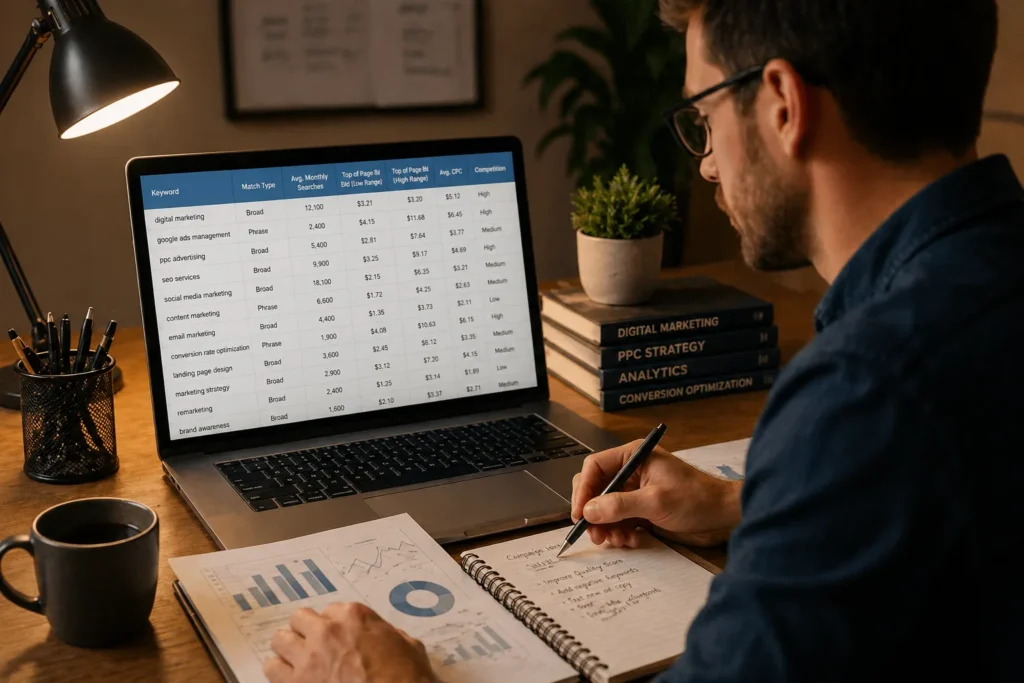
What Was Actually Better About Early Google Ads?
Control. Full stop. That’s what the early platform offered, and it’s what many advertisers miss most.
You picked every keyword. You set every bid by hand. If your cost per lead spiked on Tuesday, you could trace it to a specific keyword, a specific ad, a specific hour. The cause-and-effect loop was tight and transparent.
The learning curve was also manageable. I’ve seen small businesses build profitable campaigns with nothing more than a spreadsheet and a few hours of reading Google’s help docs. CPCs were low because competition was thin. A local plumber could run ads for a couple hundred bucks a month and get real leads.
But let’s not romanticize it. Campaign management was brutal. Manual bid adjustments across hundreds of keywords, constant monitoring, no cross-device attribution until 2016, no remarketing until 2010. Scaling past a few thousand keywords required serious labor. Reporting was shallow. And if you weren’t personally watching the account, performance could slide fast with nobody noticing.
The early Google Ads rewarded patience and hands-on skill. It was direct, measurable, and honest about what it was doing. It was also slow, labor-heavy, and limited in reach.
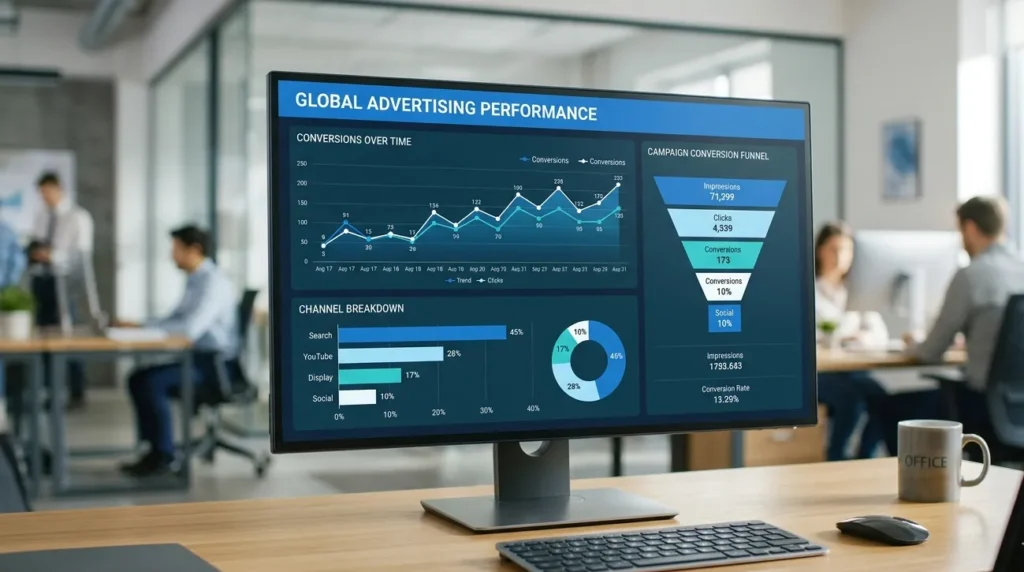
What Does Google Ads Do Better Now?
Reach and efficiency, by a wide margin. Today’s platform processes millions of signals per second to decide who sees your ad, when, and on which device. No human could replicate that math.
Smart Bidding strategies like Target ROAS and Maximize Conversion Value adjust bids in real time based on historical patterns and contextual signals. Performance Max runs across Search, YouTube, Display, Discover, and Maps from a single campaign. Demand Gen reaches users during passive browsing. The automation handles tasks that used to eat 20+ hours a week of manual management.
Creative tools have caught up, too. Gemini-powered features generate ad copy, images, and video aligned with brand tone. For teams that struggled to produce enough creative assets, this is a genuine time-saver.
The data stack is also better than ever. Google Analytics 4, enhanced conversions, and first-party data integrations let advertisers track complex user journeys while staying within tighter privacy standards. Modeled conversions fill the gaps where cookie-based tracking used to live.
And the ROI picture is solid. HubSpot’s 2026 State of Marketing report found that Google Ads returns an average of $2 for every $1 spent when campaigns are properly managed. Over 75% of marketers surveyed plan to increase or maintain their paid search investment in 2026. The strongest returns come from pairing paid campaigns with a broader SEO and Google Ads strategy that covers both sides of the SERP.
| Feature | Early Google Ads (2000-2010) | Google Ads 2025 |
| Bidding | Manual CPC, full control | AI-driven Smart Bidding |
| Channels | Search only | Search, Display, YouTube, Shopping, Discover, Maps |
| Average CPC | Under $1 for most industries | $4.51-$5.26 average; legal hits $22.75 |
| Creative | Text ads only | Text, image, video – AI-generated |
| Reporting | Basic click and cost data | Cross-channel, modeled conversions, GA4 |
| Targeting | Keywords and location | Audiences, signals, intent, behavior |
| Time to manage | 20+ hours/week for mid-size accounts | Heavily automated |
The trade-off is visibility. You can’t always tell which keyword, audience, or placement drove a specific conversion. For advertisers who built their careers on granular optimization, that loss stings. And with paid ads now competing for SERP space alongside featured snippets and AI Overviews, the organic-paid relationship has gotten more complicated than ever.

How Is Google Responding to Advertiser Pushback?
Performance Max took the most heat. When it launched, reporting was a black box. Advertisers couldn’t see which channels their budget went to, which search terms triggered their ads, or which creative assets performed best.
Google listened, partially. The August 2025 updates added asset-level performance data, channel-level reporting, and improved search term visibility. Account-level negative keywords and brand exclusion controls addressed complaints about budget leaking into irrelevant placements.
But here’s a contrarian take most articles won’t give you: these transparency improvements still don’t show you everything. Practitioners on r/PPC regularly report that Performance Max learning phases burn through 30-50% of small budgets before the algorithm finds its footing. If you’re spending $2,000 a month, losing half of it to “learning” for the first 4-6 weeks is painful.
Google’s conversational campaign setup – where you describe goals in plain language and Gemini builds the campaign is aimed at small businesses who found the old interface intimidating. It works for simple accounts. For anything complex, experienced advertisers still need to get under the hood.
Privacy pressure from GDPR and the continued deprecation of third-party cookies is forcing Google to lean harder on modeled conversions and consented first-party data. Advertisers who connect CRM data, offline conversion imports, and privacy-safe remarketing signals have a measurable advantage over those who don’t. The skillset has shifted from bid management to data stewardship.Google keeps saying AI supports advertisers rather than replacing them. I’d say it’s more accurate to say AI replaced one type of advertiser skill and created demand for a different one. The people who thrived on manual bid optimization now need to thrive on data architecture and creative strategy. The same AI shift reshaping paid ads is also rewriting the future of search on the organic side.
Is Google Ads Better Now Than It Was?
For most advertisers spending $5,000+ a month with clean conversion data and a decent creative library, yes. Today’s Google Ads delivers more reach, faster optimization, and better cross-channel coordination than anything possible in 2005 or even 2015.
For small businesses on tight budgets without strong tracking? It’s honestly gotten harder. CPCs climbed across 87% of industries in 2025 alone. The learning phase on automated campaigns burns real money. And the loss of manual control means small-budget advertisers can’t fine-tune their way to profitability the way they once could.
The global online ad market is projected to grow from $323.74 billion in 2026 to $525.39 billion by 2031, according to Mordor Intelligence. Google controls the lion’s share. The platform isn’t going anywhere, and neither is the cost pressure.
My recommendation: if you’re running Google Ads in 2025, stop treating it like a keyword tool. It’s a data-and-creative machine now. Feed it clean conversion data, give it strong creative assets, and build negative keyword lists like your budget depends on it because it does. Understanding the SEO vs PPC difference helps you allocate spend more effectively across both channels. The advertisers who win on today’s Google Ads aren’t the ones with the biggest budgets. They’re the ones with the best data pipelines. If you’re not sure where your account stands, an SEO consultation can help you audit what’s working and what’s leaking money.
FAQs
How Much Does a Click Cost on Google Ads in 2025?
The average CPC across all industries reached $5.26 in 2025, according to WordStream benchmarks using data. That’s a 12.88% increase from the prior year. Backlinko’s analysis puts the median slightly lower at $4.52. High-competition sectors like legal services can hit $22.75 per click, while home services typically range from $4.11 to $8.86.
What ROI Should You Expect From Google Ads?
HubSpot’s 2026 State of Marketing report found that properly managed Google Ads campaigns return an average of $2 for every $1 spent. That’s a 200% ROI benchmark. Actual returns vary widely depending on industry, conversion tracking accuracy, and how well campaigns are optimized. Home service businesses with strong lifetime customer value often see higher multiples on booked projects.
Has Performance Max Improved for Advertisers?
Yes, but it’s still a work in progress. Google’s August 2025 updates added channel-level reporting, search term visibility, and asset-level performance data. Advertisers can now see which creative elements drive results and where ads appear. Account-level negative keywords and brand exclusion controls were also added. Practitioners still report that small budgets can lose 30-50% of spend during the algorithm’s learning phase.
Is Google Ads Worth It for Small Businesses in 2025?
It depends on your budget and tracking setup. Small businesses spending under $2,000 a month face higher risk from automated learning phases and rising CPCs. If you have clean conversion tracking and strong landing pages, Google Ads can still produce profitable leads. Without proper tracking, you’re essentially feeding money into a system that can’t learn what “success” looks like for your business.
What’s the Biggest Change Coming to Google Ads in 2026?
AI Max for Search is expanding across more accounts, and Google is migrating Dynamic Search Ads to AI Max by September 2026. Both moves push the platform further toward AI-controlled targeting and creative generation. Advertisers who haven’t built solid first-party data connections will fall behind as automation depends more heavily on conversion signals.
How Much Should You Spend on Google Ads Monthly?
Most small to mid-size businesses spend between $1,000 and $10,000 per month on ad spend. Agency management fees typically add $800 to $2,000 per month (or 10-20% of total spend). Your ideal budget depends on your industry’s average CPC, your target cost per lead, and your conversion rate. Starting below $1,500 a month makes it hard for automated bidding to collect enough data.