

By Michael Vale, Founder of Eclipse Remodeling and a certified Google Partner. We run Google Ads and SEO for home remodeling companies across the U.S.
A bathroom remodeler came to us spending $4,200 a month on Google Ads and couldn’t tell us which half was working. His previous agency had built the account on broad match with no negative keywords, so “bathroom remodel” was quietly triggering ads for “bathroom cleaning service” and “bathroom accessories.” We added conversion tracking, cut the 60% of keywords that hadn’t produced a single lead in six months, and brought his spend down from $4,200 to $1,800 a month with the same number of leads. Results vary by market and account, but the lesson doesn’t.
Here’s the short version for remodelers who don’t have time for a 3,000-word lecture. Google Ads work, just not the way most guides sell them. Local Services Ads usually beat Search for residential work. The homeowner who calls from your ad is yours, unlike the shared Angi lead that went to four other remodelers at the same time. And the B2B tricks you’ll read elsewhere, the “identify the companies visiting your website” pitch, are close to useless when your buyer is a homeowner choosing between you and two other bids.

What are Google Ads for remodeling contractors?
Google Ads for remodeling contractors are paid campaigns that put a business in front of homeowners at the moment they search for renovation help. They include Search ads, Local Services Ads (the pay-per-lead units with the Google Verified badge), Display, and video. For most remodelers, only two of those move the needle: Local Services Ads and Search.
The other formats have a place. Display and YouTube are fine for staying visible to homeowners who already know your name. But they don’t book kitchens. Until you’re spending several thousand a month and want to stay top of mind, put every dollar on the two channels that catch buying intent.

Local Services Ads vs Search Ads: where remodelers should start in 2026
Start with Local Services Ads. For a residential remodeler, they almost always produce a lower cost per booked job than Search. They’re the reason a well-run account can pull 10 to 20 remodeling leads a month from Google’s top three spots.
Local Services Ads sit at the very top of the results page, above the regular text ads. You pay per lead, not per click, so you’re only charged when someone calls or messages. They carry the Google Verified badge (it replaced Google Guaranteed in 2025), which matters more than most remodelers expect. A homeowner about to let a stranger tear out their kitchen wants a trust signal, and that check mark is one. You can also dispute junk leads and get credited, something Search will never do for a wasted click.
The trade-off is control. You can’t write the ad, and lead quality swings week to week. That’s why we never run Local Services Ads alone. We pair them with a tight Search campaign that catches the high-intent, long-tail searches they miss, like “quartz kitchen remodel” plus your city, or “1970s bathroom gut renovation.”
The bigger point holds either way: a lead from your own Google ad belongs to you. A shared lead from Angi or HomeAdvisor, which our clients report paying $87 to $142 for, gets sold to four or five remodelers at once. That’s why those leads close so much worse.
| Factor | Local Services Ads | Search Ads |
|---|---|---|
| You pay for | Each lead (call or message) | Each click |
| Position | Above all text ads | Below Local Services, above organic |
| Trust signal | Google Verified badge | None built in |
| Junk leads | Can be disputed and credited | No refunds for wasted clicks |
| Control over messaging | Low | High |
| Best for | Core lead flow | Specific, long-tail intent |
If you only have bandwidth to set up one thing this month, get verified for Local Services and start there.
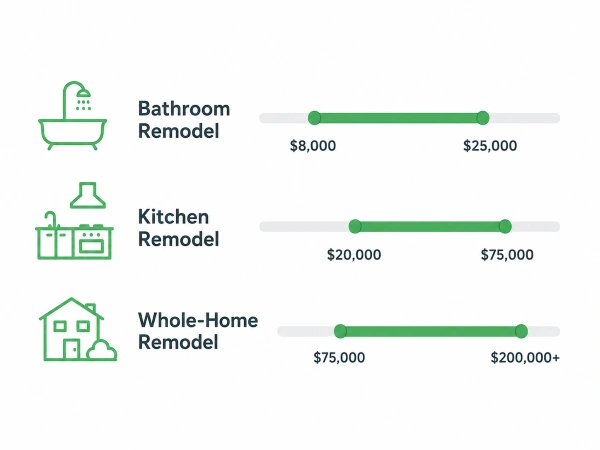
What do Google Ads cost for remodeling contractors in 2026?
More than almost any other home service. Remodeling keywords are among the most expensive clicks on Google, because the job at the end is worth tens of thousands of dollars. Whole-home, addition, and “near me” searches cost the most. Single-room terms cost less. On Local Services Ads you pay per lead instead of per click, which usually works out cheaper per booked job.
Pull live numbers for your own market before you budget, because costs swing hard by city and season. We track seasonality across thousands of remodeling search terms, and the pattern is consistent: “kitchen remodel cost” peaks in January, “deck builder near me” peaks in April. Bidding the same all year overpays in the slow months and underbids the rush.
One warning about keyword tools. Many will label a term like “bathroom remodel near me” as “low competition” while showing a top-of-page bid in the tens of dollars. Don’t believe the label. A term nobody wants doesn’t cost that much per click. The bid is the honest competition signal, and on remodeling terms it’s high, because the job it leads to is worth so much.
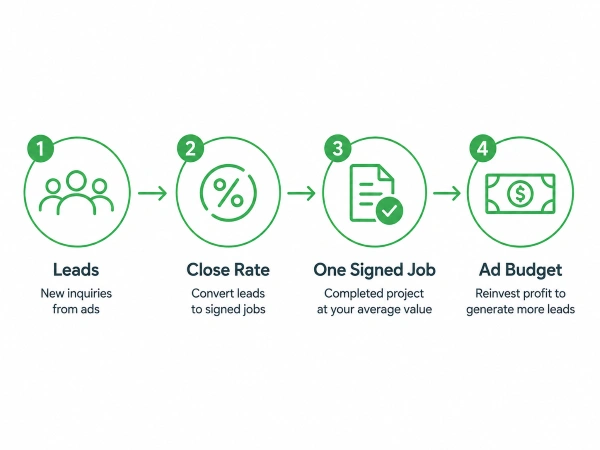
How much should a remodeler budget?
Budget backward from one closed job, not forward from a round number. That single habit fixes most of the ad spending we inherit from new clients.
Run the math with your own figures. Say a booked job is worth $30,000 and you close one in five qualified leads. If each qualified lead costs you, say, $150 in ad spend, then five leads, roughly $750, should book one job worth $30,000. Even at a one-in-ten close rate, that’s a job worth many times what you spent to win it. Plug in your real average job value and close rate, and the picture gets clear fast.
So the real question was never “is $500 a month enough.” It’s “how many leads does my close rate need.” At the prices remodeling clicks command, $500 a month buys only a handful of clicks, too few to close consistently or to feed Local Services Ads enough data to learn. Plan on at least a few thousand a month per market. Below that, you’re not testing Google Ads, you’re donating to it.
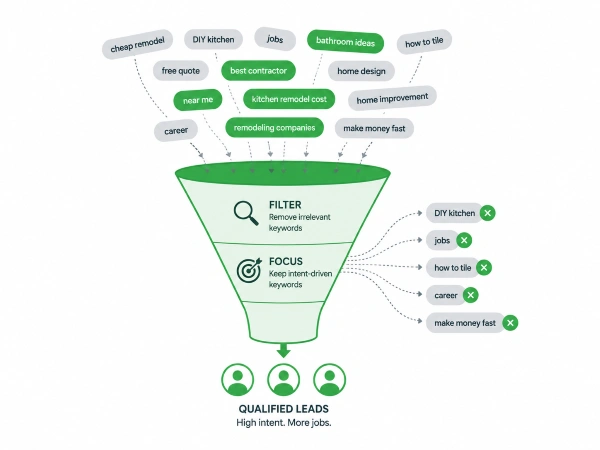
The keywords that book jobs, and the ones that drain the budget
Bid on service-plus-intent terms, and block the tire-kickers with a hard negative keyword list from day one. Both halves matter equally.
The terms that book estimates are specific and local: “bathroom remodel contractor,” “kitchen remodeler near me,” “home addition contractor” plus your city, “whole home renovation” plus your city. Point each one at a landing page for that exact service. Skip broad head terms like “remodeling” on their own. They burn cash on people writing school papers and pricing out DIY tile.
The negative keyword list is where the savings live. Before you spend a dollar, add these as campaign negatives:
diy, do it yourself, how to, ideas, cost calculator, salary, jobs, hiring, career, cheap, free, wholesale, supplies, home depot, lowes, rental, apartment, mobile home, hoa, license lookup, classes, courses, permit fee
This isn’t theoretical. On the bathroom remodeler’s account above, the previous agency’s broad match had “bathroom remodel” serving ads for “bathroom cleaning service” and “bathroom accessories.” Cleaning up match types and adding a real negative list let us pause 60% of his keywords, the ones that had produced zero leads in six months, and cut his monthly spend from $4,200 to $1,800 without losing a single real lead.
Writing ads homeowners actually click
Lead with proof and specifics, not adjectives. “Licensed, hundreds of 5-star reviews, free in-home estimate” beats “quality craftsmanship you can trust” every time.
Use responsive search ads and give Google real material. Rotate headlines that name the service and city, a concrete proof point, and one clear next step. A pattern that performs across our accounts:
- Headline: Kitchen Remodeling in Your City
- Headline: Licensed, Hundreds of 5-Star Reviews
- Headline: Free In-Home Estimate This Week
- Description: See recent projects in your city, then book a free in-home estimate. Licensed, insured, and Google Verified.
Turn on call assets, location assets, and image assets so the ad takes up more of the page and gives mobile users a tap-to-call button. Tight relevance between the keyword, the ad, and the landing page also lifts Quality Score, which lowers your cost per click. Vague, one-size-fits-all ads quietly cost more.
Landing pages that turn clicks into booked estimates
Send every ad to a page that matches the exact service and city, with one job: book an estimate. A kitchen remodel ad for your city should never land on your homepage. When paid traffic isn’t converting, it’s usually a web design problem, not a traffic problem.
The pages that convert share a short list of traits. The headline repeats the ad promise. A phone number and a short form sit above the fold. Real before-and-after photos prove the work is yours, not stock. Reviews show a real count, not just stars, because a specific number reads very differently from “great reviews.” The service area is named so out-of-zone clicks self-select out, and financing gets a mention, because a five-figure project is a payment question as much as a design one.
Keep the form to four fields: name, phone, project type, and zip. Every extra field costs submissions. And build mobile-first, because most remodeling clicks come from a phone, usually at night after the kids are down.
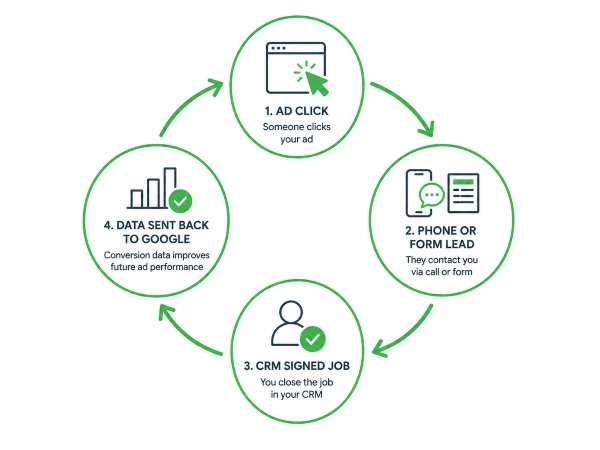
Conversion tracking: how to know which keyword paid for the truck
Track three things: form fills, phone calls, and closed jobs. The third is what separates a real remodeling account from an amateur one.
Most remodelers track form fills and stop there. Call tracking matters too, since a large share of remodeling leads pick up the phone instead of typing. We run ours through GoHighLevel so every call and form ties back to the keyword that produced it. Then comes the step almost nobody does: importing closed jobs. When a lead becomes a signed contract in your CRM, feed that back into Google with offline conversion import, so Google optimizes toward signed revenue instead of cheap clicks.
The bathroom remodeler above is the whole case for this. Before we installed call and form tracking, his previous agency “sent graphs” with no idea which keywords produced jobs. Once he could see which searches actually booked estimates, we killed the waste and put the money where the contracts were. In his words, it was “the first time I actually understood what I was paying for.” Turn on enhanced conversions too, so your tracking survives the ongoing loss of cookies.
Chase qualified jobs, not lead volume
A bigger lead count is the wrong target. What matters is how many calls turn into signed jobs. This is the mistake even good accounts make, because lead volume is easy to celebrate and close rate takes discipline to track. One high-end kitchen remodeler we worked with saw leads drop from 15 a month to 11 after we cut the price-shopper searches. The owner was nervous, until the numbers came in: qualified leads went from 30% to 72%, and close rate went from 12% to 34%, at an average project value near $94,000. Fewer calls, far more signed work. Ad settings like Maximize clicks and generic terms like “remodel cost” pull in browsers. Tighter targeting brings fewer, better-fit homeowners.
Don’t let Google’s automation run unsupervised
Google’s automation is built to spend your budget, and it will. Broad match, Smart Bidding, and auto-applied recommendations can help an account that already has clean conversion data. On an account without it, they push toward Google’s goal, which is more spend, rather than yours, which is more booked jobs. Turn off auto-applied recommendations. Feed the system real conversion data before you trust automated bidding. Keep a human reading the search terms report every week. Automation is a tool, not an autopilot for a remodeler’s ad budget.
Should you run it yourself or hire an agency?
Run it yourself if you can commit a few focused hours a week and your budget is modest. At that size, the setup above is manageable, and you’ll learn your own numbers faster than any report can teach you.
Once you’re spending several thousand a month, the math usually favors a specialist, and that’s the range where we start working with remodelers. The gap between a decent account and a well-run one at that spend is easily more than a management fee, and the offline-conversion and Local Services dispute work is fiddly enough that most owners quietly let it slide. Paid ads also work best next to SEO for remodelers, which is the asset you actually own. Ads rent you attention this month; rankings own your market next year. Whichever way you go, keep admin access to your own Google Ads and Local Services accounts. Remodelers get burned every year by agencies that hold the account hostage.
What this really comes down to
The remodelers who win on Google in 2026 aren’t the ones with the biggest budgets or the fanciest automated bidding. They’re the ones who track closed jobs, feed that data back to Google, and stop renting shared leads they don’t own. Run Local Services Ads first, a sharp Search campaign second, and treat every paid lead as a bridge to the day your own rankings carry the load. That’s the difference between buying customers this month and owning your market for good.
Want us to build this for your remodeling company? See how we run Google Ads for home remodeling companies, or explore our full marketing services.
FAQ
Do Google Ads work for remodeling contractors?
Yes, when the account is built and tracked properly. You have to track closed jobs, not just clicks, and put budget where homeowners convert. One bathroom remodeler we took over was spending $4,200 a month with no idea what worked; after we added tracking and cut dead keywords, he got the same lead volume for $1,800. Results vary by market and account.
How much do Google Ads cost for remodeling contractors?
Remodeling keywords are among the most expensive clicks on Google, because the jobs are worth tens of thousands of dollars. Whole-home and “near me” terms cost the most; single-room terms cost less. Local Services Ads charge per lead instead of per click, which usually works out cheaper per booked job. Pull live numbers for your market from Google’s Keyword Planner before you budget.
Are Local Services Ads better than Google Ads for contractors?
For most residential remodelers, yes. Local Services Ads sit above Search results, charge per lead instead of per click, and carry the Google Verified badge that homeowners trust. You can also dispute junk leads and get credited, which standard Search never does.
Is $500 a month enough for Google Ads for remodeling?
Rarely. At the prices remodeling clicks command, $500 a month buys only a handful of clicks, too few to close consistently or to train Google’s bidding. Plan on at least a few thousand a month per market to get a real read.
How do I get the Google Verified badge?
Apply through Google Local Services, then pass license, insurance, and background checks. Verification usually takes a couple of weeks. The badge is often what makes a homeowner trust a remodeler they haven’t heard of.
How long before Google Ads generate remodeling leads?
The first leads often arrive within days, but give it a few weeks of data before you judge performance. Signed jobs lag further, because remodeling sales cycles run weeks to months from first call to contract.
Should I hire an agency to run my remodeling Google Ads?
If your budget is modest and you can spend a few hours a week on it, running it yourself can work. Once you’re spending several thousand a month, a specialist usually pays for itself, as long as you keep admin ownership of your own accounts.
What negative keywords should remodelers add?
Start with searches that never become a job: “cheap,” “DIY,” “salary,” “jobs,” “repair,” “how to,” and any unrelated service terms. Open the search terms report, sort by cost, and add the money-wasters as negatives every week at first, then monthly.
Are Google Ads better than Angi or HomeAdvisor for remodelers?
Google Ads leads are yours alone, while Angi and HomeAdvisor sell the same lead to several contractors, so you compete on price. Client-reported cost per shared lead runs $87 to $142, and shared-platform leads close at only 22 to 31%, against about 73% for leads you own. Which fits you depends on your margins and how you sell.