Here’s the short version. Social media marketing for remodelers works, but not the way most agencies sell it. It builds trust and shows off your projects. It rarely fills your calendar on its own. After running 87 remodeling campaigns since 2019, I can tell you where the jobs come from: homeowners searching Google, reading your reviews, then calling. Social media backs that up. It is not the engine.
Most remodelers I meet have it backwards. They post on Instagram five days a week and wonder why the phone stays quiet. Meanwhile their Google Business Profile has 11 reviews and the company across town has 90. That is the real problem, and it is fixable. Below I will show you what to post, how often, which platforms earn your time, and the one hour a week that pays you back.
What is social media marketing for remodelers?
It is using your social accounts to prove you do good work, not to chase strangers into becoming customers. Done right, it shortens the trust gap for a homeowner who already found you.
Social media marketing for remodelers is the use of platforms like Facebook, Instagram, and YouTube to show completed projects, build trust with local homeowners, and support a remodeling company’s lead generation. For most remodelers it works best as a proof-and-trust channel that feeds Google reviews and referrals, not as the main source of new jobs.
That last part is where the money hides. A homeowner sees your kitchen remodel on Facebook, remembers your name, then searches you on Google two weeks later when they are ready. Your feed did not create the lead. It closed the trust gap before the call.
Does social media actually get remodelers leads?
Sometimes. It is almost never the top source. For most remodeling companies, social media influences a decision that started on a search bar.
Here is the data I trust, because it is ours. Across clients who share their CRM with us, leads from organic Google search book estimates at about 73%. Leads from shared paid platforms like Angi and HomeAdvisor book at 22% to 31% (client-reported). The searcher is ready. The shared lead is price-shopping four other contractors. Social sits closer to the research crowd than the ready-to-buy crowd, which is why we watched content aimed at browsers convert below 2% while high-intent pages converted above 6% in a 90-day test across four clients.
None of that means quit posting. It means stop expecting your feed to ring the phone. The homeowners who hire you are on Google reading reviews, and the fastest way to help your remodeling leads is to feed that behavior, not fight it. Results vary by market, competition, and how consistent you are.

Social media vs Google: where do remodeling leads come from?
Google, in almost every market we track. Homeowners search, check the map, read reviews, and call. Social media supports the trust step; it rarely starts the search.
Google’s own data shows “near me” searches carry strong local intent, the moment a homeowner is closest to calling. And review behavior backs it up: BrightLocal’s 2026 survey found 97% of consumers read online reviews for local businesses, with Google the site they check most. Compare that to reach that looks impressive but does not buy. Yes, Instagram reaches nearly 2 billion people worldwide, according to DataReportal. Almost none will remodel a kitchen in your zip code this year.
Here is how the channels stack up for a remodeler. Understanding organic versus paid search helps you read this table:
| Channel | Who it reaches | What it costs you | Booked-estimate rate | Who owns it |
|---|---|---|---|---|
| Google organic and the Map Pack | Homeowners searching for a remodeler in your area | Time or an SEO investment, no per-lead fee | ~73% (client-reported) | You. The rankings and reviews are yours |
| Paid lead platforms (Angi, HomeAdvisor) | The same lead sold to 4 to 5 contractors | $87 to $142 per shared lead (client-reported) | 22% to 31% (client-reported) | The platform |
| Paid social ads (Facebook, Instagram) | Local homeowners by interest and zip, mostly not searching yet | Ad budget plus management | Lower, best for retargeting and awareness | You rent the audience |
| Organic social posts | Past clients, referrals, some new local followers | About 1 hour a week | Low direct, high for trust and reviews | You own the account |
The takeaway is not “ignore social.” It is to point your best hours at where remodeling leads come from and let social do the job it is good at.
Which platforms should remodelers actually use in 2026?
Facebook and Instagram, in that order. For most remodelers, everything else is optional. Match the platform to where your buyer already is.
Pew Research Center’s 2025 data shows Facebook still reaches 71% of US adults, with Instagram at 50% and TikTok at 37%. TikTok skews young: about 80% of adults 18 to 29 use Instagram versus 19% of those 65 and older, and TikTok tilts younger still. Your $60,000 kitchen buyer is usually 35 to 65. That person is on Facebook, sometimes Instagram, and almost never hunting for a remodeler on TikTok.
A few honest calls on the rest. YouTube reaches 84% of US adults and is worth it only if you will post real project walkthroughs, which double as content Google likes. LinkedIn is for hiring and for builder or general-contractor relationships, not homeowner leads. If a platform is not Facebook or Instagram and you do not enjoy it, skip it. One account done well beats five done badly.
How often should you post?
Two to three times a week, every week. That beats posting daily for two weeks and then going quiet for a month. Consistency is the whole game, and burnout is the enemy.
The remodeler who posts every Tuesday and Friday for a year looks more reliable than the one who dumps 15 photos in January and disappears. Pick two days. Keep them. If you only have the energy for one solid post a week, do that instead of faking a daily habit you will drop by March.
What should you post?
Proof, not filler. Show the work, name the details, and make every post something only your company could publish. Generic tips are what everyone else posts.
Skip “5 kitchen trends” lists. Post the things that prove you are real and local:
- A before-and-after with the actual materials named, like white oak floors and matte quartz counters.
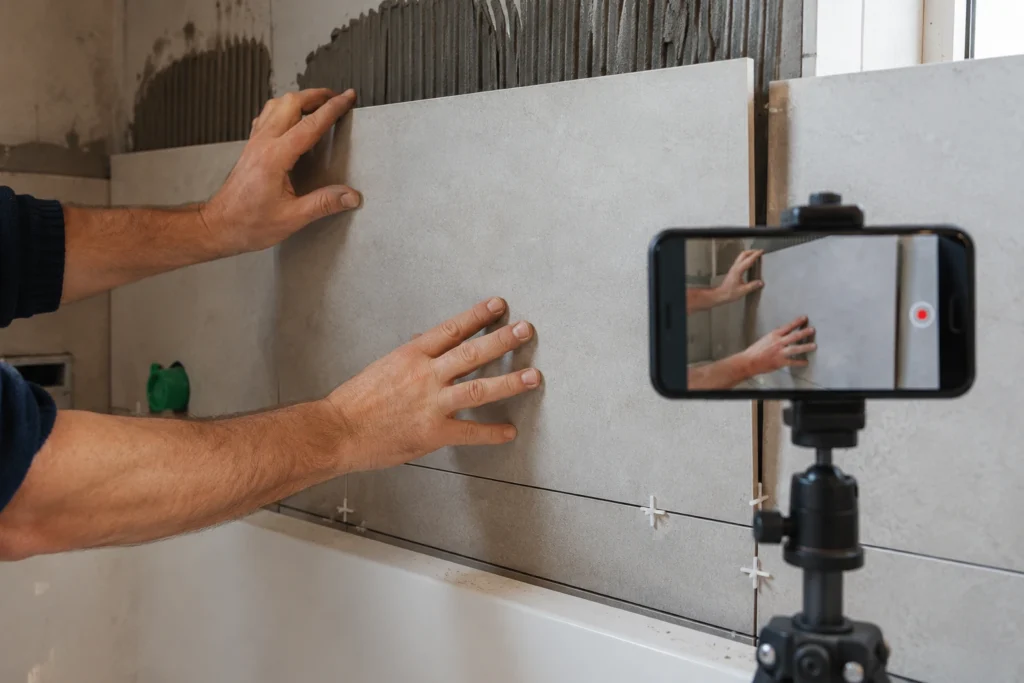
- A 20-second progress clip of a demo day or a tile install.
- The permit timeline in your city, so homeowners know what to expect.
- A finished project on a named street or neighborhood.
- A shout-out to the electrician or tile sub you trust.
- A five-star Google review turned into a simple graphic.
That last one matters more than it looks. Every post that reminds a happy client to leave a review does double duty, because reviews are what the next homeowner reads on Google before calling.

The one-hour-a-week social system for remodelers
You do not need a content calendar with 40 slots. You need a routine you will actually keep. Here is the one I give clients who want to run it themselves.
- Monday, 15 minutes: post one project photo to Facebook and Instagram with the location and the material used.
- After every finished job, 5 minutes: text the client and ask for a Google review. This is the highest-value thing on the list.
- Wednesday, 10 minutes: reply to every comment and message. Fast replies read as professional.
- Friday, 20 minutes: schedule next week’s post and reshare one recent five-star review.
- Once a month, 10 minutes: check which posts drove profile visits or calls, and do more of that.
The review step is why this works. BrightLocal found 97% of consumers read reviews, and after we install a simple request system, clients go from 0 to 1 new Google review a month to 4 to 6. If even one hour a week is too much, that is a fair reason to hand your posting to a social media team that knows remodeling.
When social media is a waste of your time
When you are using it to avoid the work that actually gets you found. I say this to new clients often, and it lands hard.
If your Google Business Profile has fewer than 10 reviews, close the app and go ask past clients for reviews. If your service pages do not rank and you are posting daily, you are polishing the wrong thing. And if you are chasing follower counts instead of booked estimates, that is motion, not progress. Fix your presence in local search results first. Social media is the garnish, not the meal.

Should you pay for social media ads?
Yes for two jobs, no for one. Use paid social to retarget people who already visited your site and to stay visible in a tight service area. Do not use it as your main lead source.
Retargeting works because it reaches homeowners who already know you, right when they are comparing options. If you want to test it, run retargeting ads on Facebook and Instagram with a small budget and real project photos. When you need calls this week, not next quarter, that is a job for Google Ads on high-intent searches while your organic rankings build. Social ads fill the top of the funnel. Search ads catch the ready buyer.
So use social media marketing for remodelers the way it earns its keep: proof, trust, and reviews that back up what a homeowner already found on Google. Post twice a week. Ask every finished client for a review. Put the hours you save into the channel that rings the phone. If you would rather hand the whole thing to a team that only works with remodelers, start with a free call.
Results vary by market, competition, and client engagement. Past performance does not guarantee the same outcome. Per-lead and revenue figures are client-reported.
Frequently asked questions
Does social media marketing for remodelers actually generate leads?
It helps, but it is rarely the top source. For most remodeling companies, social media builds trust for a homeowner whose decision started on Google. In our client data, organic-search leads book estimates at about 73%, while shared paid-platform leads book at 22% to 31%. Use social to support that, not replace it.
Which social media platform is best for a remodeling company?
Facebook first, Instagram second. Pew Research Center’s 2025 data shows Facebook reaches 71% of US adults and Instagram 50%, while TikTok sits at 37% and skews young. Your typical remodel buyer is 35 to 65, so Facebook and Instagram reach them best. Skip the rest unless you enjoy it.
How often should a remodeler post on social media?
Two to three times a week, every week. Steady posting beats a burst of daily activity that fizzles out. Pick two days, show real projects, and reply to comments quickly. Consistency matters more than volume.
Is social media or SEO better for getting remodeling leads?
For most remodelers, search wins. Homeowners find and vet contractors on Google, where 97% of consumers read reviews before calling, per BrightLocal’s 2026 survey. Social media is a strong support channel for trust and referrals, but organic search and your Google Business Profile drive the calls.
Can I do social media marketing for my remodeling business myself?
Yes. Most remodelers can run it in about one hour a week: post twice, ask every finished client for a Google review, and reply to messages. The review habit is the highest-value step, since clients who add a request system go from 0 to 1 review a month to 4 to 6. Hand it off only when that hour is the constraint.
Should remodelers run paid ads on Facebook and Instagram?
Use paid social for retargeting past site visitors and for local awareness, not as your main lead source. It reaches homeowners who are not searching yet. When you need calls quickly, Google Ads on high-intent searches usually returns faster while your organic rankings build.