

In February 2026, home improvement contractors paid an average of $53 for a single Google Local Services Ad lead and $233 for every lead that actually became a paying customer, according to SearchLight Digital’s benchmark of 888 contractors. Rank organically for those same searches and that cost per customer trends toward zero as your content compounds. That gap is the whole argument for SEO.
It matters more now because buying attention keeps getting pricier. In LocaliQ’s 2025 benchmark of 3,211 home service campaigns, cost per lead rose year over year for 69% of advertisers, and roofing leads averaged $79 apiece. SEO is the one channel where the unit economics move in your favor over time instead of against you. The catch: local search in 2026 is more crowded, more technical, and more AI-mediated than the “just add some keywords” advice most contractors have heard. Here are 15 strategies that actually move rankings and booked jobs, in rough priority order.

Why SEO is the highest-ROI channel for home improvement
U.S. homeowners spent north of $500 billion on improvements and repairs in 2025 (Statista), and most of that money starts with a search. When someone types “kitchen remodeler in Denver” or “roof replacement near me,” they aren’t browsing. They’re hiring. A single kitchen remodel can be worth $30,000 to $80,000, so one organic customer can pay for months of SEO and keep paying back long after.
Paid ads stop the moment your card gets declined. Rankings, reviews, and content keep working. The 15 moves below build that durable position.
1. Own the map pack with a dialed-in Google Business Profile
For local queries, your Google Business Profile outranks your own website, the three-result “map pack” sits above everything else. Proximity to the searcher drives roughly 55% of local ranking (Whitespark’s 2026 survey), which you can’t control. Two things you can control matter enormously: your primary category and your reviews. Category is the single strongest on-profile factor, so pick the narrowest accurate one, “Kitchen Remodeler,” not “Contractor.” Fill every field, add real project photos, set your service areas, and reply to reviews. Businesses that respond to 80% or more of their reviews see measurable ranking lifts.
2. Build one page per service, and one per city you serve
A single “Services” page ranks for nothing specific. If you do kitchen remodels, bathroom renovations, roofing, and siding, each needs its own page targeting its own keyword. Then go a level deeper. A dedicated “Bathroom Remodeling in Austin” page beats a generic page for that search every time. Serve ten suburbs? Build ten service-area pages with truly local content, not one paragraph with the city name swapped out. That last part is where most contractors get flagged for thin, duplicate content and quietly buried.
3. Map every keyword to search intent
Not all searches are equal, so sort your targets into three buckets. High-intent service searches (“siding replacement cost in Sacramento”) convert now. “Near me” searches (“emergency plumber near me”) signal a homeowner ready to hire this hour. Research-phase searches (“how long does a bathroom remodel take”) catch people early and keep you in the running until they’re ready. Service pages should own the first two. Blog and FAQ content should own the third.
4. Get the on-page fundamentals right
Every page needs a keyword-and-city title tag, a click-worthy meta description, one H1, logical H2s, and descriptive image alt text. Then link it. Internal links from your blog posts to your service pages tell Google which pages matter and help homeowners move from reading to requesting a quote. Meta descriptions won’t rank you, but they win the click once you’re ranked.
5. Publish cost, comparison, and how-to content
“How much does a bathroom remodel cost in [city]?” gets searched thousands of times a month. Answer it plainly, with real local price ranges, and you capture homeowners while they’re still deciding. Cost guides, material comparisons (“quartz vs. granite countertops”), and how-to and FAQ pages build the topical authority Google rewards. Skip the “Why SEO Matters for Contractors” style posts, nobody hiring a remodeler ever searched for one.
6. Turn reviews into a ranking and conversion engine
Reviews are both a ranking factor and the deciding factor. In BrightLocal’s 2025 survey of 1,026 U.S. adults, 91% read local reviews and most won’t consider a business rated under 4 stars. Recency and velocity beat raw totals: a 4.6-star contractor with 40 recent reviews outperforms a 4.9-star one whose last review is from 2023. The highest-yield tactic is a post-job email ask – 40% of people are most likely to review after an email request, up from 32% in 2024. Then respond to every review within a week.
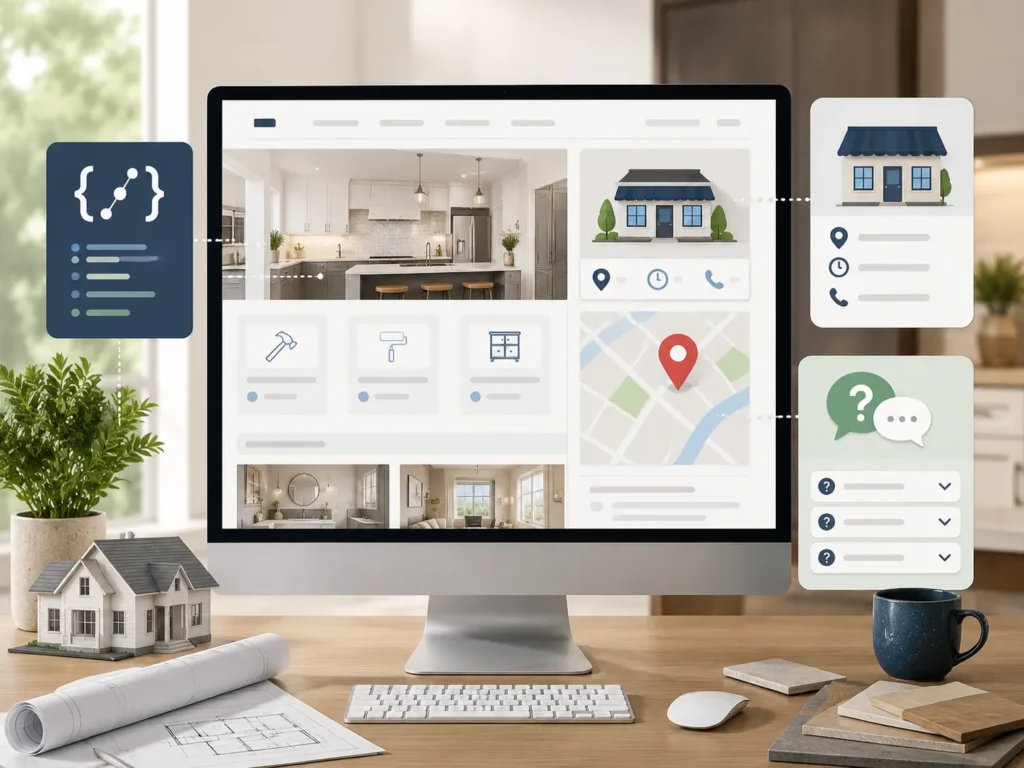
7. Add local and FAQ schema markup
Schema is code that tells search engines exactly what you are. LocalBusiness and Service schema clarify your trades and service area. FAQPage schema can win rich results and feed AI answers. AggregateRating markup can surface your star rating right in the results. It’s invisible to visitors and increasingly non-negotiable for both Google and AI engines.
8. Make the site fast and mobile-first
Between 60% and 75% of home service traffic arrives on a phone. If a page loads slowly or a form needs pinch-to-zoom, the lead is gone. Pass Core Web Vitals, put a tap-to-call button in a sticky header, and keep quote forms short. On mobile, click-to-call beats a seven-field contact form every single time.
9. Showcase before-and-after projects in photos and video
Before-and-after galleries are trust builders and indexable content at once. Describe each project: the service performed, the neighborhood, the materials, the problem solved. That’s keyword-rich copy Google can actually read. Add a short walkthrough video and post it to YouTube – the second-largest search engine, using the same local descriptions so it works twice.
10. Earn local links and citations
Consistent name, address, and phone citations on Houzz, Angi, HomeAdvisor, and your local Chamber validate your location for Google. Then earn real local links: sponsor a youth sports team, get quoted in local news, partner with suppliers and realtors who’ll link back. A handful of relevant local links beats dozens of generic directory listings.
11. Prove real-world trust and get Google Screened
Google rewards demonstrated expertise and trust (the E-E-A-T signals). Put your licenses, insurance, certifications, warranties, and years in business on the page, the same things a homeowner checks before hiring. Then pursue the Google Guaranteed or Google Screened badge through Local Services Ads. It isn’t strictly organic, but it shares the same local real estate and the same trust signals, and the economics are hard to argue with: LSAs averaged a $53 cost per lead and a 7.84x closed return in early 2026, with a lower cost per customer than standard Google Ads.

12. Show up in AI answers with GEO
More than half of U.S. Google searches now end without a click, and AI Overviews increasingly answer the “who should I hire” question before a homeowner reaches your site. The trap: lead-gen platforms like Angi and HomeAdvisor dominate those AI answers while individual contractors get skipped. You counter it the same way you win reviews and schema, structured, consistent content and a deep, recent review base that gives AI a clear “consensus” to cite. Generative Engine Optimization is local SEO’s next front, not a separate discipline.
13. Win the speed-to-lead race
This is where rankings quietly die. Home services miss 14% of inbound calls, and 78% of homeowners hire whoever responds first (CallRail; Lead Connect). You can rank number one for “roof replacement in Tampa” and still lose the job to a competitor who answers on the second ring. Track your calls, staff the phone during peak hours, and follow up on web leads in minutes, not hours. Ranking gets the phone to ring; speed decides whether it was worth it.
14. Build pages ahead of your seasonal demand curve
Home improvement search is seasonal, and the swings are dramatic. HVAC-related keywords move 500% to 600% between their low and high months, while remodeling demand peaks in spring and again in fall (WebFX). Publish and optimize seasonal pages 60 to 90 days before demand hits so they’re already ranked when the wave arrives. Trying to rank for “AC repair” in July is too late , that page needed to exist in April.
15. Measure cost per booked job, not rankings
Roughly 98% of website visitors never fill out a form, so traffic and rankings alone tell you almost nothing. Connect Google Search Console, GA4, and call tracking, then tie leads back to booked jobs and revenue. The number that matters isn’t position one. It’s cost per booked job, broken out by service and city. That’s the metric that tells you which pages to double down on and which to cut.
The bottom line
The contractors who win local search in 2026 aren’t chasing every ranking. They’re compounding a few durable assets: a dominant Google Business Profile, deep and recent reviews, service pages built city by city, and content that answers real buying questions. Paid leads will keep getting more expensive. The AI answer box will keep absorbing clicks. Both trends quietly reward the businesses that built genuine local authority early and penalize the ones still waiting for a reason to start.
That’s the work Eclipse does for home improvement and renovation companies, turning local search into a predictable pipeline of booked jobs, not just traffic. If you want a plan built around your market and your trades, get in touch.
Frequently asked questions
Should I invest in paid ads or SEO for my home improvement company?
Run both, for different jobs. Use Local Services Ads and Google Ads to buy visibility now – useful for launches, new service areas, and peak season. Use SEO to lower your blended cost per lead over time. With paid CPLs rising for 69% of contractors in 2025, the businesses that survive those increases are the ones building organic and Google Business Profile visibility alongside their ads, not instead of them.
What keywords should a home improvement company target?
A mix of three: high-intent service-plus-city terms (“siding replacement in Sacramento”), “near me” terms that signal urgency, and research-phase questions (“cost to remodel a kitchen”). Prioritize the service-plus-city terms first because they convert, then build content for the research questions to capture homeowners earlier in the process.
Do reviews help my home improvement and renovation company’s SEO?
Yes, twice over. Review count, star rating, recency, and your response rate all feed Google Business Profile prominence, and reviews now account for a rising share of local ranking. They also decide whether a searcher picks you – 91% read reviews and most skip anyone under 4 stars. Ask for a review by email after every completed job.
How do I know if my SEO is actually working?
Look past rankings to booked jobs. Use Google Search Console for impressions and clicks, GA4 for on-site behavior, and call tracking to connect calls to specific pages and keywords. If your cost per booked job is falling and your map pack visibility in target cities is climbing, it’s working – even in a month when one keyword slips a spot or two.
Can SEO get me more leads during off-season months?
That’s exactly when it earns its keep. Because search is seasonal, you publish and optimize pages in the off-season so they rank before demand spikes. The slow months are also the time to target planning-stage keywords (“planning a spring kitchen remodel”) that fill your pipeline ahead of the rush.
What can I do if competitors already rank in the top spots?
Go where they’re thin. Most contractors run one generic services page and a shallow review profile. Beat them with city-specific service pages, a faster mobile site, deeper and more recent reviews, and content answering questions they ignore. Winning the map pack in one specific suburb is far easier than trying to outrank a national brand everywhere at once.