

Most businesses spent years adding schema markup to their sites for rich snippets and search visibility. That investment just became a lot more valuable. Microsoft’s NLWeb protocol, launched in May 2025, gives your existing structured data a second job: powering conversational AI directly on your website.
NLWeb schema markup is the connection point between the structured data you’ve already built and the AI-powered search experiences your visitors are starting to expect. If your site runs Schema.org JSON-LD (and roughly 45 million web domains do, according to Wix’s 2026 reporting), NLWeb can turn that data into a conversational interface without months of custom engineering.
I’ve watched organizations burn six figures building custom AI chat tools from scratch. Most of those projects stalled. NLWeb sidesteps that entire mess by working with what you already have.
What Is NLWeb Schema Markup and How Does It Work?
NLWeb (Natural Language Web) is an open-source toolkit from Microsoft that converts Schema.org markup into AI-ready endpoints. Microsoft introduced NLWeb in May 2025, and it lets visitors ask your website plain-language questions and get real answers pulled from your own data, not generic chatbot filler. The overlap between AI and SEO is getting bigger by the month, and NLWeb sits right at the center of it.
R.V. Guha, the co-creator of Schema.org and a Microsoft CVP and Technical Fellow, led NLWeb’s development. That matters because the person who helped build the structured data standard also designed the tool that reads it. The two fit together by design, not by afterthought.
NLWeb creates two types of endpoints when deployed. The first is a human-facing /ask interface where visitors type natural questions. The second is an MCP (Model Context Protocol) server that lets AI agents query your content programmatically. Every NLWeb instance doubles as both.
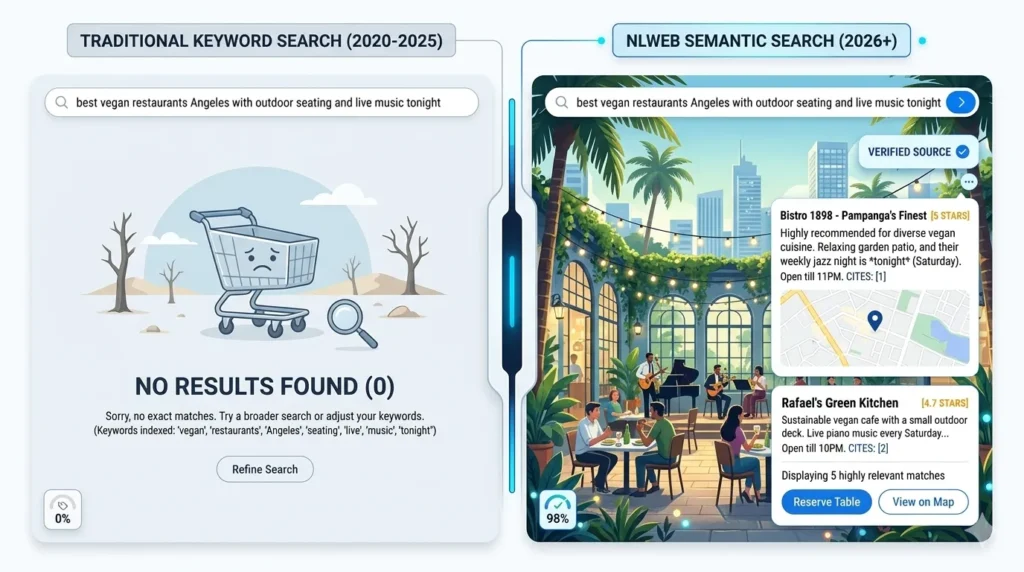
The protocol works by ingesting your JSON-LD schema markup, converting it into vector embeddings, and storing those in a vector database. Unlike keyword search, vector databases map content by meaning. So a query about “structured data” still returns your “schema markup” pages because the concepts are semantically identical. That’s a real upgrade over rigid keyword matching.
For data that isn’t already in JSON-LD format, NLWeb can also ingest RSS feeds and convert them. But JSON-LD is the preferred input, and it’s where you’ll see the best results.
The interface itself is intentionally bare-bones. Microsoft designed it as a blank canvas your dev team can customize to match your brand. The default UI is just a placeholder. You control the prompts, the look, and which Schema.org types the system prioritizes for your content.
How Does NLWeb Process Your Schema Markup?
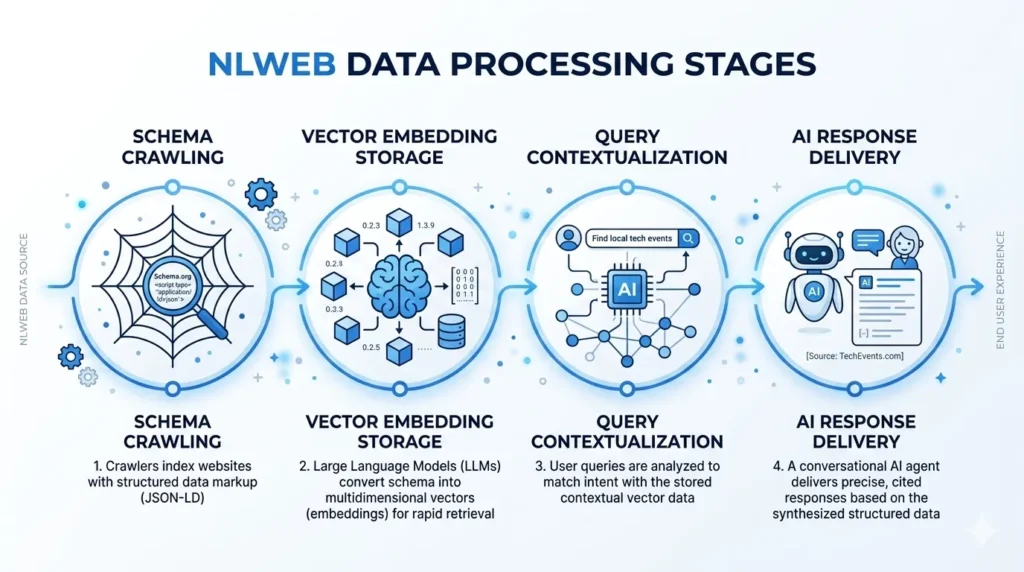
The technical flow breaks down into four stages:
- NLWeb crawls your site and extracts schema-marked-up data
- That data gets stored as vector embeddings in a database
- When a query comes in, NLWeb contextualizes it using parallel calls to the LLM and vector store
- The system selects the right response tool (search, item details, or combined queries) and delivers results
NLWeb also ships with pre-built prompt templates for common interactions: list, summarize, and generate. You don’t need to write custom prompts from scratch, which saves significant development hours.
One thing most explanations skip: the system can fast-track simple queries past the full contextualization step. If someone asks “what’s your phone number,” NLWeb doesn’t need to run the full pipeline. That keeps response times tight for basic questions while still handling complex ones.
Microsoft’s documentation is blunt about why they built this. Schema.org is already widespread. LLMs already understand it well. NLWeb just connects those two facts into something usable.
The NLWeb project is technology-agnostic, too. It supports all major operating systems, works with any major LLM, and connects to multiple vector database options. You aren’t locked into Microsoft’s stack to use Microsoft’s protocol.
What Results Can You Expect From NLWeb?
Does NLWeb Improve Site Search?
Yes, and the improvement is immediate. Traditional site search is keyword-based. If a visitor searches “pricing” but your page says “cost,” they get nothing. NLWeb’s semantic search connects those concepts automatically.
A 2026 audit found a +0.34 Pearson correlation between valid schema pass-rate and AI-citation frequency. That correlation isn’t just academic. Sites with clean, complete schema are getting cited more by AI systems, the same way clean structured data already improves featured snippet rankings. NLWeb takes that same clean schema and puts it to work on your own site, not just in third-party AI results.
Will NLWeb Help People Find More of My Content?
Blogs, product pages, documentation, landing pages, content that used to sit buried behind bad internal search now gets surfaced. NLWeb makes connections at the meaning level, so a question about “how to set up my account” can pull results from your help docs, your onboarding blog posts, and your FAQ page simultaneously.
Most enterprise sites have this problem: they’ve published great content that nobody finds because their search tool is stuck in 2015.
And the discoverability gap gets worse as you publish more. The more content you produce with a bad search tool, the more content gets buried. NLWeb flips that equation. More content means more data for the AI to draw from, which means richer, more accurate answers for visitors.
Can NLWeb Power Chatbots and AI Tools?
NLWeb provides the data layer for building AI-enabled applications like chatbots, knowledge assistants, and customer-facing tools. It doesn’t replace those tools. It feeds them.That distinction is underrated. Most failed AI chatbot projects don’t fail because the chatbot itself is bad. They fail because the data pipeline feeding it is broken. Quality content drives SEO results, and NLWeb solves the pipeline problem using that same content you already own.
Why Should Your Organization Adopt NLWeb in 2026?
Speed is the biggest reason. Microsoft and its early adopters (including Eventbrite, Shopify, and Tripadvisor) have demonstrated that you can get a proof-of-concept running in as little as an hour. Compare that to the months-long timelines of custom AI integration projects.
Cost is the second. Building a similar solution in-house requires specialized engineers, custom vector database configuration, LLM integration work, and ongoing maintenance. NLWeb gives you that stack out of the box.
The third is future-proofing. The agentic web is growing fast. AI agents that browse, query, and transact on behalf of users need structured endpoints to work with. Search Engine Land covered why NLWeb and the agentic web make schema a more important SEO asset than ever. MCP is becoming the standard protocol for that agent-to-site communication, and NLWeb builds MCP compatibility in from the start. For enterprise SEO teams managing thousands of pages, that kind of built-in interoperability is a major advantage.
I’ll be direct: if your competitors are already letting AI agents interact with their content and you aren’t, you’re losing visibility you can’t get back by just publishing more blog posts.
What Happens If You Don’t Adopt NLWeb?
Three risks stand out.
First, your site search falls further behind. Users are already trained by ChatGPT and Google AI Overviews to expect conversational answers. A keyword-based search box feels broken by comparison.
Second, you accumulate technical debt. Organizations that try to build custom AI ingestion pipelines in-house often end up with systems that cost more to maintain than they deliver in value. Fixing on-page SEO issues is already hard enough without layering a fragile custom pipeline on top. Worse, those custom systems may not be compatible with emerging standards like MCP, so you’d eventually rebuild anyway.
Third, and this is the one most people underestimate: missed opportunities compound. Every month you delay is another month where AI agents can’t discover, query, or recommend your content. That’s invisible lost traffic you’ll never see in your analytics.
The agentic web isn’t a prediction anymore. Shopify, Eventbrite, Tripadvisor, and O’Reilly Media are already running NLWeb in production. These aren’t beta experiments. They’re live customer-facing deployments from companies that decided early adoption was worth the effort.
How to Start Using NLWeb the Right Way
Don’t rip out your existing search on day one. Run NLWeb alongside it. A/B test. Measure engagement, query completion rates, and time-on-site differences.
Once you’ve validated the results, expand into more advanced use cases. Chatbots, knowledge assistants, automated workflows, NLWeb gives you the data layer for all of them. The deployment itself is open-source and available on GitHub, so your development team can start experimenting without a vendor contract.
Where most organizations stumble is schema quality. A 2026 audit of enterprise sites found that the most common failure point wasn’t NLWeb itself. It was broken or incomplete JSON-LD. Sites with superficial schema (basic page-level markup but no entity relationships, no SameAs properties, no interconnected knowledge graphs) got poor results from NLWeb even though the toolkit worked fine. If you’re already dealing with technical SEO problems on your site, those same issues will carry over into NLWeb.
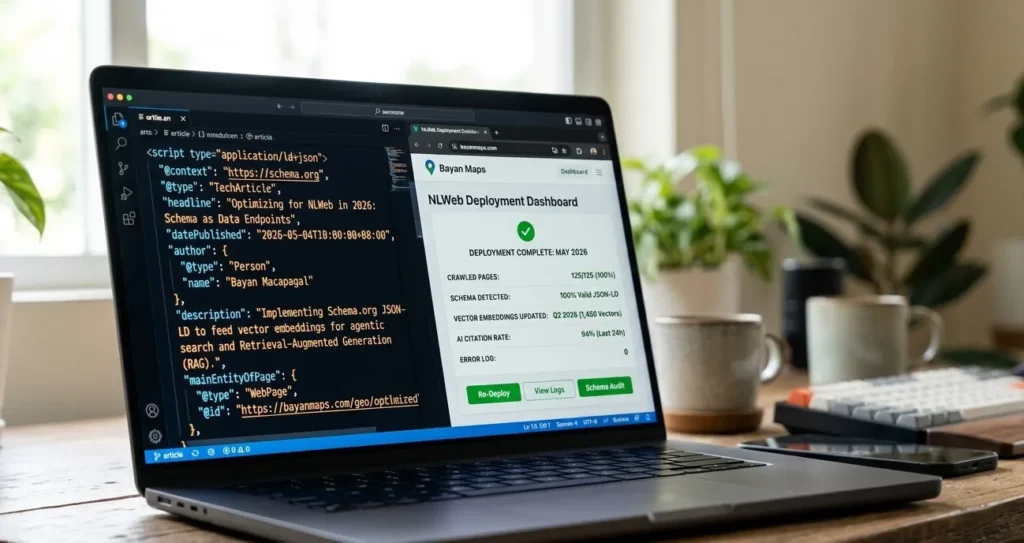
You need to audit your schema before you deploy NLWeb. Not just with Google’s Rich Results Test, which catches syntax errors but misses structural gaps. Test against actual MCP endpoints. Ask: are your entities connected? Is your Organization schema linked to your Person schemas? Do your Article types reference your FAQPage types? Yoast SEO’s Schema Aggregation feature already helps WordPress sites organize their structured data for NLWeb readiness, so that’s one place to start if you’re on WordPress.If the answer to those questions is “I’m not sure,” an SEO agency that understands structured data can audit your schema and get it NLWeb-ready faster than most in-house teams.

NLWeb Schema Markup Is the Bridge Between Your Data and AI
NLWeb doesn’t ask you to start from scratch. It takes the structured data investment you’ve already made and turns it into something AI systems can actually use. For enterprise organizations that have spent years building out their Schema.org markup, that’s an enormous head start.
The organizations moving fastest on NLWeb schema markup right now are the ones who’ll own the conversational search experience in their industry 12 months from now. Everyone else will be playing catch-up.
FAQs
What is NLWeb schema markup?
NLWeb is an open-source Microsoft toolkit that ingests your Schema.org JSON-LD markup and turns it into conversational AI endpoints. It was launched on May 19, 2025, and lets both humans and AI agents query experimenting without a vendor contract.
Where most organizations stumble is schema quality. A 2026 audit of enterprise sites found that the most common failure point wasn’t NLWeb itself. It was broken or incomplete JSON-LD. Sites with superficial schema (basic page-level markup but no entity relationships, no SameAs properties, no interconnected knowledge graphs) got poor results from NLWeb even though the toolkit worked fine.
You need to audit your schema before you deploy NLWeb. Not just with Google’s Rich Results Test, which catches syntax errors but misses structural gaps. Test against actual MCP endpoints. Ask: are your entities connected? Is your Organization schema linked to your Person schemas? Do your Article types reference your FAQPage types?
If the answer to those questions is “I’m not sure,” that’s the first thing to fix.
How do I optimize my site for NLWeb in 2026?
Start with valid, complete JSON-LD schema markup that includes strong entity relationships, not just page-level basics. Your Organization, Person, Article, and FAQPage types should all be interconnected with properties like SameAs and knowsAbout. Run audits beyond Google’s Rich Results Test, because passing syntax validation doesn’t mean your schema is ready for NLWeb ingestion.
Does NLWeb replace traditional SEO?
No. NLWeb complements your existing SEO by giving your structured data a second function. Your schema still supports rich snippets, AI Overviews, and search visibility. NLWeb adds a conversational layer on top of that same data. Think of it as getting more return on an investment you’ve already made.
What schema types matter most for NLWeb?
Organization, Product, Article, FAQPage, and entity schemas with SameAs and knowsAbout properties perform best. Completeness matters more than volume. A site with 50 deeply connected entity schemas will outperform a site with 500 shallow, page-level-only schemas.
Is NLWeb free to use?
Yes. NLWeb is open-source and available on GitHub. The toolkit itself costs nothing. Your expenses come from the infrastructure to run it: vector database hosting, LLM API costs, and development time for customization. For most enterprise sites, a proof-of-concept can be running in under an hour.
How does NLWeb differ from Google AI Overviews?
AI Overviews are controlled by Google. The search engine crawls your content, summarizes it, and displays it however it sees fit. NLWeb gives you direct control. You host the conversational endpoint on your own domain, powered by your own schema data. Visitors interact with your content on your site, not on a third-party search results page.
What tools or plugins support NLWeb right now?
Yoast SEO released a Schema Aggregation feature in March 2026 that prepares WordPress sites for NLWeb compatibility. Several major CMS platforms are building similar optimizations. The open-source GitHub repository provides the core deployment tools for any development team to implement.