
Your Google Business Profile decides whether a homeowner ever sees your remodeling company. The Map Pack sits above every blue link, and only three companies get in. This is the 15-point checklist we run on every profile, ordered by what actually moves rankings in 2026. Across 87 remodeling campaigns since 2019, a full profile overhaul lifts map views an average of 340% in the first 90 days, and 78% of those clients reach the Map Pack within six months.
Most checklists hand you 40 items at equal weight. That is why they do not work.
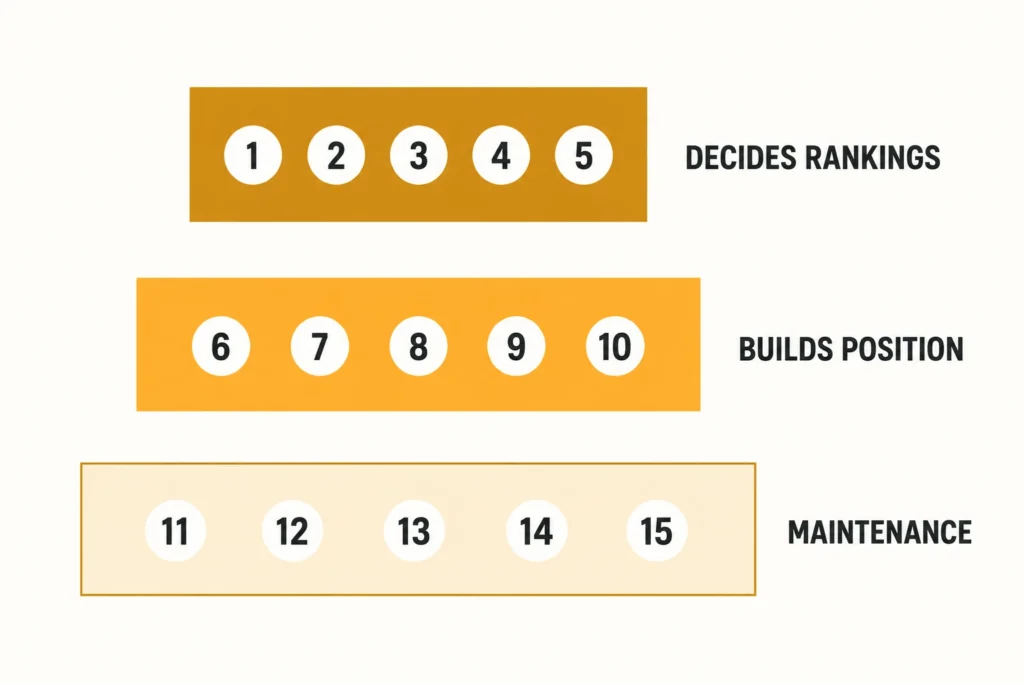
Five of these points decide almost everything. Five more build on them. The last five are maintenance. Work them in that order.
This covers the profile only. If your website is also part of the problem, start with the SEO checklist for remodeling companies instead.
What does the 15-point checklist cover?
The 15 points cover your category, address, name, pin, hours, reviews, services, photos, description, posts, questions, attributes, and monthly tracking. They are ranked here by weight, not by the order they appear in your Google dashboard.
The ranking comes from Whitespark’s 2026 Local Search Ranking Factors survey, cross-checked against what we see across our own campaigns. Google has never published weights. Anyone who tells you they have is guessing.
| # | Point | What it drives | Tier |
|---|---|---|---|
| 1 | Primary category | Relevance | Decides the Map Pack |
| 2 | Address or service area | Prominence + distance | Decides the Map Pack |
| 3 | Business name | Relevance | Decides the Map Pack |
| 4 | Map pin placement | Distance | Decides the Map Pack |
| 5 | Hours | Relevance | Decides the Map Pack |
| 6 | Review count with text | Prominence | Builds position |
| 7 | Review replies | Conversion | Builds position |
| 8 | Secondary categories | Relevance | Builds position |
| 9 | Services list | Relevance | Builds position |
| 10 | Project photos | Conversion | Builds position |
| 11 | Description | Conversion | Maintenance |
| 12 | Posts | Conversion | Maintenance |
| 13 | Questions and answers | Conversion | Maintenance |
| 14 | Attributes | Filtering | Maintenance |
| 15 | Performance report | Measurement | Maintenance |
Points 1 to 5: the five that decide the Map Pack
1. Set the primary category to the job you want most
Primary category is the single heaviest factor in local ranking. It beats reviews. It beats your website.
Pick the one that matches the work you want, not the work you tolerate. A kitchen and bath company that sets “General Contractor” will lose kitchen searches to a company that set “Kitchen Remodeler.”
Search your main service in Google Maps. Look at who is in the top three. Their primary category is usually visible right under the business name. Match it.
Google’s category guidelines tell you to describe what your business is, not what it sells. Recheck the list every quarter. Google adds categories without announcing them.
2. Decide the address question before anything else
Every contractor SEO guide tells you the same thing. Hide your address, set service areas, done.
That advice costs you rankings. Nobody says so.
This is worth its own section further down. Read it before you touch your profile.
3. Use the name that is on your truck
Keywords in the business name rank high as a factor. They also get profiles suspended.
So here is the honest version. “Vale Kitchen Remodeling” is fine if that is the name on your signage, your permits, and your invoices. “Vale Kitchen Remodeling Denver Bathroom Contractor” is a suspension waiting to happen.
Google’s guidelines for representing your business ask for the name as it appears in the real world. Not your LLC filing. Your signage.
If you already renamed yourself and got suspended, the appeal is a separate job. Do not just change it back and hope.
4. Drop the map pin on the actual door
Pin placement is a real ranking factor and almost nobody checks it.
Open your profile in Google Maps. Look at where the pin actually sits. On a shop in an industrial park it often lands on the wrong unit, or on the road.
Drag it to your door. Takes two minutes.
5. Set hours you actually answer
Being open at the time of the search is one of the top five factors. A homeowner searching at 7pm sees a different Map Pack than one searching at 10am.
Do not list 24 hours to game it. If someone calls at 9pm and nobody picks up, you get a one-star review about not answering.
Set holiday hours too. An “Open Now” badge on Thanksgiving when you are closed is a bad first impression.
Points 6 to 10: the five that build position
6. Beat the review count of your top three competitors
Two review signals land in the 2026 top ten. A 4 to 5 star average sits at number six. The count of reviews carrying written text sits at number nine. Silent five-star clicks are worth less than a review that says what you built.
Do the arithmetic yourself. Search your main keyword. Write down the review count for the three companies in the Map Pack. Say they have 166, 89, and 76.
Your target is 200. Not because 200 is magic, but because it clears the highest visible number with margin.
Now divide by time. Clients running our text-first ask go from 0 or 1 reviews a month to 4 to 6. At 5 a month, 200 takes about three years from a standing start, or a year and a half if you already have 100.
That number is uncomfortable. It is also why remodelers who start now win the market in 2028. Here is the exact ask system we use.
7. Reply to every review, and know what the reply does
You will read that Google confirmed replies improve local ranking. Google did not.
What Google’s local ranking page says is that more reviews and positive ratings can help ranking, and that replies help you stand out. Standing out is not ranking.
Reply anyway. It works on the homeowner reading it, and it keeps people leaving reviews.
Name the job in the reply. “Thanks Sarah, glad the primary bath came out how you pictured it.” That reads like a person. “Thank you for your feedback” reads like a form.
One caution. Do not send review requests that tell the customer what to write. Scripts that plant a service and a city into the review are the pattern Google has been tightening on. Ask for the review, not for the wording.
8. Fill all nine secondary categories
You get one primary and up to nine more. Most remodelers use two.
Each one opens searches your primary does not cover. A kitchen and bath remodeler can legitimately add Bathroom Remodeler, Cabinet Store, Countertop Store, Tile Contractor, and Flooring Contractor.
Only add what you actually do. A category you cannot back up is a suspension risk, and it dilutes what Google thinks you are.
9. List every service with its own description
Name services the way homeowners say them. “Kitchen Remodel” beats “Culinary Space Transformation.” “Walk-In Shower Conversion” beats “Bath Solutions.”
Write a short description under each. Put the price range in if you have one. Cost queries are some of the highest intent searches a remodeler gets.
If you do not want to publish pricing, say what the service includes instead. An empty description field does nothing.
10. Load 25 or more real project photos
Photos are a weaker ranking factor than most guides claim. They are a strong conversion factor.
A homeowner comparing three remodelers in the Map Pack picks on the photos. Six stock images of a generic white kitchen lose to 25 phone shots of work you actually did.
Shoot before and after on every job. Name the file before you upload it: kitchen-remodel-arvada-co.jpg, not IMG_4392.jpg. Cover interior, exterior, at work, and team.

Points 11 to 15: maintenance
11. Write the description for the homeowner, not for Google
You get 750 characters. Google does not rank you on them.
Lead with what you build and where. Say how long you have been doing it. Say who you are not for, if that is true. “We do full kitchen and bath remodels in the north Denver suburbs. We do not do handyman work.”
That last line saves you three bad calls a week.
12. Post weekly through your busy season
Posts do not expire after seven days anymore. That is old advice still floating around in checklists written this year.
Update posts stay on your profile and get archived later. Offer and event posts end on the date you set.
Posting is a weak ranking signal. It is a decent conversion signal, because a homeowner who sees a job you finished last week believes you are busy. Post finished projects, not tips.
13. Seed the questions homeowners already ask you
You can post and answer your own questions. Google allows it.
Use the ones you answer on every estimate. Do you handle permits. How long does a kitchen take. Do you have a showroom. What is your minimum project size.
Ten is plenty. Check monthly for real ones, because if you do not answer, a stranger will.
14. Set every attribute that applies
Attributes are checkboxes. Free estimates, veteran-owned, women-led, appointment required, onsite services.
They feed search filters, so they can put you in front of a narrower homeowner. Takes five minutes once.
One thing to skip: chat. Google shut off Business Profile chat and call history on July 31, 2024. Any checklist still telling you to turn on messaging was not checked this year.
15. Read the Performance report monthly
It is called Performance now, not Insights. Track calls, direction requests, website clicks, and the searches that triggered your profile.
Watch two months, not one. A single down month is noise. Two in a row means something changed, usually a competitor’s review count or your own posting stopping.
Also search your top five keywords in an incognito window once a week and note where you land. The report will not tell you your position.
The address decision most remodelers get wrong
Here is the part nobody in contractor SEO says out loud.
In Whitespark’s 2026 survey, having an address showing on your profile instead of running as a service area business ranks as the seventh strongest local pack factor. Two more of the top ten are proximity of your address to the searcher and having a physical address in the city being searched.
So going service area costs you. That is the trade-off, and most guides skip it entirely.
Now the other side. Google’s service area rules say if you do not serve customers at your address, remove it. Listing a home address you do not meet clients at is a guidelines problem, and it is one of the most common reasons remodelers get suspended.
So how do you actually decide.
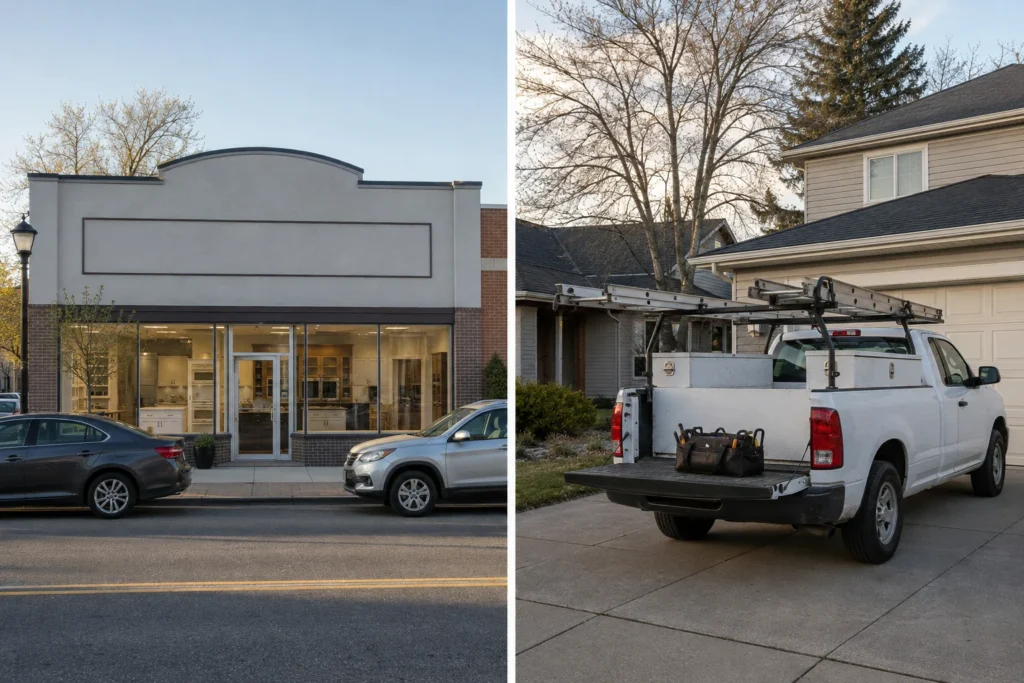
Show the address if you have a real shop, showroom, or office where homeowners can walk in. Staff it during your posted hours. That is legitimate, and it is worth real ranking.
Go service area if you run out of a truck and a home office. You will rank slightly harder for it. Trying to fake an address is worse, because a suspension costs you the whole profile, not a few positions.
If you go service area, two rules. Cap it at 20 areas. Keep the whole footprint inside about two hours of driving from your base, which is Google’s own limit and the one most remodelers blow past.
And if you already have a showroom, the ranking case for opening a second one in a city you want is stronger than any amount of profile tuning. That is a real business decision, not an SEO trick. We have covered how proximity works in more detail.
How long does this take to show up?
Across 87 campaigns, remodelers reach the Map Pack in 4 to 7 months. 78% get there inside six.
Map views move first. A full overhaul lifts them an average of 340% in the first 90 days, before position changes much. That is Google showing your profile to more people, which is the leading indicator.
Calls follow reviews. If your count is far behind the Map Pack, the profile work alone will not close it, and anyone promising 90 days is selling you the timeline you want to hear.
Category, address, name, pin, and hours can all be fixed this afternoon. Do those five first, then start the review ask.
We break the full ramp down in what remodeling SEO actually costs and how long it takes.
Frequently asked questions
What is the most important Google Business Profile setting for a remodeler?
Your primary category. It ranks as the heaviest local pack factor in Whitespark’s 2026 survey, ahead of reviews and ahead of your website. Set it to the job you want most, then check what the top three companies in your Map Pack are using.
Should a remodeler hide their address on Google Business Profile?
Only if you do not serve customers there. Google requires service area businesses to remove the address, but showing a real address ranks as the seventh strongest local factor in 2026. If you have a genuine shop or showroom, show it. If you work out of a truck, go service area and accept the trade-off.
How many Google reviews does a remodeler need to rank?
There is no fixed number. Take the review counts of the three companies in your Map Pack, add margin to the highest, and round. That is your target. Remodelers running a consistent ask system earn 4 to 6 new reviews a month.
Do Google Business Profile posts still expire after seven days?
No. Update posts stay on your profile and get archived later. Offer and event posts end on the date you set. The seven-day rule is old advice that is still repeated in checklists written this year.
Can I still turn on messaging for my remodeling business?
No. Google discontinued Business Profile chat and call history on July 31, 2024. Homeowners call, request directions, or click through to your site. If you need call tracking, it has to run through your own number and analytics.
How many service areas should a remodeler list?
Google caps you at 20, and the whole footprint should stay inside about two hours of driving from your base. Listing cities you would not actually drive to does not add reach and can cause problems.
Work the first five, then call us
Points 1 through 5 are free and take an afternoon. Do them yourself. You do not need an agency to drag a map pin.
Where remodelers get stuck is the review count and the address call, because both are business decisions with real money behind them.
That is the part we handle inside SEO for home remodeling contractors. No contract, and the profile stays yours either way.
If you want a read on where your profile actually sits against the three companies above you, book a call and we will pull the numbers on a screen share. You will see what we see, and you can go run the fixes yourself if you want to.