
How Does AI Personalized Search For E-Commerce Work 2026
E-commerce stores using AI-powered personalized search convert shoppers at 1.8x the rate of stores stuck on generic keyword matching, according to Econsultancy data published by Bloomreach in November 2025. That single stat explains why the AI search engine market hit $16.28 billion in 2024 and is on pace for $50.88 billion by 2033, per Grand View Research.
AI personalized search for e-commerce is the process of using machine learning, natural language processing, and real-time behavioral data to customize product search results for each individual shopper. Instead of returning the same list of products for every person who types “running shoes,” AI-driven search reads that shopper’s click history, past purchases, and session behavior to rank the products most likely to lead to a sale, right now, for that person.
But I want to be honest about something most articles on this topic skip: personalized search isn’t magic, and it isn’t plug-and-play. Working with e-commerce brands at Eclipse Marketing, I’ve seen stores spend six figures on AI search tools and get marginal results because their product data was a mess. The technology only works as well as the data feeding it. If your catalog has inconsistent titles, missing attributes, and no structured markup, AI can’t fix that for you.
So this article won’t just explain what AI personalized search does. It’ll cover what actually matters: the mechanics, the data, and the parts that break down. So you can decide whether it’s the right investment for your store right now.

What Is Personalized Search in E-commerce?
Personalized search customizes the products a shopper sees based on who they are and what they’ve done. It’s the opposite of static search, where everyone gets the same results for the same keyword.
A standard search engine matches keywords. You type “boots,” you get every boot in the catalog sorted by some default rule (usually relevance or popularity). Personalized search layers individual data on top of that: your browsing history, your purchase record, your location, and even the time of day. According to Salsify’s 2025 Consumer Research report, 37% of shoppers say they buy more because of personalized product suggestions. That’s not a small edge.
There are two flavors of personalization that most platforms use, and the distinction matters.
History-based personalization relies on a known user profile. The shopper has logged in before, bought things, and browsed categories. The system knows them. This works well for repeat customers, but most e-commerce sites have a problem: the majority of visitors don’t log in. Over 75% of shoppers browse anonymously, according to Coveo’s research on search personalization.
In-session personalization doesn’t need history. It reads what the shopper is doing right now. The queries they type, the filters they click, the products they linger on. It adjusts results on the fly. Coveo calls this “personalization-as-you-go,” and it’s what makes AI search viable for stores where most traffic is cold.
The gap between personalized and generic search isn’t theoretical. It shows up directly in conversion rates. And it’s getting wider as shoppers expect smarter results from every site they visit, partly because Google and ChatGPT have trained them to expect answers, not just links.
How Does AI Personalized Search for E-Commerce Boost Results?
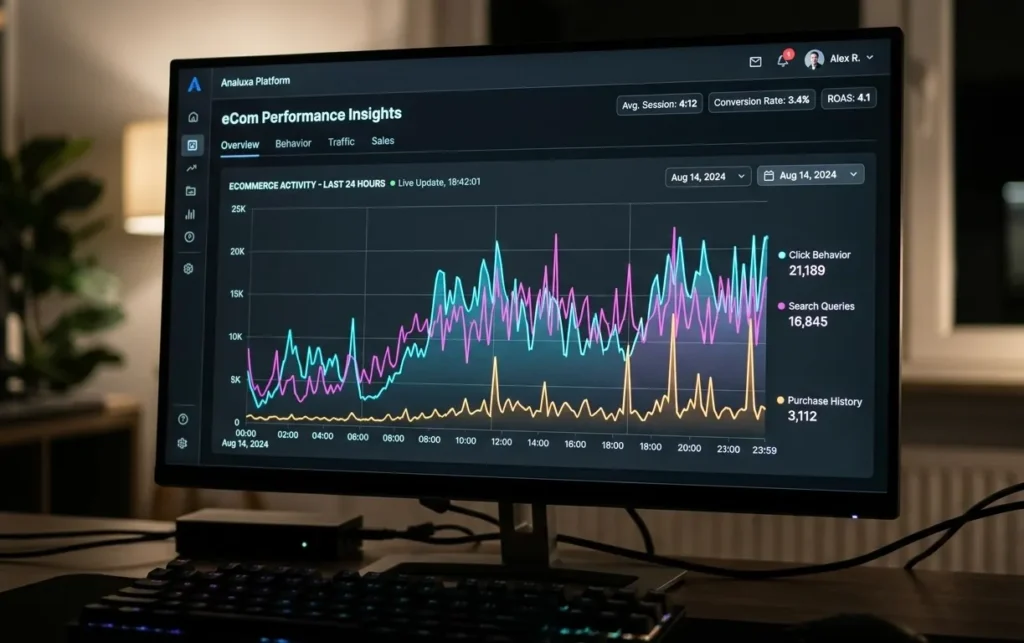
AI processes three categories of data simultaneously: what the shopper searches for, what they click (or skip), and what they’ve purchased before. It blends those signals to re-rank products in real time. A Semrush report from November 2025 found that AI search traffic jumped 527% in a single year. That growth rate mirrors AI’s broader reshaping of search.
The specific AI technologies doing the work break down into three areas.
Machine Learning Predictions
Machine learning algorithms look at patterns across millions of interactions to predict what a specific shopper wants. If shoppers who browse “organic face serum” also tend to buy “vitamin C moisturizer,” the system learns that association and starts suggesting the moisturizer earlier in the journey.
What’s less obvious: ML also learns what to suppress. If a user consistently ignores products above a certain price, the system stops showing them. Amazon’s Personalize platform, which uses a re-ranking approach built on OpenSearch, explicitly lets merchants control the weight between algorithmic personalization and default relevance scoring. You set a dial between 0 and 1, where closer to 1 means heavier personalization. That kind of control matters because over-personalizing creates filter bubbles. I’ll come back to that.
Natural Language Processing
NLP is the reason a shopper can type “cozy winter boots under $80” and get useful results instead of a random pile of footwear. Traditional keyword search sees four separate words. NLP reads intent: warm, insulated, budget-constrained, seasonal.
Salsify’s 2025 data shows shoppers are moving away from keyword searches entirely. Instead of typing “espresso machines,” they’re asking, “What are the best espresso machines under $500?” That shift matters because NLP-powered search handles conversational queries; old-school keyword matching doesn’t. EMARKETER reports that 58% of global consumers have already replaced traditional search engines with GenAI tools for at least some product research.
Real-Time Behavioral Adaptation
AI search doesn’t just learn from the past. It adapts within a single session. If a shopper filters by “size M jackets” three times in a row, the system should start prioritizing size M across all results, not just jackets. And if that shopper shifts to searching for hiking gear mid-session, the AI recalibrates.
This is where most “AI-powered” search tools fall short. A lot of platforms claim real-time personalization, but actually batch-process data on a delay. By the time the system “learns” the session, the shopper has already bounced. According to DemandSage’s January 2026 report, AI-driven e-commerce campaigns saw a 38% rise in conversions, but that data comes from stores with properly implemented real-time systems, not bolt-on solutions running on yesterday’s data.
What Does AI Personalized Search Look Like in Practice?
Theory is one thing. Execution looks different depending on the use case.
Dynamic Filter Adjustments
If a returning customer always selects “organic” when browsing skincare, a good AI search system learns to prioritize organic products automatically. The filters still exist, but the defaults shift. That shopper doesn’t have to click “organic” every single time.
Amazon’s approach with Personalize takes this further. It re-ranks the entire result set based on a weighted combination of the user’s history and the store’s default product ranking. Merchants can fine-tune how aggressive that re-ranking gets for different query types. Broad queries like “all Nike products” get heavy personalization. Specific queries like “Nike Pegasus 41 size 10” keep the default ranking since the intent is already clear.
Conversational Query Handling
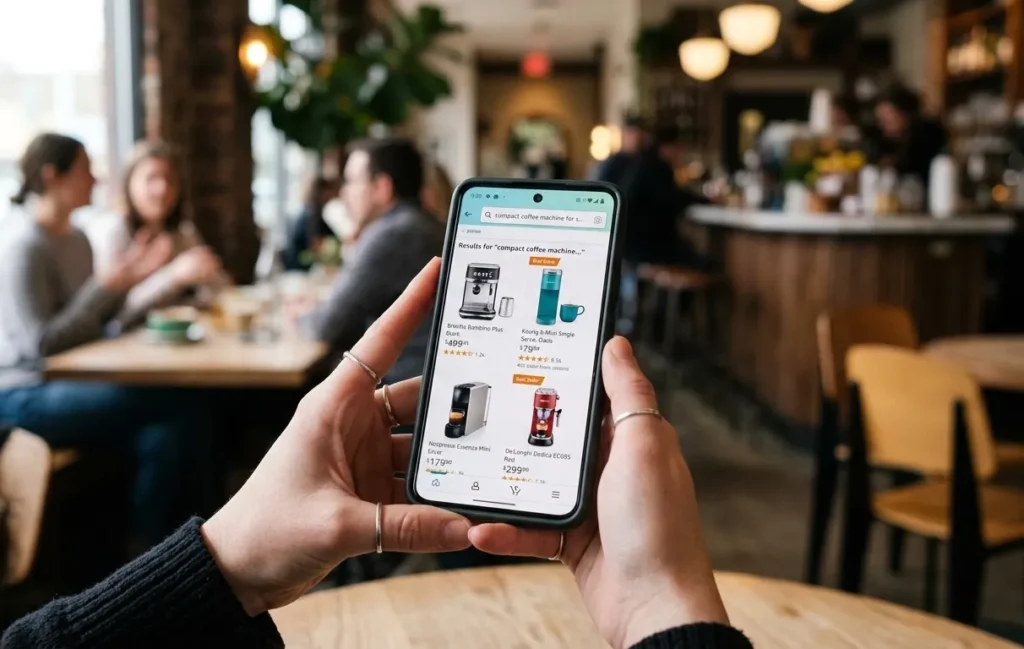
A shopper types: “compact coffee machine for a small apartment.” Traditional search breaks. It doesn’t know which word is the priority. AI search decomposes the query: it identifies “coffee machine” as the product category, “compact” and “small apartment” as size constraints, and returns machines that actually fit on a countertop.
Salsify’s research found that 64% of shoppers now use AI tools to discover or research products, and Digital Commerce 360 reported a staggering 4,700% year-over-year increase in AI-driven visits to e-commerce sites. Shoppers arriving via AI channels showed 10% higher engagement and 27% lower bounce rates. The shift is real and accelerating.
Cross-Session Recommendations
Bought a camera last week? AI search remembers. Your next visit surfaces compatible lenses, memory cards, and tripods, all without you asking. But here’s the contrarian take: this can backfire. I’ve seen stores over-index on complementary products to the point where the shopper can’t find anything unrelated. If someone buys a camera and then searches “birthday gift for mom,” they don’t want camera accessories. A good AI search knows when to turn off the personalization and return to general relevance.

Key Benefits of AI-Powered E-commerce Search in 2026
Higher Conversion Rates
Personalized search narrows the gap between “browsing” and “buying.” When a shopper sees products matched to their actual intent, the decision gets easier. DemandSage’s 2026 data shows AI-driven campaigns lifting organic traffic by 45% and e-commerce conversions by 38%. Roughly 70% of businesses report higher ROI after adding AI to their SEO and search stack, per Semrush.
Less Friction, More Repeat Purchases
Irrelevant results create friction. Friction kills sales. A shopper searching “running shoes with arch support for flat feet” who gets a generic sneaker list will bounce and probably won’t come back. Personalized search shows them shoes matching their foot type, preferred brands, and price range in the first three results.
BrightLocal’s 2025 survey found that 40% of consumers already use generative AI in their search behavior. And 72% plan to increase their use of GenAI-powered search for shopping, per HubSpot. Shoppers are training themselves to expect precision. Stores that don’t deliver it lose to stores that do.
Self-Learning Systems That Reduce Manual Work
The real operational win is labor savings. AI search platforms learn continuously from customer behavior, which means merchandising teams spend less time manually tweaking search rankings and product placements. Some platforms report cutting manual merchandising tasks by up to 50%.
But don’t confuse “self-learning” with “set and forget.” Every AI search system needs monitoring. 83% of large organizations report measurable gains from AI-driven SEO, according to DemandSage, but 6.22% saw no improvement at all. The difference usually comes down to data quality and ongoing oversight.

How to Choose an AI Search Platform for Your Store
This is the section most articles get wrong. They turn into a product pitch for one vendor. I won’t do that.
Instead, here’s what actually matters when you’re evaluating AI search tools for e-commerce, based on what I’ve seen work and fail across dozens of implementations.
Match the Tool to Your Catalog Size
Enterprise platforms like Algolia, Constructor, and Coveo are built for large catalogs with millions of SKUs. They handle complex query loads and offer deep customization. But they’re expensive, and setup takes engineering resources.
If you’re running a Shopify store with 2,000 products, you don’t need enterprise infrastructure. You need a search plugin with solid NLP and basic personalization. Over-engineering your search is a real risk for smaller stores. The 1.8x conversion lift from personalized search depends on having enough product data and traffic for the algorithms to learn from.
Prioritize Structured Data Before Anything Else
AI search systems are only as good as the product data they ingest. If your product titles are inconsistent, your descriptions are thin, and you have technical SEO gaps like missing Product, Review, or FAQ schema, no amount of AI will save you.
This is the most expensive mistake I see: stores invest in AI search tools while ignoring the structured data foundation those tools need. Sites without proper schema markup are missing direct inclusion in AI-generated shopping answers, which can mean double-digit traffic drops as AI Overviews expand. Organic click-through rates on queries with AI Overviews dropped 61% between June 2024 and September 2025, according to ALM Corp.
Measure Beyond Clicks
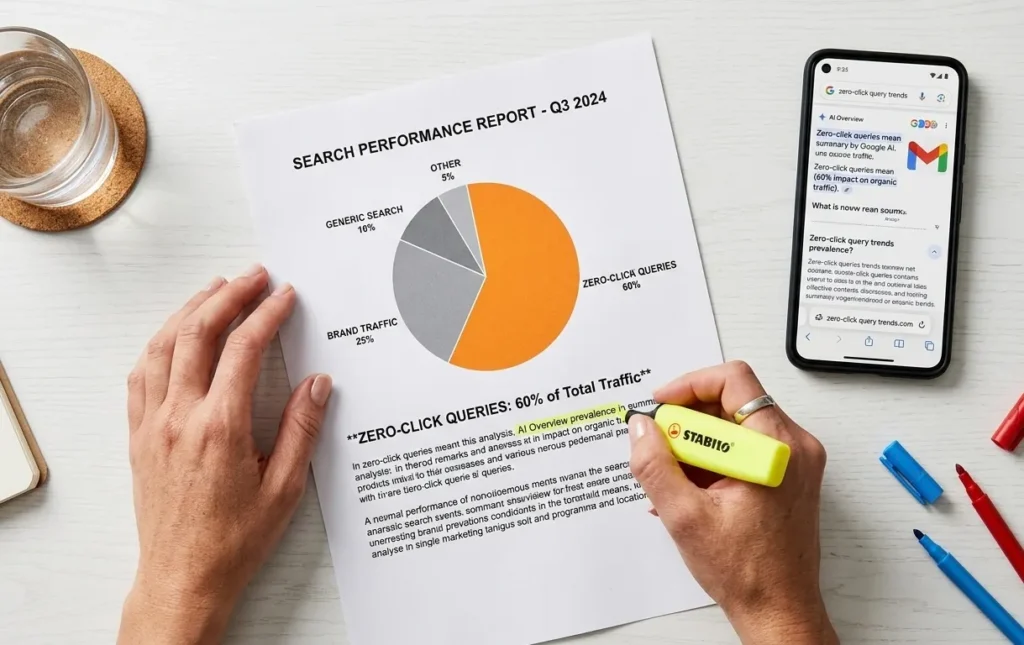
The metrics for AI-powered search are different from traditional search. Zero-click searches now account for roughly 60% of all search engine queries, per Bain & Company data. That means shoppers might find your product in an AI Overview, a featured search result, or a ChatGPT recommendation without ever clicking through to your site.
You need to track AI citations, brand mentions in LLM responses, and impression data, not just click-through rates. Tools like Ahrefs’ Brand Radar and Semrush’s AI visibility tracking are built for this new measurement model. If your analytics only count clicks, you’re flying blind in 2026.
Watch for Filter Bubble Risks
Over-personalization is a real problem. When every result is tuned to a shopper’s past behavior, they stop discovering new products. That kills average order value and narrows your catalog exposure. The best AI search systems balance personalization with discovery, showing products the shopper is likely to want alongside products they didn’t know they wanted.
93.8% of links in AI-generated answers come from URLs that don’t even rank in the traditional top 10, according to analysis cited by Semrush. Rankings aren’t what they used to be. Visibility in AI systems depends on on-page and off-page signals, structured data, and content quality, not just position.
| Feature | Basic Search | AI Personalized Search |
| Query handling | Keyword matching only | Intent + context + NLP |
| Results ranking | Same for everyone | Unique per shopper |
| Data requirements | Product catalog | Catalog + behavioral data + structured markup |
| Setup complexity | Low | Medium to High |
| Conversion impact | Baseline | Up to 1.8x improvement |
| Best for | Small catalogs, low traffic | 500+ SKUs, 10K+ monthly sessions |
Should Your E-commerce Store Invest in AI Search Right Now?
If your store does over 10,000 monthly sessions and carries more than 500 SKUs, AI personalized search is probably worth testing. The conversion data supports it, and the technology is mature enough that you don’t need a machine learning team to implement it.
But if your product data is messy, start there. Clean titles, consistent attributes, proper schema markup. A strong content foundation matters more than the AI layer sitting on top of it. 47% of e-commerce sellers already use AI for product descriptions alone, according to Semrush, which suggests the industry is investing in data quality alongside search.
The e-commerce stores that win in 2026 won’t just be the ones with the best products. They’ll be the ones that combine AI search with the fundamentals: quality backlinks, clean product data, and structured content that helps every shopper find what they’re looking for fast.
FAQs
How much can AI personalized search actually increase e-commerce conversions?
Personalized search lifts conversion rates by about 1.8x compared to generic search, based on Econsultancy data published by Bloomreach in 2025. DemandSage’s 2026 report puts the broader AI-driven e-commerce conversion boost at 38%. The exact impact depends on your catalog size, traffic volume, and data quality. Stores with thin product data or under 10,000 monthly sessions typically see smaller gains.
Do I need a huge budget to add AI search to my online store?
No. Enterprise platforms like Algolia and Constructor run into five or six figures annually, but smaller stores can start with AI search plugins built into platforms like Shopify or WooCommerce. The real cost isn’t always the tool itself. It’s cleaning your product data so the AI has something useful to work with. Messy titles, missing attributes, and no schema markup will tank your results regardless of what tool you buy.
How has AI changed the way shoppers search for products in 2026?
Shoppers have shifted from short keywords to conversational queries. Instead of typing espresso machine, they ask, What are the best espresso machines under $500? EMARKETER reports 58% of global consumers now use GenAI tools instead of traditional search for at least some product research. Salsify’s Q4 2025 report found 64% of shoppers use AI tools for product discovery, and Digital Commerce 360 measured a 4,700% year-over-year surge in AI-driven e-commerce site visits.
What’s the biggest mistake e-commerce stores make with AI search?
Ignoring structured data. Product schema, Review schema, and FAQ markup are what feed AI systems, both on-site search engines and external AI like Google’s AI Overviews and ChatGPT. Without proper markup, your products are invisible to AI-generated shopping answers. Organic click-through rates dropped 61% on queries where AI Overviews appeared, and 93.8% of links cited in AI answers come from outside the traditional top-10 rankings.
Does AI personalized search work for small e-commerce stores?
It can, but with caveats. Machine learning needs data to learn from. If you’re running a store with 200 products and 500 monthly visitors, there isn’t enough behavioral signal for AI to personalize meaningfully. In-session personalization (adapting results based on current clicks, not past history) works better for smaller stores since it doesn’t need a deep user profile. But even then, your product data needs to be clean and consistent.
How do I know if my current e-commerce search is underperforming?
Check your site search analytics. If your search exit rate is above 30%, or if more than 15% of searches return zero results, your search is costing you sales. Also look at search-to-conversion rates: industry benchmarks put this around 2-4% for generic search. If you’re below that, personalization could close the gap. Semrush data shows roughly 70% of businesses report higher ROI after adding AI to their search and SEO strategy.
Will AI search replace traditional SEO for e-commerce?
Not replace. It reshapes how search works. You still need strong on-page content, clean technical SEO, and quality backlinks. But how search results get delivered is changing fast. 60% of queries now end without a click, and AI Overviews are appearing on an increasing share of product-related searches. E-commerce stores need to optimize for both traditional rankings and AI citations. That means structured content, specific data points, and markup that AI systems can extract cleanly.

Michael Vale has over 5 years of experience helping clients improve their business visibility on Google. He combines his love for teaching with his entrepreneurial spirit to develop innovative marketing strategies. Inspired by the big AI wave of 2023, Michael Vale now focuses on staying updated with the latest AI tools and techniques. He is committed to using these advancements to deliver great results for his clients, keeping them ahead in the competitive online market.