
Why E-Commerce Websites Need An Actual SEO Strategy
Roughly 23.6% of all e-commerce orders come from organic search, according to a 2026 study. That’s nearly one in four sales coming from customers who typed something into Google and clicked a non-paid result. For a store doing $500,000 in annual revenue, that’s $118,000 tied directly to SEO performance.
An e-commerce SEO strategy is the process of structuring an online store so search engines can find, understand, and rank its pages for the terms real buyers are searching. It covers everything from product page copy and site speed to internal linking and structured data. Most stores treat SEO as a checkbox. The ones pulling in consistent organic revenue treat it as the foundation their entire acquisition model sits on.
The SEO services market hit an estimated $83.98 billion in 2026, per Mordor Intelligence, and e-commerce and retail account for 26.25% of that spend. That concentration tells a clear story: online stores are pouring money into organic search because it works. But throwing money at it without a plan is how businesses burn through $4,000-a-month retainers and have nothing to show for it six months later.

Why Does SEO Matter for E-Commerce Businesses?
Organic search is the single most cost-effective acquisition channel for online stores. Paid ads stop producing the moment the budget runs out. SEO compounds. A product page that ranks well today can keep pulling in sales for months or years without additional ad spend.
A 2026 report found that e-commerce SEO delivers an average 317% ROI with a breakeven window of 9 to 16 months. Compare that to paid search, where the return disappears the moment the campaign ends. The difference isn’t small. Over three years, a study estimates that e-commerce SEO produces a 3.65 return on ad spend equivalent.
There’s also the trust factor. Approximately 93% of online experiences begin with a search engine.
Shoppers who find a store through organic results tend to convert at 14.6%, per HubSpot’s 2026 marketing statistics. Cold outbound leads? Just 1.7%. Organic visitors are already looking for what the store sells. They don’t need convincing. They need a clear path to buy.
And yet, most e-commerce businesses still rely on paid channels as their primary traffic source. That works until cost-per-click rises (and it always does) or the ad budget gets cut. Stores without an on-page and off-page SEO foundation have no fallback.

How to Build an E-Commerce SEO Strategy in 2026
There’s no single tactic that makes e-commerce SEO work. It’s a stack of decisions, each one reinforcing the others. Some carry more weight than they get credit for. Others get repeated endlessly online but barely move the needle for a real store.
Start With Long-Tail Keywords
Long-tail keywords (three or more words) account for 56% of customer searches, per Business Research Insights data. A store selling running shoes gets far more qualified traffic from “lightweight trail running shoes for wide feet” than from “running shoes.” The first search signals someone ready to buy. The second is someone browsing.
The mistake most stores make is stuffing broad keywords into product pages and calling it a day. Experienced practitioners know that content built around intent matters more than keyword volume. A category page targeting “waterproof hiking boots under $150” will outperform a generic “hiking boots” page because it matches exactly what the buyer typed.
Pair long-tail terms with short-tail targets. Use tools like Ahrefs or SEMrush to find the phrases shoppers actually use, then map those terms to specific product and category pages. One keyword per page. No overlap.
Does the Domain Name Affect Rankings?
Short answer: less than most people think. A clean, brandable domain with a relevant keyword can help with brand recall, but Google has been clear for years that exact-match domains don’t carry the ranking weight they once did.
Store owners should pick a domain that’s easy to remember and spell. Include the brand name. Skip gimmicky keyword-stuffed URLs. The SEO value comes from what’s on the site, not the domain itself.
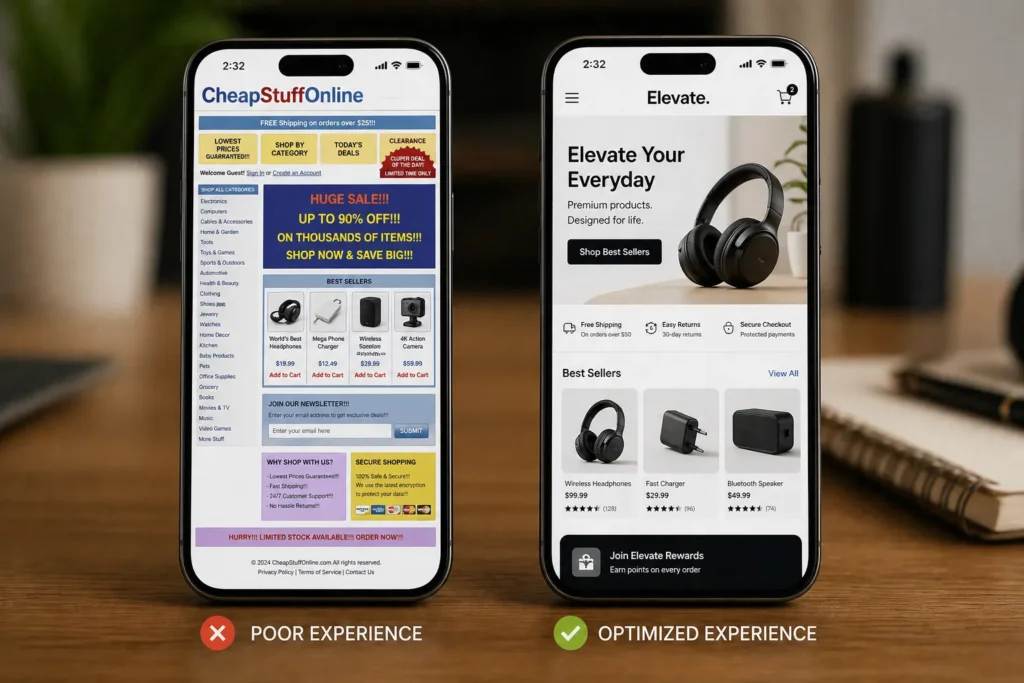
Mobile Optimization Isn’t Optional
Smartphones now account for over 78% of retail website visits globally and roughly 57% of e-commerce sales, per Statista and HubSpot data. U.S. mobile commerce alone hit $564 billion in 2024, growing 14.8% year over year.
Google uses mobile-first indexing, which means it evaluates the mobile version of a site before anything else. A store with a sluggish mobile experience, tiny tap targets, or content hidden behind popups will get penalized in rankings. There’s no workaround.
Technical priorities for mobile include hitting Google’s INP (Interaction to Next Paint) thresholds, compressing images without killing quality, and making sure the checkout flow doesn’t require pinch-zooming. These are common technical SEO issues that bleed revenue quietly.
How Does Local SEO Help Online Stores?
Online stores with a physical location or regional focus can pick up significant traffic through local SEO. A Google Business Profile, consistent NAP (name, address, phone) across directories, and locally targeted content can surface the business in map packs and local search results.
Even pure online stores benefit from local signals when they target regional keywords. A store selling handmade candles in Portland, Oregon, can rank for “handmade candles Portland” far faster than it’ll ever rank for “handmade candles” nationally.
Claim every relevant directory listing. Make sure the business information matches across all of them. Inconsistency confuses search engines and kills local rankings.
Why Image Optimization Gets Ignored
This is one of the highest-ROI, lowest-effort SEO moves for e-commerce, and most stores skip it entirely. Every product image without descriptive alt text is invisible to Google Image Search. That’s traffic left on the table.
Proper image SEO means writing unique alt text that includes relevant keywords (not stuffed, just accurate), compressing file sizes for speed, and using descriptive filenames instead of “IMG_4582.jpg.” For stores with hundreds or thousands of products, automating this process saves enormous time and can produce a measurable ranking lift within weeks.
Structured data around product images (like Product schema with image properties) also helps these visuals appear in Google’s shopping and image carousels. Stores running on Shopify, WooCommerce, or Magento all support this, but few bother to set it up.

What Does E-Commerce SEO Actually Cost?
This is the question most articles dodge, so a direct answer: monthly retainers for e-commerce SEO typically run $4,000 to $15,000 or more, depending on catalog size, competition, and how much technical debt exists. Smaller stores with under 1,000 SKUs might start around $3,000 per month. Mid-size and growing catalogs usually land in the $5,500 to $10,000 range. Enterprise stores with international targets or complex migrations can easily exceed $15,000 monthly.
| Tier | Monthly Cost | Best For |
| Budget | ~$3,000+ | Small catalogs, under 1,000 SKUs |
| Mid-Range | $5,500 to $10,000 | Growing stores, active content + link building |
| Enterprise | $10,000 to $25,000+ | International, migrations, AI search visibility |
DIY is technically free, but the opportunity cost is brutal. Professional campaigns accelerate results through audits, execution speed, and avoiding the penalties that come from common mistakes like thin content or broken internal links. A single Google core update can wipe out months of DIY work if the technical foundation wasn’t built properly.

Stop Treating E-Commerce SEO as an Afterthought
The stores that win organic search aren’t the ones running a blog and hoping for the best. They’re the ones treating SEO like infrastructure. Product pages get unique, intent-matched copy. Category pages are built around how buyers actually search. Technical issues get fixed before they snowball. And structured data gives AI systems and search engines the signals they need to feature the store over competitors.
Global e-commerce sales are projected at $6.88 trillion in 2026, per eMarketer data via Backlinko. That market is only getting bigger, and the businesses capturing the largest organic share are the ones who committed to an e-commerce SEO strategy before they needed one. The stores still waiting are already behind.
FAQs
How much does e-commerce SEO cost per month?
Monthly retainers for e-commerce SEO typically range from $3,000 for small stores with limited catalogs to $15,000 or more for enterprise operations. Mid-size stores usually spend $5,500 to $10,000 per month. The final number depends on catalog size, competitive pressure, and how much technical cleanup the site needs upfront. A 2026 analysis pegs average e-commerce SEO ROI at 317%.
How long before an e-commerce SEO strategy shows results?
Most e-commerce sites start seeing measurable organic traffic improvements within 4 to 6 months. Full ROI breakeven typically lands between 9 and 16 months, based on one e-commerce SEO campaign data. Stores with severe technical debt or thin product page content may take longer. The timeline shortens significantly when technical issues are addressed first.
What’s the difference between on-page and off-page SEO for e-commerce?
On-page SEO covers everything store owners control directly: product descriptions, meta tags, internal linking, site speed, and image alt text. Off-page SEO involves signals from external sources like backlinks, brand mentions, and directory listings. Both matter. A store with great on-page work but zero off-page authority will plateau. An e-commerce SEO strategy needs both working together to produce lasting results.
Will Google AI Overviews hurt e-commerce organic traffic?
AI Overviews can reduce click-through rates. Some analyses show drops of up to 61% for certain queries where AI answers appear. But stores with strong E-E-A-T signals, product schema, and featured snippet opportunities can actually gain visibility through AI citations. The shift requires building content that AI systems want to reference, not just content that ranks in traditional blue links.
Does an online store really need SEO if it already runs paid ads?
Paid ads stop producing traffic the moment the budget runs out. Organic search keeps working. SEO leads convert at 14.6% compared to 1.7% for outbound channels, per HubSpot’s 2026 data. Running both in parallel makes sense, but stores that rely solely on paid traffic are one budget cut away from zero visibility.
How do Google core updates affect e-commerce product pages?
Google’s core updates (including the March 2026 update) increasingly reward original, intent-matched content and penalize thin or duplicate product descriptions. Stores that rely on manufacturer copy or auto-generated text are the most vulnerable. Unique product descriptions, real customer reviews, and proper schema markup reduce volatility during updates.
What structured data should e-commerce sites use for SEO?
Product schema, Offer schema, Review schema, and FAQ schema are the highest-priority types for online stores. Product and Offer schema enable rich results in Google Shopping and search results. FAQ schema can capture additional SERP space. Incomplete implementation limits visibility in both traditional search and AI-powered features.

Michael Vale has over 5 years of experience helping clients improve their business visibility on Google. He combines his love for teaching with his entrepreneurial spirit to develop innovative marketing strategies. Inspired by the big AI wave of 2023, Michael Vale now focuses on staying updated with the latest AI tools and techniques. He is committed to using these advancements to deliver great results for his clients, keeping them ahead in the competitive online market.