
What Is A Backlink Analysis? How To Run One In 2026
95% of all web pages have zero backlinks, according to Ahrefs and Backlinko data from 2025. If your site has even a handful of links from real websites, you’re already ahead of almost everyone. The question is whether those links are doing anything useful.
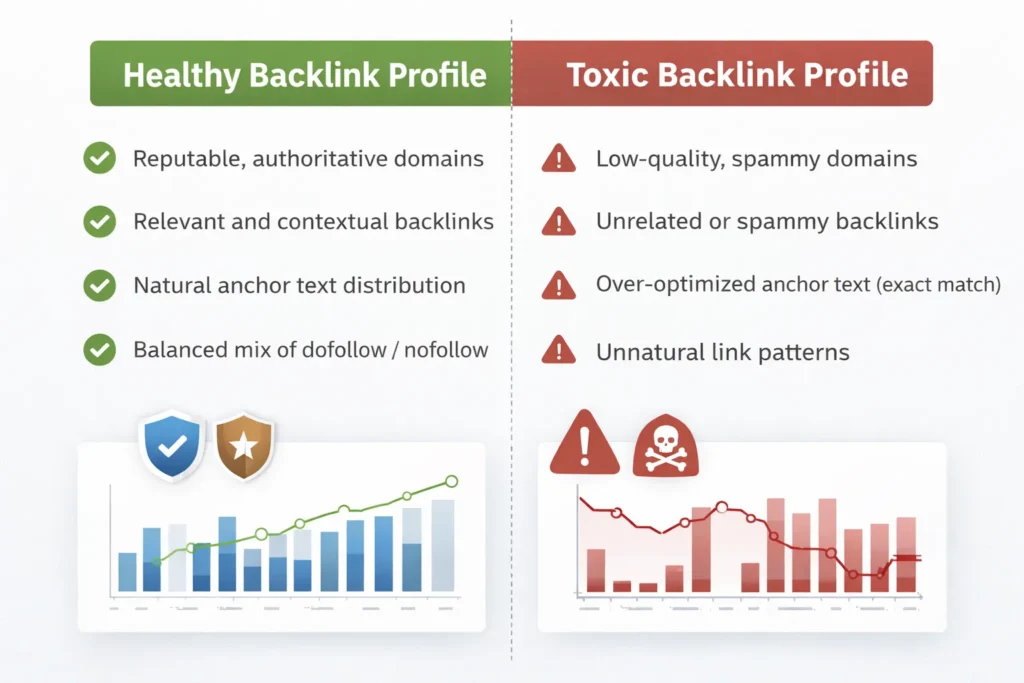
A backlink analysis is a review of the links pointing to your website from other domains, evaluated by volume, quality, and relevance. It shows you which links send authority, which ones carry risk, and where gaps exist between your profile and your competitors’. A solid backlink analysis covers total link count, referring domain diversity, anchor text patterns, and toxicity scores, then turns those findings into a plan. I’ve run hundreds of these audits over the past decade at Eclipse Marketing. Most businesses skip this until something goes wrong. A ranking drops. Traffic falls off a cliff. Running a backlink analysis before things break is cheaper and faster than diagnosing a penalty after the damage is done.
Why Run a Backlink Analysis?
Backlinks remain one of Google’s top ranking signals. Top-ranking pages average 3.8x more backlinks than pages in positions two through ten. Google’s SpamBrain system keeps devaluing manipulative links, and the March 2026 Google core updates caused major ranking volatility for sites with weak link profiles. A backlink analysis tells you where you stand before an algorithm history timeline update decides for you.
But your own site isn’t the only one worth checking. Running a backlink analysis on three or four competitors shows you the authority gap, who’s linking to them that isn’t linking to you, and what it’ll take to outrank them, based on data, not guesses. Understanding the importance of backlinks to your overall strategy makes this step non-negotiable.
I’ll push back on one common recommendation: most guides say to analyze a dozen competitors. Don’t. Pick three to five that rank for your priority keywords. Three competitors analyzed well beat fifteen on autopilot.
How Do You Conduct a Backlink Analysis?
Three steps. None complicated, but rushing through them is where most people lose the value.
1. Pick the Right Sites to Analyze
Start with your own site. Then add competitors who rank for your target keywords. Don’t guess, type your top five keywords into Google and see who shows up. Those are the sites to study.
Semrush’s organic competitors report and Ahrefs’ Competing Domains tool, both show which domains overlap with yours on shared keywords. If you’re a local business, your competitors are the other service providers showing up in the map pack for your money keywords. Limit the list to five sites total. More than that, and the data gets unwieldy.
2. Choose Your Backlink Analysis Tool
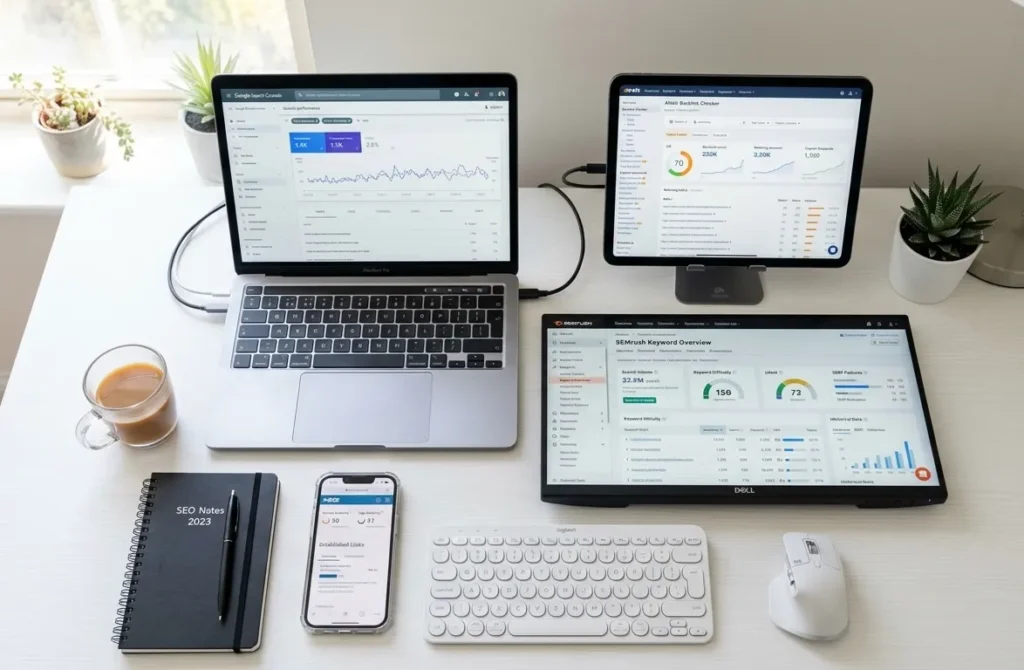
The four most common tools are Google Search Console, Ahrefs, Semrush, and Moz. Each pulls from a different link database, and the numbers won’t match across tools. That’s normal. Semrush reports 43 trillion links as of early 2026. Ahrefs reports 35 trillion. They crawl different parts of the web at different speeds.
For the budget, tools break down roughly like this:
| Tier | Tool Examples | Cost (Monthly) | What You Get |
| Budget | SE Ranking, Moz entry | $49–$129 | Basic backlink checks and limited data |
| Mid-range | Semrush Pro, Ahrefs Lite | $129–$319 | Full analysis, monitoring, and competitor gaps |
| Agency/Enterprise | Custom retainers | $3,000–$15,000+ | Outreach, monitoring, and link acquisition included |
Google Search Console is free and shows links Google actually knows about as the most accurate source for your own site. But it doesn’t show competitor data. For that, you need a paid tool.
A warning on Semrush’s Backlink Audit tool: it flags links for disavow that often don’t need disavowing. I’ve seen it generate files with hundreds of perfectly fine domains. Google’s guidance is clear: only submit a disavow file if you’ve received a manual penalty AND have a history of paid or manipulative links. If neither applies, don’t touch it. Knowing what to look for when avoiding backlink mistakes saves you from making this worse.
3. Collect and Record the Data
Type each domain into your tool and pull the core metrics. Record everything in a spreadsheet; one tab per competitor, one for your site.
Biggest mistake: collecting data without a question to answer. How many linking domains does Competitor A have versus me? Where are their best links from? Which of my pages earned the most links? Those questions drive useful analysis.
What Metrics Matter Most in a Backlink Analysis?
Backlink tools give you dozens of metrics. Most is noise. Focus on these three.
How Many Links and Referring Domains Do You Have?
Total backlinks is the raw link count. Referring domains are the number of unique websites that the links come from. The second number matters more.
A site with 2,000 backlinks from 100 referring domains has a thin profile. A site with 2,000 backlinks from 1,500 referring domains has a healthy, diverse one. Google values diversity. Getting a link from a new domain carries more weight than a fifth link from a site that already links to you. Understanding the different types of backlinks helps you evaluate what you’re looking at.
Editorial. Link’s 2026 State of Link Building survey puts the average cost per quality backlink at $508. Earlier, Ahrefs data placed it at $361. Either way, each new referring domain represents a real investment; tracking this number over time is the clearest indicator of whether your link building is working.
Which Referring Domains Are Worth Paying Attention To?
Not all referring domains are equal. One link from a high-authority news site outweighs fifty from random blog networks. Sort by domain authority (Moz), Authority Score (Semrush), or Domain Rating (Ahrefs); different names, same concept. Don’t confuse these with citations vs backlinks; they measure different things.
For competitor analysis, this is the real gold. Export your competitor’s referring domains, sort by authority, and highlight every domain linking to them but not you. That’s your outreach list. 80% of SEOs report that a new backlink impacts rankings within two to six weeks, per Editorial. Link data cited in SE Ranking statistics from December 2025. If you land a high-authority link and don’t see movement within a month, check whether it’s nofollowed or on a page Google rarely crawls.

Which Pages Are Attracting the Most Links?
Every backlink tool lets you sort pages by link count. The homepage usually wins. The useful insight comes from everything below it.
If original research attracted sixty links, publish more. If a how-to guide pulled links while product pages got zero, that tells you what earns links in your space. Content-driven acquisition still outperforms cold outreach for most sites I’ve worked with. The broader off-page ranking factors all tie back to this same principle.
Do the same for competitors’ top pages. If a competitor earned forty links to a case study and you don’t have one, that’s a gap worth closing. But don’t copy their topic, use their content types as inspiration, and bring a different angle or your own data. Semrush published solid backlink acquisition tactics worth reviewing for ideas.
One question most people skip: Does this link drive actual referral traffic, or just pass authority? A link from a page with real visitors sends qualified traffic and SEO value. Given the choice between two outreach targets, pick the one with traffic.
Run a backlink analysis quarterly at a minimum. Tools change, algorithms shift, and competitors don’t sit still. The sites maintaining rankings in 2026 treat this as a recurring audit, not a one-time project. If your team doesn’t have bandwidth for this, and backlinks still important to your growth, Eclipse Marketing can handle it.
Stop Treating Backlink Analysis Like a One-Time Project
The biggest mistake I see businesses make isn’t picking the wrong tool or tracking the wrong metric. It’s running a backlink analysis once, building a spreadsheet, and never opening it again.
Your competitors are earning new links every month. Google rolls out core updates that shift how link signals get weighted. Toxic links pile up without you noticing. A backlink analysis you ran six months ago is already stale.
Quarterly is the minimum. Monthly is better if you’re spending real money on link building, and with the average quality backlink costing $508, you probably are. Treat your backlink analysis the way you’d treat a financial audit: scheduled, recurring, and tied to decisions. The sites holding rankings in 2026 aren’t the ones with the most links. They’re the ones that know exactly what their link profile looks like right now, and backlinks are still important to staying there. If your team doesn’t have bandwidth for this, Eclipse Marketing can handle it.
FAQs
How long does a new backlink take to affect rankings?
Most backlinks take two to six weeks to show ranking impact. An Editorial.Link survey of 500 SEO professionals found that 80% reported seeing movement within that window. The caveat: Google core updates can delay or erase the effect entirely if the linked page has weak content or low E-E-A-T signals. A link from a high-authority domain on a page Google crawls frequently will register faster than a link buried on a low-traffic blog.
What’s the best free tool for backlink analysis in 2026?
Google Search Console is the most reliable free option because it shows the links Google actually knows about. Moz offers a limited free version, and both Semrush and Ahrefs provide restricted free tiers. Paid tools give you competitor data and larger indexes (Semrush reports 43 trillion links, Ahrefs reports 35 trillion), but for checking your own site’s profile, Search Console covers the basics at zero cost.
Is it worth paying for backlinks in 2026?
64% of SEOs spend $3,000 or more per month on link building, and 78.1% report satisfying ROI from those efforts, according to the Reporter Outreach 2026 State of Link Building survey. But only high-quality editorial links deliver real value. The average cost per quality link is $508. Cheap links from guest post farms or Web 2.0 directories are a waste of money; Google’s SpamBrain system catches them, and a core update can wipe out whatever temporary boost they provided.
How do you find and disavow toxic backlinks safely?
Run a backlink audit through Semrush or Ahrefs and flag links with high toxicity scores. SE Ranking’s 2025 data found that roughly 3 in 10 backlinks show medium or high toxicity markers. But don’t rush to disavow. Google’s own guidance says to submit a disavow file only if you’ve received a manual action penalty and had an influx of paid or manipulative links. Disavowing healthy links by mistake can damage your profile more than leaving questionable ones alone.
Do backlinks still matter with AI Overviews and zero-click search?
Yes. Backlinks remain a core authority signal even as search evolves. Top-ranking pages still average 3.8 times more backlinks than lower-ranking competitors, and Mordor Intelligence projects the global SEO services market will reach $148.86 billion by 2031 at 12.12% CAGR. Authority signals from backlinks also influence which sources AI systems like Google’s AI Overviews, ChatGPT, and Perplexity choose to cite. Sites with strong, relevant link profiles are more likely to appear as citation sources in AI-generated answers.
How often should you run a backlink analysis?
Quarterly is the minimum. Monthly is better if you’re actively building links or operating in a competitive space. Google rolls out core updates multiple times per year, and each one can shift how link signals are weighted. A quarterly audit catches toxic links before they become a penalty risk and shows you whether your link building investment is producing results. If you’ve just launched a major campaign or noticed a ranking drop, run one immediately.
What’s the difference between backlink analysis and a backlink audit?
A backlink analysis is the broader process of reviewing link data for both your site and competitors to inform strategy. A backlink audit is narrower, it focuses specifically on your own site’s links with the goal of identifying toxic or harmful links to clean up. Think of analysis as strategic (where do I stand and what should I do?) and audit as tactical (which specific links need to go?). Most SEO professionals run both, but they serve different purposes.

Michael Vale has over 5 years of experience helping clients improve their business visibility on Google. He combines his love for teaching with his entrepreneurial spirit to develop innovative marketing strategies. Inspired by the big AI wave of 2023, Michael Vale now focuses on staying updated with the latest AI tools and techniques. He is committed to using these advancements to deliver great results for his clients, keeping them ahead in the competitive online market.