
What Is Google SEO? A Beginner’s Guide to Ranking (2026)
Roughly 94% of all web pages get zero traffic from Google. Not low traffic. Zero. That stat from an SE Ranking study should tell you everything about why Google SEO matters and why most websites get it wrong.
Google SEO is the practice of optimizing your website so it ranks higher in Google’s unpaid search results, driving more visibility and traffic without paying for ads. It covers everything from the words on your pages to the technical structure behind them to the links pointing at your domain from other sites. Google processes an estimated 8.5 billion searches per day, and the first organic result captures roughly 39.8% of all clicks. Position 10? Just 1.6%. The gap between showing up and being invisible is razor-thin.
I’ve watched businesses pour thousands into paid ads while ignoring the one channel that compounds over time. The team at Eclipse Marketing sees this pattern every week. SEO isn’t fast. But it’s the only marketing channel where last month’s work still brings in customers six months from now.
How Does Google SEO Actually Work?
Google SEO works by aligning your website with how Google discovers, understands, and ranks content. The process has three stages, and getting just one wrong can tank your visibility.
Crawling comes first. Google sends automated programs called crawlers across the web, following links from page to page. If your site doesn’t have clear internal links or a submitted sitemap, crawlers might never find your most important pages.
Indexing happens next. Google analyzes each page it crawls and decides whether to store it in its index, a massive database of web content. Pages that are thin, duplicated, or blocked by technical errors don’t make the cut.
Ranking is the final stage. When someone types a query, Google pulls matching pages from its index and ranks them based on hundreds of signals. Backlinks, content relevance, page speed, and user experience all factor in. Google runs between 500 and 600 algorithm updates per year, so the criteria shift constantly.
You don’t “set and forget” SEO. Ongoing SEO services keep your site competitive as algorithms change. Unlike paid ads, the results don’t vanish the moment you stop spending.
What Are the 4 Types of Google SEO?
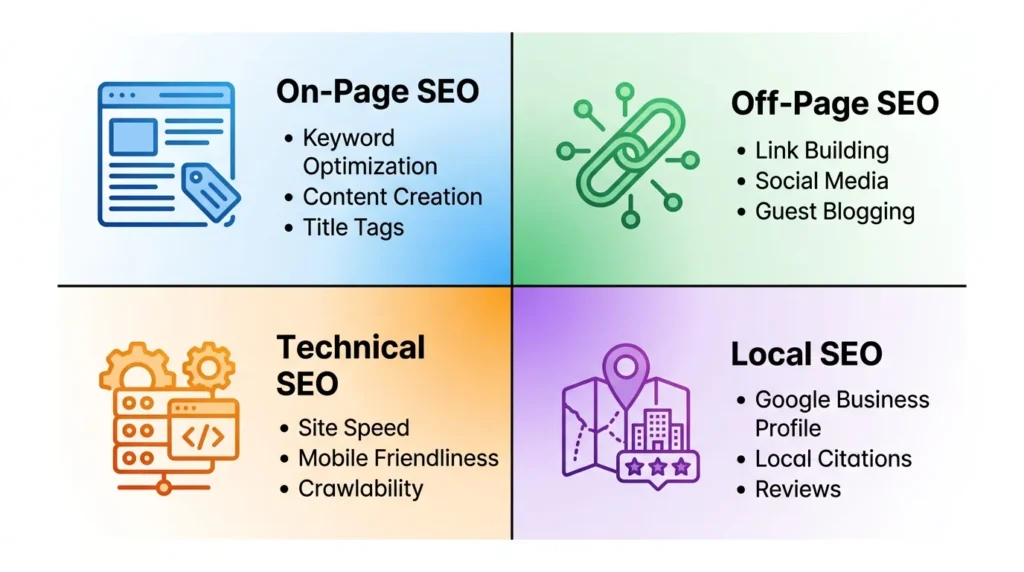
Four categories of SEO exist, and most businesses only pay attention to one or two. That’s a mistake.
On-page SEO is what people think of first: optimizing the content and HTML on individual pages. Keywords, headings, meta tags, internal links. It’s the stuff you control directly.
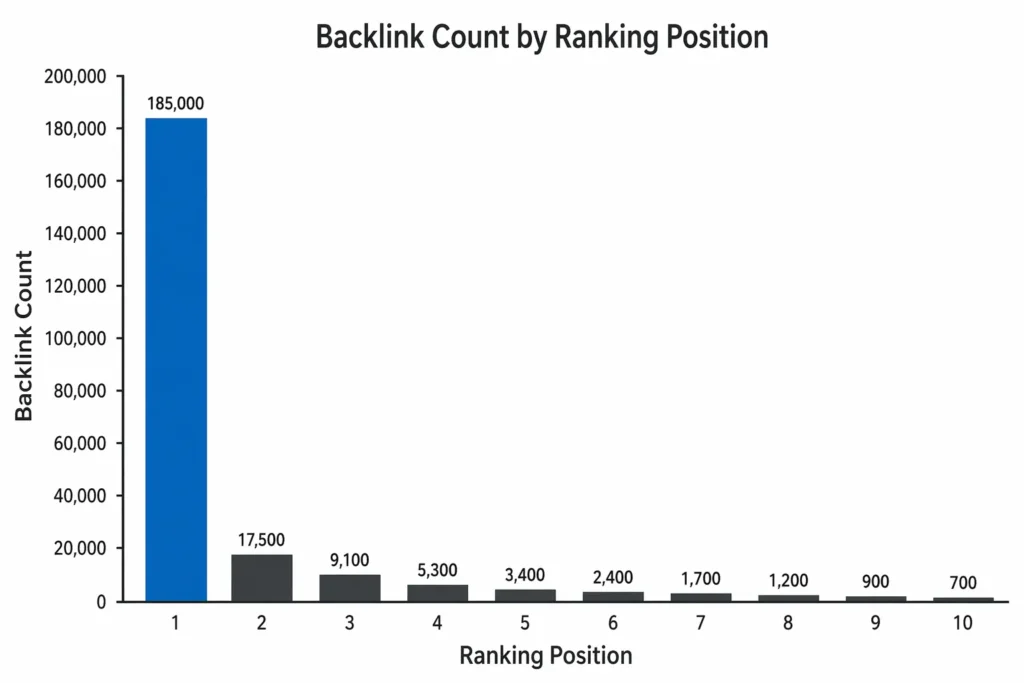
Off-page SEO is about signals from outside your website, primarily backlinks. Pages ranked #1 on Google average 3.8 times more backlinks than positions 2 through 10, according to Ahrefs search data. Authority gets built off-site, not on it. Crafting backlinks for peak performance requires a mix of relationship building, content quality, and outreach.
Technical SEO covers your website’s backend: crawlability, indexation, site speed, mobile-friendliness, and structured data. It’s invisible to most visitors but directly affects whether Google can find and process your content. About 72% of first-page results use schema markup, per Backlinko’s SEO research. If you’re skipping structured data, you’re giving competitors a free advantage.
Local SEO targets location-based searches. If you’re a service business or retail store, this is where your money is. Proven local SEO strategies include Google Business Profile optimization, local citations, and reviews; these drive the map pack results that most consumers click on first.
You need all four working together. But if you’re just starting out, on-page and technical SEO give you the fastest wins because they’re entirely within your control.

6 Google SEO Tips That Actually Move Rankings in 2026
Skip the theory. These six areas produce real results for beginners.
1. Write Content That Matches What Searchers Actually Want
Content quality starts with search intent, the reason someone types a query into Google. Get this wrong, and nothing else matters. You could write the best article in the world, and if it doesn’t match what the searcher needs, Google won’t rank it.
There are four types of intent: informational (learning something), transactional (buying something), commercial (comparing options), and navigational (finding a specific site). The easiest way to figure out intent? Search the keyword yourself and look at what’s already ranking.
I see businesses constantly write salesy landing pages for keywords where Google wants educational content. That’s wasted effort.
Once you understand intent, go deeper than your competitors. Look at the top five results and ask: what did they leave out? Google’s quality guidelines push sites to demonstrate experience, expertise, authority, and trustworthiness (E-E-A-T). Writing from genuine experience – sharing specific examples, mistakes you’ve made, results you’ve seen, separates your content from the generic AI-generated stuff flooding the web right now.
Quality SEO content creation matters more than volume. One article that answers a query better than anything else on page one will outperform twenty thin posts every time.
A word on AI content tools: they’re useful for drafting, but the output is thin unless you’re feeding in real data and subject-matter expertise. Using ChatGPT to write blog posts without adding original insight is like photocopying someone else’s homework.
2. How Should You Place Keywords for Google SEO?
Put your primary keyword in the page title, the first paragraph, at least one subheading, and the last paragraph. Add it to your title tag and meta description, too.
Your title tag should land between 50 and 60 characters. Google is 57% more likely to rewrite title tags that run too long, according to Ahrefs. Keep it tight.
Meta descriptions should stay under 155 characters. They don’t directly affect rankings, but they affect click-through rate, and that does matter. Write descriptions that give a clear reason to click, not just a keyword-stuffed summary.
Beyond the primary keyword, use natural variations. If your main keyword is “Google SEO,” also use “search engine optimization,” “ranking on Google,” or “organic search traffic.” Write the way you’d explain the topic to a colleague, and the variations appear naturally.
One mistake I see constantly: people force their target keyword into every other sentence until it reads like spam. If a keyword sounds awkward, rephrase it. Readability always wins.
3. Why Do Backlinks Still Matter for Google Rankings?
Backlinks, links from other websites pointing to yours, remain one of Google’s top three ranking factors. They’re votes of confidence. The more reputable sites that link to you, the more authority Google assigns to your domain.
Not all links are equal. One link from a high-authority industry publication is worth more than fifty links from random directories. Understanding what backlinking is and why it matters is the first step toward building a real link profile.
Practical ways to earn backlinks:
- Publish original research or data that others want to cite
- Find broken links on relevant sites and offer your content as a replacement
- Respond to journalist queries through platforms like Connectively
- Build relationships with complementary businesses for case studies and co-marketing
A heads-up on buying links: Google’s guidelines explicitly prohibit it. The penalty, losing rankings across your entire domain, isn’t worth the shortcut.
4. Can Google Actually Find and Index Your Pages?
If Google can’t crawl your site, nothing else in your SEO strategy matters. This is where I see small businesses lose months of potential traffic without realizing it.
Start by submitting an XML sitemap through Google Search Console. This tells Google exactly which pages you want indexed.
Then check the “Page indexing” report. If pages you care about show “Not indexed,” dig into the reasons. The most common culprits:
- Robots.txt blocking crawlers from pages you actually want indexed
- A “noindex” tag left over from development or staging
- 404 errors from deleted or moved pages without redirects
Newly launched sites are especially vulnerable. Developers often block search engines during staging and forget to remove those blocks before launch. I’ve seen it happen more times than I’d like to admit.
Run a crawl audit using Screaming Frog, Ahrefs, or a similar tool after every major site update. Redesigns, CMS migrations, and large content deletions are the moments when indexing issues slip through.
5. Does Page Speed Affect Google Rankings?
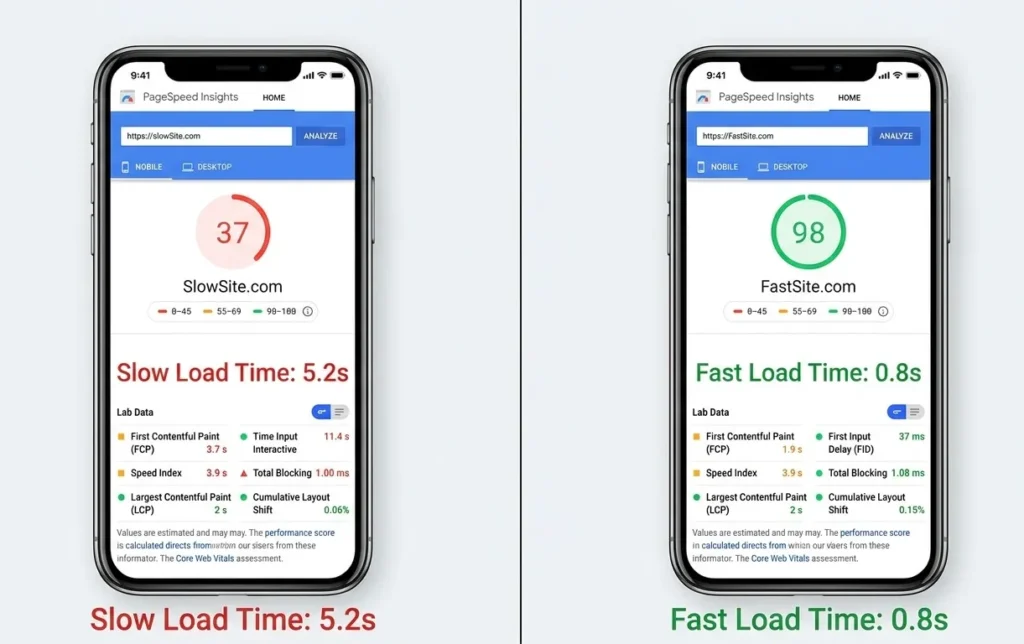
Yes. Google confirmed page speed as a ranking factor years ago, and it’s only gotten more important. Sites meeting Core Web Vitals standards see measurably better performance; one study reported a 22.8% lift in organic revenue for sites that passed all CWV thresholds.
I want to push back on the obsession with perfect speed scores, though. Plenty of websites scoring in the 60s and 70s rank just fine. Fix what actually hurts users, not what bothers a testing tool.
Focus on these high-impact fixes first:
- Compress and convert images to WebP format (often the single biggest win)
- Reduce unused JavaScript and CSS
- Enable browser caching and lazy loading for below-the-fold images
A well-built website that loads in under three seconds on mobile puts you ahead of most competitors. Chasing the last 200 milliseconds has diminishing returns unless you’re running an e-commerce site where every fraction of a second affects conversion.
6. How Do You Optimize a Google Business Profile?
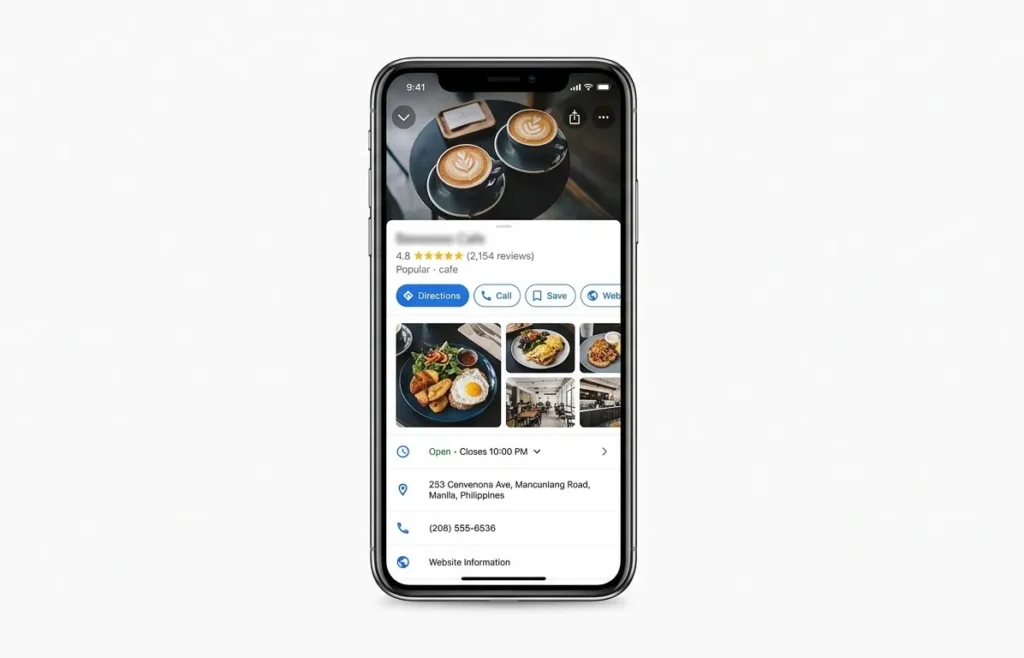
If you serve customers in a specific area, your Google Business Profile (GBP) is arguably more important than your website for local searches. The local map pack, those three business listings above organic results, pulls directly from GBP data.
Key optimizations that move the needle:
- Write a clear business description using relevant keywords and your service area
- Upload high-quality photos regularly (businesses with 100+ photos get 520% more calls, per BrightLocal data)
- Post updates at least weekly: offers, events, tips
- Respond to every review, positive and negative
- Make sure your name, address, and phone number (NAP) match across every directory
Reviews deserve special attention. Google’s local algorithm heavily weights review quantity and recency. Set up a simple follow-up system after completed jobs, and the reviews accumulate on autopilot.
Does Google SEO Still Matter With AI Search in 2026?
This is the question everyone’s asking, and the honest answer is: yes, but the game is expanding.
Google still processes roughly 8.5 billion searches daily and holds about 89% of the global search market share. Traditional SEO isn’t going anywhere. But AI Overviews now appear in about 25% of U.S. searches as of early 2026, according to Conductor’s query analysis of 21.9 million queries.
The impact is real. Pew Research measured a 46.7% drop in click-through rates for queries where AI Overviews appear. Semrush data from September 2025 showed 93% of searches in Google’s AI Mode ended without a single click to an external website.
So what do you do? You don’t abandon Google SEO. You adapt it.
Sites cited inside AI Overviews see a 35% CTR increase over uncited sites. Getting cited is the new page one. And the way you get cited is by doing what good SEO has always required: publishing specific, data-backed, well-structured content that directly answers questions. Optimizing for AI search visibility is becoming just as important as ranking in traditional results.
Three things that matter more now than two years ago:
- Self-contained answers. Write sections that make sense if pulled out of the article completely. AI systems extract chunks, not full pages.
- Original data and experience signals. AI can summarize generic content from anywhere. It cites sources that add unique data or first-person experience.
- Structured formatting. Tables, numbered lists, and clear heading hierarchies make content easier for both humans and AI to parse.
Traditional Google SEO best practices, helpful content, clean technical foundation, and strong backlink profile remain the baseline. But monthly SEO that accounts for both traditional rankings and AI citations is what separates businesses that grow from those that stall. The businesses building this into their Google SEO strategy from the start will own the next five years.
FAQs
How long does Google SEO take to show results?
Most websites see measurable ranking improvements within 3 to 6 months of consistent work. Competitive keywords in saturated markets can take 6 to 12 months. According to Ahrefs, roughly 60% of pages ranking in Google’s top 10 are more than 3 years old. SEO compounds over time; the longer you maintain it, the harder it becomes for competitors to displace you.
Is Google SEO free?
The traffic itself is free; you don’t pay per click like you would with Google Ads. But the work required to earn those rankings costs time, tools, or both. The global SEO services market reached an estimated $83.98 billion in 2026. Small businesses investing in outside help spend an average of $497 per month on SEO services.
What’s the difference between Google SEO and paid ads?
SEO earns organic rankings through content and optimization. Paid ads buy placement at the top of search results. The big difference: ads stop generating traffic the moment you stop paying. SEO builds an asset that keeps producing leads over months and years.
How do AI Overviews affect Google SEO in 2026?
AI Overviews now appear in about 25% of U.S. Google searches. They pull answers directly from web content, which reduces clicks to the original source. Pew Research measured a 46.7% CTR decline for queries where AI Overviews appear. But sites cited within those overviews see a 35% increase in clicks compared to uncited sites. Getting cited requires specific, data-backed content that AI systems can cleanly extract.
Do I need backlinks to rank on Google?
For anything beyond low-competition keywords, yes. Pages ranked #1 on Google average 3.8 times more backlinks than pages in positions 2 through 10. Quality matters more than quantity; one link from a trusted industry source outweighs dozens from irrelevant directories.
How important is mobile optimization for Google SEO?
Mobile devices drive roughly 58 to 62% of all Google searches, and Google uses mobile-first indexing for 100% of websites. If your site doesn’t load properly on a phone, you’re invisible to most searchers. About 80% of top-ranking websites are mobile-optimized, according to StatusLabs data.
Can I do Google SEO myself as a beginner?
Yes. The fundamentals: writing helpful content, placing keywords correctly, submitting a sitemap, optimizing page speed, don’t require a developer or expensive tools. Google Search Console is free and gives you more data than most beginners know what to do with. Where most people hit a wall is backlink acquisition and technical audits, which is when hiring help starts making sense.

Michael Vale has over 5 years of experience helping clients improve their business visibility on Google. He combines his love for teaching with his entrepreneurial spirit to develop innovative marketing strategies. Inspired by the big AI wave of 2023, Michael Vale now focuses on staying updated with the latest AI tools and techniques. He is committed to using these advancements to deliver great results for his clients, keeping them ahead in the competitive online market.