
Why On-Page SEO Is Very Crucial For Rankings In 2026
Most businesses chase backlinks and social media mentions while their own pages are a mess. Title tags that say “Home.” Missing H1s. Meta descriptions left blank.
On-page SEO is the practice of optimizing individual web pages to rank higher in search results and pull in qualified organic traffic. It covers everything you directly control on your site: title tags, meta descriptions, heading structure, content quality, internal links, image alt text, and page speed. According to BrightEdge research, roughly 53% of all website traffic comes from organic search. With Google’s AI Overviews reshaping the future of search, pages with clean structure and specific answers are the ones getting cited. If your on-page SEO isn’t solid, nothing else you spend on marketing will work the way it should.
What Is On-Page SEO?
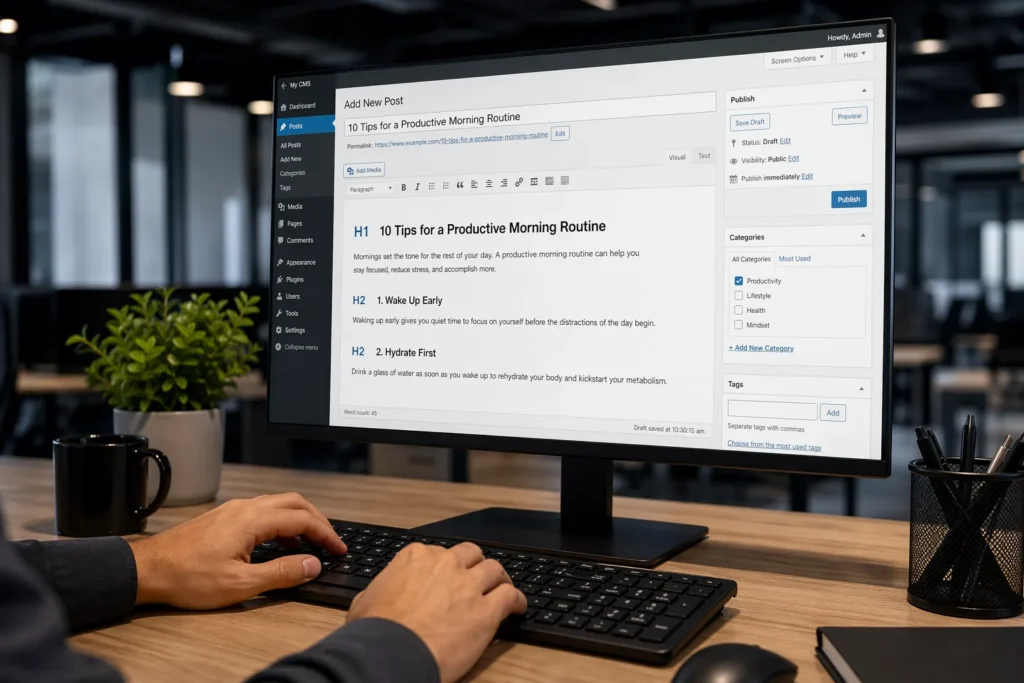
On-page SEO covers every optimization you make directly on your website. Title tags, meta descriptions, heading hierarchy, keyword placement, image alt text, internal links, and the actual words on the page.
The opposite is off-page SEO: backlinks, brand mentions, social signals, and anything happening away from your domain. You don’t control those. The differences between on-page and off-page SEO are real, and the balance of power has shifted.
And here’s what most people get wrong. They assume link building is where the real ranking power lives. Backlinks still matter, but that was a bigger deal five or six years ago. After Google’s 2025 and 2026 core updates, on-page factors carry the majority of weight in most niches. Practitioners on r/bigseo estimate on-page signals account for 70-80% of the battle now. The pages winning top positions are the ones with the strongest on-page foundations: clear intent match, original information, and solid technical structure.
I’m skipping the deep technical setup of how crawling and indexing work. That’s its own article.
Why Does On-Page SEO Still Matter?
On-page SEO tells search engines what your page is about and whether it matches a query. Google’s December 2025 and March 2026 core updates made this more direct than ever. Pages with strong on-page signals rank. Pages without them drop, sometimes permanently.
But the ROI case is what should get your attention.
HubSpot’s 2026 State of Marketing Report ranked website content and SEO as the #1 ROI-generating channel for B2B brands, ahead of paid social and email. Professional on-page SEO programs commonly return 3-5x within 12 to 18 months. Unlike paid ads, organic traffic compounds. It keeps coming after you stop writing checks.
The first organic result on Google captures roughly 31-33% of all clicks. The entire first page grabs over 90%. If you’re not ranking there, you’re invisible to people actively looking for what you sell.
I’ve worked with businesses spending $3,000 a month on Google Ads while their title tags still said “Home.” That’s burning money. Fixing your on-page SEO foundation first, then layering paid campaigns on top, is the smarter play.
The global SEO services market hit $74.9 billion in 2025, per Mordor Intelligence, with projected growth to $148.86 billion by 2031. Businesses aren’t spending that because SEO is optional. They’re spending it because organic search is the most reliable customer acquisition channel available.
What Are the Most Important On-Page SEO Elements?
Three categories make up the core: meta tags, content quality, and internal linking. Get these right and you’ve handled roughly 80% of the work. Everything else is fine-tuning.
Meta Tags
Your title tag and meta description are the first things Google and searchers see. The title tag is a confirmed ranking factor. The meta description isn’t a direct signal, but it controls your click-through rate, and CTR affects rankings indirectly.
A solid title tag puts your primary keyword near the front, stays under 60 characters, and reads like something a person would actually click on. Most sites either stuff keywords into title tags or leave the default CMS-generated title. Both cost you clicks.
Content Quality and E-E-A-T
Google evaluates content on Experience, Expertise, Authoritativeness, and Trustworthiness. The “Experience” component was added in late 2022, and it’s the one most website content still misses entirely.
SEMrush’s 2024 Ranking Factors Study analyzed 300,000 search results and found that content quality, relevance, and readability ranked among the strongest correlates with higher positions. Keyword density, by contrast, barely moved the needle. If you’re still counting keywords per 100 words, you’re running a strategy from 2015.
Actually, that framing isn’t quite right. Keyword density isn’t completely dead. But obsessing over it wastes time when intent alignment and original insight carry far more weight. Does this page answer the query better than the other nine results on page one? Does it include real data or first-hand experience? Those are the signals Google rewards in 2026.
Internal Links and Site Structure
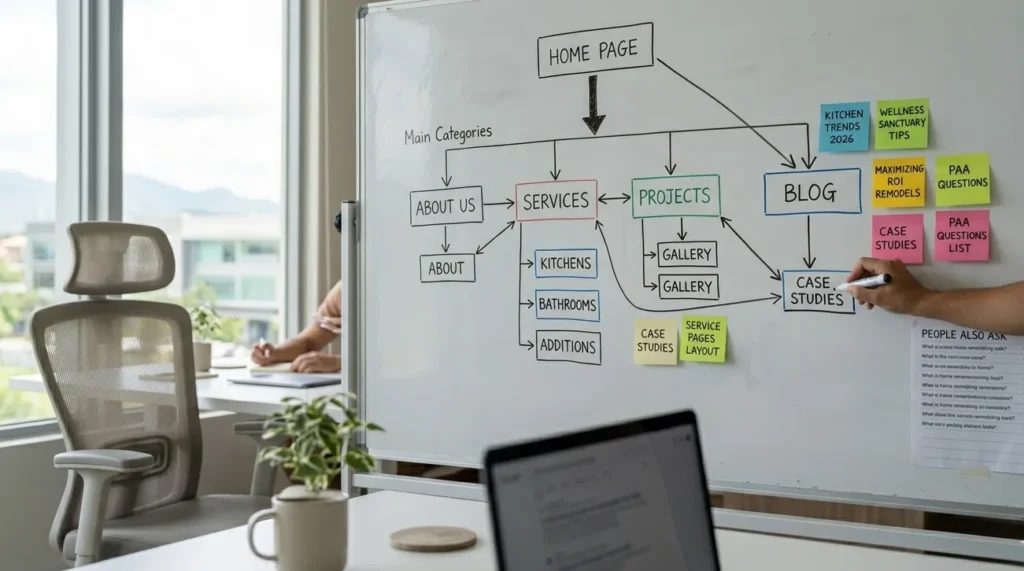
Internal links show Google which pages on your site matter most and how your topics connect. A page with no internal links pointing to it is basically invisible to crawlers.
Google’s own documentation calls for a “clear conceptual page hierarchy.” That means logical navigation, descriptive anchor text, and a linking structure where every page of value sits within 2-3 clicks of the homepage.
Most sites have orphan pages they don’t know about. Good content sitting there with nothing linking to it. Fixing internal links is often the fastest ranking win you can get, and it costs zero dollars.
How Can You Improve On-Page SEO Rankings in 2026?
The core principles haven’t changed dramatically, but the execution has. Google’s recent algorithm updates reward intent alignment and original insight far more than raw keyword targeting.
Search Intent
Every query has an intent: informational, commercial, transactional, or navigational. If your page targets “best running shoes” but reads like a product spec sheet instead of a comparison guide, you’ve mismatched the intent.
Before optimizing any page, search your target keyword. Look at what’s ranking. Those results tell you what Google thinks the searcher wants. Match that format. Pages that align with intent also tend to win featured snippet positions, which grab even more visibility above the standard results.
Mobile Optimization
Google has used mobile-first indexing since 2019. Your site’s mobile version is the one that gets ranked. A desktop site that loads poorly on phones gets filtered out.
Test on real devices. Tap targets, font sizes, and load times on a 4G connection all matter. Core Web Vitals (INP fully replaced FID in 2024) carry increased ranking weight.
HTTPS and Site Security
HTTPS has been a ranking signal since 2014. In 2026 it’s non-negotiable. Sites on HTTP get a “Not Secure” warning in Chrome that kills trust before a visitor reads your headline.
Page Speed and User Experience
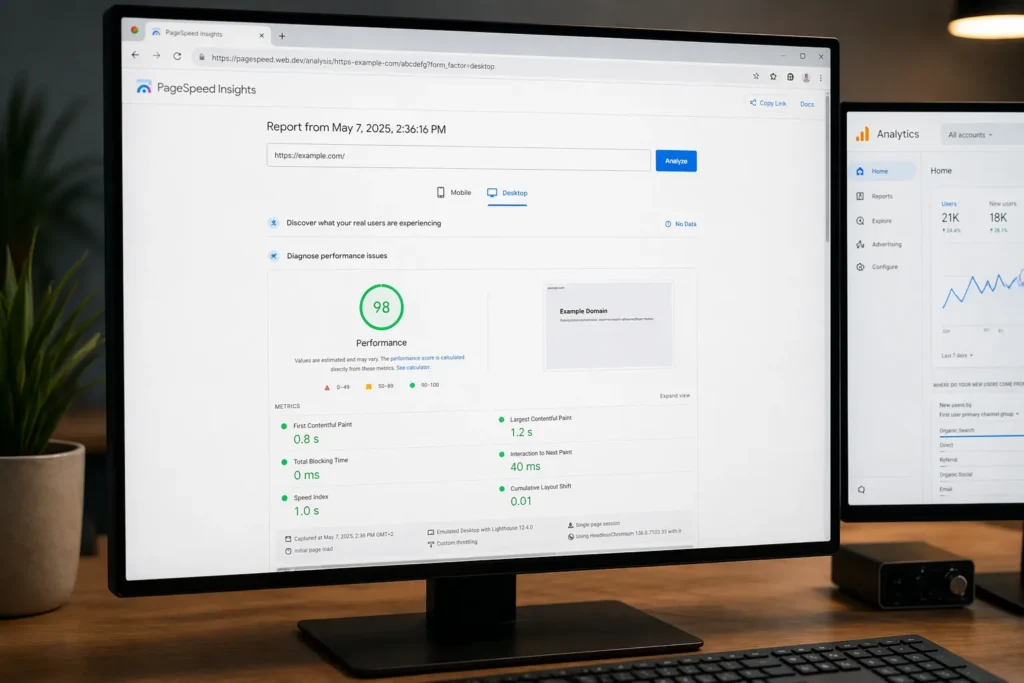
Slow pages lose visitors and rankings. Google’s Core Web Vitals measure load performance, interactivity, and visual stability. Catching technical SEO issues early prevents these problems from compounding.
Joshua Hardwick of Ahrefs documented a case in his on-page SEO checklist where optimizing one page’s on-page signals increased monthly traffic 12x, from roughly 18,000 to over 215,000 visits. That’s what happens when on-page SEO gets treated as a serious investment instead of a checkbox.
Because that’s the point most guides skip. On-page SEO isn’t something you finish. It’s something you maintain. Content gets stale. Competitors improve. Google updates its algorithm 3-4 times per year. One site reported on Reddit lost 40%+ of traffic permanently after a 2025 core update because its on-page signals had gone stale. The businesses that keep their rankings are the ones treating on-page SEO as ongoing work.
FAQs
Is On-Page SEO Still Important in 2026 With AI Search?
Yes. On-page SEO matters more now, not less. Google’s AI Overviews pull content from pages with clear structure, specific answers, and strong E-E-A-T signals. Those are all on-page elements. Ahrefs documented a case in March 2026 where optimizing one page’s on-page signals produced a 12x traffic increase. AI search doesn’t replace on-page SEO. It rewards it.
What Is the Biggest On-Page SEO Mistake Businesses Make?
Treating it as a one-time project instead of ongoing maintenance. Pages go stale. Competitors update their content. Google runs 3-4 major algorithm updates per year. A site that was well-optimized 12 months ago can lose 40%+ of its traffic after a core update if on-page signals haven’t been refreshed.
Does Keyword Density Still Matter for On-Page SEO?
Not the way it used to. Modern Google updates prioritize readability, intent alignment, and content quality over raw keyword counts. SEMrush’s 2024 study of 300,000 search results found content relevance and quality correlated far more strongly with top rankings than keyword frequency. Write for the reader first. The keywords land naturally when you do.
How Long Does On-Page SEO Take to Show Results?
Professional on-page optimization typically produces measurable ranking improvements within 3 to 6 months. DIY efforts often take 6 to 12 months or longer due to the learning curve. Low-competition niches move faster. Core algorithm updates can accelerate results or temporarily reset progress.
What Is the Difference Between On-Page SEO and Off-Page SEO?
On-page SEO covers everything you control directly on your website: title tags, content, internal links, page speed, and site structure. Off-page SEO involves external signals like backlinks, brand mentions, and social media activity. Both matter, but on-page SEO is the foundation. Strong off-page signals can’t compensate for weak on-page fundamentals.
Should I Optimize Pages for Featured Snippets or AI Overviews?
Both. They require similar on-page techniques: concise direct answers near the top of a section, structured data markup, numbered lists for processes, and question-format headings. Patrick Stox of Ahrefs reported that featured snippet optimization yielded a 38.9% traffic lift in tests. The same structure that wins snippets tends to get cited in AI Overviews.
How Much Does On-Page SEO Cost in 2026?
It depends on scope. Basic on-page audits and fixes for small or local sites run $500 to $1,500 per month. Mid-range campaigns covering intent optimization, content clusters, and technical work cost $1,500 to $5,000 per month. Enterprise-level programs with full E-E-A-T buildout and AI search preparation start at $5,000 and go up from there.

Michael Vale has over 5 years of experience helping clients improve their business visibility on Google. He combines his love for teaching with his entrepreneurial spirit to develop innovative marketing strategies. Inspired by the big AI wave of 2023, Michael Vale now focuses on staying updated with the latest AI tools and techniques. He is committed to using these advancements to deliver great results for his clients, keeping them ahead in the competitive online market.