
“Kitchen remodel cost” gets 27,100 searches a month. “How much does a kitchen remodel cost” gets 410. Same homeowner asking the same question, but the first phrase carries a keyword difficulty score of 83 and the second sits at 20. The small one is easier to rank for, and it pulls people who are closer to hiring. That gap is what keyword research for remodelers is really about, and most guides skip right past it.
Keyword research for remodelers is the work of finding the exact phrases homeowners type when they want a remodel, then matching each phrase to one page on your site. For a remodeling company, the goal is booked estimates from homeowners in your service area who are ready to hire, not raw traffic.
We have run 87 remodeling SEO campaigns across 18 markets since 2019, and the pattern repeats. The remodelers who win pick 30 to 60 sharp phrases and give each one a page. The ones who stall chase whatever term shows the biggest search number. Below is how to be the first kind.

What keyword research for remodelers actually means
Keyword research means listing the phrases your future customers search, then deciding which ones deserve a page. For a remodeler, that list is shorter than you would expect.
A homeowner does not read fifteen articles before calling. They search, look at the map results, read a few reviews, maybe check a cost guide, and pick up the phone. Your keywords need to match that path, not the path of someone shopping for software. Three kinds of phrases matter most: the service plus the city like “bathroom remodeler in [city],” the money question like “how much does a kitchen remodel cost,” and the direct hire like “kitchen remodeler near me.” Everything else supports those three.
Volume looks nice. Intent pays the bills.
Intent beats volume for a remodeler almost every time. Search volume tells you how many people type a phrase. Intent tells you what they want, and that second number is the one that rings your phone.
“Kitchen remodeler near me” shows 22,400 searches a month with clear buying intent, so it belongs on your list. But a phrase with barely 40 searches a month can be worth more. One of our clients targeted a set of niche garage-conversion and ADU terms at that kind of volume, and a single one of those searches booked a $62,000 project, because the person typing it wanted exactly that service. We keep intent tags on a database of 2,400 remodeling search terms, tracked since 2021, for this reason. A small, ready-to-hire audience closes more work than a big, curious one.
How do you find keywords for a remodeling business?
Start with the three services that pay your bills, then add every city and neighborhood you serve. Run each phrase through Ahrefs or Google Keyword Planner, write down the volume and the difficulty, and tag the intent. A remodeler in one metro ends up with 30 to 60 core phrases, not 500.
Then group them. Kitchen phrases go with the kitchen page. Bathroom phrases go with the bathroom page. City phrases get their own city pages. This is where a site built to convert earns its keep, because a keyword with nowhere to land does nothing for you.
Two sources most remodelers ignore: your own past customers, and the questions they ask on the phone. If five homeowners this month asked whether you handle permits, then “kitchen remodel permits in [city]” is a page worth writing. The forums where homeowners compare notes are the other place to find the exact words they use.
Which keywords are the easiest to rank for?
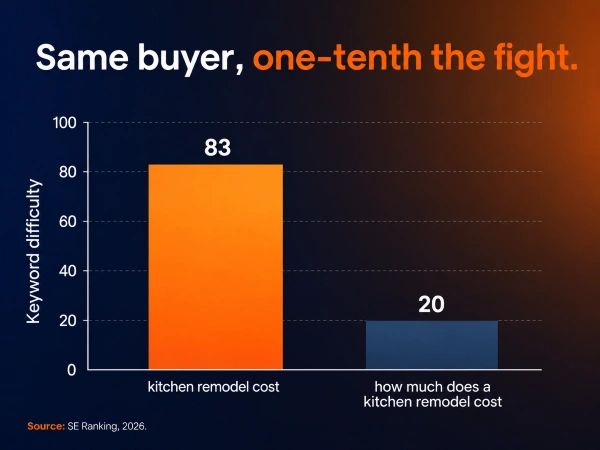
The easiest keywords to rank for are usually questions. “Kitchen remodel cost” carries a difficulty score of 83 and takes years to crack. “How much does a kitchen remodel cost” sits at 20 and can reach page one in 60 to 90 days. Same buyer, one-tenth the fight.
Across our 87 campaigns, the first page-one rankings almost always come from these long-tail question terms, not the head terms every remodeler asks for on the first call. We go after the easy, high-intent phrases first to get leads moving, then work up to the harder terms once the site has earned some standing. Google’s own SEO guidance makes the same point in plainer words: match the page to what the searcher actually wants. And treat any difficulty score as a hint, not a verdict. Trust your own results more than a tool’s estimate.

Are “near me” keywords worth it?
Yes, but they will not carry you on their own. “Remodeling contractor near me” pulls 9,900 searches a month from homeowners ready to hire, so you want to show up for it. The catch is that Google reads “near me” from the searcher’s location, not from the words on your page. You rank for it only when your Google Business Profile and your city pages are strong.
Pair every “near me” term with a named-city page and a filled-out profile. Reviews carry a lot of the weight here. Homeowners read them before they call, something BrightLocal’s research on how homeowners read reviews has tracked for years. A page can rank, but the review count often decides who gets the call.
How to do city and neighborhood keyword research
Local keyword research means building a phrase list per city and per neighborhood, not one national list. For each city you serve, take your core services and add the place name: “kitchen remodeler in [city],” “home addition contractor [city],” “[neighborhood] bathroom remodel.”
Some of these have tiny search numbers, and that is fine. One of our clients built 142 long-tail keywords around garage conversions and ADUs, including terms with 40 searches a month, then ranked number one for “garage conversion [city]” in four months. Those leads closed at 45%, because every person who found the page wanted that exact service. The mistake is treating a big city and a small one the same. A metro with 400 remodelers on Google needs a different phrase list and a different timeline than a town with 60, which is part of the full SEO picture for a remodeler.
How many keywords does a remodeling website need?
Most remodelers need 30 to 60 well-chosen keywords, not hundreds. We have audited remodeling sites with 200 blog posts that pull fewer leads than sites with 35 tight service pages.
More phrases split your effort thin. Fewer phrases, each mapped to a strong page, rank faster and convert better. Pick the services you want more of, cover the cities you serve, add the money questions homeowners ask, and stop there. A short list you finish beats a long list you never do.
Blog posts or service pages, what comes first?
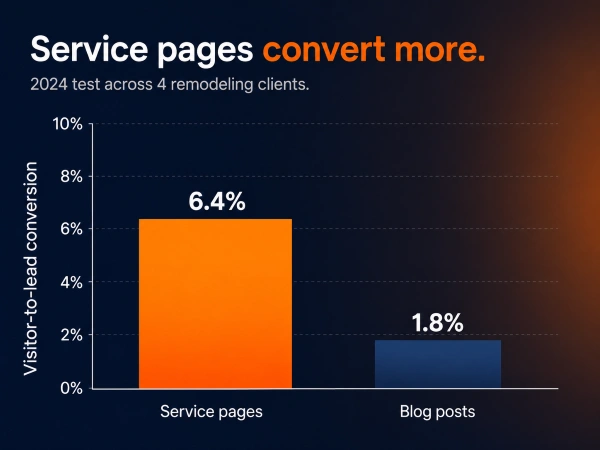
Build service pages first. In a 2024 test across four of our clients, service pages converted visitors at 6.4% while blog posts converted at 1.8%. The blog posts ranked faster, an average of 47 days to page one against 68 for service pages, but they brought in researchers instead of buyers.
So we deploy service pages in the first three months to catch homeowners who are ready to hire, then add content that feeds your service pages from month four to build authority and answer research-stage questions. Blog content has a real job. That job is feeding the pages that book work, not standing in for them.
How long until your keywords rank in 2026?
Faster than most agencies will tell you. We see keywords enter the top 50 in 30 to 60 days, and the first page-one rankings for long-tail terms in 60 to 90 days. Entry into the Google map results for a primary city term takes 90 to 180 days, mostly depending on how many reviews you have.
The “SEO takes twelve months before anything happens” line is how a lot of agencies buy themselves a year of billing. It holds only if you define results as ranking number one for the hardest term in a huge metro. For the long-tail phrases that actually book jobs, movement comes much sooner. If you need leads while the rankings build, you run Google Ads while SEO builds and let organic replace that ad spend over time.
The tools we use, and the numbers to distrust
A remodeler needs one keyword tool and one source of truth, and they are not the same thing. We run research in Ahrefs, cross-check it against Google Keyword Planner, then treat Google Search Console as the source of truth once a site has traffic, because it shows the phrases you already rank for and the ones you sit just below.
Every keyword tool guesses at search volume. Only Google knows the real number. Two tools will show the same phrase at 40 and at 10, so use the figures to compare phrases against each other, not as promises. Demand also moves with the seasons. Kitchen planning searches climb through the winter as homeowners get ready for spring work, and we track those peaks across all 2,400 terms in our database so a client is not rattled when December dips. Harvard’s Joint Center for Housing Studies publishes remodeling market spending data that lines up with what we see in search.
Common remodeling keywords by service
The highest-intent remodeling keywords pair a service with a place. Here are the ones worth building pages around first. Add your city to each.
| Keyword (add your city) | Searches per month | What the searcher wants |
|---|---|---|
| kitchen remodeler near me | 22,400 | ready to hire |
| kitchen and bath remodeling | 9,900 | ready to hire |
| remodeling contractor near me | 9,900 | ready to hire |
| home remodeling services | 1,800 | comparing options |
| room additions | 810 | researching |
| how much does a kitchen remodel cost | 410 | researching, easy to rank |
| garage conversion cost | 320 | researching, niche and high-close |
Kitchen and bathroom terms carry the most demand and the most competition. The cost questions are your easy entry points. Niche services like garage conversions show small numbers but close at high rates, because the homeowner searching them already knows what they want.
Where to start this week
Pick your three top services. Add every city you serve. Pull volume and difficulty for each phrase, tag the intent, and map every keyword to one page. Start with the easy question terms to get leads moving, then climb toward the harder head terms once you have earned some ground. Done right, keyword research for remodelers wastes nothing and points every page at a homeowner who is ready to hire. If you would rather have it built for you by an agency built only for remodelers, that is the work we do.
Frequently asked questions
What is keyword research for remodelers?
It means finding the phrases homeowners type when they want a remodel, then matching each one to a page on your site. For a remodeling company, the goal is booked estimates from homeowners in your area who are ready to hire, not raw traffic.
What keywords should a remodeling company target first?
Start with your top three services plus every city you serve, like “kitchen remodeler near me” at 22,400 searches a month or “bathroom remodeler in [city].” Then add long-tail question terms such as “how much does a kitchen remodel cost,” which is far easier to rank for than the head term.
Can I do keyword research for remodelers myself?
Yes, for a starter list. Pick your top services, add your cities, and pull volume and difficulty in a free tool. Owners tend to get stuck on tagging intent and mapping each term to the right page, which is the part that turns a list into leads. Most hand it off once the site work begins.
How long does it take for a remodeler’s keywords to rank?
In most markets, keywords enter the top 50 in 30 to 60 days and reach page one for long-tail terms in 60 to 90 days. Entry into the Google map results for a primary city term takes 90 to 180 days, depending on your review count and local competition.
Are “near me” keywords worth it for remodelers?
Yes. “Remodeling contractor near me” pulls 9,900 searches a month from buyers ready to hire. Google shows results based on the searcher’s location, so you only rank when your Google Business Profile and city pages are strong. Pair every “near me” term with a named-city page.
Should remodelers write blog posts or service pages first?
Service pages first. In a 2024 test across four of our clients, service pages converted at 6.4% while blog posts converted at 1.8%. Build service pages first to catch ready-to-hire searches, then add blog content to support them and build authority.
How much does keyword research cost for a remodeler?
On its own, keyword research is usually part of a broader SEO engagement rather than a line item. We fold it into month-to-month management that runs $3,500 to $5,000 depending on market competition. Pricing varies by market and scope, so contact us for a custom quote.