

A Google Business Profile is the free listing that puts your remodeling company in the map results when a homeowner searches something like “kitchen remodeler near me.” For most remodelers, it’s the first thing a homeowner sees, ahead of your website and ahead of your reviews anywhere else. Set up right, a Google Business Profile for remodelers brings in calls at no cost per lead. Left half-built, it hands those calls to whoever ranks above you. This guide covers the setup, the category and review choices that move your rank in 2026, how to pass Google’s video verification, and the one business-name habit that gets remodeler profiles suspended.
Google Business Profile optimization for remodelers means setting your primary category, service area, services, photos, and reviews so Google matches your listing to local remodeling searches. The goal is the Map Pack: the top three local results that sit above the blue links and collect most of the clicks. Everything below is how you get there.

Why a Google Business Profile matters for remodelers in 2026
Your profile decides whether you show up the moment a homeowner is ready to hire. Google ranks local listings on three things, and BrightLocal’s breakdown of the local algorithm names them plainly: relevance (does your profile match the search), distance (how close you are to the searcher), and prominence (reviews, activity, and links). Two of those three live inside your Business Profile. Your website barely touches them.
That’s why a remodeler with a plain website and a strong profile often beats a competitor with the reverse. A homeowner searching “bathroom remodel” plus a city name sees three map listings before anything else. Miss that box and you’re fighting for the scraps underneath it.
Most remodeler profiles are half-finished: no services listed, six photos, a dozen reviews, the wrong category. That’s not a problem. It’s an opening. The bar in this trade is low, and a fully built profile clears it fast. Plenty of owners still ask whether local search is worth the effort, and for anyone taking remodeling calls in a set area it is, which is also who local search helps most. It fits where search is heading, too.
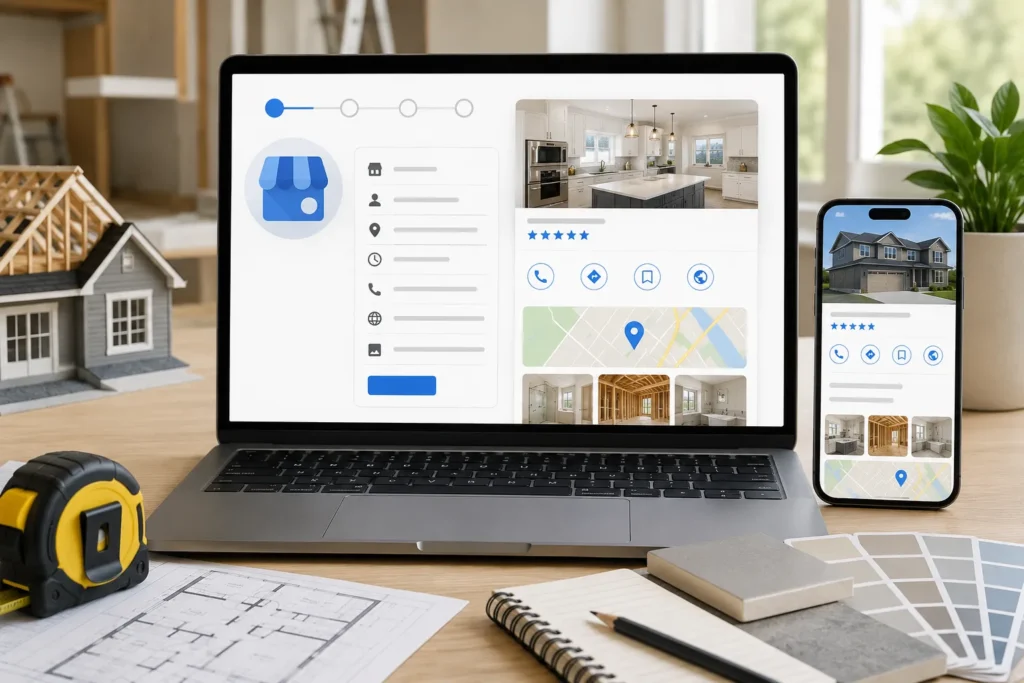
How do you set up a Google Business Profile for a remodeling company?
Claim the profile first, then build it. Go to business.google.com, search your business name, and either claim the existing listing or create one. You can’t rank a profile you don’t control, and you can’t control it until Google confirms you’re the owner. For a lot of remodelers in 2026, that confirmation now means video.
Should remodelers show or hide their address?
Most remodelers should hide the address and set up as a service-area business. You work at the homeowner’s house, not at a storefront they visit. Google lets you list up to 20 service areas by city, county, or zip and keep your home address private. Pick the towns where you actually take jobs, not a 90-mile wish list. A tight, honest service area reads as more relevant to Google than a bloated one.
There’s a real tension here worth naming. Distance to the searcher is a ranking factor, and a hidden address gives Google less to anchor you to. You can’t fake proximity. What you can do is define your service areas precisely, keep your city named across your website and citations, and win on the two levers you do control: category and reviews. That consistency is why keeping your listings consistent across directories pays off.
Passing video verification (the step nobody warns you about)
Google now asks many service-area remodelers to verify with a video, and it trips up more setups than anything else. Per Google’s video verification guidance, you record one continuous clip, at least 30 seconds, on your phone, with no cuts and no edits. You’ll need to show three things: that the location is real, that the business is yours, and that you’re standing in it.
For a home-based remodeler, that means filming street signs or landmarks near your address (skip the empty lot with no markers), then your proof of work: branded truck, tools, business cards, a shirt with your logo. Google reviews the footage and usually replies within five business days. Film it once, film it steady, and have your license and a branded item ready before you hit record. Most rejections come from stitched clips or a video that shows a house but nothing tying it to your company.
Which category should a remodeler choose?
Pick the single category that matches the work you most want to be hired for, then add the rest as secondary. Your primary category is the strongest relevance signal on the whole profile, so a bathroom specialist listed as “General Contractor” is telling Google the wrong thing. Google carries specific remodeling categories. Use them.
Here’s a straight decision rule by what you do most:
| If most of your revenue is | Primary category | Add as secondary |
|---|---|---|
| Kitchens | Kitchen Remodeler | Bathroom Remodeler, Remodeler, Cabinet Maker, Countertop Installer |
| Bathrooms | Bathroom Remodeler | Kitchen Remodeler, Remodeler, Tile Contractor |
| Whole-home or additions | Remodeler or General Contractor | Kitchen Remodeler, Bathroom Remodeler, Home Builder |
| Design-build | Remodeler | Interior Designer, General Contractor, Kitchen Remodeler |
Don’t stuff every category you half-qualify for. Each secondary category should be work you actually do, or you’ll show up for searches you can’t serve and burn clicks. If you’re torn between two primaries, pick the one with the highest-value jobs, not the widest reach. A remodeler ranking for kitchens at $40,000 a job beats one ranking for “handyman.”

Photos that turn into remodeling leads
Homeowners hire with their eyes, so your photos do more selling than your description. Google has reported that profiles with photos get 42% more requests for directions and 35% more clicks to their website than profiles without. For a remodeler, that’s not vanity. It’s a homeowner deciding whether your finished kitchens look like the one they want.
Post real project work: completed kitchens and baths, wide shots and detail shots, your crew on site, your branded truck. Add a few every week, not 40 in one dump and then silence. Fresh photos signal an active business.
One warning on before-and-after shots. An unlabeled “before” photo of a torn-up, dated kitchen can rank high on your profile and give a homeowner the wrong first impression of your work. Label them, or pair the before and after into a single image so nobody mistakes the demo for the finished job.

How many reviews does a remodeler need?
Enough to look established, coming in steadily, answered every time. There’s no magic number, but the pattern matters more than the total. BrightLocal’s Local Consumer Review Survey found 83% of consumers use Google to read reviews, and most read several before they’ll trust a business. A remodeler with 60 recent reviews and steady new ones will usually out-convert one sitting on 200 that all stopped two years ago.
Review velocity beats review count. Two new reviews a month, every month, tells Google you’re active and tells homeowners you’re still doing good work. A pile of reviews from 2023 does neither. Build a simple habit: at the final walkthrough, when the homeowner is happiest, ask in person and follow up with a text that carries your direct review link. One reminder if they forget. Then stop.
Answer every review, good or bad. A calm, specific reply to a one-star review builds more trust with the next reader than a wall of five stars with no owner in sight, and it’s part of how Google weighs trust. Never trade discounts or gift cards for reviews. It violates Google’s policy and it’s the kind of thing that gets a profile flagged.
The business-name mistake that gets remodelers suspended
Your Google Business Profile name has to be your real business name, nothing more. This is the trap: your competitors think adding keywords to the name helps them rank, and for a while it can. It’s also the fastest way to get suspended. Google’s guidelines for representing your business are blunt about it. No taglines, no city, no service keywords, no “Best” or “#1” bolted onto the name.
So “Summit Kitchen & Bath Remodeling | Denver’s #1 Kitchen Pros” isn’t clever. It’s a violation. Google has suspended profiles for exactly this, and when a listing gets pulled, every review and photo goes with it. A real estate agent lost their profile for adding “realtor” to the name and had to strip it before Google would restore the listing. Use the name on your truck, your license, and your invoices. Win relevance through your category and your reviews, where it’s allowed, instead of through a name you can lose everything over.

Google Posts, services, and the Q&A section
These three fill out your profile and help you convert, but keep your expectations straight about what each one does. Posts help the people who already found you decide to call. They aren’t what pulls you into the Map Pack; your category, proximity, and reviews do that. Post a recent project or a seasonal note every week or two, add a photo and a call button, and move on. Don’t treat posting as your ranking strategy.
Your services section is different, and it’s underused. List every service with a short, plain description: full kitchen remodel, bathroom renovation, tub-to-shower conversion, home addition, aging-in-place updates. Each one gives Google another term to match you against. Write them the way a homeowner would search, not in trade jargon.
The Q&A section is public, and anyone can answer it, which is exactly why you should seed it yourself. Post the five questions homeowners actually ask, then answer them: Do you offer free estimates? What areas do you serve? Are you licensed and insured? How long does a bathroom remodel take? Do you offer financing? You control the answer, and you save the homeowner a phone call to find out.
How do you track leads from your Google Business Profile?
Tag the website link on your profile so you can see the traffic and calls it drives, without breaking anything Google checks. Two moves do it. Add UTM parameters to the website URL on your profile (something like ?utm_source=google&utm_medium=gbp) so those visits show up as a clean source in your analytics. And if you want call tracking, keep your real business number as the primary phone (Google cross-checks it against your website and citations) and use a tracking number only in the secondary slot, so your name, address, and phone stay consistent everywhere.
Then watch the profile’s own performance panel: calls, direction requests, website clicks, and the searches that found you. If calls dip, look at review velocity and photos first. Those are the levers that usually moved. This is where a profile connects to the rest of your marketing and starts turning rankings into booked jobs.
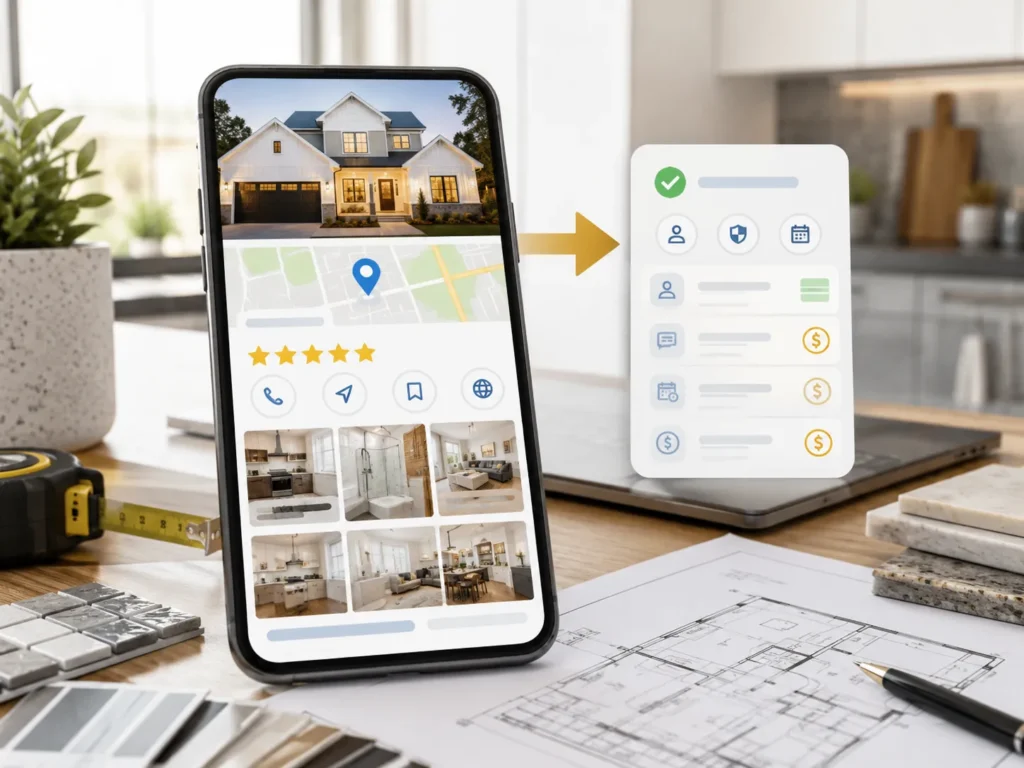
Google Business Profile vs Local Services Ads: which comes first?
They’re different tools, and remodelers mix them up. Your Business Profile is the free organic listing in the Map Pack. Local Services Ads are paid, sit at the very top with a “Google Guaranteed” badge, and charge you per lead. Here’s the honest comparison, and it mirrors how paid search compares to organic in general:
| Google Business Profile | Local Services Ads | |
|---|---|---|
| Cost | Free | Pay per lead |
| Position | Map Pack, below the ads | Very top of results |
| Setup | Claim and build | Background and license check, then Google Guaranteed badge |
| Speed | Weeks to months to rank | Leads as soon as you’re approved |
| Best for | Long-term, compounding calls | Filling the pipeline now, while organic builds |
Start with the profile, because it’s free and it compounds. Layer Local Services Ads on top if you need leads faster than your organic ranking is climbing. One rents you leads; the other builds an asset you keep.
How a Google Business Profile for remodelers shows up in Google’s AI answers
Google’s AI answers now pull local businesses straight from Business Profile data, so the same things that rank you also get you named in the AI response. When a homeowner asks an AI assistant for a “kitchen remodeler in [city],” it leans on categories, reviews, and how completely your profile answers common questions. A thin profile has nothing for the model to surface. This is a big reason what shows up in AI answers now matters, and why the rise of zero-click results is reshaping local search.
This is why the seeded Q&A, the detailed services, and reviews that mention the actual work (“they redid our primary bath”) matter more every month. They give the AI clean, specific text to quote. Structured, well-answered profiles are becoming the ones that get cited, the same way they became the ones that ranked, which is part of how structured data helps engines read your business.

What actually moves your rank (and what doesn’t)
If you only have an hour a week, spend it in this order. Category and a complete profile come first, because relevance is the foundation. Reviews come second, steady and answered, because prominence is where most remodelers are weak. Photos third. Everything else, posts included, is maintenance, not the engine.
Editor note (remove before publishing): Drop one real cross-client number here once it’s ready, for example the share of a remodeler’s inbound calls that come from Maps versus organic search, or average monthly calls before and after a full profile build. That single line would be the only first-party data point in this search result, and no competitor can copy it. Until it’s filled, this section runs on the framework above, not on invented figures.
A profile that’s fully built out, kept active, and backed by steady reviews will beat the half-finished listings around it. That’s most of your local competition. The remodeler who spends 30 minutes a week here, while the others forget the profile exists, is the one Google keeps showing.
How long until a Google Business Profile brings in leads?
Plan on weeks to a few months. Verification and a complete build can start producing calls quickly in a low-competition city, while ranking in a crowded metro takes longer and leans heavily on review velocity. If you need leads sooner, run Local Services Ads while your profile climbs.
If you’d rather hand the whole system to a team that does this for remodelers, that’s what we build for home remodeling companies every day. A well-run Google Business Profile for remodelers is the cheapest, most durable lead source you’ll ever own, and in 2026 it’s the difference between showing up when a homeowner is ready to hire and watching the job go to the contractor who did the 30 minutes of work you didn’t.
Frequently asked questions
Is a Google Business Profile free for remodelers?
Yes. Creating, claiming, and building your Google Business Profile costs nothing. You only pay if you separately run Local Services Ads or Google Ads, which are different products. The organic Map Pack listing itself is free.
What’s the best Google Business Profile category for a remodeler?
Choose the category that matches your highest-value work as primary: Kitchen Remodeler, Bathroom Remodeler, or Remodeler. Add the others as secondary categories. Your primary category is the single strongest relevance signal, so match it to the jobs you most want, not the broadest label like General Contractor.
Should a remodeler hide their business address?
Usually yes. Most remodelers are service-area businesses that work at the client’s home, so you can hide the address and list up to 20 service areas instead. Keep your service areas realistic and your city consistent across your website and citations.
How do I pass Google’s video verification as a home-based remodeler?
Record one continuous clip of at least 30 seconds with no edits. Show street signs or landmarks near your address, then proof the business is yours: branded truck, tools, business cards, or logo apparel. Google usually responds within five business days.
How many Google reviews does a remodeling company need to rank?
There’s no fixed number, but steady, recent, answered reviews matter more than a high total. BrightLocal reports 83% of consumers read reviews on Google, and most read several before trusting a business. Aim for a couple of new reviews a month and respond to every one.
Can I add my city or services to my business name to rank better?
No. Google’s guidelines only allow your real business name. Adding keywords, a city, or #1 can get your profile suspended, and a suspension takes your reviews and photos with it. Earn relevance through your category and reviews instead.