
Entity SEO Vs Semantic SEO: What’s Different In 2026
Google doesn’t match keywords anymore. It reads meaning. And in 2026, two overlapping strategies sit at the center of how that works: entity SEO and semantic SEO.
Entity SEO and semantic SEO are two optimization methods that help search engines understand your content on a deeper level. Entity SEO focuses on identifying and defining specific “things” (people, brands, places, products) so Google’s Knowledge Graph can connect them. Semantic SEO takes a broader view, optimizing for meaning, context, and user intent across an entire topic. Both are critical for ranking in traditional search results and earning citations in AI and the future of search.
Most SEO guides talk about these two ideas like they’re interchangeable. They’re not. And confusing them leads to wasted budgets and half-built strategies. I’ve seen businesses dump six months into “entity optimization” that was really just basic schema markup on a thin site. No Knowledge Graph presence. No AI citations. Nothing.
Let me break down what each one actually does, where they overlap, and how to use both.

What Is Entity SEO?
Entity SEO is the practice of optimizing your content around identifiable, defined things rather than keywords. An entity can be a person, a company, a product, a city, or a concept. Google already catalogs millions of entities in its Knowledge Graph, and your job is to make sure your brand and your content are recognized as part of that system.
HubSpot’s entity SEO breakdown from December 2025 put it clearly: entity-based SEO optimizes around concepts, relationships, and context so Google’s Knowledge Graph can connect your content for both traditional and AI-driven search.
This isn’t just about slapping Organization schema on your homepage. Real entity SEO means Google can look at your brand and confirm it with external sources like Wikidata, industry directories, and consistent citations across the web. Without that external corroboration, your structured data is just a suggestion.
Here’s what trips up a lot of people. They add schema markup, see no change, and assume entity SEO doesn’t work. The problem? Schema tells Google what you claim to be. Entity SEO requires Google to verify that claim through outside sources.
Why Does Entity SEO Matter for Your Rankings?
Sites with strong entity signals show up in knowledge panels, featured snippets and rankings, and (this is the big one in 2026) AI Overviews. Some industry data suggests pages with clear entity definitions are significantly more likely to get cited in AI-generated search results.
For brands, becoming a recognized entity builds trust signals that influence rankings beyond any single page. Your entity presence follows you across every piece of content on your domain.
But there’s a trade-off. Entity SEO requires investment in off-page consistency. Your name, attributes, and relationships need to match everywhere Google looks. For businesses in competitive urban markets, that disambiguation work is more demanding. A plumber in Phoenix has an easier path than a marketing consultant in Manhattan.
How Do You Actually Do Entity SEO?
- Add structured data markup (Organization, Person, Product schemas) with accurate attributes and relationships
- Build consistent citations across external platforms, directories, and Wikidata
- Create content that defines and reinforces your entity’s attributes and connections to related entities
- Audit for entity ambiguity, making sure Google doesn’t confuse your brand with another. Fixing on-page SEO problems like duplicate schema or conflicting markup is part of this.
Tools like InLinks can help automate entity identification and internal linking. But automated outputs often fail the verification test. Manual review still matters.
What Is Semantic SEO?
Semantic SEO optimizes content for meaning and context rather than individual keywords. Instead of targeting one phrase per page, you build content that covers an entire topic with enough depth that search engines understand your expertise on the subject. The role of content in SEO has shifted from keyword placement to topical coverage.
An Ahrefs analysis on semantic SEO from April 2025 made a blunt argument: everything people call “advanced SEO,” “entity SEO,” or “GEO” is really just semantic SEO done properly. There’s truth in that. Entity work is one piece of the semantic puzzle.
The shift started with Google’s Hummingbird update in 2013 and accelerated through BERT in 2019 and MUM in 2021. Each update moved Google further from matching keyword strings toward understanding the topics and relationships behind a search query.

How Is Semantic SEO Different from Keyword-Based SEO?
Old-school SEO: find a keyword, write a page, stuff the phrase in 15 times. That worked in 2012.
Semantic SEO: identify a topic, map every question and subtopic around it, create interconnected content that covers the full scope. Google rewards that topical depth with rankings across dozens of related queries, not just one.
According to Search Logistics data from March 2026, 49% of marketers say organic search delivers the best ROI among all channels. The businesses earning that ROI aren’t doing it with single-keyword pages. They’re building semantic content clusters.
One myth that keeps circulating: “semantic SEO means using LSI keywords and synonyms.” Wrong. Google doesn’t use Latent Semantic Indexing. It uses natural language processing, transformer models like BERT and MUM, and Knowledge Graph connections. Search Engine Land’s semantic guide breaks down how these systems actually process meaning. Synonym stuffing is not semantic SEO.
Entity SEO vs Semantic SEO: Where They Split
| Aspect | Entity SEO | Semantic SEO |
| Focus | Specific identifiable things and their relationships | Broader meaning, context, and user intent |
| Primary Tactics | Schema markup, Knowledge Graph alignment, external citations | Content clusters, intent mapping, topical depth |
| Structured Data | Heavy reliance for defining entities | Supportive role, not the main driver |
| Goal | Make your brand a verified node in Google’s graph | Help engines understand the full meaning of your content |
| Best For | Brand visibility, AI citations, rich results | Ranking across related queries, topical authority |
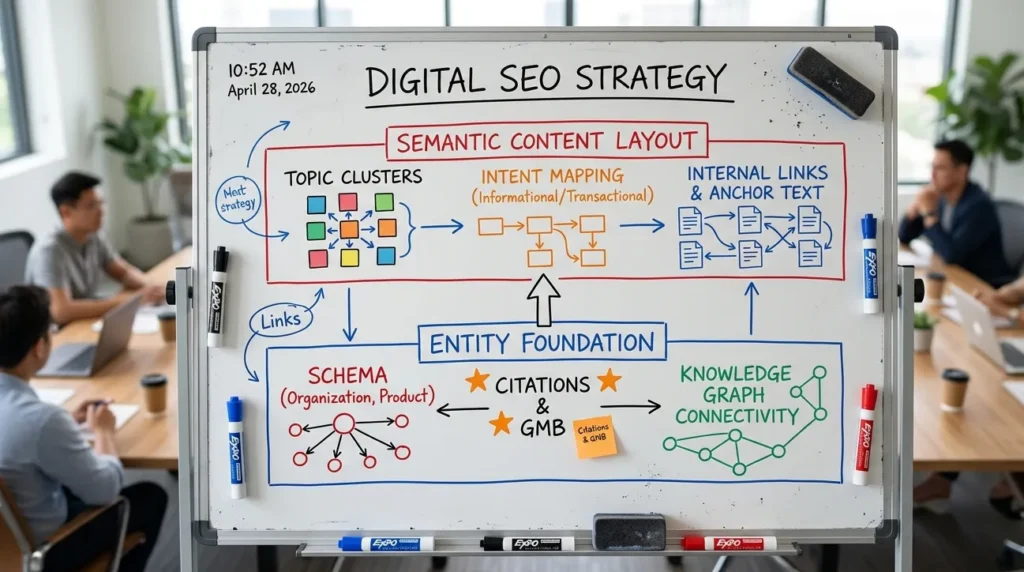
The two aren’t competing strategies. Entity SEO without semantic context is shallow. Semantic SEO without entity clarity is vague. You need both working together.
How to Use Entity SEO and Semantic SEO Together in 2026
Start with your entity foundation. Define who you are, what you do, and where you operate through structured data and external citations. Then build semantic depth around your core topics.
A practical example: if you run a roofing company, your entity work defines your business (schema, Wikidata, directory citations). Your semantic work creates a content cluster covering roof replacement costs, materials, permits, insurance claims, and seasonal timing. Each piece of content reinforces your topical authority and strengthens your entity signals.
Internal linking between these content pieces builds topical clusters that both traditional rankings and AI systems recognize as authoritative. And yes, backlinks still matter for entity verification too. The global SEO services market hit roughly $84 billion in 2026 according to Mordor Intelligence, and the businesses winning share of that market are the ones connecting entity clarity with semantic depth.
Don’t treat this as a one-time project. Entity consistency needs ongoing maintenance. Schema updates, citation audits, and new content additions should happen quarterly at minimum. I’ve watched sites lose Knowledge Graph presence after letting structured data go stale for six months.
The real question isn’t “entity SEO or semantic SEO?” It’s “how well are you doing both?” If you’re not sure where your site stands, Eclipse Marketing’s SEO services can help you audit both your entity presence and semantic depth.
FAQs
How is entity SEO different from semantic SEO?
Entity SEO targets specific identifiable things (brands, people, products, places) and defines their relationships through structured data and Knowledge Graph alignment. Semantic SEO covers broader meaning, user intent, and topical depth across your content. Entity optimization is one component within a larger semantic strategy. According to a 2026 ClickRank analysis, entity SEO focuses on defined entities and explicit relationships while semantic SEO encompasses overall meaning and intent.
Is entity SEO the same as adding schema markup?
No. Schema markup tells Google what you claim to be. True entity SEO requires external verification through consistent citations on Wikidata, industry directories, and other authoritative platforms. Many businesses add schema and call it done. Without off-page corroboration, that markup is just a suggestion Google may ignore.
Does semantic SEO mean using synonyms and LSI keywords?
Absolutely not. Google doesn’t use Latent Semantic Indexing. Semantic SEO focuses on topical depth, user intent, and content relationships using natural language processing and transformer models like BERT and MUM. Synonym stuffing is an outdated tactic that misrepresents how modern search engines work.
How does entity SEO help with AI search results in 2026?
Clear entity definitions and verified relationships increase your chances of being cited in Google AI Overviews, ChatGPT, and Perplexity responses. AI retrieval systems pull from content with specific, verifiable entity declarations. Industry data suggests pages with strong entity signals see meaningfully higher citation rates in AI-generated results.
Can small businesses benefit from entity SEO and semantic SEO?
Yes. A local service business can build entity authority through consistent schema, Google Business Profile optimization, and directory citations, then layer semantic depth through content covering related customer questions. Businesses in lower-competition markets often see faster results from basic entity work, though AI visibility gains require deeper investment.
What tools work best for entity SEO?
InLinks handles automated entity identification and internal linking. Google’s own Structured Data Testing Tool validates your schema markup. Wikidata and Wikipedia provide external entity corroboration. For semantic analysis, SEMrush and SurferSEO offer topical mapping and content gap features.
How long before entity SEO and semantic SEO show results?
Budget-tier implementations (basic schema and light content) can show movement in 3-6 months. Full entity Knowledge Graph strategies paired with deep semantic content clusters typically take 6-12 months for significant gains. The SEO services market reached roughly $84 billion in 2026 according to Mordor Intelligence, and the firms driving that growth invest in sustained, long-term entity and semantic work.

Michael Vale has over 5 years of experience helping clients improve their business visibility on Google. He combines his love for teaching with his entrepreneurial spirit to develop innovative marketing strategies. Inspired by the big AI wave of 2023, Michael Vale now focuses on staying updated with the latest AI tools and techniques. He is committed to using these advancements to deliver great results for his clients, keeping them ahead in the competitive online market.