
Keyword Vs Entity In SEO And What Actually Changed In 2026
Google stopped matching words years ago. Most SEOs haven’t caught up.
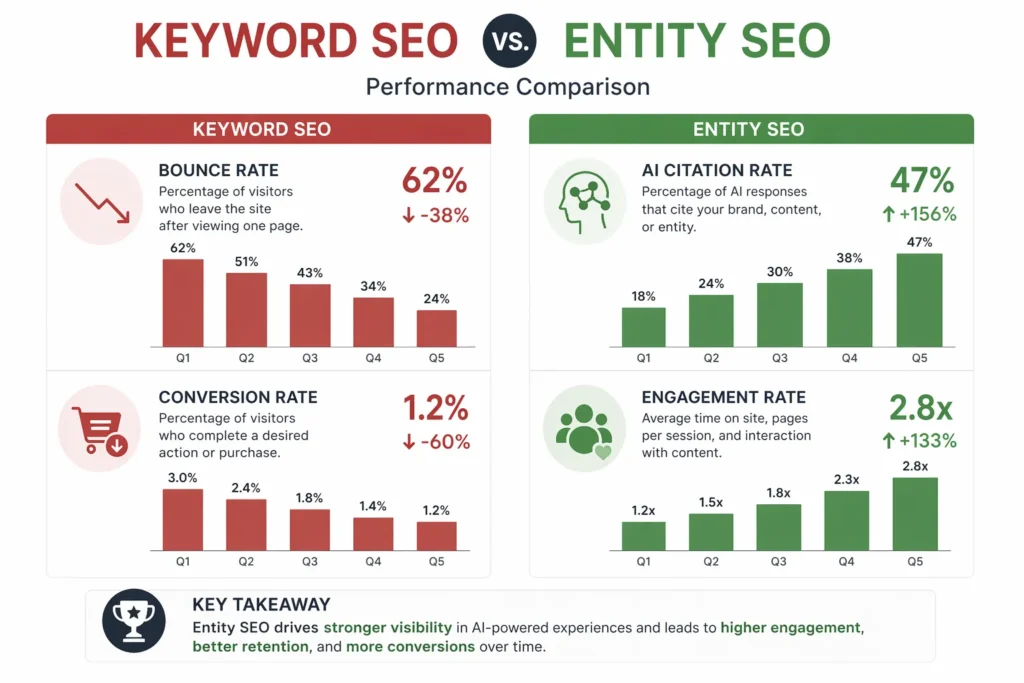
A keyword is a text string someone types into a search bar. An entity is a real-world concept (a person, place, brand, or idea) that Google stores in its Knowledge Graph with properties, relationships, and context attached. Keywords tell Google what words appear on your page. Entities tell Google what your page is actually about. And a 2024 Backlinko study of 320 websites found that pages built around entities instead of keyword density saw 14% higher conversion rates, 19% more time on page, and 28% lower bounce rates. That gap is only widening.
The distinction matters because over 58% of Google searches now end without a click, according to Similarweb data. We’ve rebuilt every Eclipse Marketing client strategy around this reality. If your content strategy still revolves around stuffing target phrases into H2s and hoping for the best, you’re optimizing for a version of Google that doesn’t exist anymore.

What Is a Keyword in SEO and How Has It Changed?
A keyword is any word or phrase a user types into a search engine. “Plumber near me.” “Best CRM software.” “How to fix a leaky faucet.” Those are all keywords.
For about 15 years, keywords ran the entire SEO game. You found a phrase with volume, you jammed it into your title tag, your H1, your first paragraph, your meta description, and a few subheadings. Google’s early algorithms were basically pattern-matchers. If the words on your page matched the words in the query, you had a shot at ranking.
That model broke for a reason. People gamed it. I’ve seen pages rank for “best dentist in Denver” that were barely about dentistry. Just keyword-stuffed walls of text with zero useful information. Google’s quality ratcheted down hard after Hummingbird in 2013, and every major update since has moved further from raw text matching toward understanding meaning.
Keywords still matter. You still need to understand primary keywords in SEO and the phrases your audience uses. But a keyword by itself is just a string of characters. It has no context, no relationships, no meaning beyond the letters on screen. Google processes roughly 8.5 billion searches per day. It can’t afford to treat those searches as simple string-matching problems.
What Is an Entity and Why Does Google Care?
An entity is any distinct, identifiable concept that exists independently of language. Google defines it as “a thing or concept that is singular, unique, well-defined, and distinguishable.” Unlike a keyword, an entity doesn’t change based on what language you search in.
The word “Tesla” could mean Nikola Tesla, the inventor, Tesla Inc., the car company, or Tesla the band. Those are three separate entities. Google assigns each one a unique identifier in its Knowledge Graph (which now holds over 500 billion facts about 5 billion entities, according to Google’s own documentation). The surrounding context on your page, things like mentions of “Model 3,” “electric vehicle,” and “Elon Musk,” tells Google which entity you mean.
This is where things get practical. Google’s 2015 patent, “Ranking Search Results Based on Entity Metrics,” laid out four scoring factors for entities: relatedness (how often entities co-occur), notability (how important an entity is within its category), contribution (how much an entity adds to a topic), and prize (the value of the entity’s associations). Those signals shape ranking decisions today, including how Google selects sources for featured snippets and ranking positions. Dixon Jones, CEO at Inlinks, explained in a Search Engine Journal feature on entities in SEO that they primarily disambiguate ideas rather than directly rank pages. But that disambiguation is what allows Google to connect your page to the right queries, even queries you never explicitly targeted.
How Does Keyword-Based Search Differ from Entity-Based Search?
Keyword search matches strings. Entity search matches concepts. That one difference changes everything about how Google picks winners.
| Keyword-Based SEO | Entity-Based SEO | |
| What Google sees | Text strings on a page | Concepts with attributes and relationships |
| Optimization focus | Density, placement, variations | Salience, schema markup, topic clusters |
| Handles ambiguity | Poorly; “jaguar” returns mixed results | Well; surrounding context resolves meaning |
| AI citation rate | Lower | 3x higher (BrightEdge, 2025) |
| Performance | +28% bounce rate vs entity-first pages | Lower bounce, higher time-on-page, better conversions |
| Resilience to updates | Fragile; vulnerable to core updates | Durable; rewards deepen over time |
Search “iPhone battery replacement” using a keyword lens, and Google hunts for pages containing those exact words. Search the same phrase through an entity lens, and Google understands you want repair information for a specific Apple product, then connects you to official support pages, authorized repair locations, and detailed guides, even if those pages never use the phrase “iPhone battery replacement” verbatim.
BrightEdge research on structured data attribution found that authoritative entity-focused content is three times more likely to be cited in AI-generated responses than pages targeting keywords alone. With AI Overviews now appearing in over half of search results, that citation gap translates directly into visibility. The difference between keyword-only and entity-first shows up across both on-page and off-page SEO signals.

How Does Google’s Semantic Search Connect Keywords and Entities?
Google’s semantic search layer acts as the bridge. It takes the keyword a user types, identifies the entities involved, maps those entities to its Knowledge Graph, and returns results based on conceptual relevance, not just text overlap.
If you search “restaurants near the Louvre,” Google doesn’t scan for pages containing those four words. It recognizes “Louvre” as a museum entity located in the 1st arrondissement of Paris, then surfaces dining options within that geographic radius. The keyword triggered the search. The entity resolved the intent.
Google’s NLP API entity analysis tool scores entity salience on a scale from 0 to 1. That score measures how central a concept is to a piece of content. A page where “email marketing” appears once in passing might score 0.05 salience. A page built entirely around email marketing strategy, with related entities like “automation,” “segmentation,” and “deliverability” woven throughout, might score 0.85. That salience score influences how confidently Google associates your page with that entity.
I’ve watched sites lose 30-40% of organic traffic after core updates because their content was built on keyword repetition with low entity salience. The pages mentioned the right words but didn’t demonstrate real topical depth. Google’s March 2026 core update hit these pages especially hard.

Why Should You Focus on Entities Instead of Just Keywords?
Because that’s how Google’s ranking system actually works now. And most content still doesn’t reflect that.
Entity-focused content ranks for more queries with less effort. Write a thorough page about the entity “content marketing,” and you’ll naturally cover related concepts: editorial calendars, distribution channels, content audits, and performance metrics. Google sees those entity relationships and ranks you for dozens of related searches you never individually targeted.
SEMrush’s December 2025 guide on entity-based SEO strategy found that these approaches support better recognition by large language models. Their AI Visibility Toolkit now tracks how often content gets cited in AI responses. Dawn Anderson, a respected SEO researcher, said it plainly: entity-based optimization is the foundation of effective SEO in 2026.
The most expensive mistake I see? Building isolated keyword-targeted pages without entity relationships or schema markup, then watching traffic crater when a core update rolls through. Those pages look optimized on the surface. But they’re missing the connective tissue that Google and AI systems look for when deciding what deserves to rank and what deserves to be cited.
Small sites get hit hardest. If you don’t have a massive backlink profile propping you up, entity authority is the clearest path to competing with bigger domains. As AI reshapes the future of search, that advantage will only compound.
How Do You Optimize Content for Both Keywords and Entities in 2026?
You don’t pick one. You use keywords as entry points and entities as the structural foundation.
Step 1: Start with entity mapping, not keyword lists. Before you write anything, identify the core entities in your topic and their relationships. Tools like Google’s Natural Language API, InLinks, and TextRazor show you which entities Google associates with your subject. If you’re writing about “digital marketing,” your entity map should include social media platforms, analytics tools, advertising networks, and measurement frameworks.
Step 2: Build topic clusters around entities. Each pillar page should cover a core entity thoroughly. Supporting pages should cover related entities with clear internal links connecting them, reinforcing content’s role in SEO across the full topic. This builds the topical authority signal that both traditional search and AI systems use when evaluating your site.
Step 3: Add schema markup. Use “about” and “mentions” properties to explicitly tell Google which entities your content covers. Schema doesn’t replace good writing, but it removes ambiguity. Ignoring it is one of the most common technical SEO problems we find in audits. A page with proper Organization, Product, or Article schema gets processed faster and more accurately by Knowledge Graph indexing.
Step 4: Write for salience, not density. Forget counting keyword occurrences. Focus on making your primary entity the most prominent concept on the page. Use related entities naturally throughout. If you removed every mention of your target keyword and Google could still tell what the page is about from context alone, you’ve nailed entity optimization.
Keywords aren’t dead. They’re the language your audience uses. But entities are the concepts Google understands. The sites winning right now use both: keywords to match how people search, and entities to match how search engines think.
FAQs
Is keyword density still important for SEO in 2026?
No. Entity salience has replaced density as the more reliable signal. A 2024 Backlinko study of 320 websites found that keyword-density-focused pages had 28% higher bounce rates than entity-first pages. Google’s Natural Language API now scores entity salience on a 0-to-1 scale, measuring how central a concept is to your content. Writing naturally around a topic with related entities performs better than hitting an arbitrary keyword count.
How do entities differ from keywords in Google’s ranking system?
Keywords are text strings, the actual characters someone types into a search bar. Entities are unique concepts stored in Google’s Knowledge Graph with properties, relationships, and context attached. Google uses entity identifiers (not words) internally. The keyword “Tesla” is ambiguous. The entity “Tesla Inc.” (KGMID: /g/11bc5btn0c) is specific. Google resolves which entity you mean using surrounding context on your page.
Can entity SEO help with AI Overviews and zero-click searches?
Yes, and this is becoming the primary reason to invest in entity optimization. BrightEdge research found that entity-focused content is three times more likely to be cited in AI-generated responses. With Similarweb data showing over 58% of searches ending without a click, getting cited inside AI Overviews may matter more than traditional ranking positions for many queries.
What is entity salience and why does it matter?
Entity salience measures how central and prominent a concept is within a piece of content. Google’s NLP API assigns a score from 0 to 1. A page that mentions “content marketing” once in passing might score 0.05, while a page built around that topic might score 0.85. Higher salience tells Google your page is genuinely about that entity, not just mentioning it. Low salience pages tend to lose visibility during core algorithm updates.
Do I still need keyword research if I’m doing entity SEO?
Absolutely. Keywords and entities serve different functions. Keywords reveal how your audience phrases their searches, the actual language they use. Entities provide the conceptual framework Google uses to understand and categorize your content. The strongest approach combines keyword research (to match user language) with entity mapping (to match Google’s understanding). Dropping either one leaves gaps.
How does schema markup help with keyword vs entity optimization?
Schema markup explicitly tells Google which entities your content covers using machine-readable structured data. The “about” and “mentions” properties are especially useful because they connect your page to specific Knowledge Graph entries. A page with proper schema gets processed more accurately by Google’s indexing systems and has a better chance of appearing in knowledge panels, rich snippets, and AI-generated summaries.
Why are small sites losing traffic after 2025-2026 core updates?
Many small sites built their SEO around isolated keyword-targeted pages without entity relationships or topical depth. Google’s recent core updates (including March 2026) increasingly reward semantically connected content that demonstrates real authority across a topic. Sites without clear entity signals, schema markup, and internal topic clusters are losing ground to competitors who’ve invested in entity-based architecture, regardless of their domain authority score.

Michael Vale has over 5 years of experience helping clients improve their business visibility on Google. He combines his love for teaching with his entrepreneurial spirit to develop innovative marketing strategies. Inspired by the big AI wave of 2023, Michael Vale now focuses on staying updated with the latest AI tools and techniques. He is committed to using these advancements to deliver great results for his clients, keeping them ahead in the competitive online market.