
AI And SEO In 2026: What’s Actually Changing And What Isn’t
AI SEO is the biggest shift in search since Google rolled out mobile-first indexing. But if you’ve read five articles on this topic, you’ve probably seen five different predictions, most of them wrong.
So here’s the short version. AI isn’t killing SEO. It’s rewriting the rules for how you show up in search results, who gets cited in AI-generated answers, and what “ranking” even means anymore. The global SEO services market hit roughly $84 billion in 2026, according to Mordor Intelligence, up from $74.9 billion the year before. An industry on life support doesn’t grow at 12% per year.
AI SEO is the practice of adjusting your search strategy to account for how artificial intelligence now influences rankings, generates answers, and changes user behavior. It covers everything from getting cited in Google AI Overviews to using machine learning tools for keyword research and content planning.
This article won’t cover paid ads or social media algorithms. Those are different conversations. We’re focused on organic search and how AI is reshaping it right now, not in some hypothetical future.

How Is AI Changing the Way SEO Works?
AI is changing SEO by sitting between the user and the traditional list of search results. Google’s AI Overviews now appear on a growing number of queries, pulling answers directly from pages that already rank well. If your content isn’t in the top 10, it doesn’t get cited. Period.
One of the most misunderstood parts of this shift is the idea that AI “creates” answers independently. It doesn’t. Every AI Overview on Google summarizes content from pages that earned their position through standard ranking signals: backlinks, E-E-A-T signals, relevance, and site speed. AI runs on top of SEO. It doesn’t replace it.
The real change is in how users interact with results. A Semrush study from 2025 found that click-through rates drop 34–61% when an AI Overview appears. That sounds scary until you look at the other side. Visitors arriving through AI search referrals convert at 4.4 times the rate of traditional organic clicks. Fewer clicks, but the clicks that come through are worth more.
For businesses, the takeaway is simple. Getting cited in AI answers matters more than chasing raw traffic volume. And the way you get cited? The same way you’ve always earned rankings. Strong content, real expertise, and a site that works well technically. AI didn’t invent a new game. It raised the bar for the existing one.
How SEO Went from Keyword Stuffing to AI-Assisted Strategy
The gap between traditional SEO and AI-assisted methods is enormous. Ten years ago, you could rank a thin page by stuffing keywords into every heading and buying a handful of low-quality links. That stopped working years ago, but AI has accelerated the shift even further.
What Does AI-Based SEO Look Like Today?
AI-based SEO means using machine learning to handle data-heavy tasks that used to take hours of manual work. Keyword clustering, content gap analysis, search intent mapping, competitor benchmarking. These are areas where AI tools save time and improve accuracy.
But here’s where most businesses get it wrong. They treat AI as a replacement for thinking. I’ve seen companies spin up hundreds of AI-generated articles in a month and watch their traffic tank after the next core update. Google’s December 2025 Core Update (which rolled out December 11–29) specifically targeted low-quality content across YMYL, news, and e-commerce categories. Sites that relied on bulk AI output without human editing got hammered.
The practitioners getting results are using AI as an assistant, not an author. They draft with AI, then add original data, firsthand experience, and an actual point of view. That’s how AI fits into modern SEO when it’s done right. About 17% of top-ranking results now show signs of AI assistance, according to Originality.ai data. But “assistance” is the key word. Pure AI content ranks briefly, then disappears.
How Is AI Reshaping Keyword Research?
Keyword research used to mean plugging a seed term into a tool and sorting by search volume. AI has changed that process in two ways.
First, AI tools now cluster keywords by intent, not just topic. Instead of giving you a flat list of 500 terms, tools like Semrush and Ahrefs group them by what the searcher actually wants. That’s a huge time saver when you’re planning content for a site with dozens of service pages.
Second (and this is the part most people miss), AI is changing what keywords actually matter. Conversational queries are growing fast because users type differently when they know an AI is generating the answer. Searches that look more like questions and less like two-word fragments are becoming the norm, especially among younger users.
Ahrefs and Semrush both added AI visibility tracking features in 2025 and 2026 specifically to help SEOs measure how often their content gets pulled into AI-generated answers. If you’re not tracking that metric yet, you’re flying blind on roughly half the picture.
Google AI Overviews and What They Mean for Your Traffic
Google rebranded its Search Generative Experience (SGE) to “AI Overviews” in mid-2024. By December 2025, AI Mode had surpassed 75 million users. And in late 2025, Google expanded AI Overview ads to 11+ additional countries.
The impact on organic traffic is real but uneven. Zero-click searches now account for roughly 60% of all Google queries, according to Semrush and Pew Research data. But that number isn’t entirely caused by AI. Featured snippets, knowledge panels, and local packs were already eating clicks before AI Overviews existed.
Here’s the contrarian take most SEO articles won’t give you. AI Overviews are actually better for sites that rank in positions 4–10 than the old system was. Before, positions 4–10 were basically invisible. Now, if your content answers the query well, Google’s AI might cite it regardless of your exact position. Being cited in an AI Overview bumps click-through rates from roughly 0.6% to 1.08%, based on Semrush’s 2025 AI Overviews study.
The losers in this shift are sites with thin, generic content that used to scrape by on domain authority alone. If your page doesn’t say anything a machine can’t summarize from five other sources, you’ve got a problem that existed long before AI Overviews changed search.

Will SEO Still Exist in 5 or 10 Years?
Yes. And I’ll stake my professional reputation on it.
Google Search advertising generated $54 billion in Q4 2024 alone, which is 56% of Alphabet’s total revenue. Google isn’t going to let organic search disappear because organic search is the reason advertisers show up. Kill the organic results and you kill the ad revenue. The money answers this question more clearly than any industry prediction.
Why SEO Isn’t Going Anywhere Soon
The US SEO and internet marketing consultants industry is forecast to grow at 15.5% CAGR through 2029, reaching $210 billion, per IBISWorld data. The Bureau of Labor Statistics projects 7% growth in web developer and digital designer roles through 2034, which is well above average.
SEO will change shape. It already has. But the core premise (making your business findable when someone searches for what you sell) doesn’t go away just because the interface looks different. Whether someone types into Google, asks ChatGPT, or talks to Alexa, the answer still comes from content that was created, structured, and built by people who understand how search works.
ChatGPT currently holds about 4.33% of traditional search market share, according to analysis from SparkToro’s Rand Fishkin. And 70% of ChatGPT searches are unique prompt-style requests that don’t overlap with standard Google queries. This isn’t the search engine replacement some people imagine.
AI vs. SEO: It’s Not Either/Or
The framing of “AI vs. SEO” is wrong. It’s like asking “will hammers replace construction?” AI is a tool inside the SEO process. It doesn’t replace the process itself.
What changes is the skill set. Search engine optimization professionals who refuse to learn AI tools will struggle. But professionals who think AI tools alone are enough will also struggle. The sweet spot is human strategy backed by AI speed. About 70% of businesses report higher ROI after integrating AI into their SEO and content workflows, per Semrush’s 2024 Content Marketing Report. The gains are real, but only when a person is steering the ship.
The Biggest SEO Trends to Watch in 2026
The shift from tracking rankings to tracking citations is the single biggest trend this year. Traditional metrics like position and click volume still matter, but they don’t tell the full story when AI Overviews can send traffic without a traditional “click.”
GEO (Generative Engine Optimization) and AEO (Answer Engine Optimization) are gaining traction as extensions of SEO, not replacements. Mordor Intelligence’s January 2026 report found that GEO is adding roughly 2.4% to short-term industry growth, while zero-click AI Overviews are creating a 2.1% long-term drag. The net effect is still positive, but it shows how the gains and losses are happening at the same time.
The EU AI Act is also starting to affect content workflows. Phased transparency and labeling rules for AI-generated content are taking full effect in 2026, which means businesses publishing AI-assisted content in European markets will need clear disclosures. That’s a compliance burden that most US-focused guides are ignoring.
And here’s one trend that rarely gets discussed. Research from SparkToro in January 2026 found that AI brand recommendations are wildly inconsistent across platforms. Ask ChatGPT, Perplexity, and Google the same question and you’ll get different brand suggestions each time. That means relying on a single AI visibility tracker gives you a misleading picture.
Understanding what AEO means in practice is becoming just as important as knowing your on-page fundamentals. The businesses tracking both traditional rankings and AI citations are the ones pulling ahead right now.
Which AI SEO Tools Are Actually Worth It?
Most AI SEO tool lists just describe what each tool says on its own marketing page. Here’s what I’ve actually found useful after testing these across dozens of client campaigns.
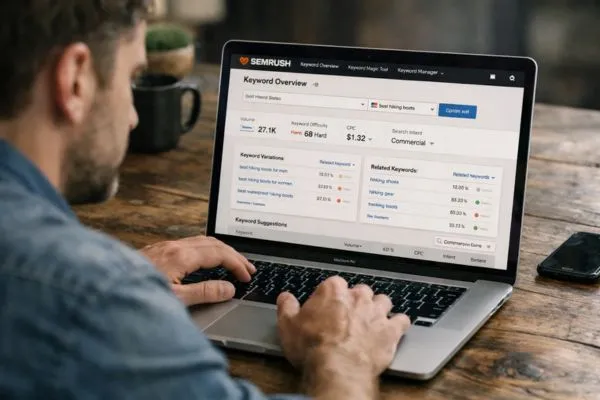
- Semrush added an AI Visibility Toolkit in 2025 that tracks how often your pages appear in AI-generated answers across Google and other platforms. For agencies managing multiple clients, this is becoming non-negotiable. Their keyword research has also gotten sharper with machine learning-driven clustering.
- Ahrefs rolled out AI visibility features alongside their traditional backlink and keyword data. Where Ahrefs stands out is competitive analysis. If you want to know which competitors are getting cited in AI Overviews and why, their data is the most granular I’ve found.
- Surfer SEO is strong for on-page content scoring. It analyzes SERP data and tells you exactly what a top-ranking page for your target keyword looks like in terms of word count, heading structure, and keyword usage. It’s a time saver, but it won’t fix bad strategy.
- Clearscope does something similar to Surfer but focuses more on semantic relevance. If your team writes content regularly, Clearscope helps ensure each piece covers the topic thoroughly enough to compete.
- ChatGPT is useful for drafting, brainstorming, and outlining. It’s not an SEO tool in the traditional sense, and treating it like one is a mistake. It doesn’t check rankings, analyze backlinks, or track AI citations. But for getting past a blank page, it’s fast and cheap.
The tool you pick matters less than how you use it. A $200/month Semrush subscription in the hands of someone who doesn’t understand search intent is a waste. A free version of Ahrefs in the hands of someone who knows how to pick target keywords will outperform it every time.
What AI SEO Means for Your Business Going Forward
If you take one thing from this article, let it be this. AI SEO isn’t a separate discipline from regular SEO. It’s where SEO is headed, and the businesses that adapt now are the ones that will be hardest to unseat in two years.
The most expensive mistake I’ve seen in the last 12 months is companies building AI content farms without human oversight. Those sites lose 30–60% of organic traffic after core updates, and recovery takes 6–12 months of rewrites and fresh link building. The cost in lost revenue often runs into hundreds of thousands of dollars. Knowing the differences between AEO and SEO helps you avoid putting all your eggs in one basket.
The smartest move is simpler than it sounds. Keep doing what works (quality content, strong backlinks, solid technical foundations like Core Web Vitals) and layer AI on top for efficiency. Track your AI citations alongside your traditional rankings.
And if you’re a small or mid-size business that doesn’t have time to figure this out internally, partnering with an experienced SEO team is the fastest way to avoid costly mistakes. AI SEO rewards the companies that combine speed with expertise. Getting one without the other doesn’t cut it anymore.
FAQs
How does AI SEO differ from traditional search optimization?
Traditional SEO focused almost entirely on ranking in the ten blue links on Google’s results page. AI SEO adds a second layer: getting your content cited inside AI-generated answers. The ranking factors overlap (backlinks, E-E-A-T, content quality), but AI SEO also requires structured data, citation-ready formatting, and content that can stand alone when pulled out of context.
Will AI replace SEO professionals?
No. The Bureau of Labor Statistics projects 7% growth in related digital roles through 2034. AI is changing the tools SEO professionals use, but strategy, interpretation, and creative problem-solving still require human judgment. Businesses that try to automate SEO entirely tend to produce generic content that gets penalized in Google’s core updates.
Is AI-generated content bad for SEO rankings?
Not automatically. Google doesn’t penalize content for being AI-generated. It penalizes content for being unhelpful, thin, or inaccurate. AI-assisted content that’s been edited by a knowledgeable human, checked for accuracy, and published with real author attribution can rank just as well as fully human-written content. The risk comes when businesses publish unedited AI output at scale.
How much traffic do Google AI Overviews take from websites?
Click-through rates drop 34–61% on queries where an AI Overview appears. But roughly 60% of Google searches were already zero-click before AI Overviews launched. The more useful data point: sites cited in AI Overviews see their CTR rise from approximately 0.6% to 1.08%, and AI referral visitors convert at 4.4 times the rate of traditional organic traffic.
What’s the difference between GEO, AEO, and traditional SEO?
GEO (Generative Engine Optimization) focuses on getting cited by AI answer engines. AEO (Answer Engine Optimization) targets featured snippets and direct-answer boxes. Traditional SEO covers the full range of organic ranking signals. In practice, they overlap heavily. Good traditional SEO is the foundation that makes GEO and AEO possible.
How much does AI SEO cost compared to traditional SEO?
Traditional monthly SEO retainers typically run $1,500–$5,000 for most businesses. Adding GEO and AI visibility tracking can increase costs by 20–30% because of the extra structured data work, AI citation monitoring, and testing required.
How do I know if my site is showing up in AI answers?
Semrush’s AI Visibility Toolkit and Ahrefs’ AI visibility features both track whether your pages appear in AI-generated responses across Google and other platforms. These tools launched in 2025–2026 and are becoming standard for agencies that manage AI SEO campaigns. Without them, you’re measuring half the picture at best.

Michael Vale has over 5 years of experience helping clients improve their business visibility on Google. He combines his love for teaching with his entrepreneurial spirit to develop innovative marketing strategies. Inspired by the big AI wave of 2023, Michael Vale now focuses on staying updated with the latest AI tools and techniques. He is committed to using these advancements to deliver great results for his clients, keeping them ahead in the competitive online market.