
What Is Enterprise SEO In 2026? (And Why Most Companies Get It Wrong)
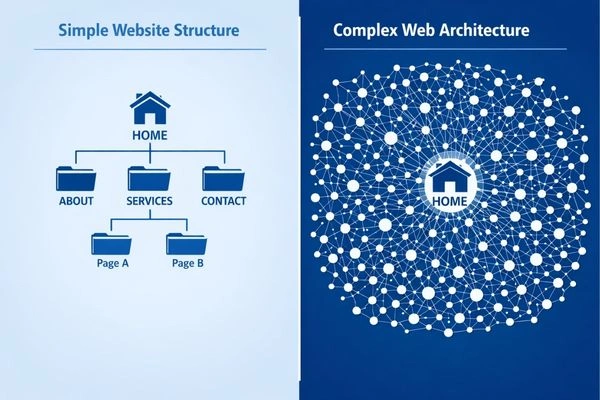
Enterprise SEO is the practice of managing search visibility across websites with 500 to millions of pages, typically for organizations pulling in $100M+ in revenue. It’s not “regular SEO but bigger.” It’s a different discipline that treats search as infrastructure, not a marketing tactic you bolt on after launch.
The global SEO services market hit roughly $74.9 billion in 2025, and the enterprise segment is growing faster than any other category at a 16.10% compound annual growth rate through 2031, according to Mordor Intelligence. That growth tells you something. Big companies are waking up to the fact that organic search still drives most of their qualified traffic, even as AI Overviews change what “ranking” looks like.
But most enterprise SEO efforts fail. Not because the tactics are wrong, but because the operating model is broken. SEO teams get held responsible for outcomes while engineering and product teams control the inputs. I’ve seen this play out dozens of times. The SEO director identifies a crawlability issue, files a ticket, and waits four months for a deploy window. By then, Google’s already moved on.
This article covers what enterprise SEO actually involves, how it differs from traditional SEO, the six challenges that sink most programs, and what to look for in a platform. It won’t cover small business SEO or local-only strategies (we have separate guides for local search that go deeper on that).
How Does Enterprise SEO Differ from Traditional SEO?
Traditional SEO and enterprise SEO use the same core techniques. On-page work, link building, technical audits, content strategy. The difference is in how those techniques get executed, who’s involved, and what “success” means.
With traditional SEO, a small team (sometimes one person) can make changes, push them live, and see results in weeks. Enterprise SEO involves dozens of people across marketing, engineering, legal, product, and localization teams. A single title tag change might require three approvals and a sprint cycle.
| Traditional SEO | Enterprise SEO | |
| Site Size | Hundreds to low thousands of pages | Tens of thousands to millions |
| Team | 1–3 people, often outsourced | Cross-functional, 5–20+ people |
| Decision Speed | Days to weeks | Weeks to months |
| Primary Metric | Rankings and traffic | Revenue, pipeline, brand visibility |
| AI Readiness | Optional | Non-negotiable |
| Budget Range | $1,000–$10,000/mo | $10,000–$100,000+/mo |
The biggest difference nobody talks about? Where the SEO team sits in the org chart. At smaller companies, SEO lives inside marketing. At enterprise companies that actually succeed with organic, SEO sits with product and engineering teams, according to a February 2026 analysis from Search Engine Journal. That’s a structural decision, not a tactical one. And it changes everything about how fast work gets done.
6 Enterprise SEO Challenges That Actually Matter
Every enterprise SEO guide lists challenges. Most of them are vague. “It’s complex.” “You need buy-in.” That’s not useful. So here are the six problems I’ve watched derail real programs, along with what actually works.
1. Keeping Thousands of Pages from Falling Apart
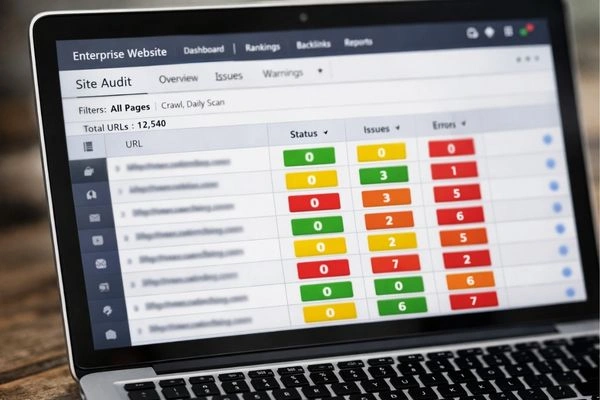
When you’re managing 50,000+ URLs, pages decay fast. Products get discontinued. Landing pages go stale. Meta data drifts from guidelines. And nobody notices until organic traffic drops 15% over a quarter.
The fix isn’t heroic manual audits. It’s building systems. Template-based SEO rules that apply across page types. Automated flags when pages drop below performance thresholds. Quarterly content reviews grouped by page category, not done page by page. If your team is still manually checking title tags on individual URLs, you’re running a 2018 playbook on a 2026 problem.
Understanding how crawl budget works matters more at this scale than almost anything else. Google won’t crawl your entire site if half of it returns thin content or redirect chains.
2. Does Internal Linking Really Move the Needle at Scale?
Yes. But not the way most teams do it.
I’ve audited enterprise sites where 40% of their pages had zero internal links pointing to them. Those pages were invisible to Google. The site had millions of URLs, but effectively only a fraction were in play.
Internal linking at this scale isn’t about manually adding links to blog posts. It’s about building programmatic link structures into your templates, your product feeds, and your category architecture. When a new product page goes live, does it automatically receive relevant internal links? If the answer is no, you have a systems problem.
Use keyword-relevant anchor text, but mix it up. A blend of exact-match and natural anchors performs better than hammering the same phrase across 10,000 pages.
3. Wrangling Subdomains and Multi-Site Architectures
Big organizations love subdomains. Support lives on help.brand.com. The blog sits at blog.brand.com. International sites run on separate country-code domains. Each one tends to develop its own SEO “strategy” (or, more often, no strategy at all).
The contrarian take here: consolidation is usually the right call. Every subdomain you maintain dilutes your domain authority and creates a new site for Google to crawl and evaluate independently. Unless you have a regulatory or technical reason to separate, bring it under one roof. Companies that have consolidated subdomains into subfolders have seen 20–40% improvements in organic visibility in my experience.
Where consolidation isn’t possible, canonical tags and hreflang implementation become your safety net. Audit them quarterly. Broken hreflang tags on a 50-language site can create thousands of duplicate content issues overnight.

4. Can You Scale Content Without Killing Quality?
This is the question that separates real enterprise SEO from the pretenders.
The answer: yes, but only if you treat content production like a product, not a campaign. That means documented style guides, subject matter expert review pipelines, and quality gates before anything publishes. The temptation at scale is to blast out 500 articles a month using AI and hope volume wins. It won’t. Google’s systems are explicitly designed to penalize sites that sacrifice quality for quantity, and the March 2024 core update proved that.
According to Grand View Research, the global SEO software market is projected to reach $154.6 billion by 2030, growing at 13.5% annually. A huge chunk of that investment is going toward content quality measurement tools, not just content production.
Successful enterprise content programs produce 30–50 high-value pieces per month, not 500 thin ones. Each piece targets a specific search intent and goes through editorial review. Volume matters. But it’s a distant second to relevance.
5. Tracking SEO Data When You Have Millions of Pages
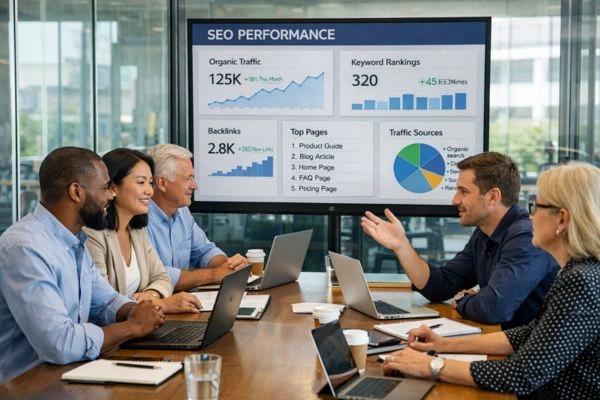
At the enterprise level, you’re drowning in data. Rankings across 200,000 keywords. Traffic across 15 markets. Conversion data split by product line, region, and device. The problem isn’t getting data. It’s knowing which data actually matters.
A February 2026 piece from Search Engine Land argued that enterprise teams should retire vanity metrics like average position and raw traffic volume in favor of revenue-correlated metrics. I agree, but with a caveat. You still need leading indicators. If you only measure revenue, you won’t catch problems until it’s too late.
The better model: track pipeline impact and AI Overview appearances at the top, then use keyword movement and click-through rates as early warning signals. Segment everything by business unit. A single dashboard for a 50,000-page site is useless.
6. Getting Buy-In Across 10 Departments
This is the unsexy challenge that kills more enterprise SEO programs than any algorithm update ever could.
SEO touches engineering (site speed, crawlability), product (page templates, UX), legal (compliance copy), marketing (content, campaigns), and executive leadership (budget). Getting all of those groups to prioritize SEO work requires proving ROI in their language, not yours.
Don’t walk into a VP of Engineering meeting talking about “organic impressions.” Talk about reduced server load from proper redirects. Talk about fewer support tickets when pages load faster. Tie every request to something they already care about.
The teams that get this right hold monthly cross-functional syncs with shared dashboards. SEO goals map directly to business KPIs, not marketing metrics. When the CMO and CTO both see the same numbers, things move faster. Working with a marketing partner who understands your vertical can help bridge that gap, especially when internal teams are stretched thin.
What Should You Look for in an Enterprise SEO Platform?
Picking an enterprise SEO tool is a high-stakes decision. Most contracts run 12–24 months. Here’s what actually matters.
Feature Set
You need a platform that handles both technical SEO and content SEO under one roof. Separate tools for each creates data silos and doubles your training burden. Look for site crawling, keyword tracking, content analysis, backlink monitoring, and automated reporting as baseline features.
AI-powered features are table stakes in 2026. If the platform can’t analyze your content against AI Overview formatting requirements, it’s already behind.
Scaling With Your Growth
Your platform should handle your current page count and 3x that without performance degradation. Ask vendors for benchmarks. If the crawler chokes at 100,000 URLs, it won’t serve you at 500,000.
Integration With Your Existing Stack
The tool needs to connect with your CMS, Google Analytics, Google Search Console, and your BI platform at minimum. Manual data exports between tools is a recipe for stale reporting and wasted analyst time.
How Much Does Enterprise SEO Cost?
Let’s talk real numbers.
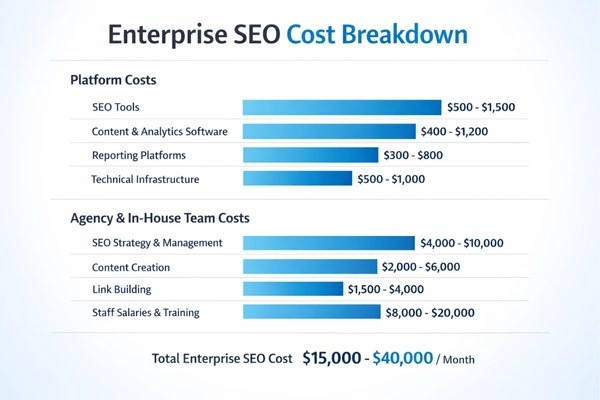
Enterprise SEO platforms typically run $10,000–$25,000 per month depending on site size and feature tier. If you’re hiring an agency to manage strategy and execution, expect $15,000–$50,000+ monthly on top of that. In-house teams add headcount costs of $500,000–$1.5M annually when you factor salaries for an SEO director, 2–3 specialists, a content strategist, and a data analyst.
Is it expensive? Compared to paid search at scale, it’s a bargain. A mid-size e-commerce company spending $200,000/month on Google Ads could redirect a fraction of that into enterprise SEO and build an asset that compounds over time instead of disappearing the moment the budget gets cut.
Where Enterprise SEO Goes From Here
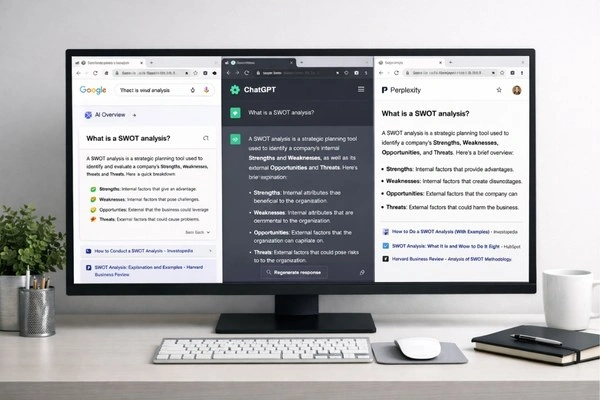
The biggest shift happening right now isn’t technical. It’s philosophical. Enterprise SEO in 2026 isn’t just about ranking on Google anymore. It’s about showing up when ChatGPT, Perplexity, and Google’s AI Overview answer questions about your industry. That means structured data, entity relationships, and understanding how AEO intersects with traditional SEO aren’t nice-to-haves. They’re the baseline.
Companies that treat enterprise SEO as infrastructure (baked into how pages get built, not patched in after launch) will win. Everyone else will keep filing Jira tickets and wondering why nothing changes.
FAQs
How does enterprise SEO differ from regular SEO in 2026?
Enterprise SEO manages search visibility across thousands or millions of pages, while regular SEO typically handles hundreds. The bigger difference is structural: enterprise programs require cross-functional teams spanning engineering, product, and marketing. In 2026, enterprise SEO also demands optimization for AI engines like ChatGPT and Google’s AI Overview, not just traditional blue-link rankings.
How much does enterprise SEO cost per month?
Enterprise SEO platforms typically cost $10,000–$25,000 monthly. Agency management adds $15,000–$50,000+ per month. In-house teams run $500,000–$1.5M annually in headcount costs. Total investment depends on site size, number of markets, and whether you’re building an internal team or outsourcing.
Is enterprise SEO still worth it with AI Overviews taking over search?
Yes. AI Overviews and generative engines like Perplexity pull their answers from well-structured, authoritative content. Strong technical SEO and E-E-A-T signals make enterprise sites more likely to be cited by AI systems. Traffic patterns may shift, but qualified visibility actually increases for sites that adapt. The enterprise SEO segment is growing at 16.10% CAGR through 2031, according to Mordor Intelligence.
What metrics should enterprise SEO teams track in 2026?
Revenue correlation, pipeline impact, and AI Overview appearances should replace vanity metrics like raw traffic and average position. Use keyword movement and click-through rates as leading indicators. Segment all data by business unit, region, and product line. A single site-wide dashboard is useless at enterprise scale.
Why do enterprise SEO programs fail despite large budgets?
The most common reason is an accountability gap. SEO teams are measured on outcomes (rankings, traffic, revenue) but don’t control the inputs (page templates, deploy schedules, site architecture). When engineering and product teams don’t prioritize SEO work, even a $1M annual budget produces minimal results. Treating SEO as upstream infrastructure instead of a downstream marketing function fixes this.
What’s the difference between enterprise SEO and enterprise SEO platforms?
Enterprise SEO is the strategy and practice of managing organic search at scale. An enterprise SEO platform is the software used to execute that strategy. Platforms handle crawling, keyword tracking, content analysis, and reporting. The strategy includes org design, content production, technical standards, and cross-team coordination that no tool can automate.
How long does enterprise SEO take to show results?
Most enterprise SEO programs need 6–12 months before meaningful organic revenue impact becomes visible. Technical fixes (crawl issues, redirect cleanup) can show improvements in 4–8 weeks. Content-driven gains take longer because new pages need time to earn authority and links. Companies that stick with a consistent program for 18+ months see compounding returns that paid channels can’t match.

Mike has over 5 years of experience helping clients improve their business visibility on Google. He combines his love for teaching with his entrepreneurial spirit to develop innovative marketing strategies. Inspired by the big AI wave of 2023, Mike now focuses on staying updated with the latest AI tools and techniques. He is committed to using these advancements to deliver great results for his clients, keeping them ahead in the competitive online market.