
Enterprise SEO Vs Traditional SEO In 2026: 10 Differences That Actually Matter
Enterprise SEO and traditional SEO solve different problems for different businesses. Enterprise SEO targets large organizations with thousands (sometimes millions) of pages, complex tech stacks, and multiple departments fighting for priority. Traditional SEO works for smaller sites with fewer pages, tighter budgets, and faster decision-making. The principles overlap, but the execution couldn’t be more different.
Enterprise SEO is the practice of managing search visibility across large, complex websites with 1,000+ pages, cross-functional stakeholder requirements, and infrastructure that demands automation over manual fixes. It’s not “bigger SEO.” It’s a different operating model.
I’ve worked on both sides of this. A 200-page local services site and a 40,000-page e-commerce build require completely different workflows, tools, and timelines. The mistake most growing companies make is assuming they can scale their small-site playbook. They can’t. And by the time they realize it, they’ve burned six months of budget on tactics that don’t move the needle at scale.
This article breaks down the 10 differences that actually change how you plan, staff, and spend. We’re not covering basic SEO definitions or rehashing beginner-level guides. If you need that, start with a primer on how SEO works first.
Here’s a quick snapshot before we get into the details:
| Factor | Traditional SEO | Enterprise SEO |
| Site size | Under 500 pages | 1,000 to millions of pages |
| Keywords | Tens to hundreds of terms | Thousands to hundreds of thousands |
| Decisions | 1–2 stakeholders, fast approvals | IT, legal, brand, product sign-off |
| Technical | Speed, mobile, basic schema | Crawl budget, log analysis, automation |
| Metrics | Rankings and sessions | Revenue attribution, AI visibility |
| Timeline | 1–3 months for early wins | 6–12 months compounding growth |
| Budget | $1,500–$5,000/month typical | $10,000–$50,000+/month typical |
How Does Site Scale Change the SEO Playbook?
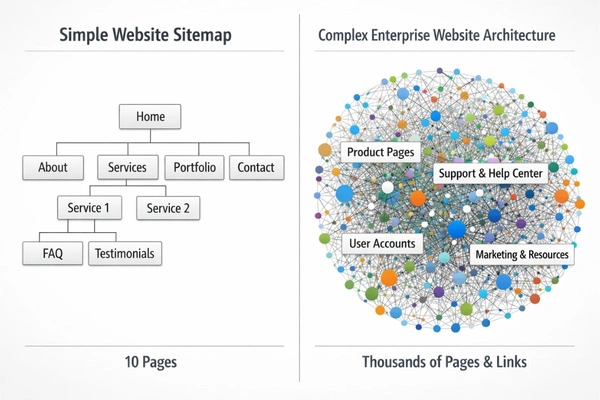
Scale is the single biggest divider. A traditional SEO campaign might manage 50–200 pages. You can touch every title tag, review every meta description, and manually optimize each URL. That approach falls apart at 5,000 pages, and it’s physically impossible at 50,000.
Enterprise sites need template-level thinking. Instead of optimizing individual pages, you build rules into CMS templates that apply fixes across thousands of URLs at once. One schema markup change deployed through a template can touch 10,000 product pages overnight.
Crawl budget becomes a real constraint. Google allocates a finite crawl budget to every site based on authority and server health. According to Search Engine Land’s enterprise SEO guide, large sites must ensure high-priority pages get crawled while low-value pages (filters, pagination, internal search results) don’t waste that budget. On a 200-page site, crawl budget is a non-issue. On a 200,000-page site, it’s the difference between your revenue pages getting indexed or sitting invisible.
Content governance multiplies too. Duplicate pages, outdated taxonomy, legacy URLs that nobody remembers creating. I’ve audited enterprise sites where roughly 40% of indexed pages were either duplicates or thin content dragging down the rest. Traditional SEO rarely faces this because the site is small enough to keep clean manually.

Technical Architecture: The Foundation Enterprise SEO Lives or Dies On
Traditional sites usually run on WordPress, Shopify, or a simple CMS. The tech stack is predictable. Enterprise sites? They’re often Frankenstein builds. Multiple CMSes stitched together, legacy systems from acquisitions, JavaScript-heavy frameworks, CDNs, third-party integrations, and authentication layers that can accidentally block search engine crawlers.
A BrightEdge study found that after AI Overviews launched, impressions on Google increased 49% but click-through rates dropped 30%. That pressure makes technical SEO even more important for enterprises because every lost click costs more at scale.
The biggest technical risks at the enterprise level include JavaScript rendering issues that hide content from Google, Core Web Vitals degradation caused by bloated third-party scripts, platform migrations that break thousands of redirect chains overnight, and crawl budget waste from poor site architecture.
Here’s the contrarian take most agencies won’t say out loud: the “just create more content” advice that works for traditional SEO is actively harmful at enterprise scale. If your technical foundation is broken, more content means more pages Google can’t properly crawl, index, or trust. Fix the plumbing first.
Content Change Control and Approval Workflows
On a traditional site, you want to update a title tag? You log into WordPress and change it. Done in 90 seconds.
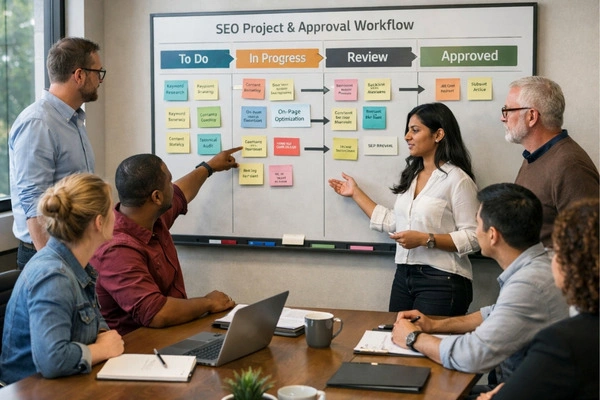
On an enterprise site, that same title tag change might require a Jira ticket, impact assessment, QA in a staging environment, legal review (if it’s a regulated industry), and deployment through a two-week sprint cycle. I’ve seen a simple meta description update take six weeks to go live at a Fortune 500 company.
This isn’t dysfunction. It’s governance. Large organizations need documentation, rollback plans, and multi-layer approval to protect against errors that could affect millions of dollars in organic traffic. But it does mean that any agency working at this level needs to understand change management, not just SEO.
The SEO partner who shows up with a 47-item audit and says “implement these changes” without understanding your sprint cycles, QA protocols, and legal review gates will fail. Every time.
How Many Stakeholders Does It Take to Ship an SEO Fix?
Traditional SEO usually involves a business owner, maybe a marketing manager, and the SEO practitioner. Three people. Decisions happen in a meeting or a quick Slack message.
Enterprise SEO touches marketing, IT, legal, compliance, brand, product, and sometimes executive leadership. Each team has its own priorities. Marketing wants visibility. Legal wants to avoid liability. IT wants stability. The brand wants messaging consistency. When these priorities conflict (and they will), SEO initiatives stall.
According to a February 2026 analysis in Search Engine Journal, most enterprise SEO operating models are structurally broken because SEO gets treated as a post-launch fix rather than an embedded function. The organizations that win at enterprise SEO build what Hallam Agency calls a “Center of Excellence,” a centralized team that sets standards while distributed specialists sit within IT, product, and content teams.
The practical fix? A RACI framework (responsible, accountable, consulted, informed) for every SEO workstream. Without one, accountability gaps kill momentum.
Compliance and Risk in Regulated Industries
This difference only matters if you’re in healthcare, finance, insurance, legal services, or another regulated sector. But when it matters, it changes everything.
Traditional SEO content can be casual, experimental, and fast. Enterprise content in regulated industries goes through legal review. Medical claims need disclaimers. Financial projections need disclosures. Even keyword choices can create compliance problems if they imply guarantees that aren’t legally defensible.
Risk mitigation slows deployment. Organizations may delay or limit updates to avoid legal exposure. I’ve worked with a financial services company that required three rounds of legal review on every blog post. That meant their content calendar operated on a 90-day lead time, not 90 hours.
Brand governance adds another layer. Prescriptive tone guides, approved terminology lists, and visual guidelines can restrict which SEO content formats are even possible. This is why a partner familiar with enterprise SEO operations matters more than one who just knows keyword research.
How Does Keyword Strategy Differ at Enterprise Scale?
A traditional SEO campaign might target 50–100 keywords. Long-tail, localized, lower competition. You can track every one in a spreadsheet.
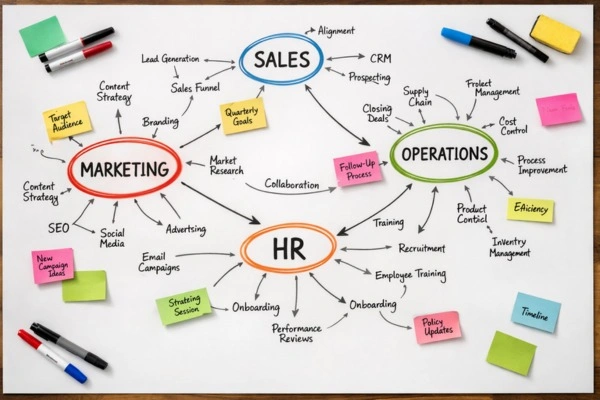
Enterprise keyword portfolios span thousands of terms across multiple product lines, business units, regions, and stages of the buyer journey. One division targets informational queries while another needs transactional rankings. Without tight mapping, these pages cannibalize each other.
Semrush reported that AI search traffic grew 527% in a single year leading into 2026, and projects it could surpass traditional search traffic by 2028. That shift means enterprise keyword strategy now has to account for two channels: traditional rankings and AI citations. Traditional SEO can mostly ignore AI visibility for now. Enterprise sites can’t afford to.
The real danger at scale is spreading resources too thin. I’ve seen enterprise teams track 15,000 keywords but focus actual resources on the same 200 head terms their competitors also target. A smarter play is clustering by intent and business unit, then mapping each cluster to a specific content asset. Understanding which keywords actually drive revenue matters more than monitoring thousands of vanity metrics.
Global and Multisite SEO: Beyond Translation
Traditional SEO typically operates in one language, one country, one domain. Simple.
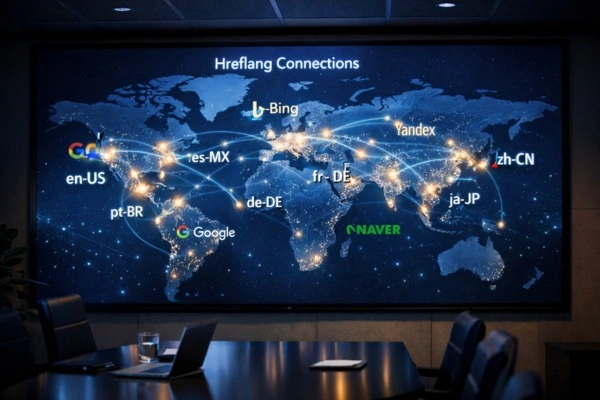
Enterprise SEO frequently spans multiple countries, languages, domains or subdomains, and regional search engines. Hreflang implementation alone can be a full-time job on a site with 15 language variants.
But here’s what most articles miss: international SEO in 2026 isn’t just about hreflang tags and localized content. AI-driven search is creating what one Search Engine Land analysis calls “semantic collapse in multilingual AI.” Identical keywords carry different intent in different regions, and LLMs don’t always respect those distinctions. Enterprises that treat localization as a translation exercise are losing visibility in markets where cultural context changes meaning.
Search intent varies by region, CMS platforms don’t always support multi-language structures out of the box, and brand consistency has to hold across every market. This is one area where the gap between traditional and enterprise SEO isn’t just about scale. It’s about a completely different set of problems.
Channel Integration and Cross-Team Alignment
Traditional SEO often operates as a standalone channel. You do keyword research, write content, build links, track rankings. It lives in its own lane.
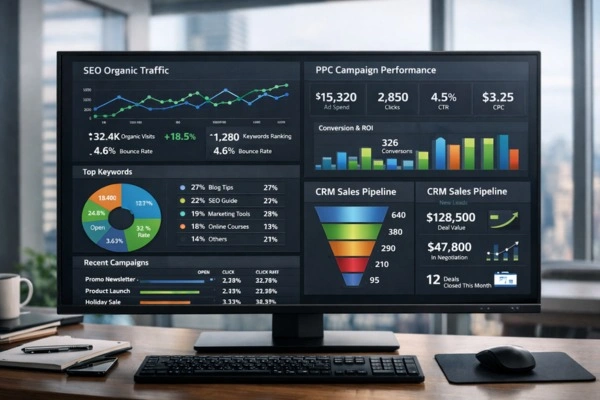
Enterprise SEO has to integrate with paid media, email marketing, social, CRM systems, and sales enablement. Shared keyword data between SEO and PPC improves targeting and reduces waste on both sides. Content built for organic can be repurposed for email nurture sequences and paid landing pages.
A January 2026 article from Search Engine Land highlighted that attribution models are shifting. Last-touch attribution (which most SMBs use) undervalues SEO’s role in discovery. Enterprise organizations are moving to first-touch attribution to credit the channels that start customer relationships, and combining SEO with paid search amplifies results when messaging stays consistent across both.
When SEO runs in a silo at the enterprise level, you get content gaps, conflicting messaging, and wasted budget. I’ve seen paid teams bidding $15 per click on keywords the organic team already ranked for because nobody shared data.
What Should Enterprise SEO SLAs Look Like?
Traditional SEO engagements are often month-to-month with informal reporting. You get a ranking report, maybe a traffic summary, and a call once a month.
Enterprise SLAs define response times, reporting cadence, compliance standards, escalation paths, and governance protocols. They exist because the stakes demand accountability. When your organic channel drives $10 million in annual revenue, you need contractual guarantees around uptime during technical SEO work, data handling standards, and cross-functional coordination.
Strong SLAs also protect both parties. The agency knows exactly what’s expected. The client knows exactly what they’re paying for. Without them, execution drifts, timelines slip, and the relationship deteriorates.
For enterprise SEO in 2026, Gartner projects that traditional search engine volume could drop 25% due to AI chatbots and virtual agents. That makes SLAs around AI visibility tracking and monitoring AI Overview performance just as important as traditional ranking reports.
Implementation Cadence: Why Enterprise SEO Moves Slower
Traditional SEO moves fast. You find an issue, you fix it, you see results in weeks.
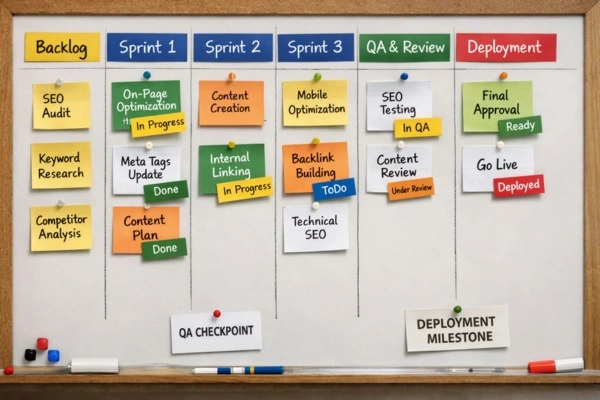
Enterprise SEO moves in phases. Updates roll out in waves across templates, regions, or business units. Every change passes through QA in a staging environment before touching production. Dependencies with content, design, compliance, and dev teams extend timelines.
This isn’t a weakness. It’s risk management. A bad redirect deployed across 50,000 pages without QA can wipe out months of organic performance overnight. Phased rollouts and sprint-aligned deployment protect against catastrophic errors.
The key is building SEO into existing release rhythms rather than fighting against them. The agencies that succeed at enterprise SEO plan their roadmaps around client sprint cycles, not around their own timelines.
Actually, framing this as “enterprise SEO moves slower” isn’t quite right. The better way to think about it is that enterprise SEO moves at the speed of its weakest organizational bottleneck. Improving that bottleneck (usually stakeholder alignment or QA bandwidth) often matters more than any technical optimization.

Pick the Approach That Matches Your Operations
Enterprise SEO vs. traditional SEO isn’t a quality question. It’s a good question. A 100-page local business site doesn’t need cross-functional governance and six-figure monthly budgets. And a 50,000-page e-commerce platform can’t get by on manual optimizations and a single SEO specialist.
The global SEO market hit roughly $107 billion in 2025 according to The Business Research Company. That money is split across both approaches, and neither is disappearing. What is changing is the requirement for AI readiness at every scale level, and the organizations that recognize enterprise SEO vs. traditional SEO as an operational decision (not just a marketing one) are the ones pulling ahead.
Pick the model that matches where your business actually is today, not where you hope it will be in three years.
FAQs
Is traditional SEO dead in 2026 because of AI?
No. Traditional SEO still drives human clicks, and those clicks convert. What’s changed is that AI search traffic grew 527% in one year according to Semrush, so traditional SEO now needs to coexist with AI visibility strategies. For most small businesses, traditional SEO remains the primary growth channel. Enterprises need both.
What’s the biggest mistake companies make with enterprise SEO?
Treating it like a scaled-up version of traditional SEO. The most common failure is applying small-site tactics (manual page edits, ad hoc content, informal reporting) to a site with thousands of pages and multiple stakeholder dependencies. According to Search Engine Journal’s 2026 analysis, most enterprise SEO models fail because they’re reactive rather than embedded into business workflows.
How much does enterprise SEO cost compared to traditional SEO?
Traditional SEO typically runs $1,500–$5,000 per month. Enterprise SEO starts around $10,000 per month and can exceed $50,000 depending on site complexity, number of markets, and required tooling. The cost difference reflects the need for larger teams, advanced platforms, cross-departmental coordination, and ongoing governance.
Do search rankings still matter for enterprise SEO in 2026?
Yes, but they’re no longer the only metric. Gartner projects that search engine volume could drop 25% by 2026 due to AI chatbots. Enterprise SEO now tracks AI citations, featured snippet ownership, and first-touch attribution alongside traditional rankings. Position in the AI retrieval chain matters as much as page-one placement.
Should a small business invest in enterprise SEO tools?
Almost never. Enterprise platforms like Conductor, BrightEdge, or seoClarity are built for sites with thousands of pages and multiple user roles. A 200-page site doesn’t need that complexity. Traditional tools like Ahrefs, Semrush, or SE Ranking provide everything a small business needs at a fraction of the cost.
How has AI changed SEO attribution models?
The shift is from last-touch to first-touch attribution. Last-touch models credit the final click before conversion, which undervalues SEO’s role in discovery. First-touch attribution gives credit to the channel that initiated the customer journey. For enterprises investing heavily in top-of-funnel content, this shift better reflects SEO’s actual revenue contribution.
What’s the difference between enterprise SEO and GEO?
GEO (Generative Engine Optimization) focuses specifically on visibility within AI-generated answers from tools like ChatGPT, Google AI Overviews, and Perplexity. Enterprise SEO is broader, covering traditional rankings, technical infrastructure, and organizational governance. Enterprises increasingly need both, but they target different platforms and require different measurement frameworks.

Michael Vale has over 5 years of experience helping clients improve their business visibility on Google. He combines his love for teaching with his entrepreneurial spirit to develop innovative marketing strategies. Inspired by the big AI wave of 2023, Michael Vale now focuses on staying updated with the latest AI tools and techniques. He is committed to using these advancements to deliver great results for his clients, keeping them ahead in the competitive online market.