
How Do You Rank With A Featured Snippet On Google?
Featured snippets are Google’s answer boxes that appear above organic search results, displaying direct answers to user queries. These position-zero results can dramatically increase your website’s visibility, drive more traffic, and establish your brand as an authoritative source in your industry. At Eclipse Marketing, we help businesses leverage these powerful SEO opportunities to dominate search results.
With Google’s AI Overview now competing with traditional featured snippets, understanding how to optimize for both systems is crucial for SEO success. This comprehensive guide covers the four main types of featured snippets (paragraph, list, table, and video), explains why they matter for your website’s search performance, and provides seven proven strategies to help your content appear in these coveted positions.
You’ll learn how to target question-based keywords, structure content for maximum snippet potential, identify easy optimization wins, and adapt your strategy for Google’s evolving AI-powered search results. Whether you’re new to featured snippet optimization or looking to improve your current results, this guide provides actionable tactics to boost your search visibility and outrank competitors.

What Are the Different Types of Answer Boxes?
Featured snippets show up in 4 main ways:
- Text paragraphs
- Bullet point or numbered lists
- Data tables
- Video clips
Google automatically picks content from top-ranking websites based on your search. It then displays this content as a featured snippet in whichever format works best. Understanding these formats is essential for any comprehensive SEO strategy that aims to capture position zero results.
1) Text Paragraph Snippets
Text paragraphs are the most common type of answer box you’ll see in Google results.
They show a short piece of text that answers question searches. These work best for “How”, “Who”, “Why”, “When”, and “What” questions.
Most paragraph snippets contain between 40 and 60 words on average. This concise format allows Google to quickly extract and display relevant information that directly addresses user queries.
2) Bullet Point and Numbered List Snippets
List snippets show answers as bullet points or numbered lists.
Google displays these for “How” or “What” questions that need step-by-step answers. They also work well for searches asking for multiple items or options.
List snippets appear in two main formats:
- Numbered lists – These show ranked items or step-by-step instructions. Examples include “top 10 movies 2021” or “how to set up a new android phone”.
- Bullet point lists – These show items that don’t need a specific order. Examples include “which are the friendliest dogs” searches.
3) Table Snippets
Table snippets show data from websites in an organized table format.
Google pulls information from a webpage and displays it in rows and columns. This works well for searches like “what are trouser sizes”.
Tables usually show numerical information like prices, rates, years, or measurement data. Proper table markup and structured data can significantly improve your chances of winning these snippet types.
4) Video Snippets
Sometimes Google shows video snippets instead of text answers.
These videos usually come from YouTube and start playing at a specific time. Google picks the exact moment in the video that answers your question.
Research from HubSpot shows that video snippets appear most often for “How-to” searches. This happens when the video title closely matches what you searched for.
Why Do Featured Snippets Matter for Your Website’s SEO?
Featured snippets are extremely important for SEO because they put your content right at the top of Google results. They show users a quick answer to their question directly from your website.
These answer boxes appear above all other search results. This prime position can boost your website’s visibility and increase clicks to your site. For businesses investing in professional SEO services, featured snippets represent one of the highest-impact opportunities available.
Users often trust featured snippets more than regular search results. When your content appears in a snippet, people see your website as a reliable source of information.
Getting your content into featured snippets helps your business in several ways. You can build authority in your field, get more people engaged with your content, and stay ahead of competitors.
This makes featured snippets a must-have part of any modern SEO strategy. According to Google’s Search Central documentation, these results help users find information quickly while driving quality traffic to websites.
Let’s look at the specific benefits that featured snippets can bring to your website.
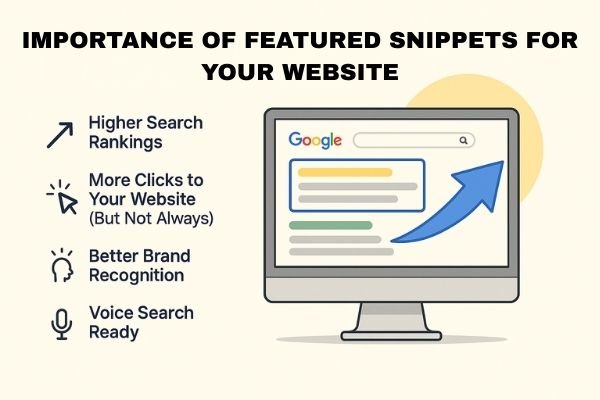
1. Higher Search Rankings
A featured snippet can help you beat your competitors and reach the #1 spot on Google search results.
This is especially helpful if your page ranks in the top 10 results but isn’t high enough to get good traffic from Google searches.
Getting into a featured snippet is much faster than traditional SEO methods. You can jump ahead of your competition without having to directly fight for higher rankings through lengthy link building campaigns or extensive technical optimization.
2. More Clicks to Your Website (But Not Always)
Pages shown in featured snippets might get more clicks than regular search results. However, this doesn’t always happen.
In the past, pages used for featured snippets also appeared as normal search results on the same page. This meant your website could show up twice on the first page of Google results.
Any page that moved up to the featured snippet spot (called “position 0”) got a massive traffic boost. Users could see and click on your content in two different places.
Unfortunately, this changed when Google released a “SERP deduplication” update.
How many clicks you get from a featured snippet depends on two main things. It depends on why people are searching and where your page originally ranked.
Featured snippets get very few clicks for “no-click searches”. These are searches where users just want a quick answer and don’t plan to click on anything.
On the flip side, featured snippets can “steal” clicks from the #1 search result on Google.
According to Ahrefs’ Study Of 2 Million Featured Snippets, featured snippets take some traffic from top-ranking pages. About 30% of clicks from the #1 ranking page can go to the featured snippet instead.
This can give you a huge traffic boost if your page was originally ranking at the bottom of the first page. The visibility gained often translates into increased brand awareness and potential customers discovering your marketing services.
3. Better Brand Recognition
Featured snippets are an excellent way to promote your brand. Your website becomes the first thing users see on Google search results.
This is especially valuable for people searching on mobile phones, where screen real estate is limited and featured snippets take up even more prominent positioning.
When you optimize for featured snippets, users become more familiar with your brand and see you as an expert in your field. This enhanced credibility can lead to improved conversion rates and customer trust.
4. Voice Search Ready
Featured snippets work with voice assistants like Siri, Cortana, Alexa, and Google Assistant.
Research from Backlinko shows that over 40% of voice search answers come from Google featured snippets.
When you optimize your pages for featured snippets, Google can use your content for many voice searches. This leads to better brand visibility and establishes you as an expert in your field. As voice search continues growing, this becomes increasingly important for local businesses in markets like Denver, Las Vegas, and New Brunswick.
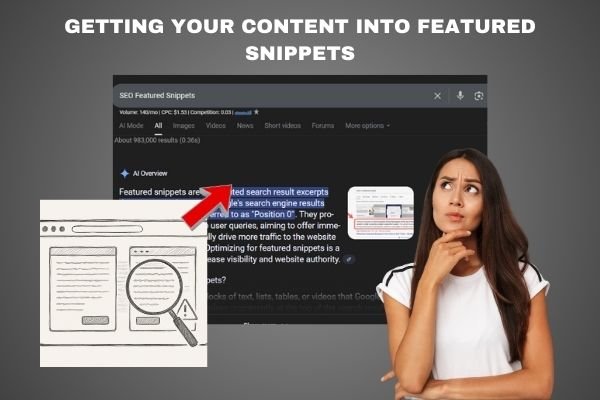
How Can You Get Your Content Into Featured Snippets?
The simple answer is it’s complicated.
First, you need to understand that you cannot directly ask Google to use your content for featured snippets. Google decides which pages qualify for featured snippets and which don’t.
Second, featured snippets change frequently, disappear, and come back over time. This happens because Google uses many different ranking factors and constantly updates its algorithms.
Luckily, there are several things you can do to improve your chances of getting featured snippets. These strategies work best when combined with professional web design and ongoing SEO optimization.
1. Target Long Questions and Specific Search Terms
Long, specific keywords and question searches usually create featured snippets in Google results.
Studies from Stone Temple and Ahrefs show that most featured snippets appear for longer keywords or direct questions.
When you optimize your pages for these longer keywords and questions, Google can use your content as answers. This gives you a better chance of appearing in featured snippets.
Google doesn’t offer an official tool to check which keywords trigger featured snippets in search results. However, Google Search Console can help you monitor which of your pages currently appear in snippets.
To research keywords for featured snippets, you need to use an SEO keyword tool like KWFinder or alternatives like SEMrush.
Here’s how it works: Type your main keyword into the tool. Then click on the “Autocomplete” or “Questions” tabs to see related longer keywords.
KWFinder will show you dozens or hundreds of long keywords and questions. You can use the filter option to remove keywords that don’t get enough searches.
This helps you focus on questions and long keywords that are actually worth optimizing for featured snippets.
Next, you need to check if these keywords already show featured snippets in Google results. Click on any keyword and KWFinder shows you the top search results. It also shows which page appears as a featured snippet.
Once you have your list of long keywords and question searches, you can create or improve your content. Simply add these keywords as headings on your pages and provide clear, brief answers right underneath.
This tells Google that your content could work as a featured snippet. You’re providing direct answers to those specific questions and search terms.
2. Get Your Page Into the Top 10 Search Results
To win a featured snippet, your page must rank in the top 10 Google search results for that keyword.
Research from Ahrefs shows that Google only uses pages that rank on the first page of search results for featured snippets.
This might seem challenging, but remember that Google wants to give users the most reliable answers. It only uses top-ranking pages that have high authority and quality content.
Fortunately, there are many ways to improve your content and boost your Google rankings. Working with experienced Google consultants can accelerate this process significantly.
You can use these strategies to improve your on-page SEO while creating a better user experience:
- Find and fix SEO problems and penalties
- Make your website easy to browse and navigate
- Add internal links and link to high-quality external sources
- Make your website load fast and work well on mobile devices
- Switch from HTTP to SSL security if you haven’t already
- Use clear, simple URL addresses
- Create content that matches what people are searching for and keep it updated
- Optimize your images for faster loading
- Make your pages easy to read and user-friendly
3. Look for Easy Featured Snippet Wins
You can win featured snippets for keywords where you already rank in the top 10 search results.
These keywords are “easy wins” because you only need to optimize your existing content. Add short, clear answers to match what people are searching for.
With a rank tracking tool like SERPWatcher, you can quickly find pages that rank well for keywords that already show featured snippets. Tools like Moz also provide excellent guidance on identifying these opportunities.
In SERPWatcher, open your list of tracked keywords and sort them by their rankings.
This arranges your keywords from highest to lowest ranking positions. Next, look for keywords that have a small quotation mark ” next to the ranking number. These are your “easy win” opportunities.
When you use these keywords as headings and add brief answers below them, you can greatly increase your chances of appearing as a featured snippet for those searches.
4. Put Your Main Answer First
The Inverted Pyramid is a writing method from journalism that shows how to structure information. You can use this same approach for featured snippet answers.
Start with your main answer first, then add supporting details in the rest of your content.
This means you answer the most important question right away, then explain the details afterward.
According to Dr. Peter J. Meyers from Moz, the inverted pyramid is a proven writing technique. It helps optimize your content for featured snippets by front-loading the most valuable information.
5. Structure Your Content Properly
Besides good writing style, organizing your content well is essential for featured snippet success.
For example, if a search shows a table featured snippet, you need to create your answer as a table. If the featured snippet shows a list, make sure your content uses lists or organized headings.
Make sure any content you want used for featured snippets has clear HTML structure like:
- <p> tags for paragraph snippets
- <table> tags for table snippets
- <ol> and <ul> tags for list snippets
Google doesn’t always require these tags, but proper HTML markup helps search engines understand your content structure better. Following W3C web standards ensures your markup is clean and semantic.
6. Use Words That Trigger Featured Snippets
Certain “trigger” words create featured snippets more often than others.
A study by the STAT Search Analytics team found that specific search terms get featured snippets more frequently. These queries were grouped by common themes that perform well.
The same study also found words that are less likely to appear in featured snippets.
You should consider avoiding these words or using them sparingly when optimizing for featured snippets. Focus on question words, comparison terms, and definition-style language that naturally triggers snippet-worthy responses.
7. Keep Your Answers Short
SEMrush studied over 10 million keywords and 1 million websites and made an important discovery. Most featured snippets are 40-50 words long. HubSpot research suggests up to 58 words.
You should keep your answers brief and direct. Aim for no more than 58 words.
Remember that there’s no perfect word count for every featured snippet. Search engines consider many other factors beyond just text length, including content quality, user engagement metrics, and overall page authority.
Conclusion
Featured snippets offer powerful opportunities to boost your website’s visibility and establish authority in your field. While Google’s AI continues to evolve search results, traditional featured snippets remain valuable for SEO success.
The key to winning featured snippets lies in strategic optimization. Target long-tail keywords and question-based searches that your audience actually uses. Ensure your pages rank in the top 10 results before expecting snippet placement.
Structure your content with clear headings and concise answers. Use the inverted pyramid method to put your main points first. Keep answers between 40-58 words for optimal performance.
Focus on easy wins by optimizing content that already ranks well. Use proper HTML markup and trigger words that generate snippets more frequently.
Success requires patience and consistent effort. Monitor your results, adjust your strategy, and keep creating high-quality content that directly answers user questions. For businesses ready to dominate featured snippets and improve their search visibility, contact our SEO experts to develop a customized optimization strategy.
Frequently Asked Questions
1. What are featured snippets and how do they work?
Featured snippets are answer boxes at the top of Google results. They provide quick answers using content from high-ranking websites in formats like paragraphs, lists, tables, or videos.
2. Can I guarantee my content will appear in featured snippets?
No, you cannot guarantee placement. Google’s algorithm automatically decides which pages qualify using many ranking factors. Snippets change frequently but you can optimize content to improve your chances.
3. What’s the ideal word count for featured snippet content?
Most snippets contain 40-50 words according to SEMrush research. HubSpot suggests under 58 words. Keep answers brief and direct while remembering that quality and relevance matter more than length.
4. Do featured snippets always increase website traffic?
Not always. Impact depends on search intent and original ranking. “No-click” searches generate few clicks, but snippets can steal 30% of clicks from #1 results, boosting traffic for lower-ranking pages.
5. What types of keywords work best for featured snippets?
Long-tail keywords and question searches work best. Focus on “How,” “What,” “Why,” “When,” and “Who” questions. Use keyword tools to find question-based searches and target keywords where you already rank top 10.

Michael Vale has over 5 years of experience helping clients improve their business visibility on Google. He combines his love for teaching with his entrepreneurial spirit to develop innovative marketing strategies. Inspired by the big AI wave of 2023, Michael Vale now focuses on staying updated with the latest AI tools and techniques. He is committed to using these advancements to deliver great results for his clients, keeping them ahead in the competitive online market.