
Is SEO Dead In 2026? What The Data Actually Shows
SEO isn’t dead. But plenty of businesses are treating it like it is, and paying for that decision in ways they haven’t noticed yet.
The global SEO services market hit $83.98 billion in 2026, according to SEO market data from Mordor Intelligence. That’s up from $74.9 billion just a year earlier. An industry on its deathbed doesn’t grow by $9 billion in 12 months. What’s actually happening is simpler and harder to deal with: SEO still works, but it’s stopped working for businesses that were getting by on weak foundations.
Is SEO dead? No. SEO is the process of making your website visible, credible, and useful to both search engines and AI systems. In 2026, that includes Google’s traditional results, AI Overviews, ChatGPT citations, and local map packs. The businesses asking whether SEO is dead are usually the ones whose websites were never set up to succeed in organic search. AI didn’t kill SEO. It just stopped covering bad websites.
I’ve watched this cycle repeat for over a decade. Mobile was supposed to kill SEO. Voice search was supposed to kill SEO. Zero-click results were supposed to kill SEO. None of them did. Each one just raised the minimum standard and businesses that didn’t keep up fell off. The future of organic search depends on the same thing it always has: whether your site earns its place.
At Eclipse Marketing, we see this pattern constantly. A business owner calls, frustrated that organic traffic dropped. We look at the site and the problem isn’t SEO strategy. It’s the website itself.
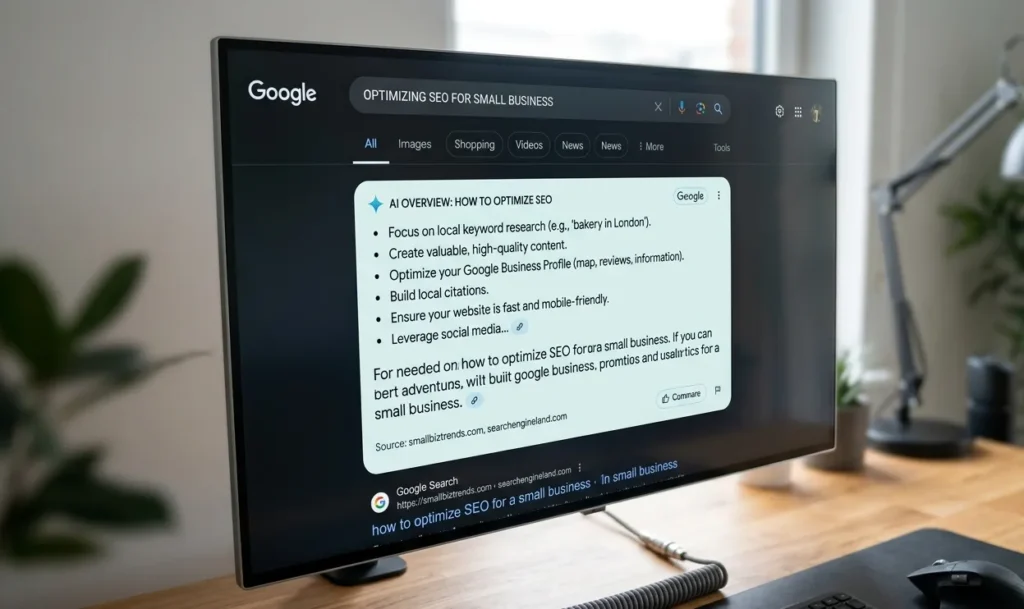
No, SEO Isn’t Dead But the Bar Just Got Higher in 2026
Google’s AI Overviews now appear in the majority of informational queries. Semrush data from 2025 shows that 58.5% of U.S. searches end without a click. Rand Fishkin at SparkToro has been tracking this zero-click trend for years, and the numbers keep climbing.
So yes, fewer people click through to websites than they used to. But that stat gets misread constantly.
Reduced clicks don’t mean reduced influence. AI Overviews still pull information from websites. They still reference, summarize, and cite businesses that have clear, well-structured content. If your site doesn’t show up in those citations, your competitors’ sites will.
And the click traffic that does come through? It’s more valuable. Someone who clicks past an AI Overview and visits your site has higher intent than the casual browsers of five years ago. According to HubSpot’s 2026 marketing data, SEO is the top ROI-generating channel for 27% of businesses, beating paid social, organic social, and email. The Bureau of Labor Statistics projects 7% growth in marketing analyst job growth through 2034, another sign the industry isn’t going anywhere.
That’s not a dead channel. That’s a channel that got pickier about who it rewards.
John Mueller and Gary Illyes at Google have said it plainly: you don’t need a separate “AI SEO” strategy. Normal SEO practices, clear content, solid site structure, real expertise, are what AI systems pull from. The businesses panicking about AI are often the ones who were gaming the system before AI made that impossible.

Does Your Website Even Deserve SEO Investment Right Now?
This is the question nobody wants to hear.
If your site can’t explain what you do, who you serve, and why someone should trust you, pouring money into SEO won’t fix that. SEO amplifies whatever your website already is. A strong site gets stronger. A weak site just burns the budget faster.
I talk to business owners every week who are frustrated with their SEO results. And roughly half the time, the problem isn’t the SEO work. The problems look like this:
- The site design fights against clarity instead of supporting it
- The CMS is so restrictive that pages can’t be expanded or structured properly
- Service pages say what the business does in three vague sentences
- There’s no proof of expertise, no case studies, no specifics, no depth
- The site was built to impress the business owner, not inform the customer
AI search systems don’t fill in the gaps. They evaluate what’s there and move on. If your content is thin, your positioning is vague, and your authority signals are weak, you won’t get surfaced. Period.
That doesn’t mean you should abandon SEO. It means you should fix the website first. Then invest in SEO. The sequence matters more than most agencies will tell you, because most agencies would rather sell you a retainer today than tell you the truth.

Why Weak Websites Won’t Survive AI-Driven Search
Every shift in search over the past 15 years followed the same pattern: raise the bar, punish weak foundations, reward clarity and expertise. AI search just runs that same playbook with less tolerance for mediocrity.
Google pushed four core updates between March 2025 and March 2026, each one following Google’s core update guidance around content quality and user experience. Each update hammered low-quality AI-generated content and thin pages. Agencies report clients losing 25–50% of their traffic after dumping money into generic AI content farms. That’s not a Google penalty in the traditional sense. It’s Google saying, “this content doesn’t help anyone.” Businesses exploring AI-powered SEO tools need to understand: these tools support strategy, they don’t replace it.
The SEO market is segmenting. First Page Sage published data showing B2B SaaS campaigns averaging a 702% ROI with a 7-month break-even. But that’s for businesses with solid foundations: good content, clear expertise, real authority signals. The businesses that skip foundations and chase tactics? They’re the ones calling SEO “dead” 12 months later.
Actually, let me reframe that. SEO hasn’t gotten less effective. It’s gotten less forgiving. There’s no room anymore for vague service pages, keyword-stuffed blog posts, or websites that exist mainly to reassure the owner. AI systems need clear signals to work with. Give them clear signals and you get rewarded. Give them nothing and you disappear.

What Mistakes Are Killing SEO Results in 2026?
The biggest mistake I see isn’t a technical one. It’s a positioning one.
Businesses that try to be everything to everyone end up ranking for nothing. Their messaging is generic, their service pages are broad, and there’s no clear audience. Both users and AI systems struggle with that. If a search engine can’t figure out why your business exists, it won’t recommend you.
Second problem: confusing activity with progress. Publishing four blog posts a month sounds productive. But if those posts don’t target the right queries, they’re noise. Understanding keyword strategy fundamentals, matching intent types to content types, is the difference between content that builds authority and content that dilutes it. And Google’s been getting better at recognizing noise since the helpful content updates.
Third: ignoring how AI measures credibility. Semrush reported that 78% of businesses still consider SEO extremely valuable, and 62.9% saw improvements in the last six months of 2024. The businesses in that group share common traits: clear positioning, consistent content, demonstrated expertise, and websites built to support organic visibility. The ones outside that group typically have one thing in common: they never fixed the foundation. Same story with building quality backlinks, doing it wrong wastes money just as fast as doing nothing.
| DIY SEO | Professional SEO | |
| Monthly Cost | $0–$500 | $1,500–$10,000+ |
| Time Required | 10–20 hrs/week | 5–10 hrs (client side) |
| Risk Level | High (penalties, wasted effort) | Lower (if properly vetted) |
| Typical ROI Timeline | Unpredictable | 7–12 months |
| AI Overview Readiness | Usually low | Built into strategy |
Cutting SEO Costs More Than You Think
Businesses usually frame dropping SEO as saving money. And for the first few months, the books look better.
Then the gap fills with paid ads. Lead aggregators. Third-party platforms. In competitive markets, those channels run $50–$150+ per lead, and the cost keeps climbing. According to SEO ROI benchmarks from First Page Sage, organic CPL averages around $147 compared to $280 for paid search. You’re paying nearly double for the same lead, and the moment you stop paying, the leads stop too.
Organic visibility builds on itself. Paid visibility resets to zero every time the budget runs out. That’s why lead generation through SEO remains one of the most cost-effective growth strategies for SMEs when it’s built on the right foundation.
But the bigger risk in 2026 is what happens with AI citations. Google’s AI Overviews and tools like ChatGPT don’t just surface content in real time. They build reference patterns over time. If your organic presence erodes, you don’t just lose clicks. You lose your place in the system AI pulls from. Getting that back takes longer and costs more than maintaining it ever would have.
Google still drives roughly 169 times more referral visits than all AI platforms combined. The traffic is there. The question is whether your business is positioned to capture it.

How Today’s SEO Gaps Become Tomorrow’s Revenue Losses
The effects won’t be obvious at first. You’ll notice lead quality slipping before lead volume drops. Sales cycles get longer. Price sensitivity increases. Prospects ask more questions because they didn’t find answers on your site before they called.
Over the next 12–24 months, businesses with clear positioning and consistent organic presence will get pulled deeper into AI-driven discovery. They’ll show up in AI Overviews, get cited by ChatGPT, and build compounding visibility. Businesses that pulled back on SEO will drift to the margins not because anything broke, but because they stopped building.
By the time the revenue impact shows up clearly, recovery is expensive. You’re not just starting fresh. You’re rebuilding while competitors have 12–24 months of momentum you don’t.
SEO Still Works If Your Foundation Does
If your website isn’t clear, credible, and useful, no SEO tactic will rescue it. Not AI content. Not a link-building campaign. Not a redesigned blog. The core SEO strategy components haven’t changed: technical health, content quality, and authority. What changed is how little slack you get on any of them.
Fix the site first. Then invest in SEO. With a strong foundation, it remains one of the highest-ROI marketing channels available. A $83.98 billion industry that’s projected to hit $148.86 billion by 2031, according to Mordor Intelligence.
Is SEO dead? The data says the opposite. But it’s only alive for businesses willing to earn it. Eclipse Marketing builds SEO programs on that principle: get the foundation right, then grow. Contact us for a straight conversation about where your website stands.
FAQs
Is SEO dead because of AI Overviews?
No. The global SEO market grew to $83.98 billion in 2026, according to Mordor Intelligence. AI Overviews changed how visibility works. They pull from websites with clear, authoritative content but they didn’t replace SEO. Google’s own search advocates have confirmed that standard SEO practices are all you need to show up in AI-generated results.
How much traffic do zero-click searches actually cost?
Semrush data from 2025 shows 58.5% of U.S. searches end without a click. That sounds alarming, but the traffic that does click through carries higher intent. And zero-click doesn’t mean zero visibility. Your brand can still appear in AI summaries, featured snippets, and knowledge panels without earning a traditional click.
What’s the ROI of SEO in 2026?
First Page Sage data shows B2B SaaS companies averaging a 702% ROI on SEO with a 7-month break-even. Organic search also produces leads at roughly $147 per lead compared to $280 for paid search. ROI varies by industry and competition level, but SEO consistently outperforms most paid channels on a long-term basis.
Should I invest in SEO or paid ads?
Both have a role, but they work differently. Paid ads stop generating leads the moment you stop paying. SEO builds compounding visibility over time. For businesses with tight budgets, fixing website foundations and investing in SEO typically delivers a better long-term return. Paid ads make more sense as a short-term supplement, not a replacement.
Does AI-generated content still rank in 2026?
Only if it meets Google’s quality standards. Google pushed four core updates between March 2025 and March 2026, and each one hit low-quality AI content hard. The pattern is clear: AI as a writing tool works fine. AI as a strategy replacement doesn’t. Human expertise, editing, and real-world experience are what separate content that ranks from content that gets filtered out.
How long does SEO take to show results?
Most businesses see measurable movement within 4–7 months. B2B SaaS companies hit break-even around month seven on average, per First Page Sage. Competitive industries take longer. The mistake is expecting SEO to work like paid ads. It’s slower to start but compounds over time, which is exactly why cutting it costs more than keeping it.
Is local SEO still worth it with AI search?
Absolutely. Google still drives about 169 times more referral visits than all AI platforms combined. Local pack results, Google Business Profile listings, and review signals continue to drive high-intent traffic for service businesses. Someone searching “plumber near me” still clicks, calls, and books. AI hasn’t changed that behavior.

Michael Vale has over 5 years of experience helping clients improve their business visibility on Google. He combines his love for teaching with his entrepreneurial spirit to develop innovative marketing strategies. Inspired by the big AI wave of 2023, Michael Vale now focuses on staying updated with the latest AI tools and techniques. He is committed to using these advancements to deliver great results for his clients, keeping them ahead in the competitive online market.