
What Role Do Featured Snippets In SEO Play For Ranking?
Featured snippets are Google’s answer boxes that appear at “position zero” above organic search results. They provide direct answers to user queries by displaying content from web pages in four main formats: definition boxes, data tables, numbered lists, and bullet points. At Eclipse Marketing, we’ve seen these snippets transform how businesses capture organic search traffic and establish thought leadership in their industries.
Key benefits of featured snippets for SEO:
- Increase click-through rates by up to 8% of all search clicks
- Boost visibility without requiring higher traditional rankings
- Drive more organic traffic through prime search result placement
- Enhance brand authority as the featured answer source
Essential requirements for winning featured snippets:
- Content must rank on Google’s first page (99% of snippets come from page 1)
- Information should be formatted in snippet-friendly structures
- Definitions need 40-60 words for optimal selection
- Content must answer specific user questions directly
Featured snippets work best for long-tail keywords and question-based searches like “what is,” “how to,” and “why” queries. Success requires combining proper content formatting with strong overall SEO performance to achieve both traditional rankings and snippet placement.
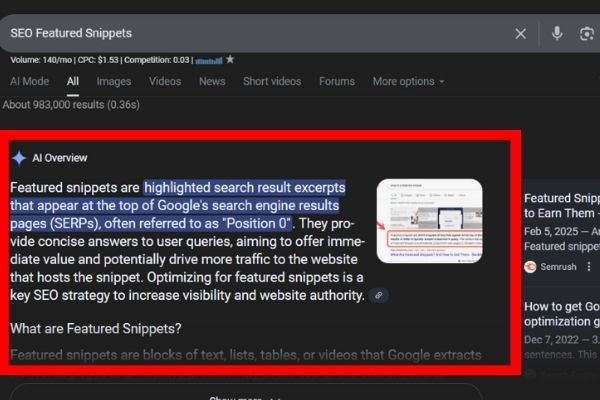
Why Featured Snippets Matter for Your SEO Success
Featured snippets affect your SEO in two important ways.
First, featured snippets help you get more clicks without ranking higher on Google. Many SEO pros call the featured snippet box “Position #0” because it sits above the normal #1 spot.
Search Engine Land found that featured snippets grab about 8% of all clicks. When you land your content in the featured snippet, your click-through-rate gets a major boost.
Google Search Console shows our page’s organic CTR hit 10.7% after winning a snippet.
Second, featured snippets create more “no-click searches” where users don’t click any results. This happens because the snippet often gives people the exact answer they want.
Before picking keywords, check if search results already have featured snippets. Ahrefs research shows pages get fewer clicks when snippets are present compared to regular results.
Don’t automatically skip keywords just because they have featured snippets though. Semrush data reveals that 4.77% of all searches show featured snippets.
This means avoiding snippet keywords completely becomes nearly impossible.
Instead, consider featured snippets alongside competition and search volume when choosing your keywords. Factor them into your keyword selection process for better results.
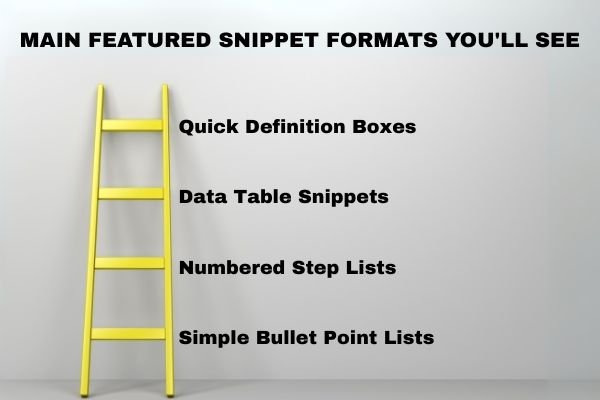
The 4 Main Featured Snippet Formats You’ll See
Google shows 4 main types of featured snippets in search results most often.
1. Quick Definition Boxes
These text snippets give searchers clear, short definitions or descriptions.
When you search for “outreach email,” you’ll see a definition box at the top. Google uses these paragraph snippets to answer “what is” questions quickly.
You can see that Google picks definitions that are short and direct. Semrush research shows the average definition snippet contains 40-60 words.
2. Data Table Snippets
Google takes information from web pages and shows it in table format.
3. Numbered Step Lists
These show items in a specific order that matters.
Google uses numbered lists for search questions that need step-by-step instructions. They also use numbered lists when ranking items in a particular order.
4. Simple Bullet Point Lists
Google shows bulleted lists when items don’t need special order.
Our rank tracking tools list doesn’t rank from best to worst. It’s just a basic list with a table showing our top picks.
Google displays each tool we mention as a simple list. It doesn’t include any ranking information one way or another.

How to Win Featured Snippets for Your Website
Spot Search Pages That Already Show Featured Snippets
Start by finding search result pages that already display featured snippets. This shows you clear featured snippet opportunities.
This way, you KNOW that Google wants to display a featured snippet for that keyword. They already do!
You can also see which type of featured snippet Google prefers for that term. This makes optimizing your page for that specific snippet type much easier.
You have two ways to find search pages with featured snippets.
First, you can search for keywords one at a time manually. If you have potential keywords to target, search each one and note whether the results show a featured snippet.
Second, you can use tools like Semrush and Ahrefs to find keywords with featured snippets.
When you run an Organic Keywords report using Semrush, you can filter keywords that already have featured snippets.
Create Content That Matches Each Snippet Type
Now it’s time to optimize your page content so Google picks your content for the featured snippet.
Here’s how to optimize your content for the 4 most popular featured snippet types.
Quick Definition Format
Give Google a short 40-60 word text snippet they can use directly. It helps if you include “What is X” right above your definition.
Because we gave Google a ready-to-use definition, we landed the featured snippet spot within months.
HubSpot goes one step further. They design little boxes in their content that look exactly like featured snippets.
You don’t need to go this far. But it shows that formatting matters for getting featured snippets. The closer your content looks like a snippet, the better your chances.
Make sure your definition stays neutral. Don’t include opinions on the topic either way.
You can see our “nofollow links” definition sounds like it came straight from Webster’s Dictionary.
Data Table Format
Google typically takes content for table snippets from existing tables on pages.
Google doesn’t collect data from different page sections and create tables. Instead, they copy tables that already exist.
When you check the source of that content, it’s literally the same table.
We once compared the top 4 backlink checker tools. One way we optimized for snippets was presenting data in table format.
How you code tables depends on your site setup and whether you use WordPress. Generally, as long as your HTML uses <tr> tags for table data, Google can read your table easily. The W3C Web Design standards provide detailed guidance on proper table markup for search engines.
Numbered Step Format
Layout your page so steps or list items appear clearly to Google.
Wrap every item or step in H2 or H3 text. Present each item as a subheader.
To make your item order crystal clear to Google, include text like “Step #1” or “1.” in each subheading.
Consistency matters most. If you present step #1 as “Step #1: Do X”, don’t make your second step “Step 2: Do Y”.
Present your steps like this: Step #1, Step #2, Step #3… Or like this: 1., 2., 3…
I prefer “Step #1” over “1.” because it’s easier for users to follow. But Google understands both.
Each process step uses the exact same format like “Step #1”, “Step #2”, and so on.
Target Multiple Long Tail Keywords on Each Page
Ahrefs found that most featured snippets appear when people search for long-tail keywords.
Long tail keywords are search terms that are very long and very specific.
Voice search queries are perfect examples of this search type.
Here’s a conversational, long tail version of that same search query.
Don’t just optimize your content for popular featured snippet keywords like “what is SEO”.
You ALSO want to optimize for snippets that show up for variations and long tail versions. Our Denver SEO agency clients have seen tremendous success targeting these specific, lower-competition phrases.
You can see we added sections to this page designed to rank for different long tail snippets. It’s almost like a mini FAQ page.
How do you find what long tail keywords to target?
Check out the “People Also Ask boxes” in search results.
These are related questions that Google considers closely connected to your searched keyword. Neil Patel’s research demonstrates how these boxes reveal valuable snippet opportunities.
One keyword we hold the featured snippet spot for is “search intent”.
That ranking came directly from optimizing our content for the definition snippet.
There are lots of long tail queries we could answer on that same page. Google shows us these queries right in the search results.
Multiply Your Featured Snippet Rankings on One Page
When your page and site have strong authority, you can rank one page for dozens of featured snippets.
The secret to scaling up is adding lots of definitions, numbered lists and other formats Google loves for snippets.
HubSpot has one main definition at the top of most of their pages.
But they also include several questions and answers on each single page. This strategy works particularly well for businesses offering comprehensive marketing services that address multiple customer pain points.
Get Your Pages Ranking on Google’s First Page First
Optimizing your content for featured snippets is just one part of the puzzle. The truth is your page must already rank on Google’s first page to win snippets.
If your page doesn’t rank on the first page, your chances of getting a featured snippet are basically zero.
Ahrefs study shows that 99% of all featured snippets come from pages that already rank on page 1.
This makes perfect sense when you think about it. The first page shows Google’s best, most trusted content about that topic. Google won’t pull information from a page 11 site, even with perfect formatting.
Besides formatting your content correctly, you must rank on page 1 to have a real shot at snippets. This is where comprehensive Google consulting becomes invaluable for businesses seeking to dominate their market’s search landscape.
This page from our site ranks “#0” as a featured snippet. We only got featured there after we reached Google’s first page for that term.
Conclusion
Featured snippets offer massive opportunities to boost your website’s visibility and drive more organic traffic. These position zero rankings give you prime real estate above traditional search results. The key is understanding the four main snippet types and optimizing your content accordingly.
Start by finding keywords that already show snippets, then format your content to match Google’s preferences. Create clear definitions, properly structured tables, and consistent step-by-step guides. Target long-tail keywords and scale your efforts across multiple snippets per page.
Remember, you must rank on Google’s first page before winning any featured snippet. Focus on improving your overall SEO performance first. Whether you need assistance with Las Vegas SEO or New Brunswick SEO services, working with experienced professionals can accelerate your path to snippet success. With proper formatting and strong rankings, you can capture these valuable snippet positions and significantly increase your organic click-through rates. For businesses ready to take their search presence to the next level, contact our team to develop a comprehensive featured snippet strategy.
Frequently Asked Questions
Q: How long does it take to rank for featured snippets?
Most websites see results within 2-6 months of optimization. Timeline depends on current page ranking and content quality. Pages ranking in positions 1-5 win snippets faster.
Q: Can I rank for multiple featured snippets on one page?
Yes, high-authority pages can rank for dozens simultaneously. Add multiple snippet-friendly formats like definitions, tables, and step lists. Create sections answering different related questions.
Q: Do featured snippets hurt my website traffic?
Snippets can reduce clicks since users get direct answers. However, they increase visibility and brand recognition significantly. Studies show snippet pages often gain net traffic.
Q: What’s the ideal word count for definition snippets?
Google prefers 40-60 words according to Semrush research. Keep definitions concise, neutral, and factual without opinions. Write like dictionary definitions for best results.
Q: Which keywords are best for featured snippet optimization?
Long-tail keywords and question-based searches work best. Look for “what is,” “how to,” and “why” queries. Use “People Also Ask” boxes to find opportunities.

Michael Vale has over 5 years of experience helping clients improve their business visibility on Google. He combines his love for teaching with his entrepreneurial spirit to develop innovative marketing strategies. Inspired by the big AI wave of 2023, Michael Vale now focuses on staying updated with the latest AI tools and techniques. He is committed to using these advancements to deliver great results for his clients, keeping them ahead in the competitive online market.