
Does Click-Through Rate Really Impact SEO Rankings?
Click-through rate (CTR) significantly impacts SEO rankings and organic traffic performance. Based on analysis of 4 million Google search results, the top position achieves 27.6% CTR while position 10 gets only 2.5%. CTR measures clicks divided by impressions, making it a critical ranking factor. Key findings show title tags between 40-60 characters perform 8.9% better, positive sentiment increases CTR by 4.1%, and keyword-rich URLs boost performance by 45%. Moving from position 2 to 1 delivers a 74.5% CTR increase. Understanding these patterns helps optimize content for better search visibility and higher organic traffic. Professional SEO services can help implement these proven strategies effectively.
What Makes a Strong Click-Through Rate for SEO
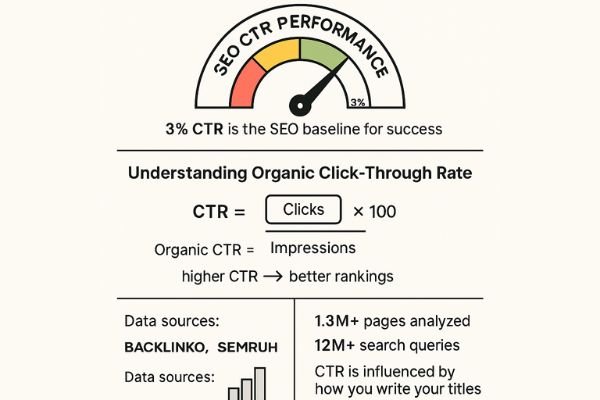
Typically, a click-through rate above 3% works well for SEO success. Put simply, this means 3 out of every 100 people who see your website will actually click on it.
Understanding Organic Click-Through Rate
Organic CTR measures daily clicks your search result gets divided by total impressions on search pages. Backlinko offers detailed guidance showing how better CTR drives higher rankings and increased website traffic. We studied 4 million Google search results to understand organic click-through rates better. First, we examined CTR information from 1,312,881 pages and 12,166,560 different search queries. Next, we explored how title length, tone, and descriptions impact your organic CTR performance. SEMrush provided valuable CTR data from multiple Google Search Console accounts for this analysis.
Main Results from Our Research
- The top Google search result gets an average click-through rate of 27.6%.
- The first organic result receives 10x more clicks than a page ranking tenth.
- Organic CTR stays nearly identical for positions 8-10. Moving up a few spots at the page bottom may not boost your organic traffic.
- Moving up one search position typically increases CTR by 2.8% on average. This depends on your starting and ending positions though. Jumping from third to second place usually creates a major CTR improvement. However, moving from tenth to ninth position shows no meaningful statistical difference.
- Question-based titles and regular titles achieve similar click-through rates.
- Title tags with 40 to 60 characters achieve the highest CTR performance. Our data shows pages with title lengths between 40-60 characters get 33.3% higher CTR than other ranges.
- Longer search terms typically generate higher click-through rates than shorter ones. Keywords with 10-15 words receive 1.76x more clicks than single-word search terms.
- URLs containing keyword-related terms achieve 45% higher click-through rates than URLs without keywords.
- Positive title sentiment can boost your CTR performance significantly. We discovered that positive titles improved click-through rates by approximately 4%.
Why Top Google Results Capture 27.6% of All Clicks
Our study aimed to create reliable CTR benchmarks for SEO professionals. We analyzed our complete dataset of 4 million results and confirmed the first result dominates clicks. We noticed CTR drops dramatically starting on Google’s second search results page. Only 0.63% of Google users actually click on second-page search results. This CTR pattern matches other industry research, including Advanced Web Ranking’s comprehensive study. Our cleaned data analysis revealed the top Google result achieves 27.6% CTR. The first result gets 10x higher CTR than the tenth-position result. Anyone working in professional SEO knows that ranking first provides significantly more value than other positions. We examined CTR performance for branded keyword searches specifically. Branded search terms generate much higher CTR for top results than non-branded terms. This happens because these searches are mainly navigational queries. Key Takeaway: Google’s top result captures 27.6% of all search clicks.
How Click-Through Rates Jump at Positions 8 and 2
Google’s first result clearly achieves the highest CTR by far. However, valuable clicks still exist beyond the top search position. While CTR stays flat at page bottom positions 9 and 10, position 8 shows significant CTR growth. This data reveals two important user behavior patterns:
- Most searchers ignore the bottom section of search results pages.
- Moving from position 9 to 8 can create a major CTR increase.
We discovered another sharp CTR jump starting at position 2. This happens because the second result often appears above the fold without ads or features. Our research shows the top 3 Google results capture 54.4% of all clicks. Key Takeaway: Simply ranking on page one isn’t enough for SEO success anymore. Focus on reaching the top position or at least the top 2 spots. The top 3 organic results receive more than half of all clicks.
How Moving Up One Position Boosts CTR by 32.3%
We found that climbing one Google position increases relative CTR by 32.3% on average. However, this CTR improvement doesn’t spread evenly across all positions. The CTR impact of ranking higher varies dramatically depending on your current position. Moving from position 10 to 9 generates only 11% more clicks. But jumping from position 2 to the top spot delivers 74.5% more clicks. Denver SEO agencies often focus on these position improvements for maximum client impact. Key Takeaway: Climbing one Google position increases your absolute CTR by 2.8% on average. This boost varies greatly based on your starting position though. The biggest CTR gain comes from moving from second to first place, creating a 74.5% relative increase.
Why Most Websites Average 25.1 Clicks Per Search Query
We examined all queries from Google Search Console data to understand click patterns. First, we found that most search queries websites rank for receive very few impressions. Actually, 90.3% of all queries in our data get only 10 impressions or less. This shows most keywords websites rank for are long-tail terms with low search volume. Or the site ranks poorly for these terms, or both situations apply. Because of low impression numbers, most queries generate small click amounts averaging 25.1 per query. Key Takeaway: Tracking “ranking for X keywords” isn’t a useful SEO measurement anymore. Most pages rank for low-volume keywords that don’t drive traffic. Instead, most impressions and clicks come from a small number of high-performing queries.
Why Question Titles and Regular Titles Get Similar Click Rates
We compared average organic CTR between titles with questions and those without questions. We defined questions as titles using “How, Why, What, Who” or titles with question marks. We discovered that question-based titles achieved slightly higher click-through rates than regular titles. However, the CTR difference between them (15.5% vs 16.3%) wasn’t statistically significant. Other CTR research, like studies published in Social Influence journal, found questions boost social media clicks. Many believe questions might improve Google CTR because searchers look for answers to their questions. Search terms are called “queries” for this reason after all. Question titles might signal to users that your result contains their exact answer. However, our data doesn’t support this theory. Key Takeaway: Question-based title tags perform similarly to regular title tags for organic click-through rates.
Why Title Tags Between 40-60 Characters Achieve Best CTR Performance
What makes the perfect title tag length? Should you write short, simple titles or longer, detailed ones? Our data shows you should target the middle ground for optimal results. We found that titles between 40-60 characters generate the highest organic CTR rates. Long title tags might help SEO by including more keywords, but this benefit gets offset by lower CTR. Etsy tested different title tag lengths in a major SEO experiment recently. They found that “shorter title tags performed better than longer ones” in their results. The study author suggested shorter titles work better because of improved query matching. Our analysis shows CTR also explains why short and medium titles perform best. Las Vegas SEO specialists regularly implement these title optimization strategies for local businesses. Key Takeaway: Title tags between 40-60 characters deliver the best organic CTR performance. Titles in this range achieve 8.9% better average click-through rates than titles outside this range.
Why Longer Search Keywords Generate Higher CTR Rates
We explored the connection between keyword length and overall click-through rate performance. For this research, we focused exclusively on first-position search results. Our chart data clearly shows longer keywords achieve higher CTR than shorter search terms. Keywords with 10-15 words generate 2.62x more clicks than single-word search terms. Longer keywords indicate very specific search intent, meaning users know exactly what they want. This makes them more likely to click on relevant results. Google understands user intent better with longer queries and delivers highly relevant search results. Short, broad keywords often have mixed search intent instead. Users must browse through results to find relevant content or search again with different terms. Neil Patel’s research confirms that long-tail keywords typically convert better due to higher user intent specificity. Key Takeaway: Long keywords receive 1.76x more clicks in organic search results, specifically for first-position rankings, compared to very short keyword terms.
How Positive Titles Boost Organic Click-Through Rates
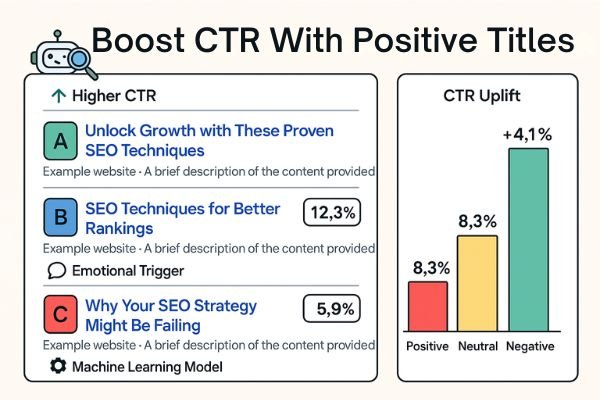
Our research shows that positive title sentiment creates higher CTR than negative or neutral titles. We found that positive titles achieve 4.1% higher absolute CTR compared to negative titles. We used machine learning models to determine each title’s sentiment as positive, neutral, or negative. Multiple industry studies, including BuzzSumo research, found connections between emotional headlines and user engagement. We couldn’t find any industry study examining emotional title tags and Google organic CTR specifically. According to our data, positive emotional titles generate higher click-through rates in organic search results. Content marketing experts emphasize that emotional triggers significantly influence user behavior across all digital platforms. Key Takeaway: Titles with positive sentiment achieve higher organic click-through rates compared to neutral or negative titles.
Proven Strategies to Improve Your Click-Through Rate
These tactics won’t guarantee top rankings, but our research shows they can boost your CTR for better organic traffic results. Use these proven strategies to enhance your search performance based on our findings. Professional marketing services can help implement these optimization techniques effectively across your entire digital presence.
Key Elements That Impact Your Click-Through Rate Performance
Now that we’ve covered all CTR research findings, here’s a quick summary of important elements to monitor. Track these factors when analyzing your keyword and search result performance.
- Content Quality That Drives Results Remember you attract what you offer to users. Quality content must inspire, inform, engage, and support your target audience effectively. In this era of AI-generated content, create authentic, valuable, and easily searchable material that stands out.
- User Experience Design That Works Build websites that provide meaningful and relevant experiences for all visitors. Good UX covers functionality, accessibility, branding, usability, and smooth user interactions across your entire site. Professional web design services ensure optimal user experience optimization.
- Fast Site Loading Speeds Use tools like PageSpeed Insights to measure how quickly your web pages load completely. Target load times between 0-4 seconds for the best conversion rates and user satisfaction.
- Branded vs Non-Branded Keyword Performance Search Engine Journal analyzed 160k keywords across 400+ websites and found interesting patterns. Branded keywords perform better across most industries, while e-commerce sites dominate non-branded keywords on desktop searches.
- Understanding Target Audience and Search Intent What’s the real purpose behind each search query your audience makes? Figure out this motivation and you’ll dramatically improve your website’s CTR performance.
- Search Volume and Keyword Popularity Is your target search query actually in demand with users? CTR success mainly depends on choosing keywords that are popular with your specific target audience.
- Mobile Search Optimization Walk through any public space and you’ll see most people browsing on mobile phones. In the US, over 50% of searches happen on mobile devices. Build mobile-responsive sites for better results.
- Stay Updated with Search Engine Changes Keep up with new trends in the search engine industry regularly. Update your site to comply with Google algorithm updates to keep it crawlable and search-friendly. New Brunswick SEO professionals stay current with these constant industry changes.
Conclusion
Our comprehensive analysis of 4 million search results reveals clear patterns for CTR success. The top position captures 27.6% of clicks while second page results get just 0.63%. Focus on reaching the top 3 positions for maximum impact. Optimize your title tags to 40-60 characters with positive sentiment and include keywords in your URLs. Target longer, specific keywords that match user intent precisely. Remember that quality content, fast loading speeds, and mobile optimization remain essential foundations. Don’t just track keyword rankings anymore – monitor high-performing queries that actually drive traffic. Implement these data-driven strategies consistently and watch your organic click-through rates improve. Google Ads consulting can complement your organic efforts while you build these CTR improvements. Start optimizing today because every position higher means significantly more clicks and traffic for your website. For professional assistance implementing these strategies, contact our team to discuss your specific SEO goals.
Frequently Asked Questions
What is a good click-through rate for SEO?
A CTR above 3% is considered good for SEO success. However, the top Google result averages 27.6% CTR while position 10 gets much less. Focus on improving your position rather than just meeting minimum CTR benchmarks.
How much does moving up one position increase CTR?
Moving up one Google position increases your relative CTR by 32.3% on average. However, this varies dramatically based on your starting position. Moving from position 2 to 1 delivers a 74.5% CTR boost. Moving from position 10 to 9 only generates 11% more clicks.
Do title tag length and sentiment really affect click-through rates?
Yes, title tags between 40-60 characters achieve 8.9% better CTR performance. Positive title sentiment increases CTR by approximately 4.1% compared to negative titles. Avoid extremely long or negative titles that hurt performance.
Should I focus on question-based titles for better CTR?
Question-based titles and regular titles perform similarly for organic CTR. The difference (15.5% vs 16.3%) isn’t statistically significant. Focus on creating compelling titles that match search intent instead. Title sentiment and length matter more than question formats.
How important are keyword-rich URLs for improving CTR?
Keyword-rich URLs can significantly boost your CTR performance when done correctly. URLs with keyword matches achieve 45% higher CTR than non-matching URLs. Include relevant keywords in your URLs but don’t sacrifice readability.

Michael Vale has over 5 years of experience helping clients improve their business visibility on Google. He combines his love for teaching with his entrepreneurial spirit to develop innovative marketing strategies. Inspired by the big AI wave of 2023, Michael Vale now focuses on staying updated with the latest AI tools and techniques. He is committed to using these advancements to deliver great results for his clients, keeping them ahead in the competitive online market.